In the paint and printing ink industries, pigment quality does not depend solely on raw materials. Grinding and dispersion efficiency also directly affect the hiding power, gloss, and stability of the final product.
If pigments are not ground to the appropriate fineness, the coating can easily develop issues such as color streaking, gloss reduction, or sedimentation after storage. This is why grinding technology is always considered one of the most critical stages in modern paint manufacturing.
Today, many companies are prioritizing grinding systems that provide better particle size control and improved energy efficiency. Among them, basket mills and bead mills are the two most commonly used solutions in the modern paint industry.
WHY IS PIGMENT GRINDING IMPORTANT?
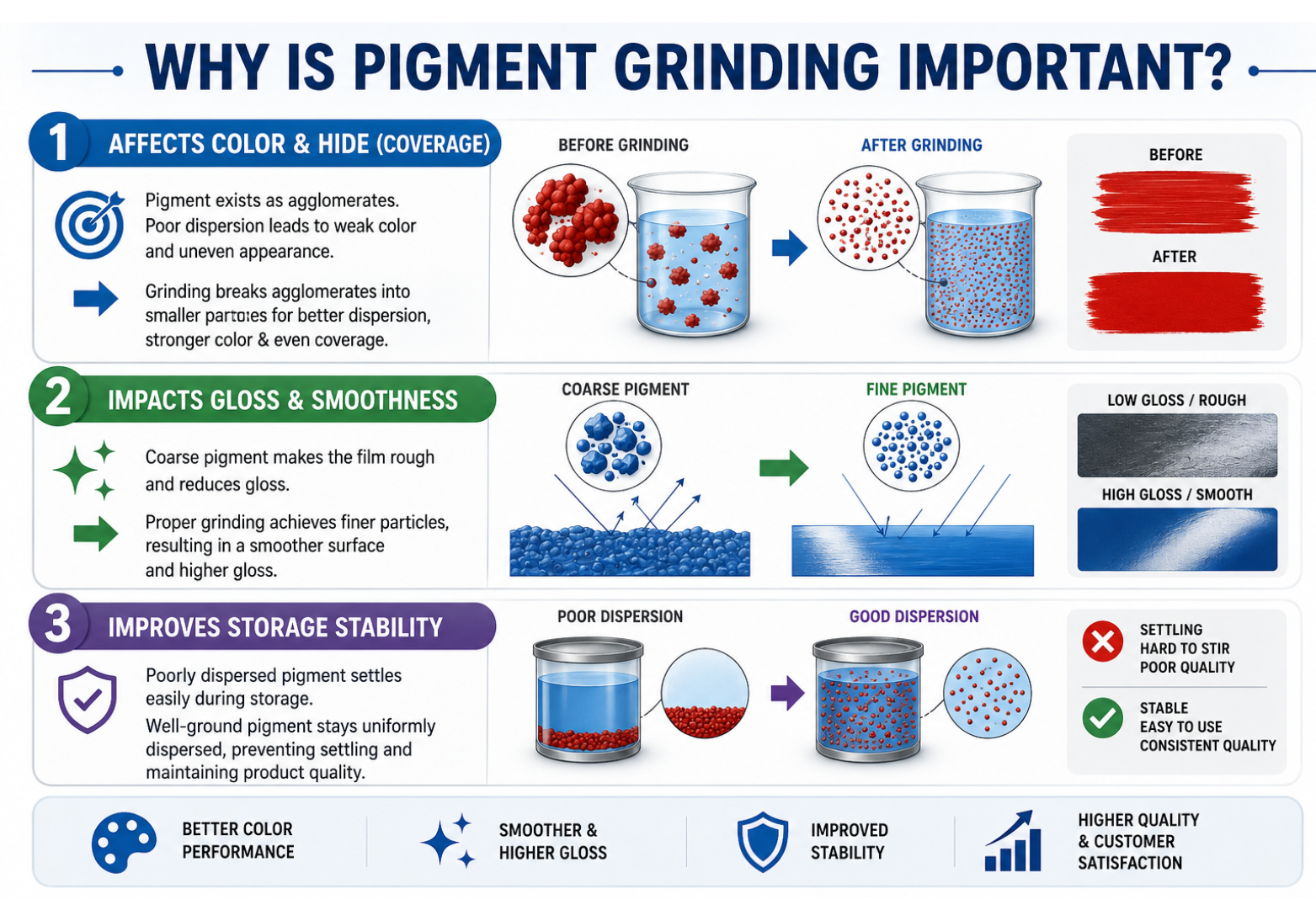
Direct Impact on Paint Hiding Power and Color
In paint manufacturing, pigments usually exist in the form of agglomerated particles. With conventional stirring alone, pigment particles are difficult to distribute evenly throughout the paint system. This reduces color development capability and directly affects coating quality.
The grinding process helps break down large pigment agglomerates into smaller particles. When pigment particles are evenly dispersed, the paint film exhibits more stable color and minimizes color streaking after application.
Impact on Gloss and Surface Smoothness
Pigment fineness directly affects the aesthetic appearance of the coating. If the pigment system still contains many coarse particles, the paint surface becomes rough and exhibits lower gloss under light.
Conversely, when pigments are ground to the appropriate particle size, the coating becomes smoother and provides a more uniform surface appearance. This factor is especially important for industrial coatings, wood coatings, and automotive paints.
Improved Storage Stability
In addition to color performance, the grinding process also directly affects paint stability during storage. If pigments are poorly dispersed, pigment particles can easily settle at the bottom of the container over time.
This makes the paint more difficult to apply and reduces the quality of the final product. Therefore, many companies today consider grinding technology a core factor in improving product quality.
COMMON PIGMENT GRINDING METHODS USED TODAY
High-Speed Disperser
High-speed dispersers are commonly used during the initial premixing stage. The equipment generates strong shear force through a high-speed rotating impeller to help distribute pigments more evenly within the liquid medium.
This solution is suitable for many paint systems requiring medium fineness. However, for difficult-to-disperse pigments or coatings requiring high gloss, this equipment often cannot achieve the required fineness.
Three-Roll Mill
Three-roll mills are widely used in high-viscosity color paste systems. The equipment utilizes three rollers operating at different speeds to generate high shear force on the pigment mixture.
This method is commonly applied in printing inks, specialty coatings, or highly concentrated color systems requiring superior dispersion. However, three-roll mills are generally more suitable for smaller-scale production compared to many modern industrial grinding systems.

Basket Mill
Basket mills are currently widely used in many small- and medium-scale paint factories. The equipment integrates both mixing and grinding functions into a single system, helping optimize production space.
This solution is suitable for companies that frequently change colors or produce multiple small batches per day.
Bead Mill
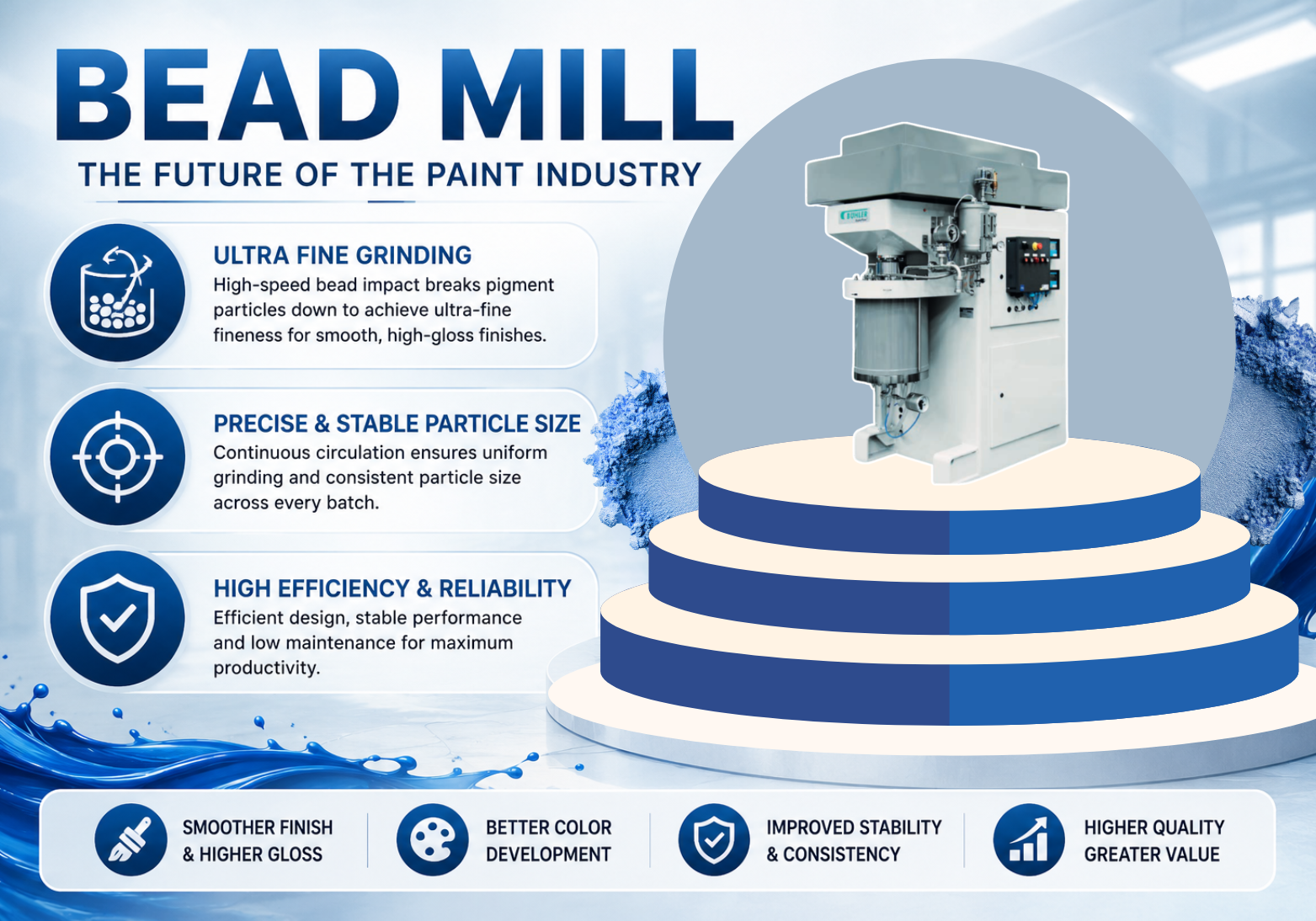
Bead mills are currently the most widely used pigment grinding technology in the modern paint industry. The equipment uses grinding beads moving at high speed to continuously impact pigment particles.
Thanks to their ability to achieve high fineness and better particle size control, bead mills are widely applied in industrial coatings and high-performance paint systems.
BEAD MILLS ARE BECOMING A MAJOR TREND IN THE PAINT INDUSTRY
Bead mills are currently the most popular pigment grinding technology in many modern paint factories. The equipment utilizes grinding beads moving at high speed to continuously impact pigment particles.
Compared with many other grinding technologies, bead mills are capable of achieving extremely high fineness. This is particularly important for coatings requiring smooth surfaces and high gloss, such as automotive paints, wood coatings, and high-performance industrial coatings.
Another major advantage of bead mills is their ability to provide more stable particle size control. The continuous circulation system helps ensure more uniform pigment grinding across production batches.
BÜHLER GRINDING SOLUTIONS
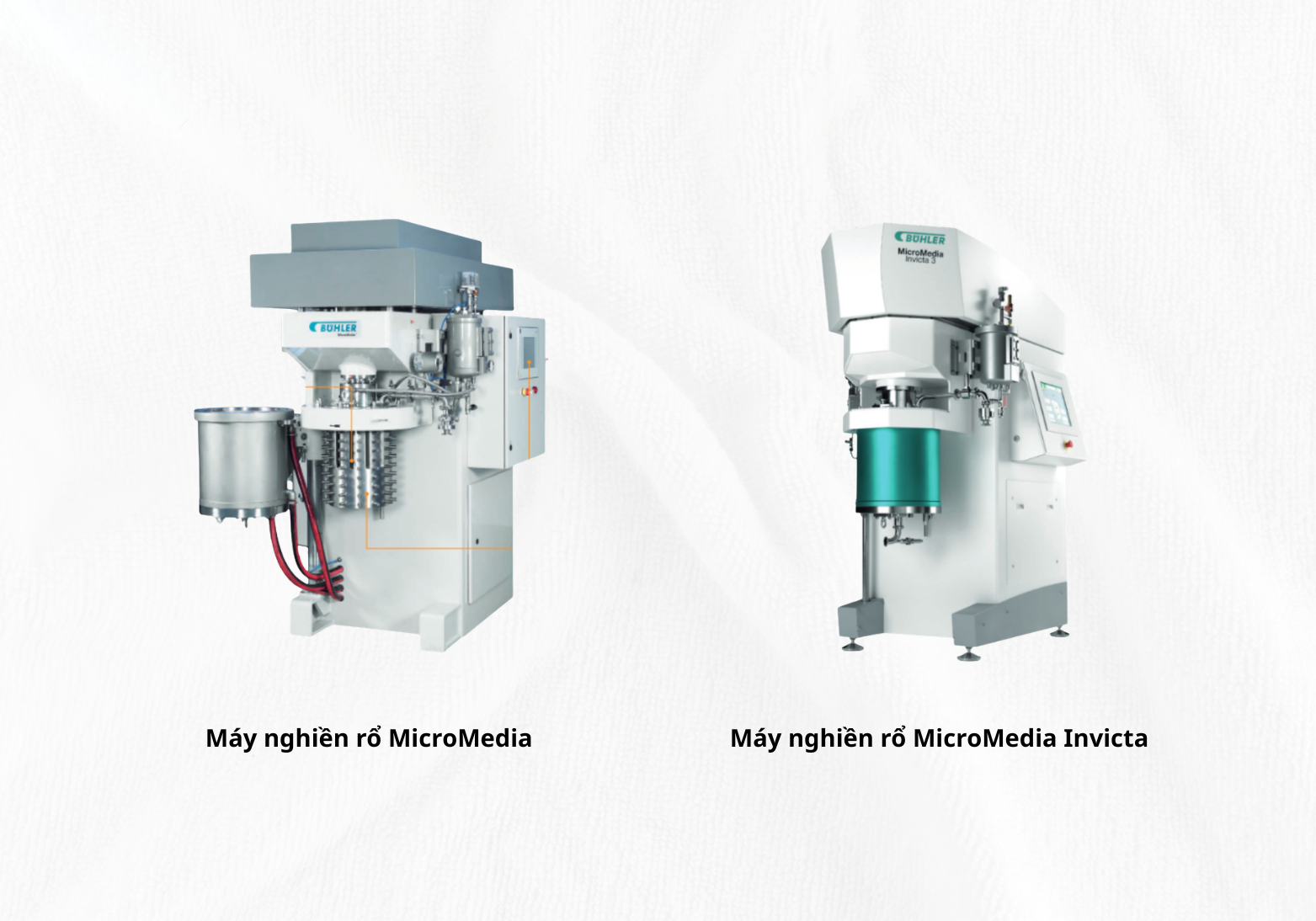
Currently, VICHEM distributes various Bühler grinding machines for the paint, printing ink, and coating materials industries. These systems are widely used by coating manufacturers worldwide due to their stable grinding performance and energy efficiency.
One of the most notable product lines is MicroMedia™. This ultra-fine bead mill system is designed for pigment systems requiring nano-level fineness and excellent temperature control. The equipment is suitable for automotive coatings, digital printing inks, and many high-performance coating applications.
In addition to MicroMedia™, VICHEM also distributes grinding systems such as:
These product lines are widely used in industrial coatings, printing inks, coating materials, and many pigment systems requiring high dispersion efficiency. Bühler is currently one of the world’s leading brands in grinding and dispersion technologies for the coating industry.
FUTURE TRENDS IN GRINDING TECHNOLOGY
The paint industry is rapidly shifting toward water-based coatings and low-VOC technologies. This creates higher demands on pigment grinding systems.
Many companies now prioritize equipment capable of real-time temperature and particle size monitoring. At the same time, ultra-fine grinding technology is receiving increasing attention for improving coating gloss and stability.
In addition, automation is becoming an important trend in modern paint manufacturing plants. New grinding systems not only improve quality but also optimize energy consumption and reduce operating costs.
In the future, pigment grinding technology will continue to play a crucial role in the development of high-performance and environmentally friendly coatings.
CONCLUSION
Pigment grinding is a core process in modern paint manufacturing. Grinding efficiency directly affects the hiding power, gloss, and durability of the final coating.
Among current technologies, basket mills and bead mills are widely applied due to their effective pigment dispersion capability and better particle size control. Each technology offers unique advantages depending on production scale and the technical requirements of different paint systems.
Along with the growing trend toward high-performance and environmentally friendly coatings, modern grinding technologies will continue to play an important role in the coating industry in the coming years.
VICHEM – AUTHORIZED DISTRIBUTOR OF CHEMICAL ADDITIVES FROM LEADING BRANDS SUCH AS COVESTRO, SINOPEC, BUHLER, … IN VIETNAM
Vichem is an authorized distributor of chemical additive products from leading brands such as Covestro, Sinopec, Bühler, … in the Vietnamese market. We not only provide high-quality products but also deliver after-sales services that meet international standards.
For more information about our products, please contact us through the following channels:
📞 Hotline: 08 1790 1790
📧 Email: contact@vichem.vn
🔎 LinkedIn: Vichem JSC
🌐 Website: www.vichem.vn
📌 Facebook: Vichem JSC