In the coating industry, attractive color alone is not enough to create a high-quality paint film. The stability of pigments within the paint system also plays a vital role. This is why pigment grinding is always considered a central process in coating production.
If pigments are not properly dispersed, the paint film can easily develop issues such as color streaking, gloss reduction, or sedimentation during storage. In contrast, when pigment particles are ground to the appropriate fineness, the coating film becomes more uniform and more durable during use.
Today, many paint manufacturers are heavily investing in grinding technologies to improve coating quality. This trend is especially common in next-generation water-based paints.
WHAT IS PIGMENT GRINDING?
In paint manufacturing, pigment grinding is the process of dispersing pigment particles into a liquid medium to create a more stable and homogeneous mixture. The primary objective of this process is to break down pigment agglomerates and achieve the appropriate particle size for each paint system.
Pigments in powder form naturally exist as agglomerated particles. These fine particles are bound together by surface attraction forces, making them difficult to distribute evenly through conventional stirring alone. Therefore, the paint industry relies on mechanical forces to separate these agglomerates into smaller particles.
In practice, pigment grinding is not simply about reducing particle size. It is also a process that ensures pigment particles are completely wetted and stably distributed throughout the paint system. If the dispersion process is inadequate, pigments may re-agglomerate after grinding, significantly reducing coating quality.
For many modern paint systems, especially water-based coatings, pigment grinding efficiency directly affects hiding power and color development performance. This is also why many companies today prioritize investment in high-precision grinding systems.
WHY IS IT IMPORTANT?
In the paint industry, pigments are the primary components responsible for coating color. However, color quality depends not only on the type of pigment used but also directly on the degree of pigment dispersion within the paint system.
When pigments are ground to the appropriate fineness, the coating exhibits more uniform color. The paint film surface also appears smoother under direct lighting. This is especially important for decorative paints and industrial coatings that require high aesthetic quality.
Conversely, if pigments are poorly dispersed, the coating is more likely to develop color streaking or uneven color appearance after application. Large pigment particles may also reduce gloss and increase surface roughness.
Beyond aesthetics, the grinding process directly affects paint stability during storage. If pigment particles are unevenly distributed, they can easily settle at the bottom of the container over time. This makes the paint more difficult to apply and reduces final product quality.
HOW DOES THE PIGMENT GRINDING PROCESS WORK?
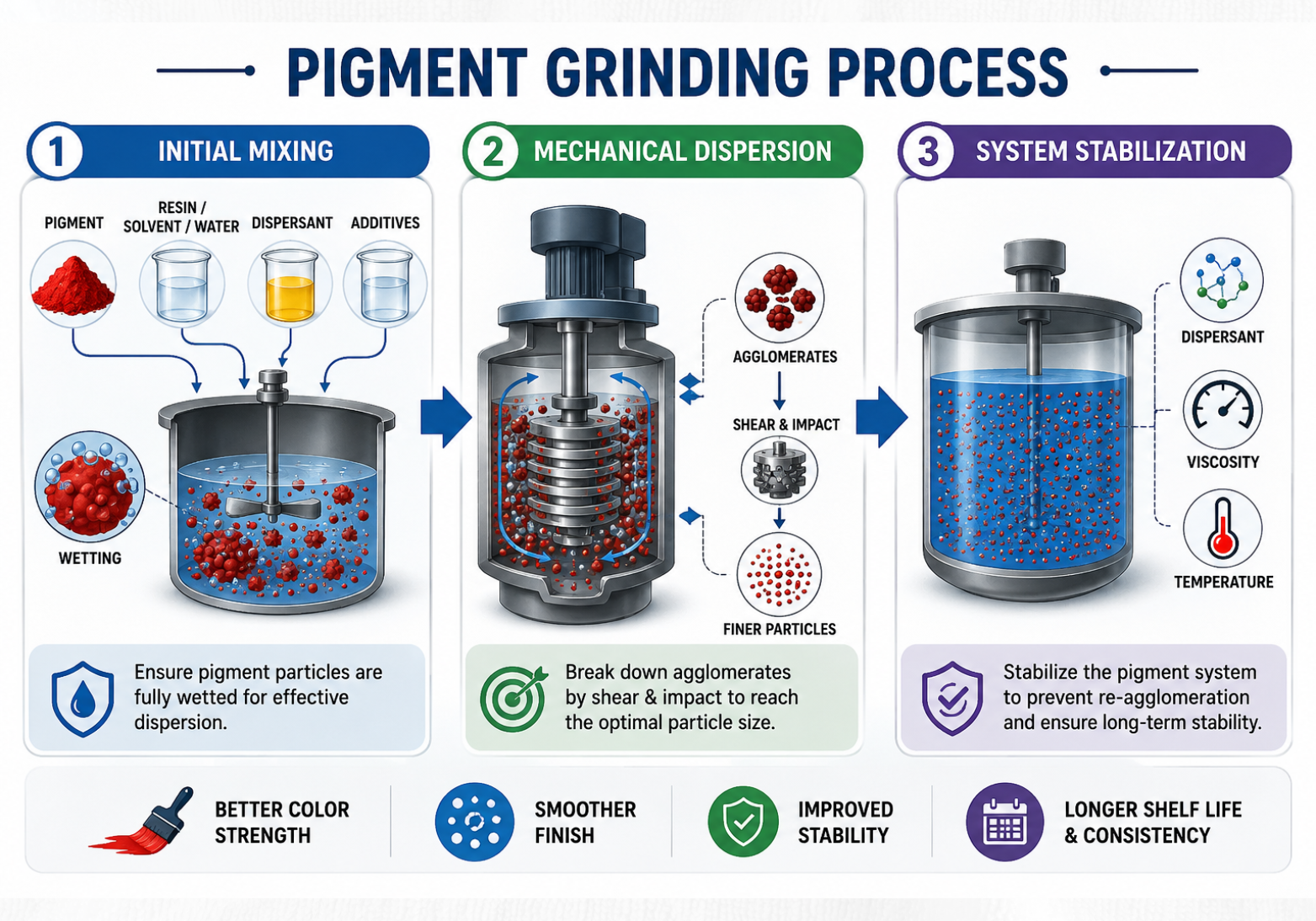
Step 1: Initial Premixing
At this stage, pigments are introduced into a mixture of resin, solvent or water, together with dispersing additives. The primary goal is to ensure that the pigment surface is completely wetted before grinding begins.
The wetting process plays a crucial role. If pigments do not interact properly with the liquid medium, the particles will be difficult to disperse uniformly within the paint system. This reduces grinding efficiency and increases processing time.
Step 2: Mechanical Dispersion
After premixing, the mixture is transferred into grinding equipment for mechanical dispersion. During this process, shear forces and impact forces break down large pigment agglomerates into smaller particles. The objective is to achieve the optimal particle size for each coating type.
Step 3: Pigment System Stabilization
Once grinding is completed, the pigment system still requires stabilization using suitable additives. Without proper control at this stage, pigment particles may re-agglomerate during storage, significantly reducing coating quality.
In addition to dispersing additives, viscosity and temperature also strongly influence the stability of the paint system after grinding. Therefore, many modern production lines now integrate temperature control systems to maintain more consistent quality.
FACTORS AFFECTING PIGMENT GRINDING EFFICIENCY
Pigment Type
One of the most important factors is the type of pigment used. Each pigment has different hardness and surface characteristics. Some inorganic pigments, such as titanium dioxide, are generally easier to disperse than organic pigments or carbon black.
Grinding Media Size
The size of the grinding media also significantly affects dispersion efficiency. Smaller grinding beads typically help achieve higher fineness. However, the system must also effectively control temperature and circulation speed to prevent excessive heat generation during grinding.
Paint System Viscosity
In addition, the viscosity of the paint system plays a critical role. If viscosity is too high, the mixture becomes difficult to circulate within the grinding chamber. This reduces dispersion efficiency and increases energy consumption.
Temperature
Temperature is another factor that must be carefully controlled. During grinding, mechanical friction can generate substantial heat. If the temperature rises too high, the paint system may experience gelation or instability.
FINENESS TESTING AFTER GRINDING
After grinding, manufacturers must evaluate the fineness of the pigment system to ensure final product quality. In the paint industry, the Hegman gauge is the most commonly used tool for this purpose. This device helps determine the size of the largest particles remaining in the paint system after grinding.
If the mixture still contains many coarse particles, the coating will exhibit lower gloss and a rough surface after application. In addition, insufficient fineness may reduce the color development capability of the paint.
Today, many modern factories also use laser particle size analyzers to achieve more precise quality control. This technology helps manufacturers maintain consistency between production batches.
PIGMENT GRINDING TRENDS IN THE MODERN PAINT INDUSTRY
The paint industry is rapidly shifting toward water-based coatings and low-VOC paint systems. This transition creates higher demands on pigment grinding and dispersion technologies.
Many companies now prioritize energy-efficient grinding systems to optimize production performance. At the same time, ultra-fine grinding technology is gaining increasing attention in high-performance coating applications.
In addition to quality improvement, automation has also become a major trend in modern paint manufacturing plants. New grinding lines are capable of monitoring temperature, viscosity, and particle size in real time. This helps maintain more stable product quality across production batches.
In the future, pigment grinding technology will continue to play an essential role in the paint industry. It will serve as a foundation for improving coating quality and meeting the increasingly demanding requirements of the market.
CONCLUSION
Pigment grinding is a core process in modern paint manufacturing. It directly affects hiding power, gloss, and coating film durability. If pigments are not effectively dispersed, the coating can easily encounter issues such as color streaking, gloss reduction, or sedimentation during storage.
With the advancement of modern grinding technologies, today’s paint industry has significantly improved pigment dispersion efficiency. This enables paint systems to achieve greater stability and better surface quality performance.
As water-based and environmentally friendly coatings continue to develop, pigment grinding technology will remain a key factor in enhancing the quality of next-generation coating systems.
VICHEM – AUTHORIZED DISTRIBUTOR OF CHEMICAL ADDITIVES FROM LEADING BRANDS SUCH AS COVESTRO, SINOPEC, BUHLER, … IN VIETNAM
Vichem is an authorized distributor of chemical additives from leading brands such as Covestro, Sinopec, Buhler, … in the Vietnamese market. We not only provide high-quality products but also deliver after-sales services that meet international standards.
For more information about our products, please contact us through the following channels:
📞 Hotline: 08 1790 1790
📧 Email: contact@vichem.vn
🔎 LinkedIn: Vichem JSC
🌐 Website: www.vichem.vn
📌 Facebook: Vichem JSC