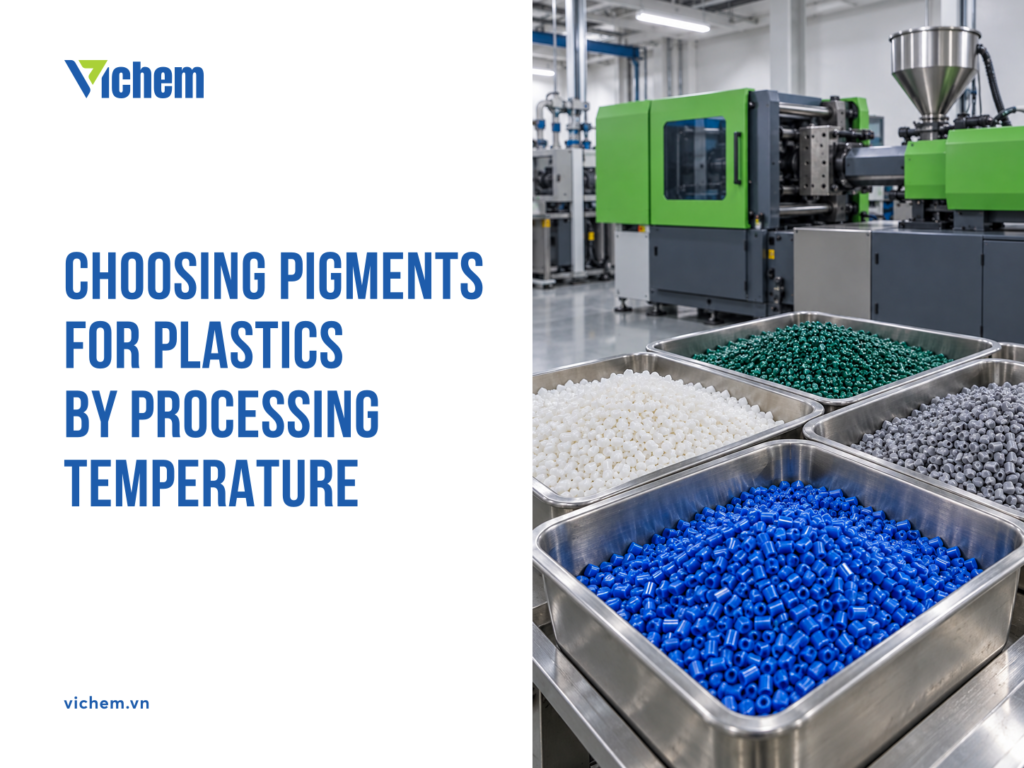
To choose pigments for plastics, compare the pigment's heat stability with the temperature and residence time of the resin you are running, then check migration and the effect on shrinkage. Shade on the color card is the last condition, not the first. Residence time is how long the pigment stays in the molten resin inside the injection molding machine or extruder. Migration is the degree to which pigment moves out to the surface of the product.
Where products fail when the wrong pigment is chosen for plastics
Pigment-related defects tend to show up late: the trial sample passes, but the production lot, or goods already in the warehouse, turn out off-color. These are the four failures seen most often in plastics and masterbatch plants.
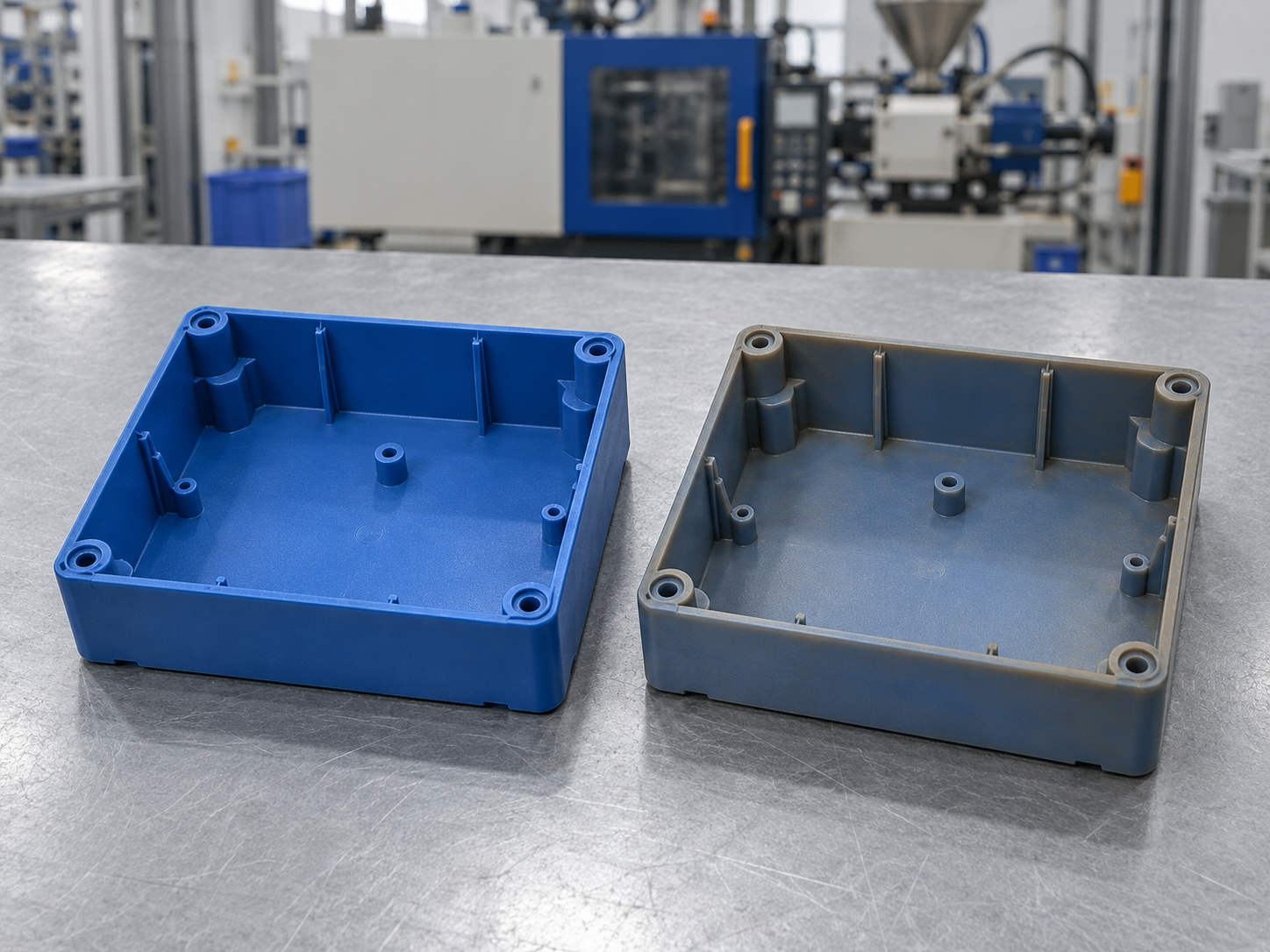
The first is color change and dulling at high processing temperatures. Pigment molecules partly decompose in the molten resin, so the shade shifts toward brown or gray and color strength drops. The molded part keeps its shape but no longer matches the standard color.
The second is color variation between batches. The formulation and set temperatures are the same, but the time the resin spends in the barrel differs because of changing cycle times, machine stoppages or mold changeovers. A pigment close to its heat-stability limit decomposes more in the batch that sits longer, and the color changes with it.
The third is migration onto contact materials. Part of the pigment dissolves in the resin or in the plasticizer and moves to the surface, staining packaging, fabric or other parts stored next to it. This defect usually appears only after storage or when the product meets heat in use.
The fourth is warpage of injection molded parts. Some organic pigments affect the crystallization of semi-crystalline resins, causing uneven shrinkage between zones of the part. When you change color and nothing else in the formulation, part dimensions can still drift.
All four defects come from selecting the pigment by shade instead of by the real processing conditions of the line.
4 criteria that decide how to choose pigments for plastics
Heat stability versus processing temperature
Pigments lose color at high temperature through two mechanisms. The first is thermal decomposition: the color-forming bonds break and produce products of a different color. The second is that the pigment dissolves into the hot resin: the pigment crystals dissolve, which changes the effective particle size and therefore the shade and opacity, and they may recrystallize on cooling.
For this reason, a heat-stability figure is meaningful only with two conditions attached: the resin used in the test and the residence time of that test. The same pigment can pass at a short residence time and fail at a long one. Pigment concentration and whether TiO₂ is present also change the result, so supplier data is only a reference point to be retested on your own machine.
Compatibility with the resin type
Engineering plastics are usually processed at higher temperatures than polyolefins, so a pigment group that works in polyolefins may not be stable enough for engineering plastics. This is why a single color card used for every resin type easily leads to errors.
Beyond temperature, there are chemical interactions. Some pigments react with or dissolve in certain resins, and some resins contain additives or functional groups that change the pigment's color. Stabilizers, flame retardants and fillers in the formulation can also act on the pigment at processing temperature. Compatibility must therefore be confirmed for the specific pigment and resin pair, together with the additives in use.
Migration
Migration occurs when the pigment partly dissolves in the resin or plasticizer and then diffuses to the surface. Pigments with small molecules and high solubility in the resin matrix tend to migrate more readily than pigments with low solubility. Soft resins, resins with a lot of plasticizer, and products that contact oils or solvents make this more pronounced.
The result is pigment transferring onto contact materials, or a colored bloom appearing on the surface after some time. For products that contact other goods, look at migration in the resin you actually use at the selection stage, rather than waiting for customer feedback.
Effect on shrinkage and warpage
In semi-crystalline resins, crystals form as the resin cools. The particle surface of some organic pigments acts as a nucleating site: with them present, the resin crystallizes faster and in a different orientation. The degree of crystallinity and the orientation directly affect shrinkage, so a part can shrink differently in the flow direction and the transverse direction.
The result is warpage, especially in flat, thin-walled or long parts. Amorphous resins are less affected. For injection molded parts with tight tolerances, run trials in the actual mold and compare dimensions between the colored sample and the uncolored base resin.
How to match pigments to your plastics line
Step 1 — Record the resin, process (injection, extrusion, blown film, masterbatch), and the actual temperature and residence time
Build a short table for each line: base resin, processing method, the measured temperature at the barrel and die, and residence time. Set temperature and actual melt temperature can differ because of screw friction, so use measured values.
Also record the worst case: the longest residence time during machine stoppages or slow cycles. For masterbatch, record the pigment concentration in the pellet as well, because a concentrated pigment withstands heat differently from the same pigment let down at a later stage. Record the regrind ratio in use too.
Step 2 — Read the TDS: heat stability in which resin, at what residence time, plus migration and light fastness
On the TDS, heat stability must be read together with the test resin and the residence time of the test. If the TDS does not state these two conditions, ask the supplier before comparing it with your line. Then read migration and light fastness for the same resin type, because these two properties are also tied to the test resin.
After matching the figures on paper, try holding the resin in the machine longer than normal: run slowly or stop briefly, then continue molding, and compare the color with a sample from a normal cycle. If the color shifts visibly, the pigment does not have enough safety margin for that line.
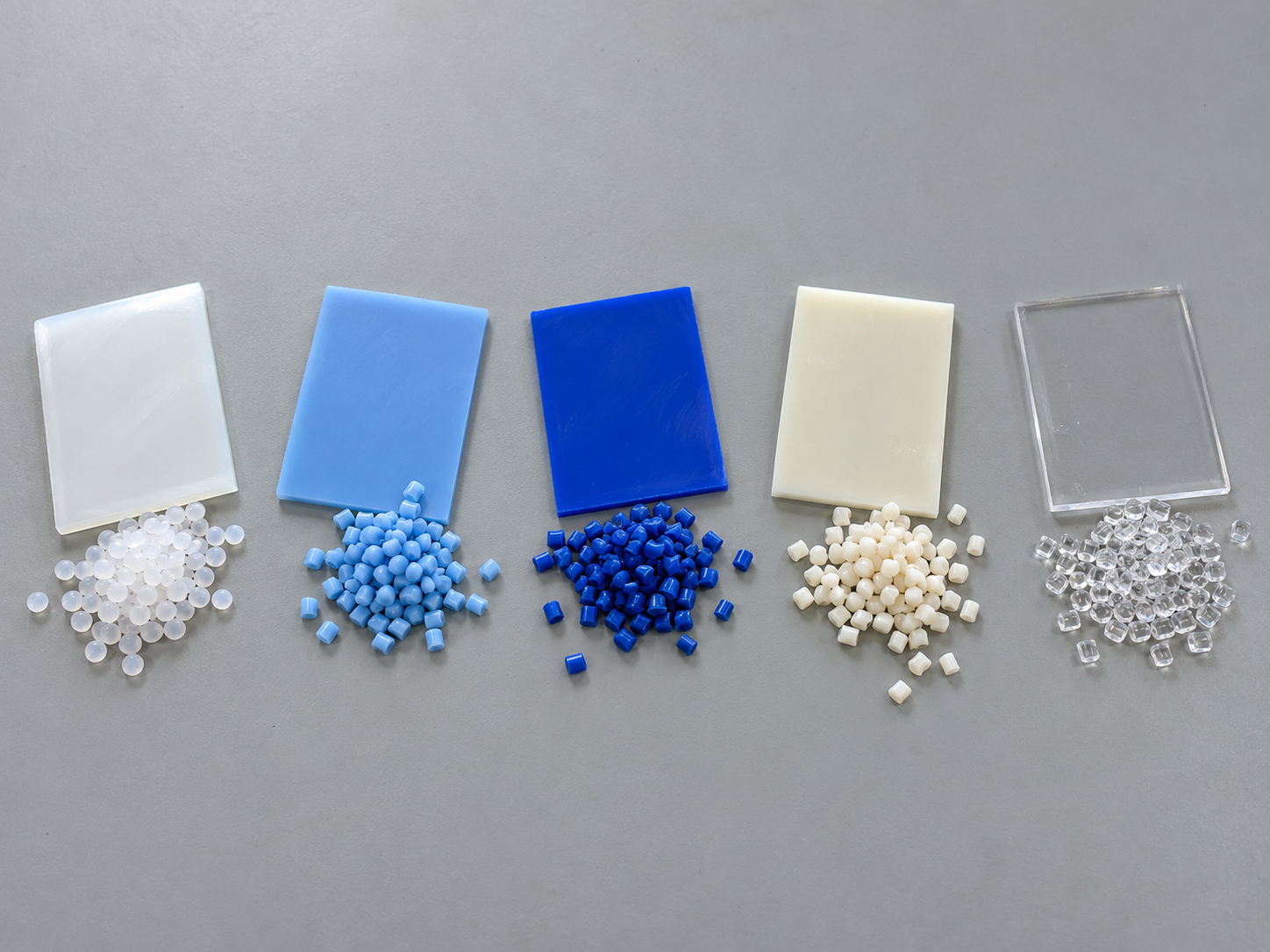
Step 3 — Choose the group: inorganic pigments when you need high heat stability and opacity; organic pigments when you need bright shades and high color strength, with careful checks on heat and warpage
Inorganic pigments suit lines running at high temperature that need good hiding power. Organic pigments give bright shades and high color strength, but need careful checks of heat stability against residence time, migration and warpage, as described above.
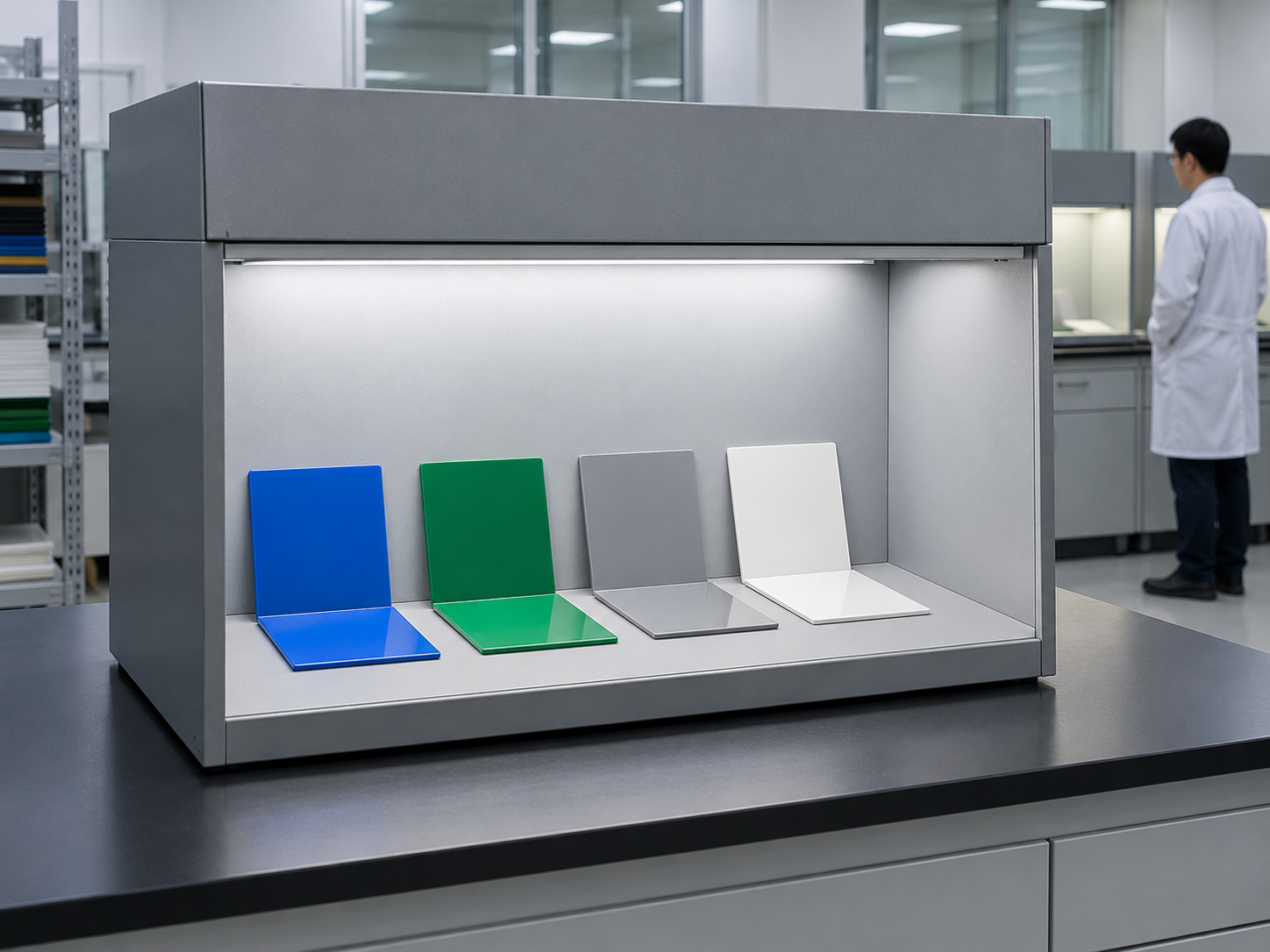
For both groups, plants can consider the organic and inorganic pigments for plastics from Hangzhou Zealan Chemical that Vichem distributes, with a TDS for each lot to check against step 2. The final result still needs a molding trial on your machine and resin, with samples placed in a color-matching light cabinet next to the standard.
Common mistakes when choosing pigments for plastics
Reading the heat-stability figure without checking the test resin and residence time. A number on the TDS may have been measured in a resin and at a residence time very different from your line. The result is a sample that passes but dulls in production.
Using a PE pigment in an engineering plastic. Engineering plastics are processed hotter, and some pigments react with the base resin. A pigment normally used in polyolefins must be reconfirmed with the TDS and a molding trial before moving to another resin.
Ignoring regrind recycling. Regrind has already been through one heat history, so the pigment in it has already seen extra residence time. When it is mixed back into a new batch, total heat exposure rises, and color can drift over successive recycling passes. Include the regrind ratio in the machine-hold test.
Running only one molding cycle. A sample molded once at the standard cycle does not reveal decomposition from residence time or migration after storage. Test a long cycle as well, and follow the samples over time.
Frequently asked questions
Which plastic pigments withstand high temperatures?
Inorganic pigments generally withstand processing heat better than most organic pigments. However, the heat resistance of each type depends on the test resin and residence time. Read the TDS for the exact pigment, compare it with the actual temperature of your line, and then run a molding trial.
Why does the pigment change color during injection molding?
The most common cause is the pigment decomposing or dissolving when the resin sits too long or runs too hot in the barrel. The actual resin temperature, the residence time during machine stoppages and the regrind all contribute. Check these three factors first, then compare again with the TDS data.
Can paint pigments be used in plastics?
Do not assume so. Paint pigments are selected for the conditions of a dried paint film, while plastics must withstand melt processing temperature and residence time in the machine. Use them only when the TDS confirms heat stability in your resin and a molding trial has passed for color and migration.
Conclusion
Choosing pigments for plastics starts from the real processing conditions of the line, and only then from shade. Heat stability, resin compatibility, migration and the effect on shrinkage are the four criteria to check, in that order.
- Record the actual temperature and residence time of each line, including the worst case.
- Read heat stability on the TDS together with the test resin and residence time.
- Hold the resin in the machine longer than normal and include the regrind ratio.
- Inorganic pigments for high heat and opacity; organic pigments for bright shades, with extra checks on heat and warpage.
- For semi-crystalline resins, run trials in the actual mold to check shrinkage.
Vichem is a distributor of chemical additives from leading brands such as Covestro, Sinopec and Bühler in the Vietnamese market.
For more information about our products, please contact us through the following channels:
- Hotline: 08 1790 1790
- Zalo OA: Vichem JSC
- Email: contact@vichem.vn
- LinkedIn: Vichem JSC
- Website: www.vichem.vn
- Facebook: Vichem JSC