In many industries today, the demand for material precision is continuously increasing. Electronic components are becoming smaller, significantly reducing the available space for protective coatings. In addition, many devices are required to operate under high temperatures and harsh environments. As a result, many traditional coating systems are gradually revealing their limitations over time.
This is why ultra-thin coatings are becoming an important trend in modern manufacturing. Despite being only a few nanometers thick, these coatings still provide effective moisture and corrosion resistance. In addition, ultra-thin coatings help reduce material weight and optimize equipment performance. Currently, this technology is being widely applied in electronics, automotive, and energy industries.
WHAT ARE ULTRA-THIN COATINGS?
Ultra-thin coatings are coating layers with extremely small thicknesses applied to material surfaces. The coating thickness typically ranges from a few nanometers to several micrometers. The primary objective of this technology is to improve the surface properties of materials while minimizing dimensional changes to components.
Unlike traditional coatings, thin coatings require extremely high precision. Even minor deviations can affect equipment performance. Many modern coating systems are also capable of achieving uniform coverage on complex surfaces. This is one of the key factors driving the rapid growth of this technology in the modern electronics industry.
Currently, ultra-thin coatings are being developed through various technologies, among which ALD, PVD, and CVD are the most widely used.
WHY ARE ULTRA-THIN COATINGS BECOMING A TREND?
Increasing Demand for Miniaturized Components
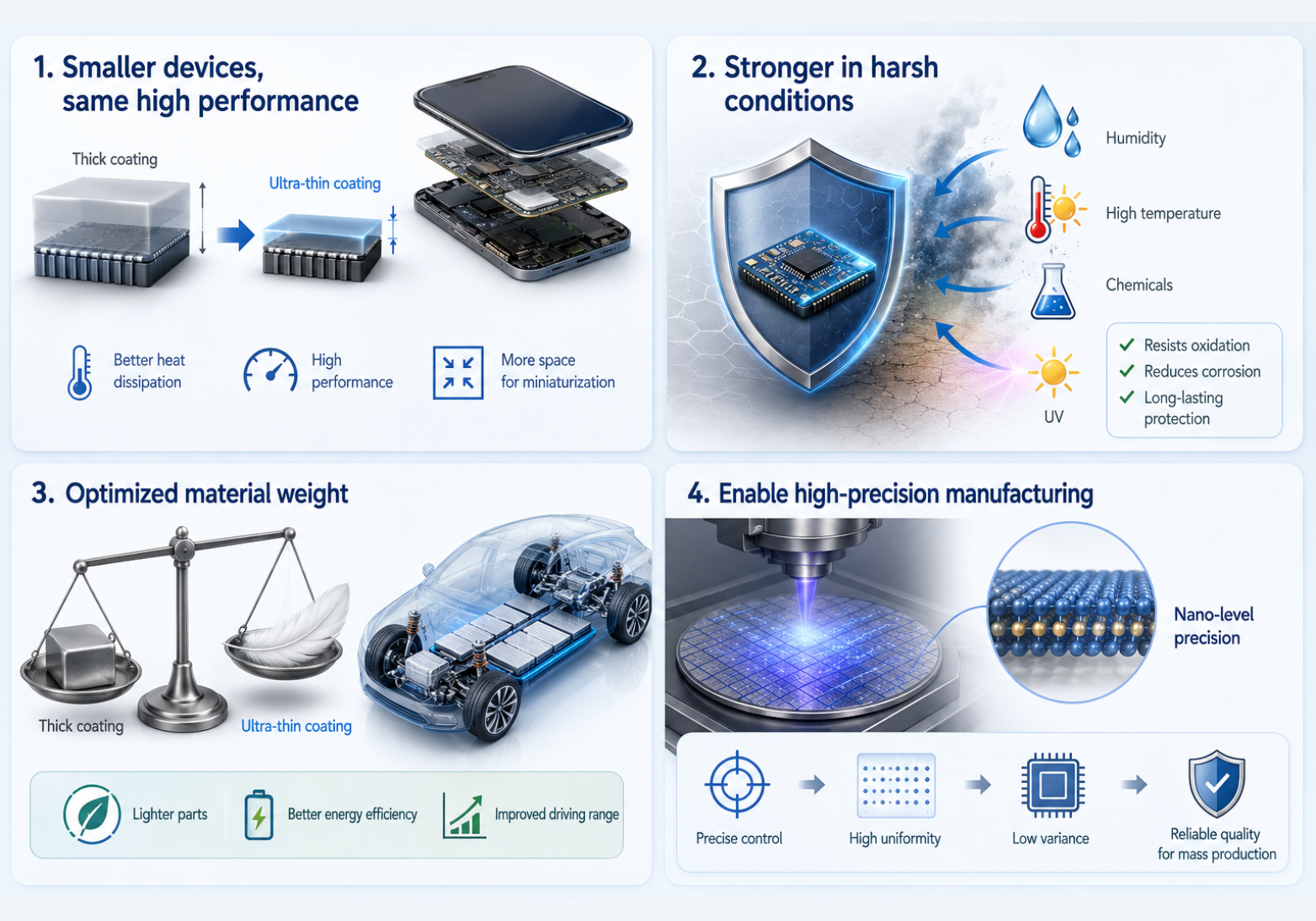
Modern electronic devices are becoming increasingly smaller and thinner. However, operational performance must still be maintained at a high level. This significantly limits the space available for protective coatings. If the coating is too thick, heat transfer efficiency may be negatively affected.
Ultra-thin coatings effectively address this issue. The coating still provides sufficient protection while occupying minimal space. In the semiconductor industry, coating thickness directly impacts component performance. Therefore, many companies are prioritizing highly precise thin coating technologies.
Higher Requirements for Environmental Durability
Many devices today must operate in highly demanding environments. High humidity and elevated temperatures can rapidly degrade coatings. In addition, chemicals and UV radiation also significantly affect material durability. These are challenges that many conventional coatings struggle to withstand over extended periods.
Meanwhile, modern ultra-thin coatings offer significantly higher stability. These coatings help minimize oxidation and reduce the risk of surface corrosion. For electronic components, coating stability is extremely important. If the coating layer delaminates, device performance may be severely affected.
Material Weight Optimization
The electric vehicle industry is placing strong emphasis on reducing equipment weight. Lower weight directly contributes to improved energy efficiency. Ultra-thin coatings significantly reduce the amount of coating material required while still maintaining effective surface protection.
This enables manufacturers to optimize the design of many modern components. In addition, weight reduction also contributes to lower operational energy consumption.
Supporting High-Precision Manufacturing
Many modern coating technologies are capable of controlling coating layers at the nanoscale level. This represents a major advancement in the advanced materials industry. Precise control improves coating uniformity while reducing manufacturing errors in mass production.
This is particularly important in the semiconductor and electronic sensor industries, where extremely high material precision is always required.
COMMON ULTRA-THIN COATING TECHNOLOGIES TODAY
ALD – ATOMIC LAYER DEPOSITION
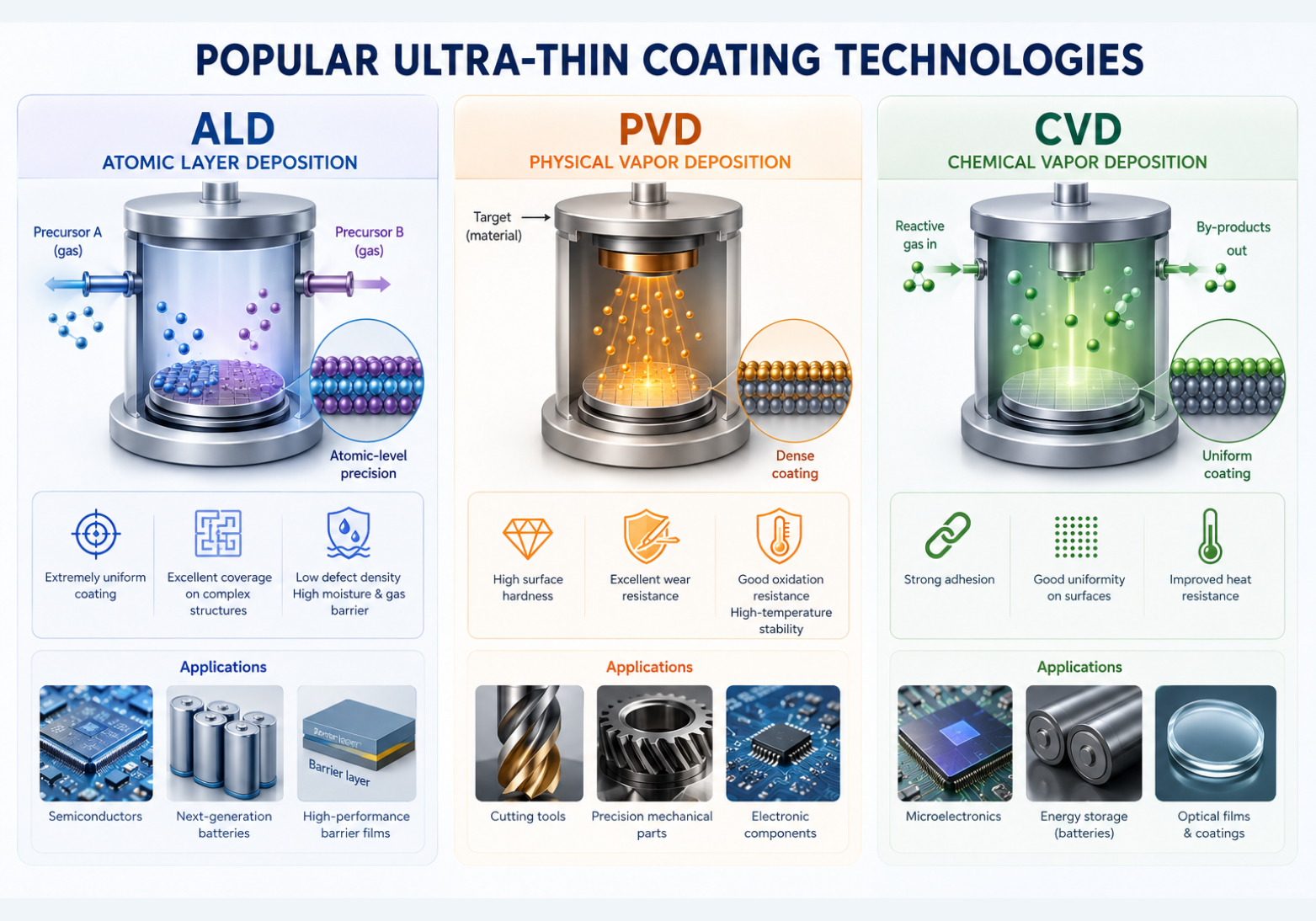
ALD is a technology that deposits atomic layers onto material surfaces. It is considered one of the most precise coating methods available today. The greatest advantage of ALD is its ability to achieve extremely uniform coverage. Even surfaces with highly complex structures can maintain excellent coating consistency.
This technology is currently widely applied in the modern semiconductor industry. In addition, next-generation batteries also commonly utilize ALD technology. ALD also enables the formation of barrier layers with extremely low defect density, significantly improving resistance to moisture and gas penetration.
PVD – PHYSICAL VAPOR DEPOSITION
PVD is a coating method based on physical evaporation or sputtering mechanisms. This technology is widely used in precision engineering applications. One major advantage of PVD is its ability to enhance surface hardness. At the same time, the coating layer also improves material wear resistance.
In addition, PVD coatings help improve oxidation resistance, which is extremely important for components operating at high temperatures. Currently, many companies utilize PVD for cutting tools and electronic components, both of which require high surface durability.
CVD – CHEMICAL VAPOR DEPOSITION
CVD operates through vapor-phase chemical reactions to form coatings. This technology typically produces highly uniform coating layers on material surfaces. Compared to many other methods, CVD provides excellent adhesion performance. Therefore, this technology is widely used in the microelectronics industry.
In addition, CVD is also applied in energy storage batteries and optical films. Some coating systems also help improve material heat resistance.
APPLICATIONS OF ULTRA-THIN COATINGS IN INDUSTRY
Electronics and Semiconductor Industry
This is currently the largest application sector for ultra-thin coatings. In semiconductor chips, thin films play an extremely important role. The coating layer directly affects electrical conductivity and insulation performance. In addition, thermal dissipation efficiency also heavily depends on these coatings.
Although only a few nanometers thick, coatings still determine component stability, which is a critical factor in modern electronics. Ultra-thin coatings are also widely used in OLED displays and PCBs. Many wearable devices also utilize nano-coating technologies.
Automotive Industry
Modern vehicles utilize numerous sensors and electronic modules. These components often operate in harsh environments. High temperatures and humidity can rapidly degrade electronic components. Therefore, protective coatings play a critical role in the automotive industry.
Ultra-thin coatings help improve corrosion resistance for electronic components while also minimizing electrical leakage. Currently, many nano-coating systems are used for LiDAR sensors. ADAS cameras in electric vehicles also widely utilize thin coating technologies.
Energy Industry
In lithium battery technology, ultra-thin coatings are developing rapidly. Nano-coatings help improve the stability of battery electrodes. In addition, coatings help reduce material degradation during charging cycles, contributing to longer energy device lifespans.
Thin coatings are also widely applied in modern solar cells. Many large-scale energy storage systems also utilize this technology.
Medical Industry
Medical devices today require extremely high cleanliness and stability. As a result, ultra-thin coatings are being increasingly adopted. These coatings help minimize bacterial adhesion on material surfaces. In addition, chemical resistance is also significantly improved.
Some nano-coatings also enhance biocompatibility, which is particularly important for implants and medical instruments.

CHALLENGES OF ULTRA-THIN COATINGS
Despite their many advantages, ultra-thin coatings still face several challenges. Investment costs for coating equipment remain relatively high. Many nano-coating systems require vacuum chambers and highly precise equipment, forcing companies to make substantial technological investments.
In addition, controlling coating uniformity is not simple. Even minor deviations can impact material performance. Surface cleanliness of the substrate is also critical for thin coatings. Improper surface treatment may reduce coating adhesion.
DEVELOPMENT TRENDS
The coating industry is currently moving toward thinner and more precise coating technologies. At the same time, environmental sustainability is receiving increasing attention. Many companies now prioritize coatings with low VOC content, which is becoming an important trend in the advanced materials industry.
In addition, AI is being integrated into automated coating production lines. This helps manufacturers improve quality control capabilities. In the semiconductor and electric vehicle industries, demand for thin coatings continues to increase, serving as a major driving force for the nano-coating market.
In the future, ultra-thin coatings are expected to play an increasingly important role. This technology is projected to continue expanding across modern manufacturing industries.
CONCLUSION
Ultra-thin coatings are becoming an essential technology in modern industry. Despite their extremely small thickness, these coatings still provide highly effective protection. Thanks to their excellent corrosion and moisture resistance, thin coatings are being widely applied across various engineering sectors.
In the future, demand for ultra-thin coatings is expected to continue growing significantly. This technology will become a key solution in the high-performance materials industry.
VICHEM – AUTHORIZED DISTRIBUTOR OF CHEMICAL ADDITIVES FROM LEADING BRANDS SUCH AS COVESTRO, SINOPEC, BUHLER, AND MORE IN VIETNAM
Vichem is an authorized distributor of chemical additive products from leading brands such as Covestro, Sinopec, Buhler, and more in the Vietnamese market. We not only provide high-quality products but also deliver after-sales services that meet international standards.
For more information about our products, please contact us through the following channels:
📞 Hotline: 08 1790 1790
📧 Email: contact@vichem.vn
🔎 LinkedIn: Vichem JSC
🌐 Website: www.vichem.vn
📌 Facebook: Vichem JSC