In the wire and cable industry, the stability of insulation layers and protective sheaths directly affects product quality. If polymer material layers adhere to each other during manufacturing or storage, cables may encounter installation issues and reduced service life.
This is why Talc powder is widely used in many modern cable production lines. In addition to serving as a mineral additive, Talc also helps create an anti-blocking layer between the inner and outer cable sheaths. As a result, winding, storage, and installation processes become more stable and efficient.
TALC POWDER IN THE WIRE AND CABLE INDUSTRY
Talc powder is a natural mineral primarily composed of hydrated magnesium silicate. This mineral features a soft, fine structure and relatively good heat resistance. In industrial applications, Talc is typically ground into ultrafine powder for use in various sectors such as plastics, paints, rubber, paper, and electrical materials.
In the wire and cable industry, Talc is mainly used to reduce adhesion between material layers during manufacturing and operation. Thanks to its fine and smooth properties, Talc can form a thin coating layer on cable surfaces. This coating prevents sheath layers from sticking tightly together when exposed to heat or pressure during winding and storage.
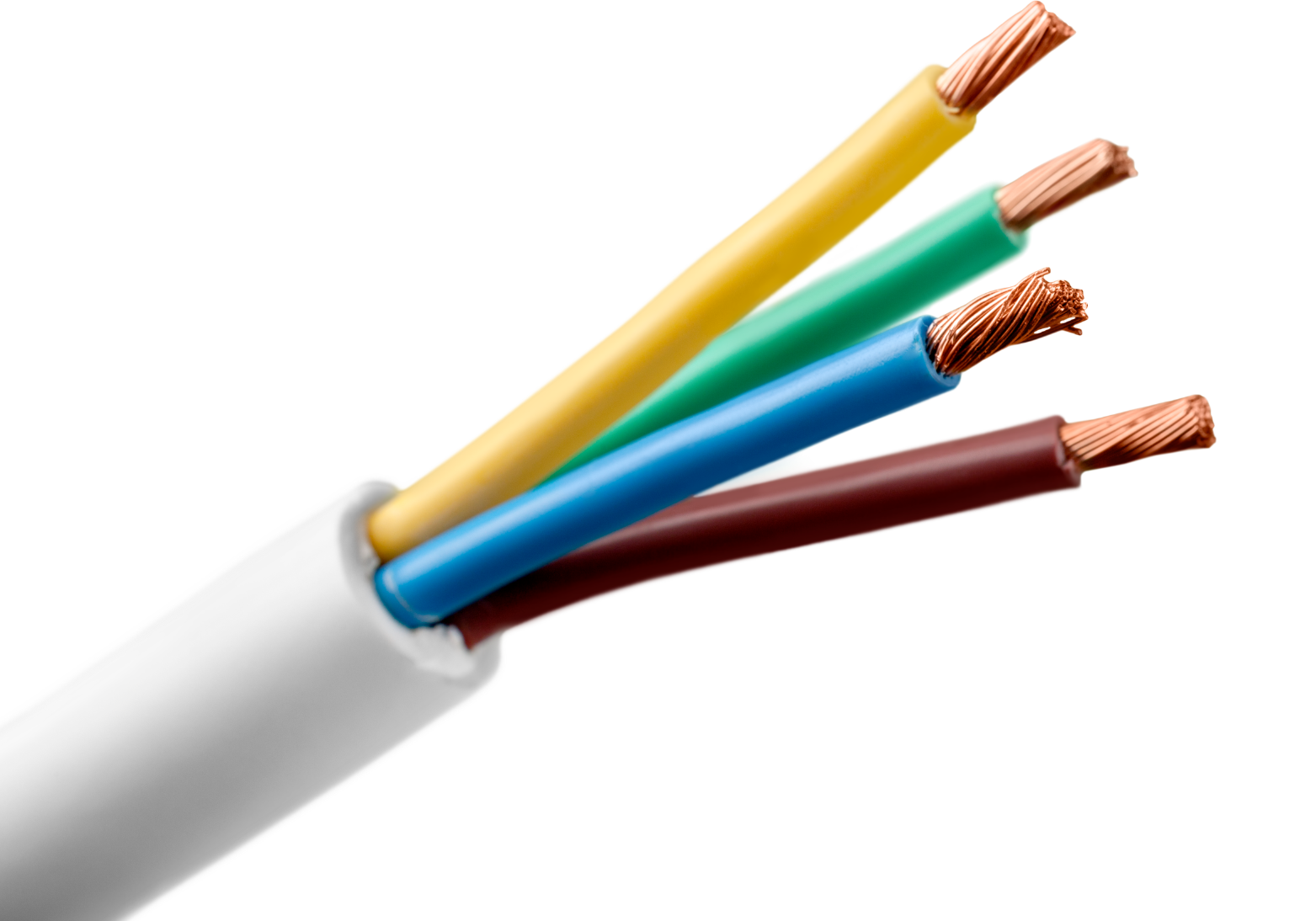
WHY ARE WIRES AND CABLES PRONE TO ADHESION?
During wire manufacturing, the sheath layer is typically applied while the material is still at a high temperature. The wire then passes through a cooling system before being continuously wound under relatively high pressure. Even after cooling, many materials still retain a certain level of surface tackiness. When wire layers remain tightly pressed together over an extended period, layer adhesion may occur.
This issue is more common in cables with soft plastic sheaths or cables stored in high-temperature environments. During unwinding, the sheath layer may stick to the upper cable layers, causing surface deformation or affecting product appearance.
In some cases, the internal insulation layer may also be affected if excessive pulling force is applied. This not only reduces product quality but also increases the risk of installation defects during actual application.
HOW DOES TALC PREVENT ADHESION?
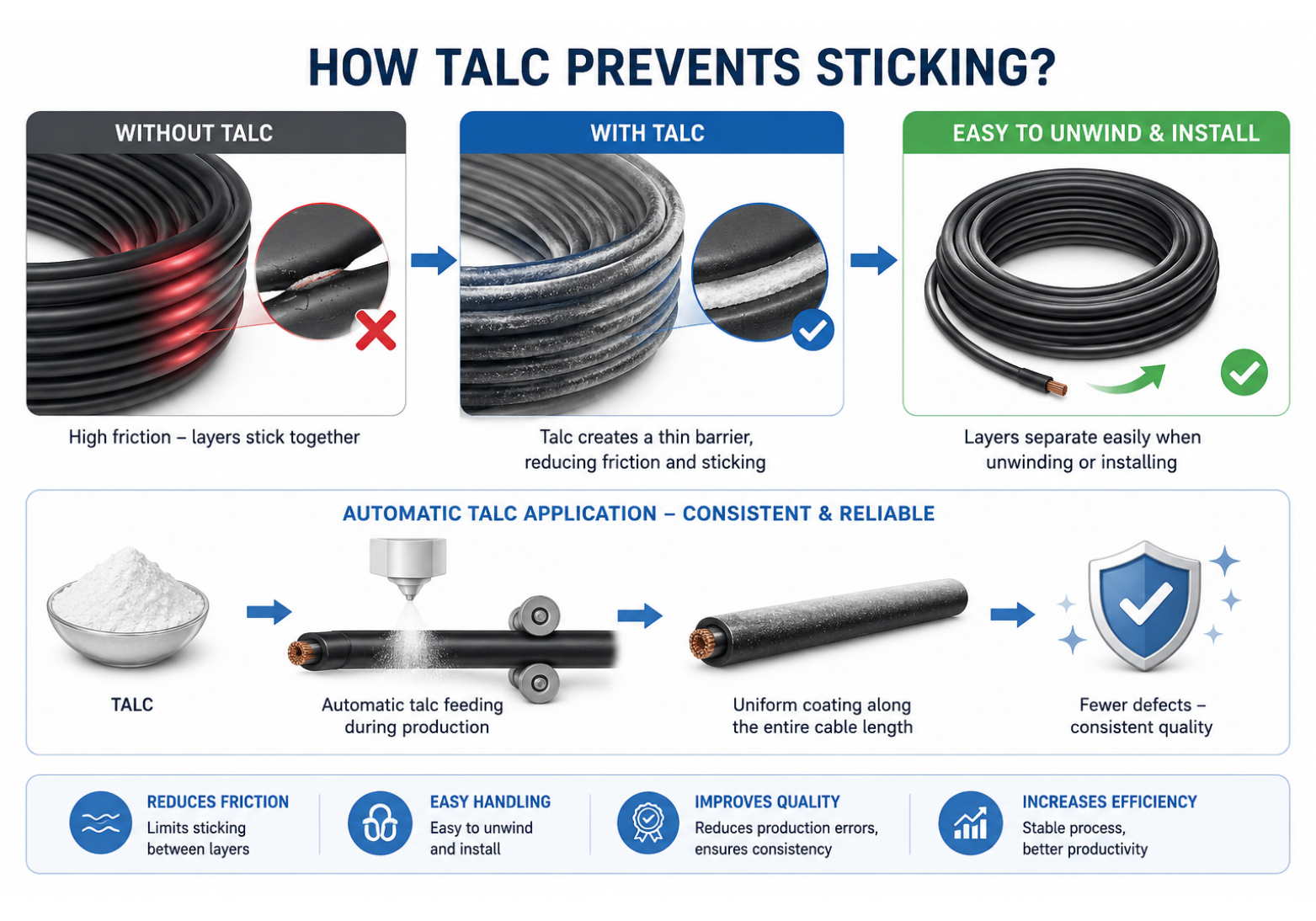
This is currently the most important application of Talc in the wire and cable industry. When applied to cable surfaces, Talc creates a very thin separation layer between material layers. This coating reduces friction and limits adhesion when cable turns are tightly pressed together during winding.
Thanks to its naturally smooth properties, Talc allows cable layers to separate more easily during unwinding and installation. This is especially important for flexible cables, as their material surfaces typically have higher tackiness.
In modern production lines, Talc is also automatically dosed to ensure uniform coverage across the entire cable length. Stable Talc dosage control helps manufacturers reduce production defects and maintain more consistent product quality.
THE ROLE OF TALC POWDER IN THE CABLE WINDING PROCESS
After production, wires and cables are typically wound at high density to optimize storage and transportation space. During this process, cable surfaces remain in continuous contact for long periods. Without a suitable anti-blocking layer, winding pressure may cause material layers to adhere tightly together. During unwinding, cables may jerk suddenly or experience outer sheath peeling.
Talc significantly reduces this issue. Thanks to the smooth coating layer on the cable surface, cable turns can slide gently over one another instead of sticking tightly together. This helps ensure a more stable unwinding process and minimizes surface damage during actual use.
TYPES OF WIRES AND CABLES THAT COMMONLY USE TALC POWDER
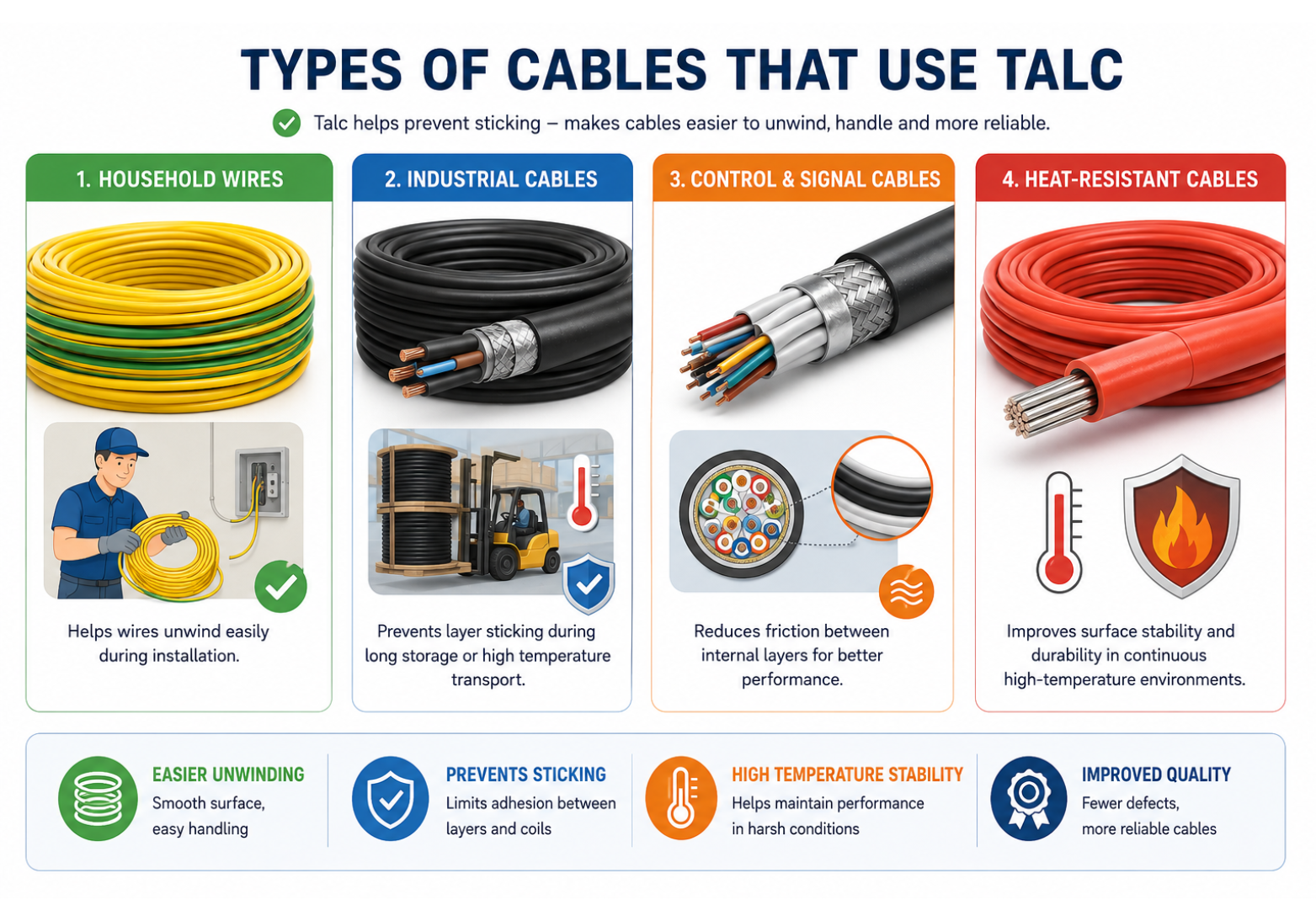
Currently, Talc is used in a wide range of wire and cable products. In residential electrical wires, Talc helps wire coils unwind more easily during installation. This is particularly important for flexible wires continuously wound at high density.
In industrial cable applications, Talc helps minimize layer adhesion when cables are stored for extended periods or transported under high-temperature conditions. Control cables and signal cables also commonly use Talc to reduce friction between internal material layers.
In addition, many heat-resistant cables today require Talc to improve surface stability when operating continuously in high-temperature environments.
TALC USAGE TRENDS IN THE WIRE AND CABLE INDUSTRY
The wire and cable industry is rapidly shifting toward high-speed and increasingly automated production lines. As a result, requirements for cable surface stability are becoming more stringent. Manufacturers are now focusing not only on electrical conductivity but also on installation experience and product stability after storage.
This is why Talc continues to play an important role in many modern wire manufacturing plants. Many companies now prioritize ultrafine Talc grades to reduce dust generation and improve coating uniformity on cable surfaces. At the same time, automatic Talc feeding systems are becoming increasingly common to ensure stable product quality in continuous production lines.
CONCLUSION
Talc powder plays an important role in the modern wire and cable industry. With its ability to reduce adhesion between the outer sheath and internal insulation layers, Talc helps improve cable stability during winding, storage, and actual use.
In addition to minimizing surface defects, Talc also helps manufacturers reduce damage during unwinding and improve post-production product stability.
As the electrical and automation industries continue to grow strongly, demand for Talc in wire and cable manufacturing is expected to increase further in the coming years.
VICHEM – AUTHORIZED DISTRIBUTOR OF CHEMICAL ADDITIVES FROM LEADING BRANDS SUCH AS COVESTRO, SINOPEC, BUHLER, … IN VIETNAM
Vichem is an authorized distributor of chemical additive products from leading brands such as Covestro, Sinopec, Buhler, and others in the Vietnamese market. We not only provide high-quality products but also deliver after-sales services that meet international standards.
For more information about our products, please contact us through the following channels:
📞 Hotline: 08 1790 1790
📧 Email: contact@vichem.vn
🔎 LinkedIn: Vichem JSC
🌐 Website: www.vichem.vn
📌 Facebook: Vichem JSC