When white paint shows the substrate despite enough coats, poor hiding power in white paint usually comes from too little TiO₂, poorly dispersed or agglomerated TiO₂ (titanium dioxide), the wrong TiO₂ grade, filler that takes up space unevenly, or a film applied too thin. Before changing raw materials, check grind fineness and dry film thickness, since these two measurements rule out the most causes.
What Poor Hiding Power in White Paint Means and How It Affects Production
Hiding power is the ability of a paint film to cover the color of the substrate. In white paint, it comes from the light scattering of TiO₂ particles in the paint. Light entering the film meets the boundary between a TiO₂ particle and the resin binder. The larger the refractive index difference between the two materials, the more the light is bent and reflected back out. TiO₂ has a much higher refractive index than the resin, so each particle acts as a small mirror distributed through the film.
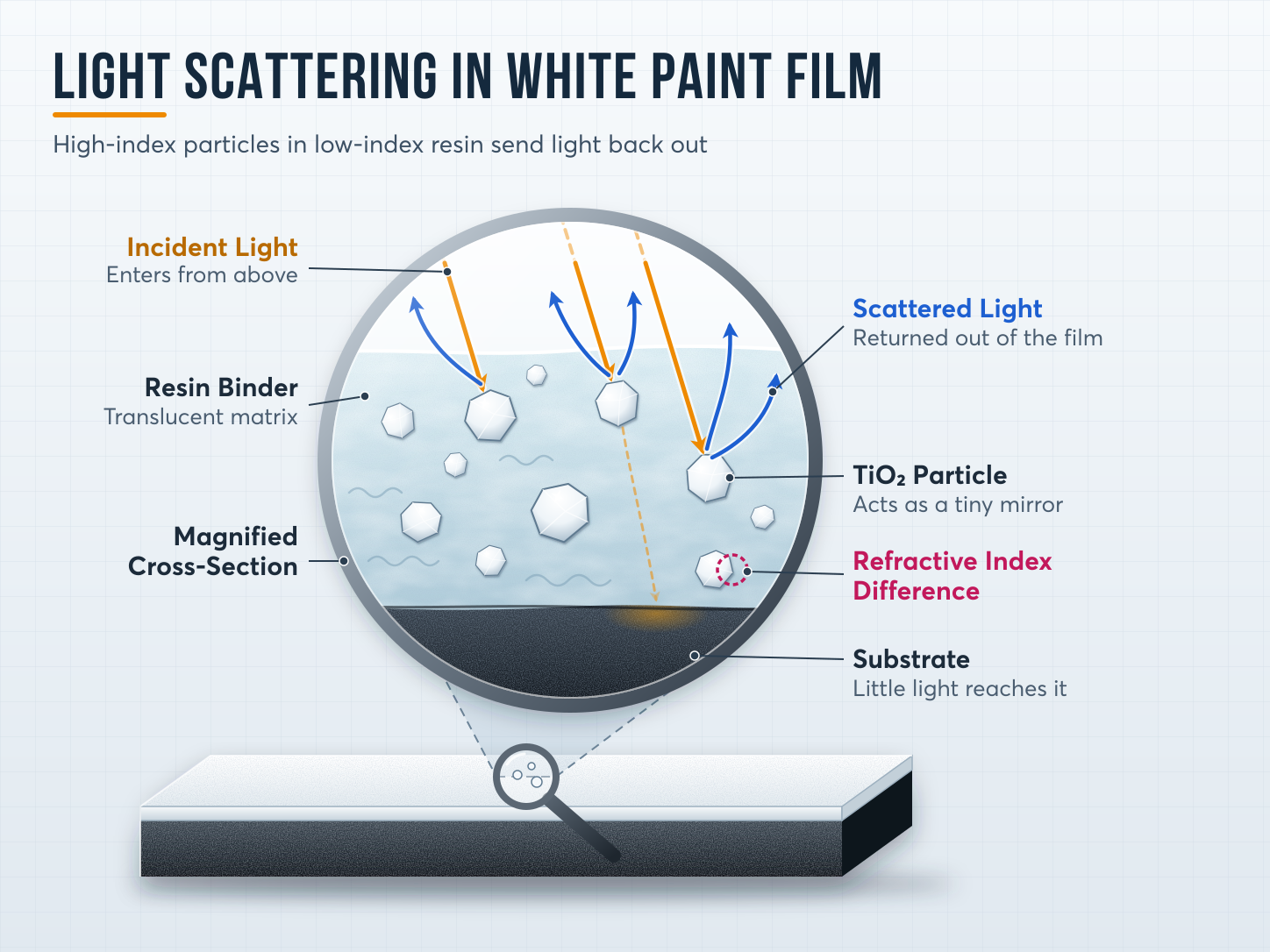
Scattering efficiency depends on whether the particles sit apart from each other at a suitable spacing. Particles clumped into agglomerates scatter less than separated particles, and particles packed too densely shade each other. So the hiding power of white paint results from the TiO₂ content, the dispersion state, the TiO₂ grade and the film thickness together.
Substrate show-through in white paint usually appears in a few ways: streaks of substrate through overlapping edges, thin areas at corners and edges, or a slightly gray white film. Each sign points to a different group of causes, so tell them apart before adjusting the formulation.
The consequences show up at several stages. The line has to spray additional coats, which uses more paint and extends drying time. Customers see the substrate through the film and complain. Between batches, fluctuating hiding power leads to color differences between batches, especially when tinting over a white base. Every rework adds cost without any certainty that it addresses the right cause.
5 Common Causes of Poor Hiding Power in White Paint
Cause 1 — Not enough TiO₂ in the formulation
Signs: the substrate shows evenly across the whole surface, at every location and for every applicator.
How to check: compare the batch weighing sheet against the formulation, check the scales and the raw material lots charged, and look for white powder or filler loaded in place of TiO₂.
Fix: correct the TiO₂ ratio back to the formulation, run a trial batch and compare hiding power with the standard sample.
Risk: raising it too far makes the particles crowd and shade each other, so hiding power does not increase in proportion while cost and batch viscosity go up.
Cause 2 — Poorly dispersed or re-agglomerated TiO₂
In TiO2 dispersion, agglomeration is the phenomenon where fine TiO₂ particles stick together into clusters before they are fully wetted and stabilized by the dispersant. Large clusters scatter light much less than individual particles.
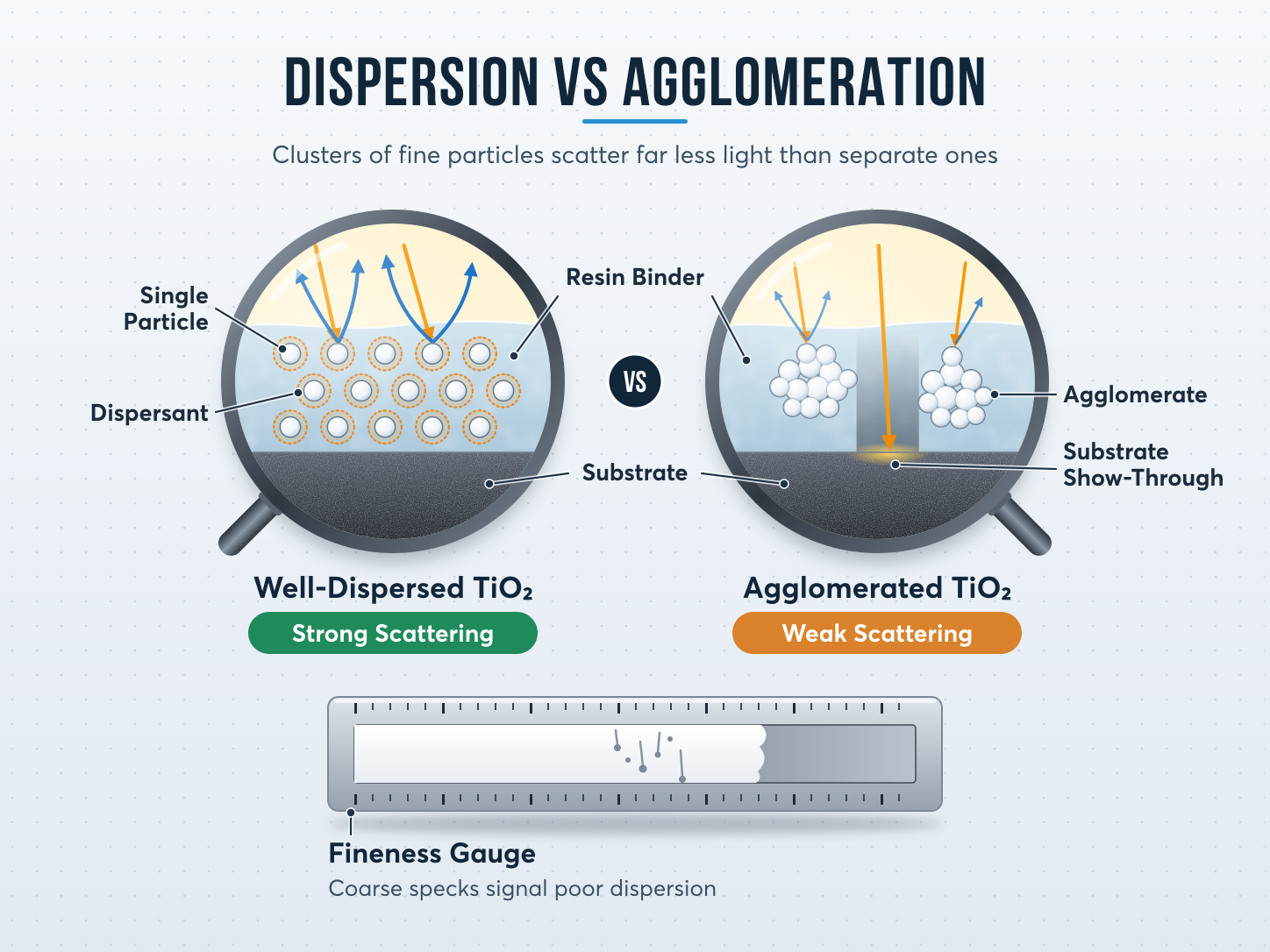
Signs: small particles or streaks in the film, and hiding power that changes on stirring or after storage.
How to check: measure fineness with a fineness gauge right after grinding and after storage.
Fix: adjust grinding time and speed, and review the type and amount of dispersant.
Risk: grinding too long heats the batch and affects the resin and solvent in the system.
Cause 3 — TiO₂ grade not suited to the paint system
Signs: low hiding power even though the loading is sufficient, and a white that shifts blue or yellow compared with the standard sample.
How to check: read the crystal type and surface treatment stated on the TDS, and compare with the lot that runs stably. Surface treatment determines how compatible the particle is with the resin and dispersant in the system.
Fix: switch to a grade that suits the paint system in terms of service environment and solvent-borne or water-borne chemistry.
Risk: changing grade without retesting causes color differences between the old and new lots.
Cause 4 — Unsuitable filler ratio and pigment volume concentration
PVC here is pigment volume concentration: the volume fraction of pigment and filler in the total solids volume of the dry film. Filler takes the place of TiO₂ particles and pushes the spacing between particles away from the design. When the film dries and shrinks, the pigment-to-resin ratio changes, so wet hiding power no longer represents the dry film.
Signs: the wet paint hides well but the dry film does not, or the reverse.
How to check: compare wet and dry hiding power of the same batch, then recalculate PVC from the formulation.
Fix: reweigh filler and pigment to the correct PVC range for the paint system.
Risk: reduced film durability if pigment and filler exceed the amount of resin that can bind them.
Cause 5 — Film applied too thin or thinned too much
A thin film has fewer TiO₂ particles per unit area, so light passes through to the substrate.
Signs: the defect appears only in the field, while a sample from the same batch tested at the factory passes.
How to check: measure wet and dry film thickness at the spots where the substrate shows, and ask again about the actual thinning ratio.
Fix: give the applicator clear instructions on thinning ratio, number of coats and required film thickness.
Risk: wrongly blaming the raw material and changing supplier when the cause lies in application.
Quick Diagnostic Workflow for Poor Hiding Power in White Paint
Go in order from the cheapest and fastest check to the checks that need a reference sample. Complete all four steps on the same defective batch.
- Measure film thickness, wet and dry, and ask about the thinning ratio in the field. If the film meets the required thickness and was thinned per instructions, rule out cause 5.
- Check grind fineness with a fineness gauge on the defective batch. Coarse particles or results that change after stirring point to cause 2.
- Verify the formulation, the batch weighing sheet and PVC. A TiO₂ amount below design is cause 1; an off-target filler ratio or a difference between wet and dry hiding power is cause 4.
- Compare the sample with a reference TiO₂ lot: make it with the same formulation and the same grinding conditions, changing only the TiO₂ lot. A different hiding power or shade indicates cause 3.
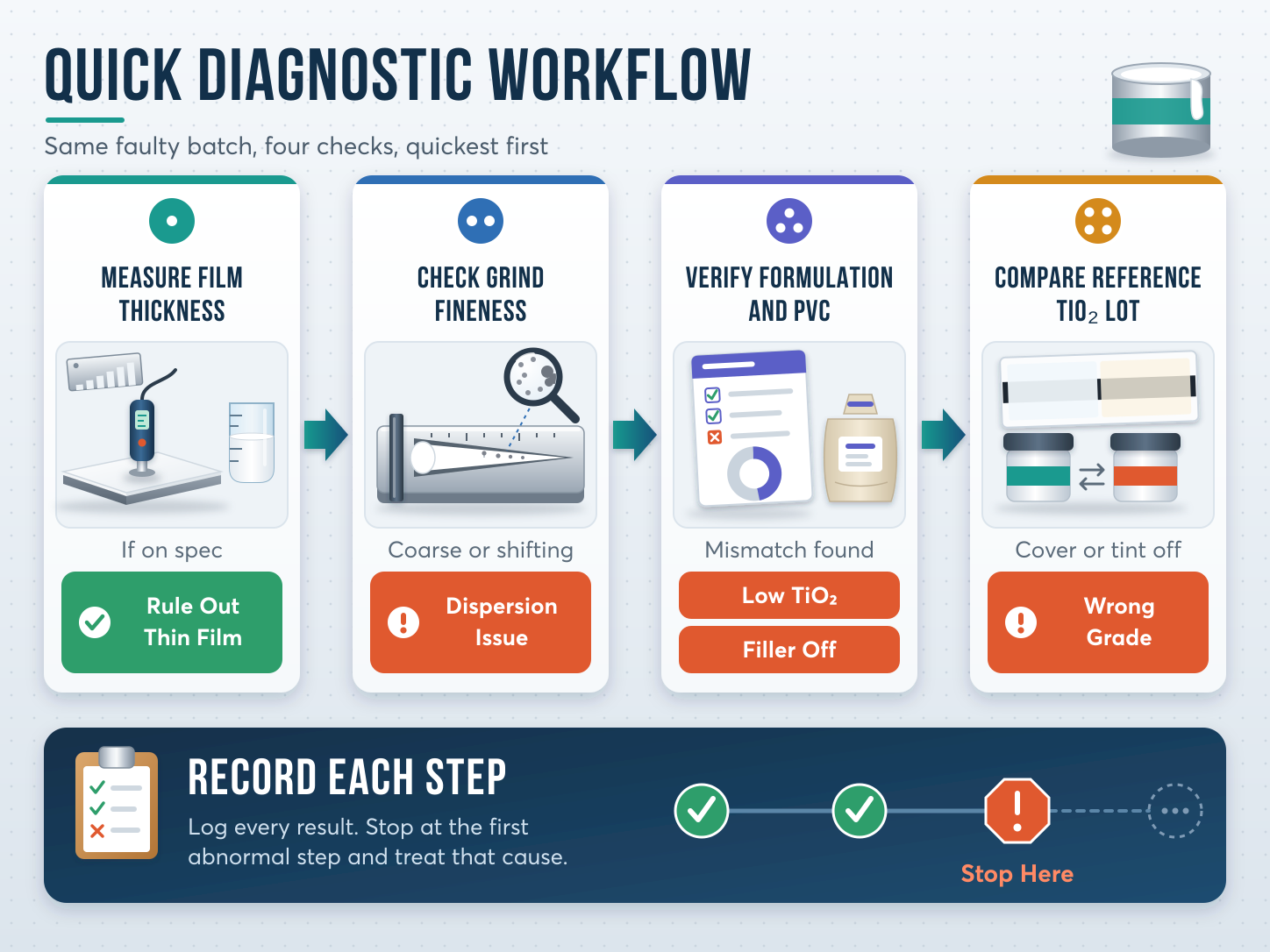
Record the result of each step. When a step gives an abnormal result, stop there and deal with the corresponding cause before moving on to the next step.
How to Prevent Poor Hiding Power in White Paint
Prevention starts with choosing the right TiO₂ grade for the paint system. Rutile TiO₂ suits applications that need hiding power and outdoor durability, while anatase TiO₂ should only be used for undemanding indoor applications. To compare these two crystal forms, plants can read the guide on choosing rutile or anatase TiO2 from Chinese suppliers.
Next is the surface treatment of the TiO₂ particle. Water-borne and solvent-borne systems need different surface treatments so that the particles wet out and stay stable in the resin. TiO₂ made by the chloride process and the sulfate process are two different groups; test both in a batch of the paint system in use and compare hiding power and tone. The properties to read are all in the TDS of each grade. Plants can consider TiO₂ from Tinox and Suzhou WhiteArrow Titanium Industry.
If the same plant uses TiO₂ for several applications, the selection criteria will differ from paint. Two separate articles, on choosing TiO2 for plastic film and white masterbatch and choosing TiO2 for outdoor PVC products, cover that.
On the process side, control grinding, including time, speed and batch temperature, and measure fineness for every batch. Check the COA of every lot of TiO₂ on receipt and keep a reference lot to compare against when hiding power fluctuates. This way, a defect can be traced right away to the supplier, the formulation or the application.
FAQ: TiO₂ and Hiding Power in White Paint
Does rutile or anatase TiO₂ give better hiding power?
Rutile gives better hiding power than anatase in paint. The rutile crystal form scatters light more strongly and holds up better under weathering, so it is chosen for outdoor paint and for demanding substrate coverage. Anatase only suits undemanding indoor applications, and its shade is also different.
Does adding more TiO₂ always increase hiding power?
No. Beyond a certain level, adding TiO₂ makes the particles crowd and shade each other, so each additional portion of TiO₂ contributes less to hiding power. The result also depends on the dispersion level and the filler in the film, so run a trial batch before adjusting the loading.
Why does white paint hide well when wet but show the substrate when dry?
Because the film shrinks as solvent or water evaporates, which changes the ratio of particles to resin in the film. If the formulation has a lot of filler or the TiO₂ particles are agglomerated, the dry film scatters less than the wet film. Compare wet and dry hiding power of the same batch, then check PVC.
Does titanium dioxide for water-borne and solvent-borne paint differ?
Yes, mainly in the surface treatment of the particle. Water-borne and solvent-borne systems have different polarity and dispersants, so the same particle grade can disperse well in one system and poorly in the other. Read the surface treatment section of the TDS and test a batch first.
Conclusion
Poor hiding power in white paint rarely comes from a single factor. Checking in order from the applied film to grind fineness, then the formulation and the TiO₂ grade, identifies the cause without changing raw materials for nothing.
- Five causes to tell apart: too little TiO₂, poor dispersion, wrong TiO₂ grade, off-target filler and PVC, and a film that is too thin.
- Measure film thickness and grind fineness before suspecting the raw material.
- Choose the TiO₂ grade by crystal form and a surface treatment that suits the paint system.
- Check the COA of every lot and keep a reference lot to compare when hiding power fluctuates.
Send photos of the areas where the substrate shows, the batch formulation and the application conditions, and we will check the cause with you.
Vichem is a distributor of chemical additives and equipment from leading brands such as Covestro, Sinopec, TotalEnergies Corbion, Bühler and Tinox in the Vietnamese market.
For more information about our products, please contact us through the following channels:
- Hotline: 08 1790 1790
- Zalo OA: Vichem JSC
- Email: contact@vichem.vn
- LinkedIn: Vichem JSC
- Website: www.vichem.vn
- Facebook: Vichem JSC