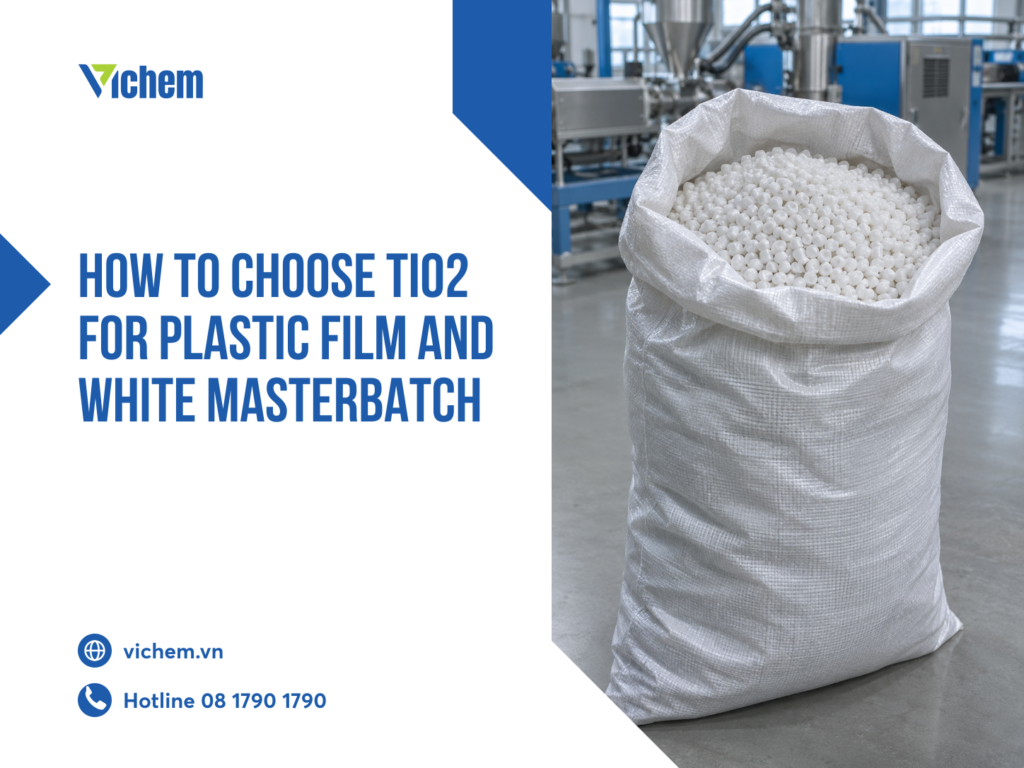
When blown film shows holes or white masterbatch clogs the screen pack, the cause often lies in the grade of TiO2 for plastics that was selected. For titanium dioxide in polyolefins such as PE and PP, use rutile with an organic surface treatment for good dispersion. For TiO2 for white masterbatch, check the surface treatment type, moisture and volatiles on the TDS and COA, then test dispersion at high loading on your own line before running full production.
Where the wrong TiO2 fails in film and masterbatch
The three most common failures on the line are film holes, agglomerates, and deviations in whiteness or color. All three appear after the material has entered the extruder, when changing raw materials already costs time and scrap.
Lacing is small holes caused by moisture escaping at extrusion temperature. Water in the TiO2 powder, or adsorbed on the surface treatment layer, vaporizes in the extruder and creates gas bubbles in the polymer melt. The bubbles expand as the film is blown thin and burst into holes or pitted streaks. The thinner the film, the more likely and the more visible the holes.
Agglomerates are clusters of TiO2 that were not fully broken down in the polymer matrix. On the film, they show up as hard white specks. In the extruder, they build up on the screen pack, raising the filter pressure and forcing a stop to change screens. In thin film, a large cluster can cause the film to break during drawing or blowing.
Low whiteness and opacity, or yellowing film, indicate that the crystal form or surface treatment is not suitable, or that the TiO2 is unevenly dispersed and does not scatter light fully. Yellowing is often linked to the interaction between the surface treatment and the polymer additives at processing temperature, so it must be tested on the exact formulation in use.
For outdoor products, anatase degrades plastics through photocatalytic activity: under UV, the particle surface generates free radicals that break polymer chains. Film or products chalk, become brittle and fade sooner than with rutile.
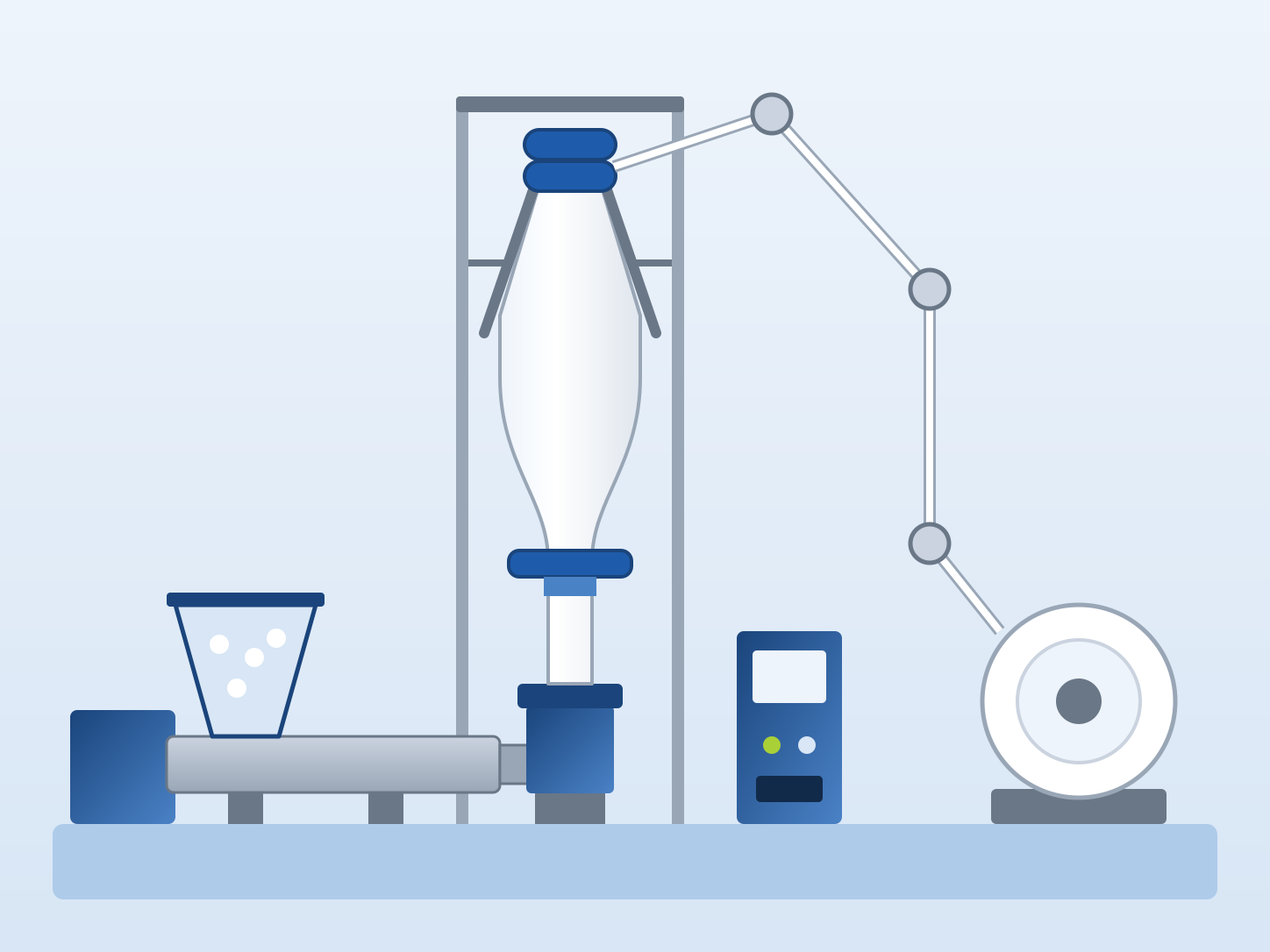
4 deciding criteria for choosing TiO2 for plastics
Each criterion below corresponds to a failure described above. Read in this order, you can rule out most unsuitable options straight from the TDS.
Criterion 1 — Crystal form: rutile TiO2 for plastics or anatase
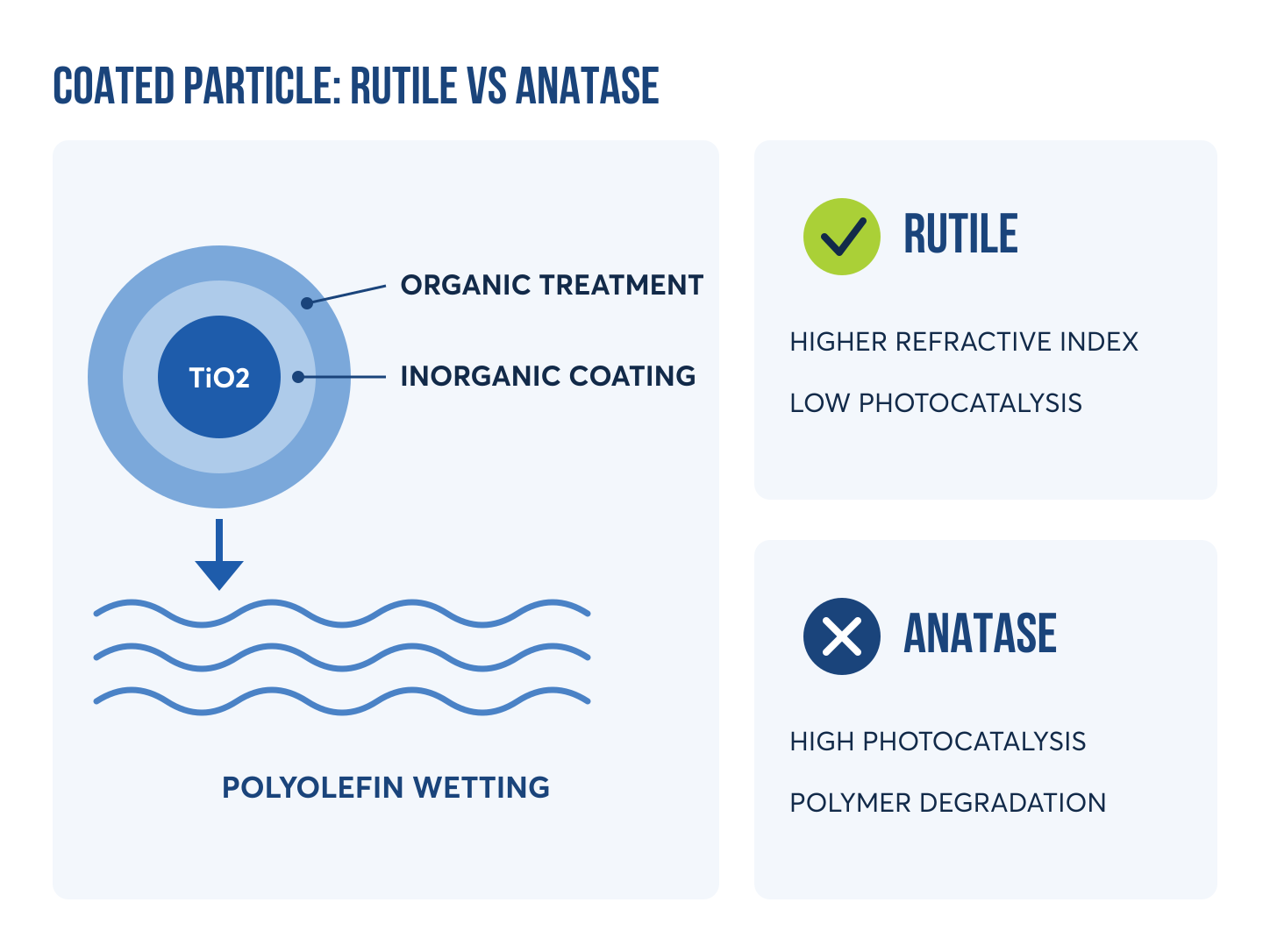
Titanium dioxide has two crystal forms commonly used in industry: rutile and anatase. Rutile has a higher refractive index, so it scatters light more strongly and gives better opacity at the same dosage. It is also more weather-resistant because its photocatalytic activity is lower.
Anatase gives a slight blue tone and is often chosen when a cool white shade is needed, but its high photocatalytic activity makes the polymer matrix degrade quickly under UV. For white masterbatch used in packaging film, agricultural film or outdoor goods, rutile is the default choice. Anatase is worth considering only when the product is for indoor use and the color requirement makes it necessary.
Criterion 2 — Surface treatment
TiO2 particles are usually coated with a surface treatment, and this layer determines how the particles behave in plastics. An inorganic layer (alumina, silica) covers the active surface of the particle, reducing photocatalysis and improving durability. An organic layer helps the polymer wet the particle, which matters for non-polar polyolefins such as PE and PP because the TiO2 surface is inherently polar and hard to make compatible with the polymer matrix.
A treatment that is optimal for paint can perform poorly in plastics. A coating designed for water-based or polar solvent-based resins often wets poorly in polyolefins, making the particles hard to separate and prone to agglomeration. When reading the TDS, check which treatment the manufacturer states and which resin systems it is intended for.
Criterion 3 — Moisture and volatiles
A thick inorganic treatment layer tends to absorb moisture from the air, so the powder can carry extra water even when it has just left the plant. This water does not disappear during mixing; it follows the particles into the extruder and vaporizes at extrusion temperature, then becomes holes in the film.
For this reason, read the moisture and volatiles specification on the TDS and compare it with the COA of each lot, because declared values can differ between lots and storage conditions. Compare the test method and measurement conditions as well, so that two suppliers can be compared on the same basis.
Criterion 4 — Dispersion at high loading
White masterbatch contains a very high proportion of TiO2, so the powder must be free-flowing and non-caking during feeding and easy to wet when mixed with the carrier resin. Caked powder feeds unevenly, causing content to vary between batches and creating agglomerate clusters.
Poor dispersion shows up as rapidly rising filter pressure and white specks on the film, and it also lowers the strength of thin film. The principles of wetting and particle separation are the same as in paint; you can read more in our article on how to fix poor pigment dispersion in industrial paint, but for masterbatch you need to test directly at the actual loading.
How to match TiO2 to your film and masterbatch line
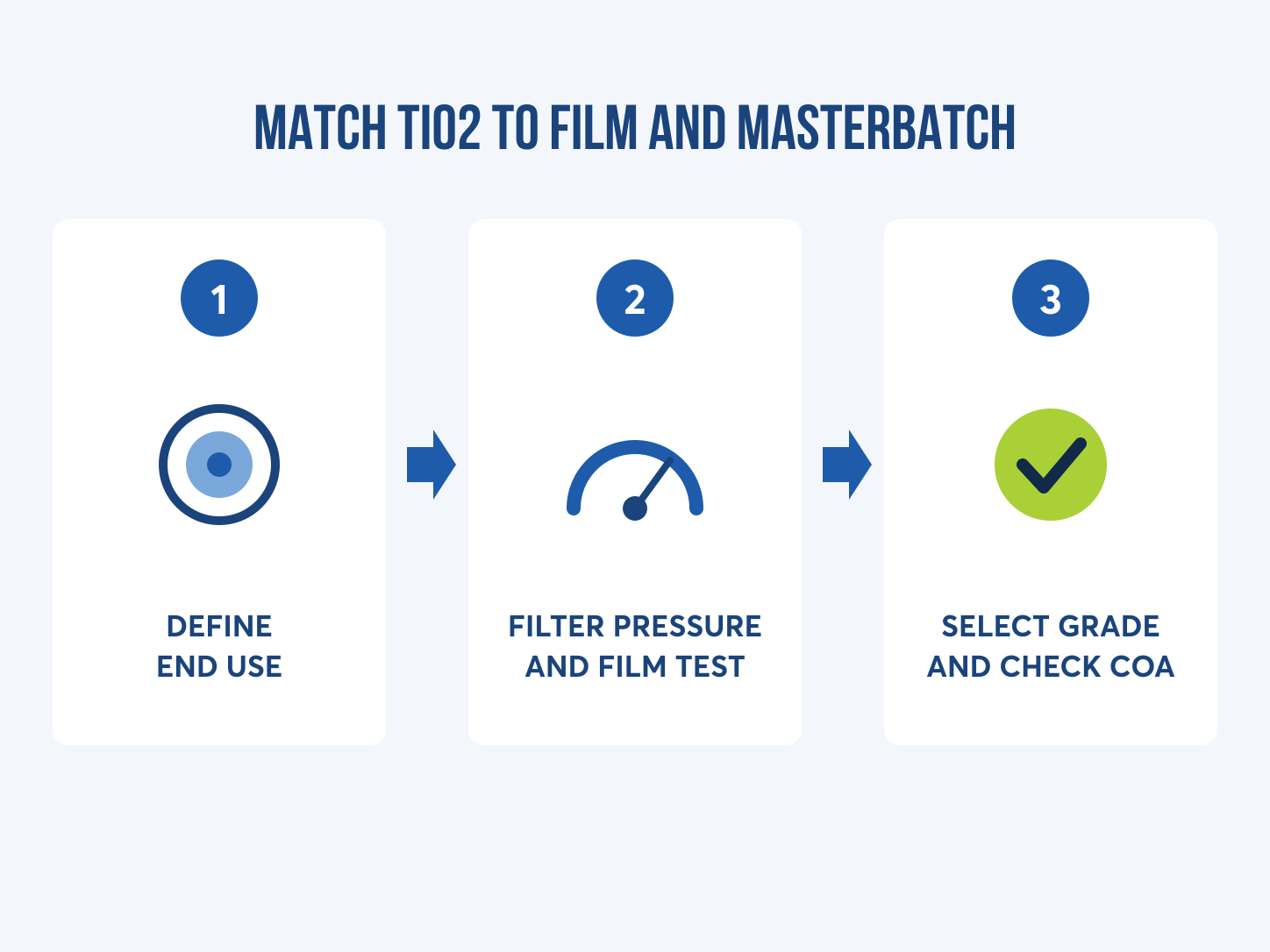
The three-step process below goes from the requirements of the end product to a specific choice, and each step has an output you can record for the raw material approval file.
Step 1 — Define the end application
State clearly whether the product is blown thin film or cast film, whether it is used outdoors or indoors, and whether the base resin is PE or PP. Thin blown film is more sensitive to agglomerates and moisture than thick film. Outdoor products need rutile with a surface treatment that resists photocatalysis. The base resin determines which organic treatment is needed.
Step 2 — Trial
Run the candidate TiO2 sample under the same conditions as the grade currently in use and measure three things:
- Filter pressure before and after a period of running, to see the rate of buildup on the screen pack.
- Particles on thin film: check for white specks and holes by eye or under backlighting.
- Whiteness and opacity compared with the current grade, at the same film thickness.
If the masterbatch is made in advance, test at the masterbatch loading as well, not only at the final concentration in the film.
Step 3 — Select the TiO2 grade
For film and white masterbatch, the suitable grade is rutile titanium dioxide with a surface treatment for plastics. Rutile provides opacity and weather resistance, and the treatment designed for plastics supports dispersion in polyolefins. Anatase should be kept for specific indoor applications.
When choosing a supplier, request TDS and COA for each lot. Vichem distributes TiO2 from Tinox and WhiteArrow for paint and plastics; you can send us a request to compare the treatment of each grade against your line's base resin. If the product is outdoor PVC, the criteria are different and we have a separate article on how to choose TiO2 for outdoor PVC products.
Common mistakes when choosing TiO2 for plastic film
The three mistakes below recur at plants that switch from paint to plastics or change TiO2 suppliers.
Using paint-grade TiO2 in plastics. The treatment on paint grades targets polar resins and solvent systems, so it wets poorly in polyolefins. Plants that make both paint and plastics easily merge them under one material code because both are white powders. A paint formulation also comes with a solvent system chosen for the base resin, as in the article on choosing thinning solvents for industrial paint by resin system; extruded plastics have no thinning step, so the powder must wet out on its own in the polymer melt.
Neglecting moisture-proof storage of bags. The inorganic treatment absorbs moisture, so bags that are opened or torn and left in a humid warehouse will carry water vapor into the extruder and cause lacing even if the original COA was in specification. Reseal bags after use and inspect bags on receipt.
Comparing only whiteness without testing dispersion at masterbatch loading. Two samples with the same whiteness when the powder is measured can still disperse differently in the polymer. Only when running at the actual loading will you see the difference in filter pressure and white specks.
Frequently asked questions
How does titanium dioxide for plastics differ from TiO2 for paint?
The difference is mainly in the surface treatment. Grades for paint are treated to be compatible with polar resins and solvents, while grades for plastics need good wetting in polyolefins and must withstand extrusion heat. Moisture, volatiles and the free-flowing behavior of the powder are also controlled more tightly.
Should TiO2 for white masterbatch be rutile or anatase?
Use rutile for most white masterbatch, because it has higher opacity and is more durable under UV. Anatase has a blue tone but high photocatalytic activity, which makes plastics chalk quickly outdoors. Consider anatase only for indoor products that need a cool white shade.
Why does white plastic film show holes when TiO2 is added?
The usual cause is water vapor in the TiO2 powder vaporizing at extrusion temperature. The water comes from a moisture-absorbing treatment layer or from poor bag storage. Check the moisture value on the lot's COA and the condition of the bags, then dry the powder or change lots to compare.
Does titanium dioxide in plastics make plastic brittle outdoors?
Rutile with a suitable surface treatment usually makes plastics more durable outdoors because it scatters and absorbs some of the UV. Anatase or a poorly treated grade promotes photocatalysis, breaking polymer chains and making the plastic brittle. Choosing the right crystal form and coating is the deciding factor.
Conclusion
TiO2 for plastic film and white masterbatch should be rutile with a surface treatment designed for plastics, because the two most common causes of failure are moisture causing film holes and poor dispersion clogging the screen pack. Both can be checked on the TDS, the COA and a trial run.
- Choose rutile with an organic surface treatment for polyolefins such as PE and PP.
- Read the moisture and volatiles of each lot to prevent lacing, and keep bags sealed.
- Test filter pressure and white specks at the actual masterbatch loading.
- Request a COA for each lot to compare between deliveries.
Send us the base resin, film thickness and extrusion conditions of your line so that the Vichem technical team can recommend a suitable TiO2 grade and support sample testing.
Vichem is a distributor of chemical additives and equipment from leading brands such as Covestro, Sinopec, TotalEnergies Corbion, Bühler and Tinox in the Vietnamese market.
For more information about our products, please contact us through the following channels:
- Hotline: 08 1790 1790
- Zalo OA: Vichem JSC
- Email: contact@vichem.vn
- LinkedIn: Vichem JSC
- Website: www.vichem.vn
- Facebook: Vichem JSC