When an anticorrosive primer blisters or a topcoat turns dull, the cause often lies in the talc selected: talc powder for paint should be chosen by platelet shape, fineness, whiteness, and mineral purity, because these four factors determine moisture barrier performance, sanding behavior, and paint color. The coating system in use (primer or topcoat, anticorrosive or decorative) sets the priority order of each criterion.
Where Industrial Paint Fails When the Wrong Talc Is Chosen
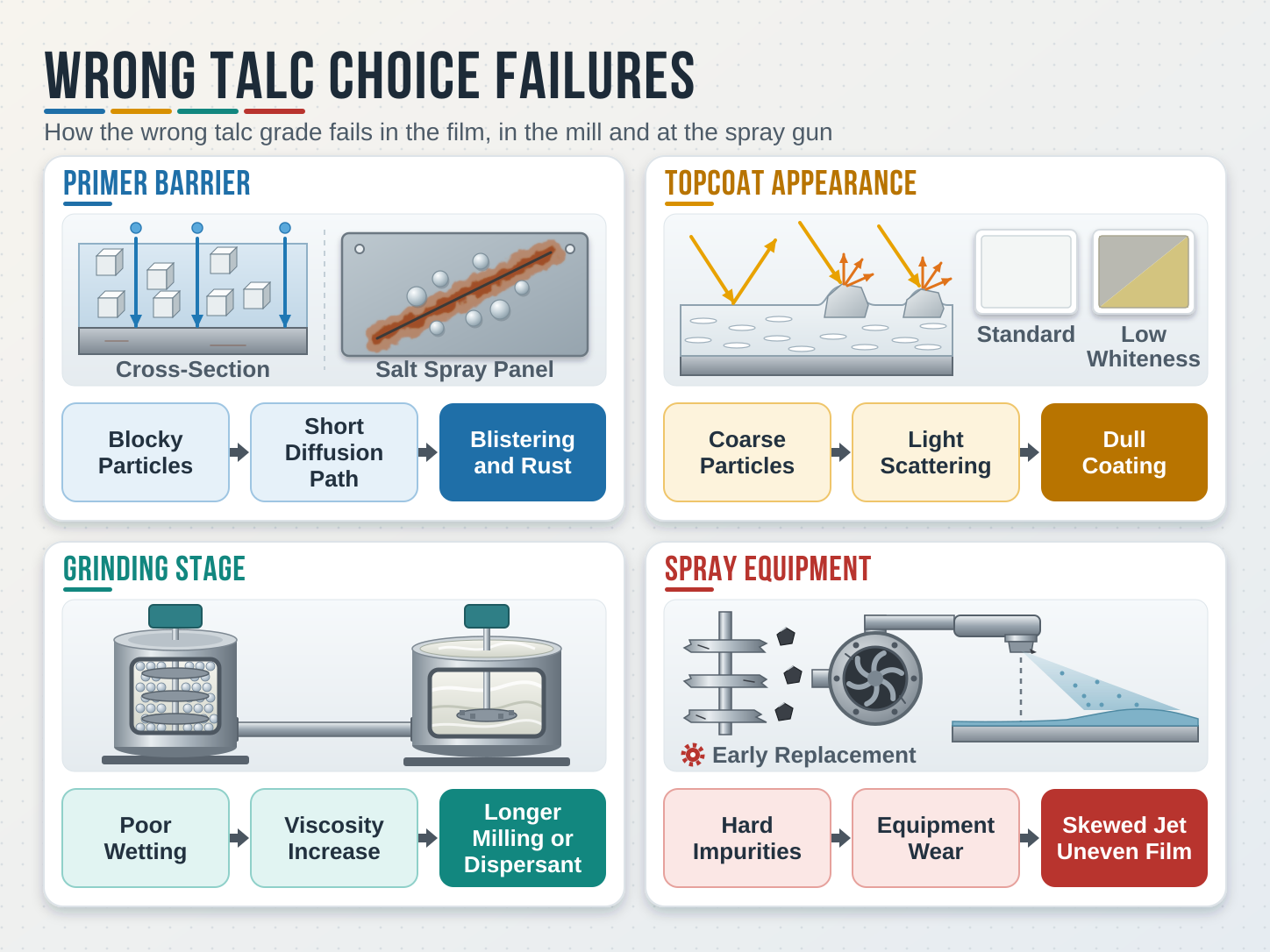
Talc-related defects show up earliest in anticorrosive primers. If most talc particles are blocky rather than separated into platelets, water vapor and ions pass through the film along a shorter path. The result is poor corrosion resistance in the primer, even though the resin and anticorrosive pigments are unchanged. On salt spray panels, the typical signs are blistering and rust creeping from the scratch.
The topcoat fails in a different way. Coarse particles protruding from the surface scatter light, so the topcoat loses gloss or looks dull. Talc with low whiteness pulls light colors toward gray or yellow, and the batch drifts from the color standard.
In production, unsuitable talc causes viscosity increase during grinding, because the particles wet out and disperse poorly. The batch needs longer grinding time or extra dispersant. Viscosity is also affected by the solvent, since the composition of the thinner solvent determines how well the resin wets the particle surface, so it must be considered together with the talc.
Finally, there is the equipment. Hard mineral impurities in talc wear down grinding shafts, pumps, and spray nozzles. A worn nozzle deflects the spray, makes the film thickness uneven, and forces the plant to replace parts earlier than the maintenance plan.
4 Key Criteria for Choosing Talc Powder for Paint
The four criteria below explain why two batches of talc can give different results on the same line. Each one can be read from the TDS or COA of the batch.
Platelet Shape (Lamellarity)
Lamellarity is the degree to which talc particles separate into thin, flat platelets whose width is much greater than their thickness. As the paint film dries, the platelets lie parallel to the substrate and stack on top of each other. Water vapor, oxygen, and ions must go around each platelet to cross the film, creating a zigzag path longer than a straight line. The film resists permeation better, so the steel beneath is attacked more slowly. This is why lamellar talc is widely used in anticorrosive primers.
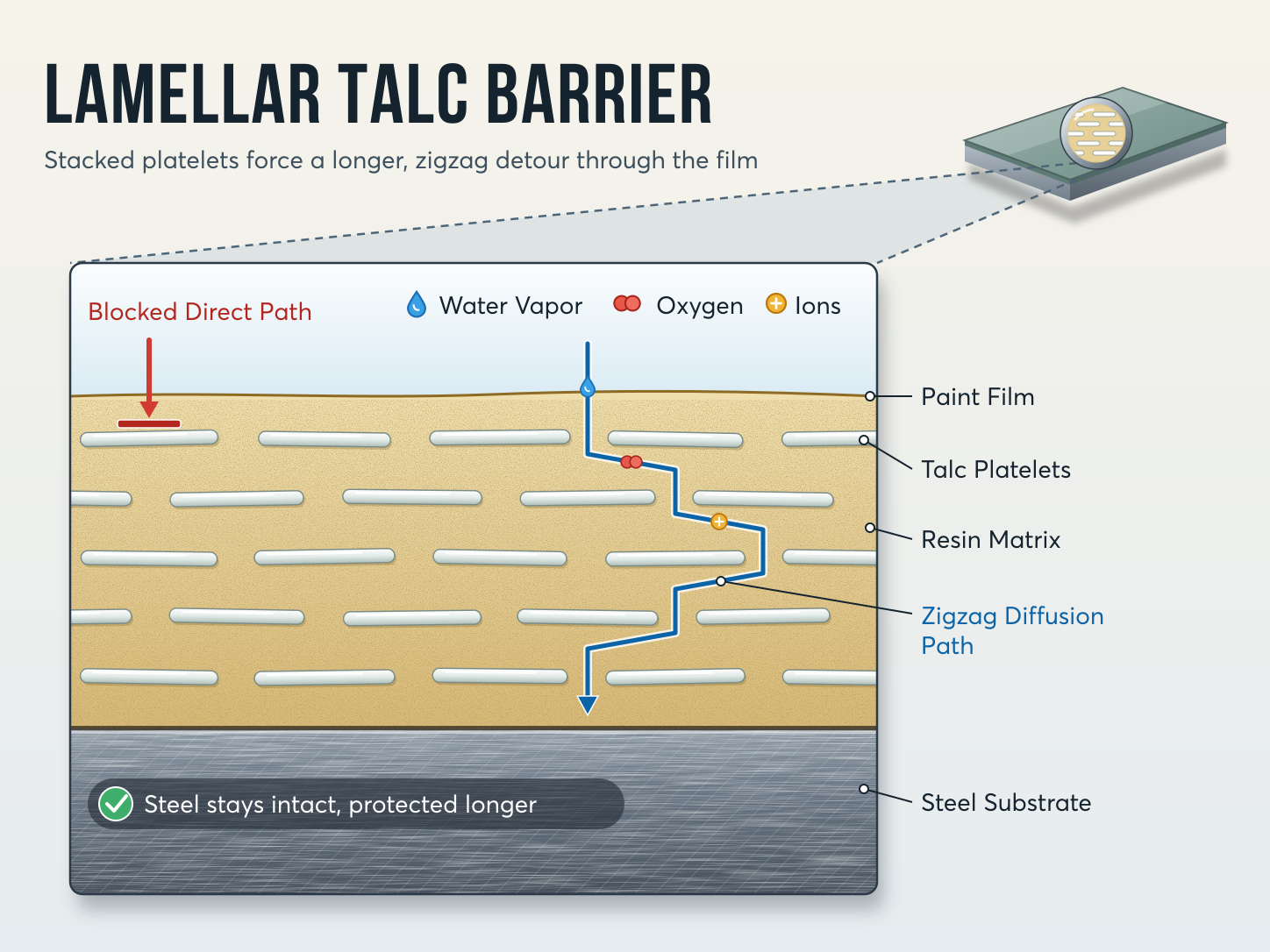
Platelet content depends on the ore and the milling method, because overly aggressive milling breaks platelets into blocky particles. Two talc batches with the same particle size on the TDS can still differ in moisture barrier performance. Ask the supplier for a parameter that describes platelet shape, and verify it with salt spray testing on the actual paint system.
Hardness and Softness of Talc
Talc is the softest mineral on the Mohs scale, at the bottom of the hardness scale. Among talc powder properties, this is a benefit for the plant: primer films containing talc are easy to sand, sanding between coats is fast, and it leaves fewer deep scratches. Mills, grinding shafts, and spray nozzles also wear less than with hard fillers.
The trade-off is that talc does not raise film hardness the way hard fillers do. If the coating needs scratch resistance or surface abrasion resistance, talc does not meet that requirement. Note that the hardness of the talc mineral differs from the actual abrasiveness of a shipment: equipment wear comes from hard mineral impurities, so check the mineral composition on the COA.
Particle Size Distribution
Particle size distribution shows the proportion of fine and coarse particles in the same batch. Fine particles sit close together in the film and keep the surface flat, so they retain gloss better. Coarse particles protrude, scatter light, and reduce gloss, but they create a roughness that helps the next coat adhere, which is useful in primers.
On the TDS, read the average particle size together with the parameter describing the coarse end of the distribution, meaning the largest particles. A small amount of coarse particles is enough to cause roughness in a thin topcoat. Compare this coarse end with the dry film thickness of the coat being run.
Whiteness and Mineral Purity
Raw talc is often contaminated with impurities such as carbonates and iron compounds. Iron turns talc yellow, brown, or gray, so whiteness drops and affects the color of light-colored paint. Carbonates are attacked by acids, so the chemical resistance of the film drops in acidic environments.
On the TDS and COA, read the whiteness and the mineral composition of each batch. White talc helps keep light colors, while hiding power is still provided by the white pigment. For choosing this pigment, see how to choose rutile or anatase TiO2 from Chinese suppliers.
How to Match Talc Powder to Your Industrial Paint System
The matching process has three steps, from the function of the talc to trial samples on the line.
Step 1 — Define the Role of Talc
State clearly what the talc must do in the formulation, because each role calls for a different criterion:
- Moisture barrier: prioritize platelet shape, for anticorrosive primers.
- Easy sanding: use the softness of talc, with a particle size just fine enough for the primer surface to sand evenly.
- Gloss reduction: coarser particle size or higher loading, suitable for matte paint.
- Anti-settling: thin platelets form a network that resists settling of heavy pigments in the can.
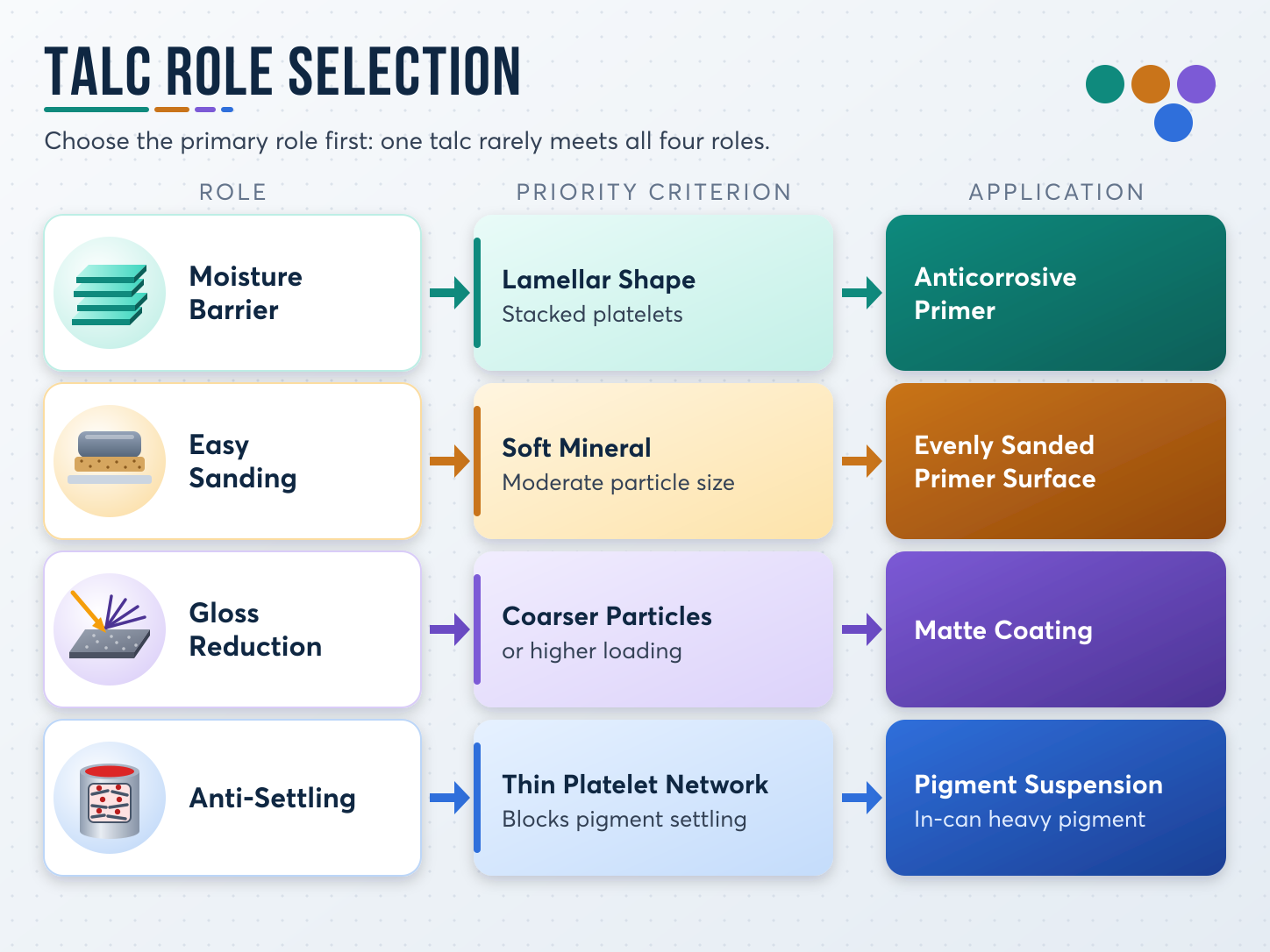
One talc grade rarely meets all four roles at once, so choose the main role first.
Step 2 — Define Color and Gloss Constraints
Light-colored or high-gloss topcoats are tightly constrained in whiteness and in the coarse end of the particle size. Primers usually tolerate both better, because the topcoat hides their color.
For UV-cured coatings, fillers change the path of UV light in the film. When testing samples, check the degree of cure, and if a defect appears, see how to fix incompletely cured UV coatings.
Step 3 — Select the Grade and Test Samples
Talc from Liaoning Xinda and Xufeng, two suppliers Vichem distributes, is used as a filler for paint. Choose by grade as follows:
- Lamellar talc for anticorrosive primers, where moisture barrier is the main requirement.
- Fine-particle, high-whiteness talc for light-colored topcoats, where gloss and color are the main requirements.
Before approval, test samples on the actual paint system with three tests: viscosity after grinding and after storage, sanding of the primer film, and salt spray for the anticorrosive coat. The sample must come from a batch with a COA so that later batches can be compared against it.
Common Mistakes When Choosing Talc Powder for Industrial Paint
The mistakes below recur at many plants and are all avoidable if the documents are read correctly:
- Choosing by price per ton: cheaper talc is often less lamellar or carries more impurities, and the cost returns in paint film repair and nozzle replacement.
- Using one talc for both primer and topcoat: the primer needs platelets and roughness, the topcoat needs fine particles and whiteness, so one grade struggles to meet both.
- Ignoring batch-to-batch variation: platelet shape, coarse end, and whiteness can drift between batches, especially when the ore changes mining area.
- Not checking the COA: without a COA, there is no way to know whether a shipment matches the approved sample.
A simple preventive measure is to check the COA of every batch against the specifications in the raw material intake standard. Any batch that deviates in particle size, whiteness, or mineral composition should be retested for viscosity and sanding before entering production. This way, batch deviation is caught in the lab, not at the customer.
FAQ on Talc Powder for Paint
How hard is talc, and how does it affect paint?
Talc is the softest mineral on the Mohs scale, at the bottom of the hardness scale. Its softness makes primer films easy to sand and reduces wear on mills and spray nozzles. In return, talc does not increase film hardness or scratch resistance; that requirement calls for hard fillers or a high-hardness resin.
Which talc property matters most for primers?
For anticorrosive primers, platelet shape matters most, because stacked platelets create a zigzag path for water vapor and improve the moisture barrier. Next is mineral purity, because carbonates reduce chemical resistance. Particle size only needs to be fine enough for an even film and rough enough for the topcoat to adhere.
How does talc differ from limestone powder (calcium carbonate) in paint?
Talc is a platelet-shaped silicate mineral that is soft and inert to acids. Calcium carbonate has blocky particles and reacts with acids. Therefore talc suits primers that need moisture barrier and chemical resistance, while calcium carbonate is more suitable for coats not exposed to acidic environments.
Does talc reduce paint gloss?
Yes, if the particles are coarse or the loading is high. Talc particles protruding from the film surface scatter light, so gloss drops; fine talc has less effect and keeps the surface flat. For topcoats that need high gloss, read the coarse end of the particle size distribution on the TDS and test on a sample panel.
Conclusion
Choosing talc powder for paint starts with defining what the talc does in that coat, and only then matching it against the TDS and COA parameters. Anticorrosive primers prioritize lamellar talc, while light-colored topcoats prioritize fine particles and high whiteness.
- Define the role of talc first: moisture barrier, easy sanding, gloss reduction, or anti-settling.
- Match the four criteria: platelet shape, softness, particle size distribution, whiteness and mineral purity.
- Read the TDS and COA of every batch, not only of the approved sample batch.
- Test samples on the actual paint system: viscosity, sanding, salt spray.
Send us your current paint system, the intended role of the talc, and your line's processing conditions so the Vichem technical team can recommend a suitable talc grade.
Vichem is a distributor of chemical additives and equipment from leading brands such as Covestro, Sinopec, TotalEnergies Corbion, Bühler and Tinox in the Vietnamese market.
For more information about our products, please contact us through the following channels:
- Hotline: 08 1790 1790
- Zalo OA: Vichem JSC
- Email: contact@vichem.vn
- LinkedIn: Vichem JSC
- Website: www.vichem.vn
- Facebook: Vichem JSC