When outdoor paint fades or chalks after one sunny season, the cause is often that the inorganic pigments for paint were chosen without regard to light and weather fastness, chemical resistance and compatibility with the resin system, and were picked from a shade card instead. Sun exposure, the chemical environment that touches the paint film and the heavy-metal requirements of export markets decide which pigment group suits your paint system.
Where outdoor paint fails when the wrong inorganic pigment is chosen
A wrongly chosen pigment usually shows its fault after a few months outdoors, when the batch has already been delivered and applied. The three groups of failure below are the most common.
Fading and color shift after sun exposure. UV and moisture gradually break down the structure of a weak pigment, so the color lightens or moves to a different tone. On the same wall, the shaded area keeps its original color while the sunlit area looks completely different.
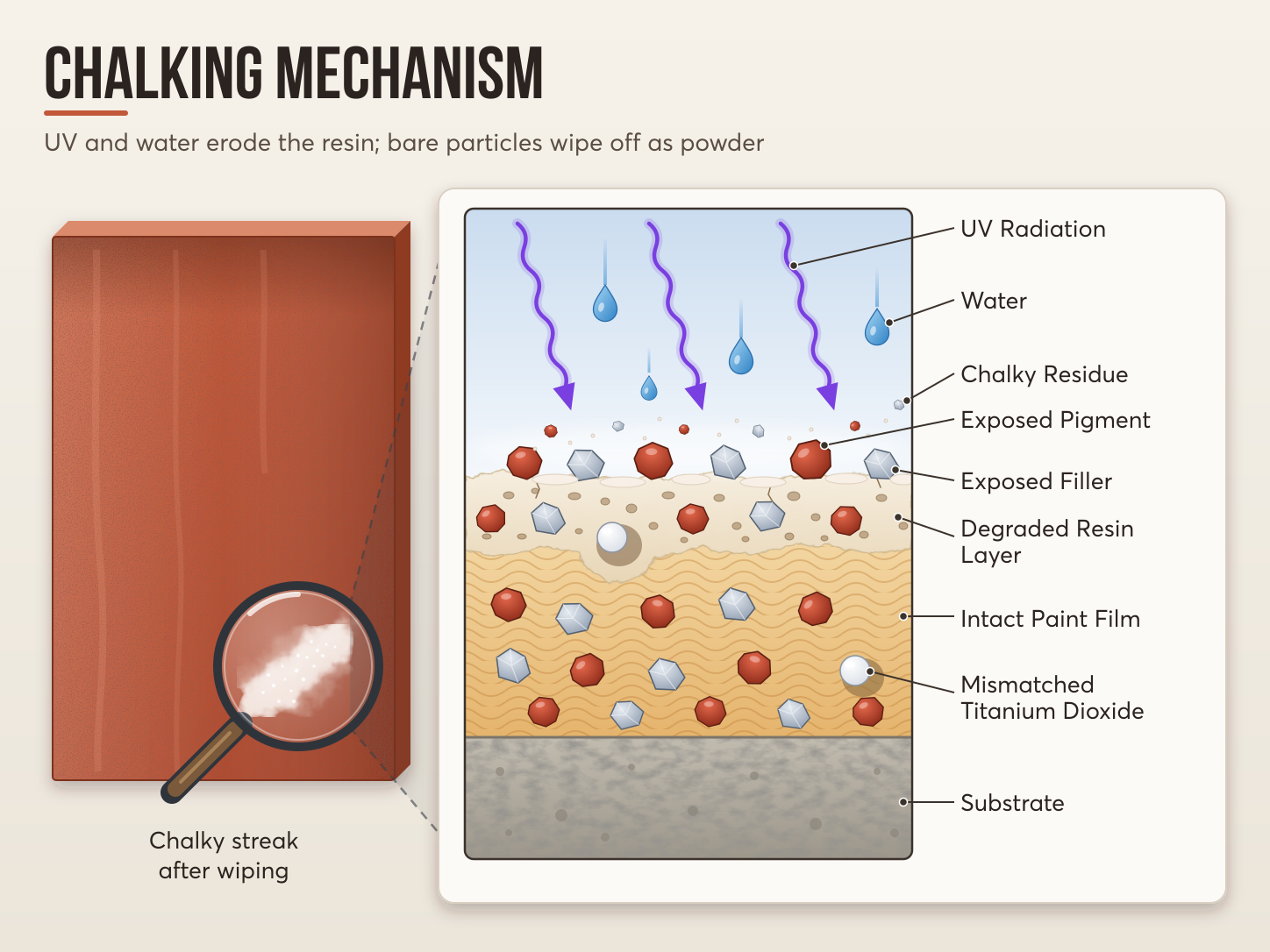
Surface chalking. Chalking is the breakdown of the topmost resin layer of the film by UV and water, which exposes pigment and filler particles and leaves a powder on the hand when the surface is wiped. Pigment or TiO₂ that is not compatible with the resin can speed this up, lightening the surface color even though the pigment itself has not faded.
Settling, color separation and flooding. Inorganic pigments have a high density, so they settle easily to the bottom of the can when dispersion and stabilization are not sufficient; the usual causes are covered in the article on 5 pigment dispersion defects in paint and how to fix them. When combined with TiO₂, the color particles and TiO₂ particles move differently in the wet film, causing flooding: the surface color differs from the color in the can and shows up as streaks.
Export rejection. Traditional inorganic pigments based on lead, chromium or cadmium leave heavy metals in the paint film. A batch found to exceed the requirements of the destination market can be returned, and this problem can only be solved at the raw-material selection stage.
4 criteria for choosing inorganic pigments for outdoor paint
Light and weather fastness
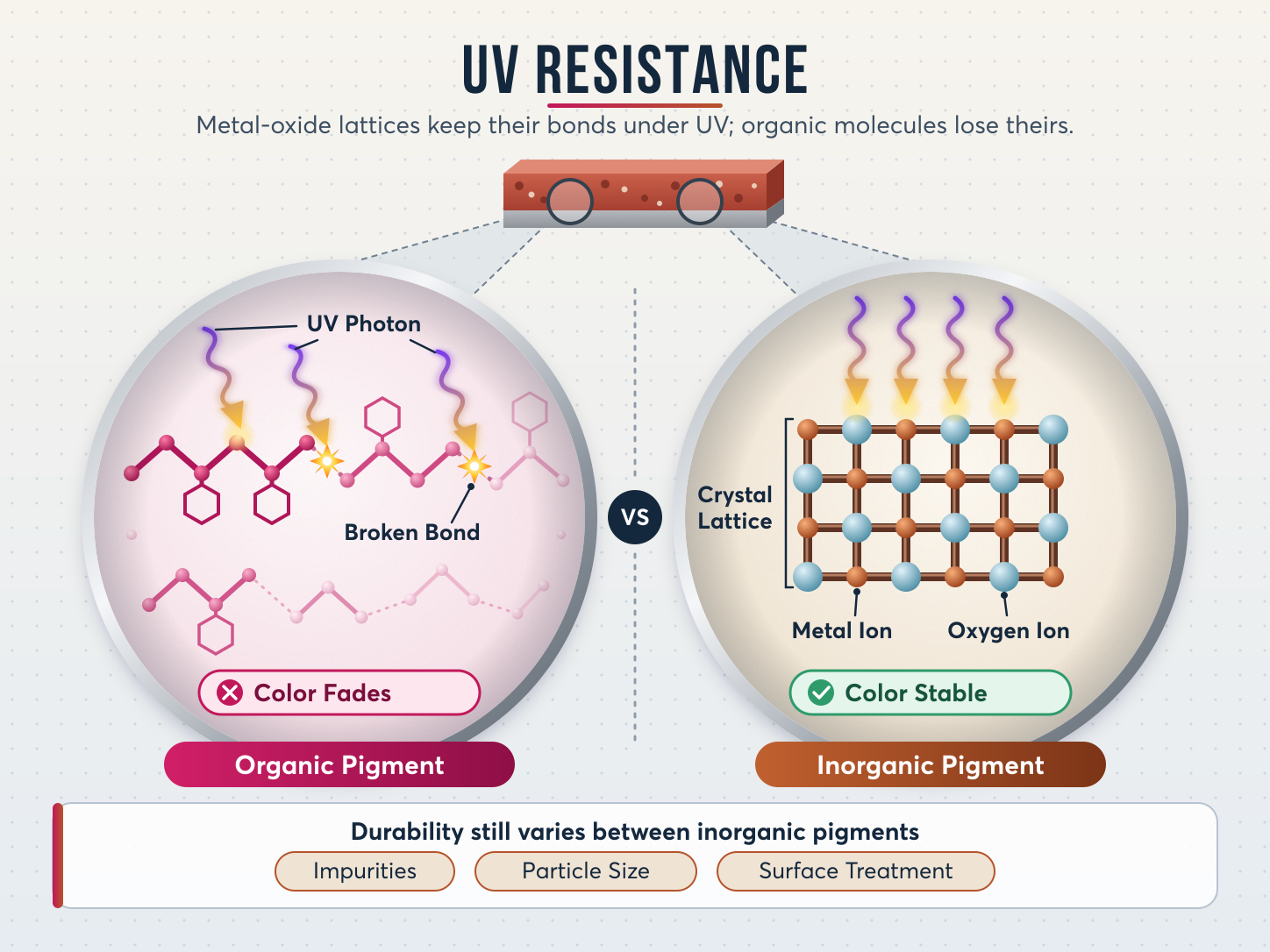
The crystal structure of metal oxides resists UV better than organic molecules, so weather-resistant pigments in the inorganic group hold their color longer outdoors. UV photons carry enough energy to break bonds in organic color molecules, while in an oxide crystal lattice the metal and oxygen ions are bonded more tightly, so the color changes less. Durability still varies among inorganic pigments, because impurities, particle size and surface treatment all have an effect.
On the TDS, read the lightfastness rating and the weather fastness rating of each grade. Pay attention to the test conditions that come with them: whether the test was run in a full-shade or a tint with white, and in which resin. A tint reduced with TiO₂ is usually less durable than a full shade, so a result from another resin system or another shade cannot stand in for your own paint system.
Heat and chemical resistance
Outdoor paint films meet three stresses: alkali from cement substrates, acid from rain and polluted air, and heat during stoving. Some inorganic pigments dissolve or change color in acid or alkali, and others change structure under stoving heat. The result is paint on a cement wall that stains from the substrate side, or a stoved batch that comes out a different color from the approved sample.
On the TDS, look for the alkali and acid resistance rating and the heat resistance rating of each grade. Compare the heat resistance rating with the actual stoving temperature and time of your line, not with a general value for the pigment group.
Dispersion and oil absorption
Oil absorption is the amount of liquid that a given mass of pigment needs to wet the whole particle surface and form a paste; it reflects the surface area and porosity of the particles. The finer the particle, the larger the surface area, and the more resin and solvent the particles need to wet out, so the viscosity of the color paste rises and the grinding energy is higher.
Surface treatment helps particles wet out more easily in the resin, which gives better gloss in the paint film; coarse particles left in the film reduce gloss. When particles do not separate well, you will see the defects described in the article on poorly dispersed pigments in industrial paint and how to fix them. Read the oil absorption and particle size values on the TDS, then compare them with the grinding capacity of the equipment you use.
Heavy metal content
Some traditional inorganic pigments contain lead, chromium or cadmium, so a pigment must be assessed on composition before it is assessed on color. This information is in the SDS and in the compliance documents that the supplier issues for each grade. Check it against the regulations of the destination market where the paint will be sold, because each market and each brand has its own requirements.
Do this check before sample trials, so you do not spend time on weathering trials of a pigment that will be rejected at the compliance stage.
How to match inorganic pigments to your plant's outdoor paint requirements
Step 1 — Define the exposure conditions
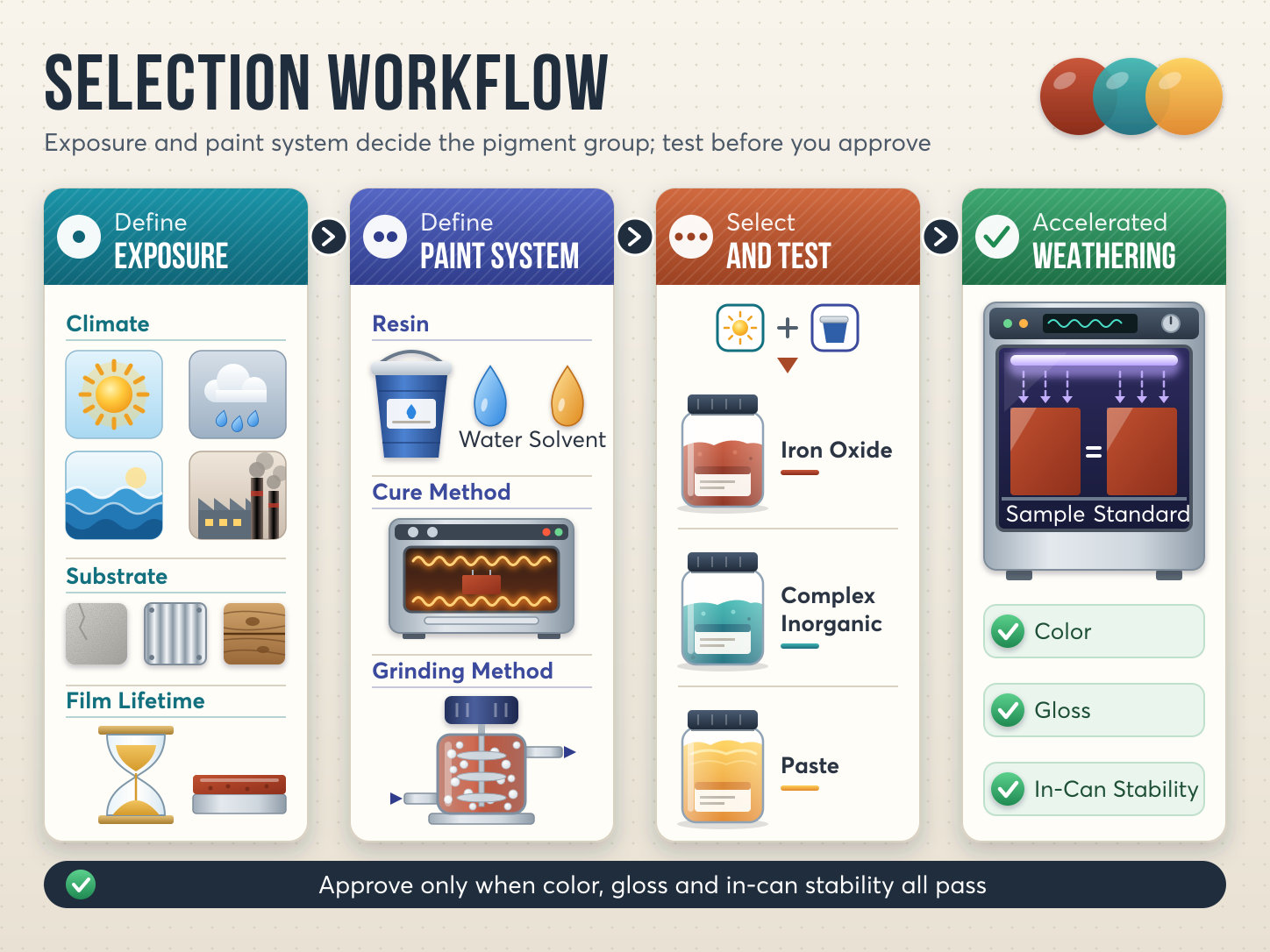
Record three things: the climate region where the paint is used (strong sun, heavy rain, coastal or industrial area), the substrate (cement, metal, wood) and the paint film lifetime that the customer requires. These three inputs set how much weather and chemical resistance you need from the pigment.
Step 2 — Define the paint system and process
List the resin type, whether the system is waterborne or solventborne, stoved or air-dried, and the grinding method in use. A waterborne system needs a pigment that wets out well in water and is stable with the dispersant; a stoving system needs a pigment that withstands oven heat. The grinding method determines whether you need a dry powder pigment or a pre-dispersed form, as discussed in the article on how to choose a pigment grinding method for industrial paint.
Step 3 — Select the pigment group and test samples
From the first two steps, choose the suitable pigment group, from iron oxide pigments to complex inorganic pigments. Vichem distributes pigments from Hangzhou Zealan Chemical in the following groups:
- Iron oxide pigments: for red, yellow, brown and black tones, durable outdoors and economical when the color does not need to be very bright.
- Complex inorganic pigments (CICP): a mix of several metal oxides calcined into one stable crystal structure; use them when you need brighter color, high durability and no lead.
- Pigment pastes: pigment already dispersed in a liquid medium, suitable when you want to cut the grinding step on the line.
Before approval, run an accelerated weathering test on a paint sample made with the plant's own resin system and TiO₂, and compare it with the standard in use. Approve only when the sample passes on color, gloss and in-can stability.
Common mistakes when choosing inorganic pigments for outdoor paint
Judging color on an indoor shade card. A color that looks good under lab lighting says nothing about outdoor durability. The shade card gives the hue, while weather fastness has to be read on the TDS and verified by exposure testing.
Substituting organic pigments to get a brighter color. Organic pigments give brighter color, but their molecules are easily broken by UV, so outdoor paint usually fades after a period of sun exposure. If you need a bright and durable color, complex inorganic pigments are the first direction worth considering.
Ignoring heavy metals. Choosing a pigment by color and price without reading the SDS can lead to a paint batch being rejected in an export market after the whole batch has been produced.
Not testing with the actual TiO₂ and resin. A pigment tested alone or in a standard resin can give a good result, but when combined with the plant's TiO₂ and resin system it floods, separates or changes gloss. The test must use the exact formulation that will be produced.
FAQ on inorganic pigments for paint
How do inorganic pigments differ from organic pigments outdoors?
Inorganic pigments are metal oxide or salt crystals, more resistant to UV, heat and chemicals, so they hold their color outdoors, but the color is usually more muted and the hiding power higher. Organic pigments give bright, vivid color, but their molecules are easily damaged by UV, so they tend to fade after a period of sun exposure.
What are complex inorganic pigments, and are they more expensive?
Complex inorganic pigments (CICP) are pigments made from several metal oxides calcined at high temperature into one stable crystal structure, giving brighter color than iron oxide and high weather resistance. The price is usually higher than iron oxide; the exact price depends on the grade and the supplier, so a quotation is needed for each grade.
Do inorganic pigments contain heavy metals?
Some do: traditional inorganic pigments based on lead, chromium or cadmium contain heavy metals, while iron oxide and lead-free complex pigments do not use these metals as main components. Check the composition on the SDS and the compliance documents of each grade, and compare with the regulations of the destination market.
Which way is the inorganic pigment market moving?
In principle, the shift is away from pigments containing lead and other heavy metals, toward lead-free pigments with high weather resistance. The drivers are the environmental and safety requirements of export markets, together with the need for outdoor paint films to hold their color longer. Plants should consider this direction when choosing a source.
Conclusion
Choosing inorganic pigments for outdoor paint starts from the exposure conditions of the product, and only then from color. The four criteria, which are light and weather fastness, heat and chemical resistance, dispersion and oil absorption, and heavy metals, need to be read on the TDS and SDS of each grade and verified by exposure testing on the real paint system.
- Choose by exposure conditions: climate region, substrate, required paint film lifetime.
- Weigh the four criteria: light and weather fastness, heat and chemical resistance, dispersion and oil absorption, heavy metals.
- Read the TDS and SDS of each grade, and note the test conditions that come with each rating.
- Run accelerated weathering and combine the pigment with the actual TiO₂ and resin before approval.
Send us your plant's exposure conditions, paint system and grinding process, and the Vichem technical team will propose a suitable pigment group and support sample trials.
Vichem is a distributor of chemical additives and equipment from leading brands such as Covestro, Sinopec, TotalEnergies Corbion, Bühler and Tinox in the Vietnamese market.
For more information about our products, please contact us through the following channels:
- Hotline: 08 1790 1790
- Zalo OA: Vichem JSC
- Email: contact@vichem.vn
- LinkedIn: Vichem JSC
- Website: www.vichem.vn
- Facebook: Vichem JSC