
When a paint film turns cloudy, shows orange peel or stays soft after baking, the cause often lies in the paint thinner composition. It determines whether the resin stays fully dissolved and in what order the solvents leave the film, so it directly controls gloss, leveling and film defects. Check the solvency of the solvents toward the resin and the solvent evaporation rate of the whole blend, not just price or odor.
Technical problems when thinning industrial paint with solvents
A thinner for industrial paint is a blend of several solvents, not a single chemical, and each component has its own job. Reducing viscosity for spraying is only the first. From the moment the paint leaves the spray gun until the film dries, the blend must keep the resin dissolved, leave the wet film enough time to flow and level, and only then leave the film in the right order.
When the thinner does not match the paint system, production lines commonly see these defects:
- Cloudy or milky film: the resin starts to precipitate when the strong solvent evaporates too early.
- Orange peel and poor leveling: the wet film loses solvent too fast to level out.
- Sagging: too much slow-evaporating fraction, or the film is sprayed too thick.
- Pinholes: solvent trapped under a skinned-over surface escapes and bursts into small holes.
- Soft film, slow hardening: the slow evaporation tail keeps solvent in the film.
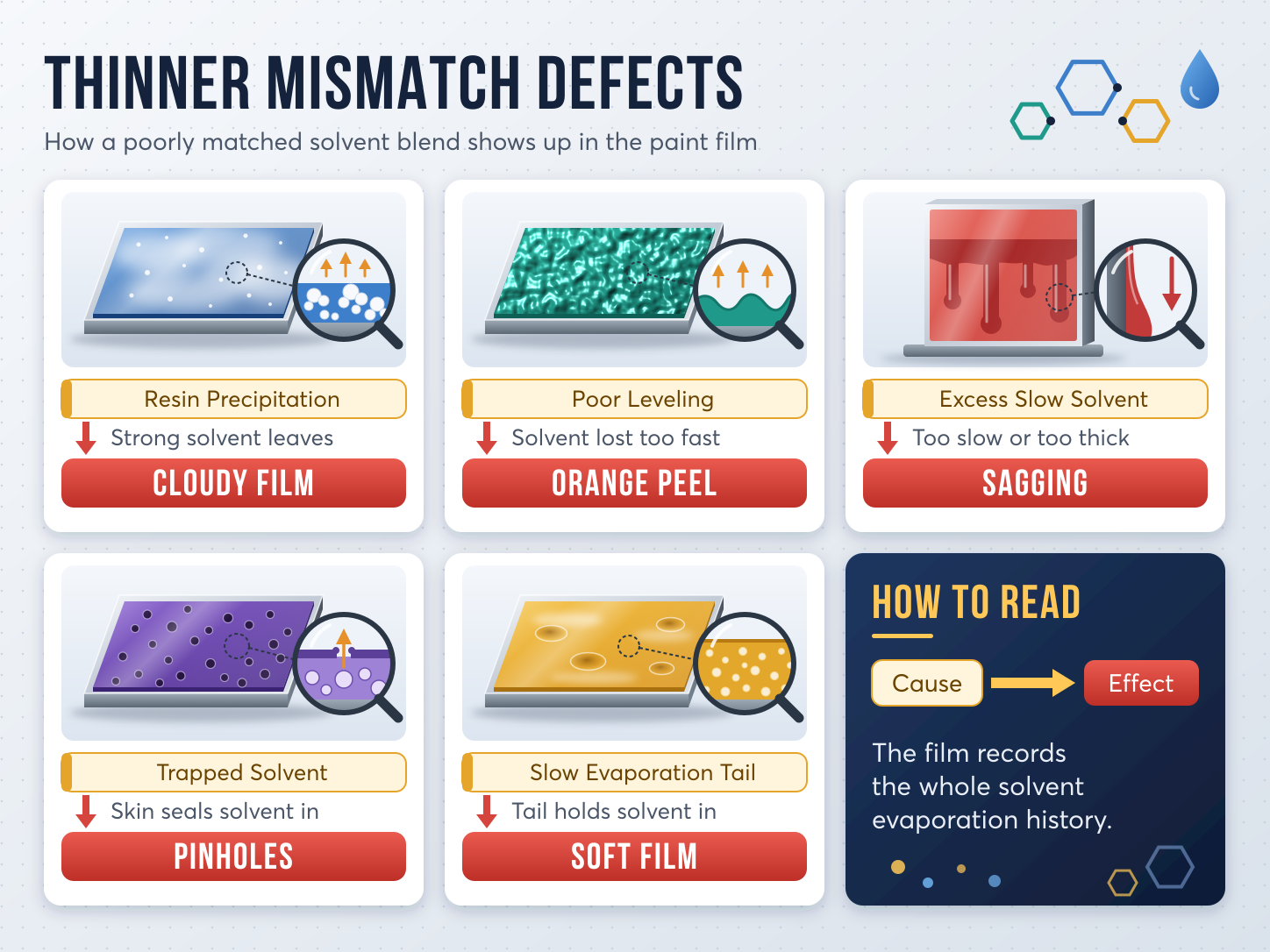
Each defect has its own way of being identified and corrected, covered in detail in the article on paint film defects caused by wrong paint thinner mixing and how to fix them.
Two thinners that give the same viscosity after mixing can still produce two different films, because viscosity only reflects the starting point. The same viscosity can be reached with a strong, fast-evaporating solvent or a weak, slow-evaporating one. After spraying, the two blends lose solvent along two different paths, so they differ in how well the resin stays dissolved at each moment and in how long the wet film can keep flowing. The paint film records that entire history.
How paint thinner composition works in the paint film
Solvency. A resin dissolves well when the polarity and interaction forces of the solvent are close to those of the resin. The solubility parameter quantifies the principle of "like dissolves like": each resin and each solvent has a set of values covering dispersion forces, polar forces and hydrogen bonding, and the closer they are, the better the resin dissolves. With a multi-component thinner, what matters is that the remaining blend stays within the resin's solubility region at every point of evaporation, not only when freshly mixed.
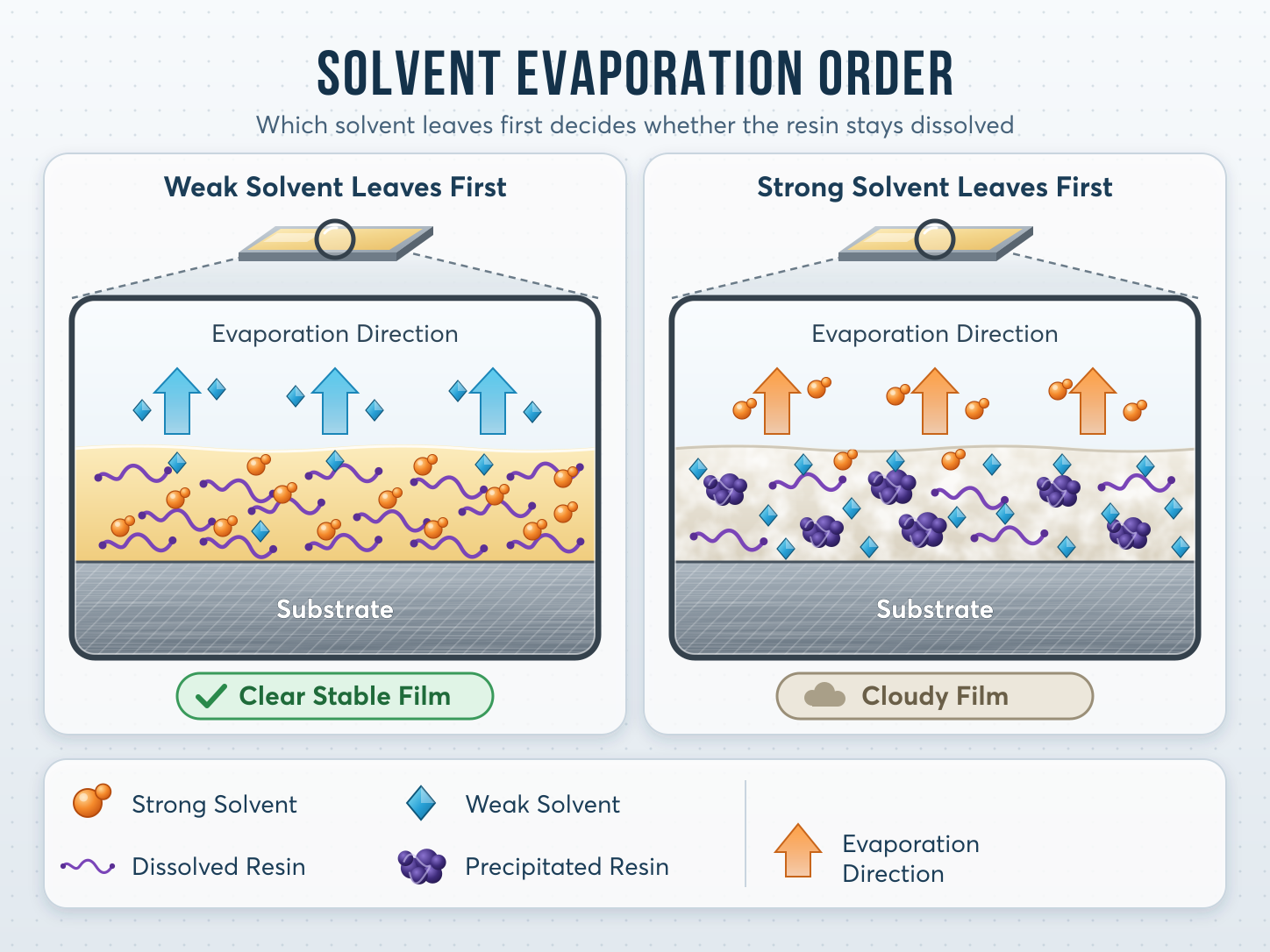
Evaporation order determines this. If the weak solvent evaporates first and the strong solvent stays behind, the last liquid in the film still keeps the resin dissolved and the film is stable. Conversely, when the strong solvent evaporates first, what remains is weak solvent, the resin partly precipitates and the film turns cloudy, even though the paint was clear when mixed. The trade-off is cost: weak solvent is added to balance price, but each resin system tolerates only a certain level of weak solvent before it becomes unstable.
Evaporation rate by stage. A paint film dries through three stages: while the paint is airborne, while it lies wet on the surface, and during film formation. The fast-evaporating fraction helps the paint adhere to the surface and raises viscosity early, so it provides sag resistance on vertical surfaces. The slow-evaporating fraction keeps the wet film open long enough for the paint to level and for bubbles to escape, giving a smooth, glossy film. These two goals pull in opposite directions: adding fast fraction improves sag resistance but risks orange peel, while adding slow fraction improves smoothness but risks sagging and retained solvent. Solvent evaporation rate must be read from the curve of the whole blend, not from each solvent individually.
The slow fraction is subject to another limit. A tail that is too long leaves solvent in the film after the paint has cured or been baked, so the film is soft, marks easily and can blister when heated.
Reactive functional groups. In 2K isocyanate systems, solvents also take part in the reaction. Water and alcohols containing OH groups react with isocyanate. Water consumes the hardener and releases CO₂ gas, which generates bubbles in the film. Alcohols bond to the isocyanate and upset the cure ratio, leaving the crosslinked network incomplete and reducing film hardness. For this reason, the moisture content and free OH groups of the thinner are mandatory checks for this system.
Factors that determine how well a paint thinner performs
Resin type in the paint. Each resin system has its own polarity, so changing the resin system means re-determining the ratio between solvent groups. A thinner that runs well with one resin can make another resin cloudy. Selection for each system is covered in the article on choosing solvents to suit each paint resin type.
Spray booth temperature and humidity. A hot booth removes the fast fraction earlier than planned, and the wet film skins over before it can level. High humidity cools the wet film surface as solvent evaporates, water vapor condenses into the film and causes blushing. It is common for the same thinner to give different results in the rainy and dry seasons.
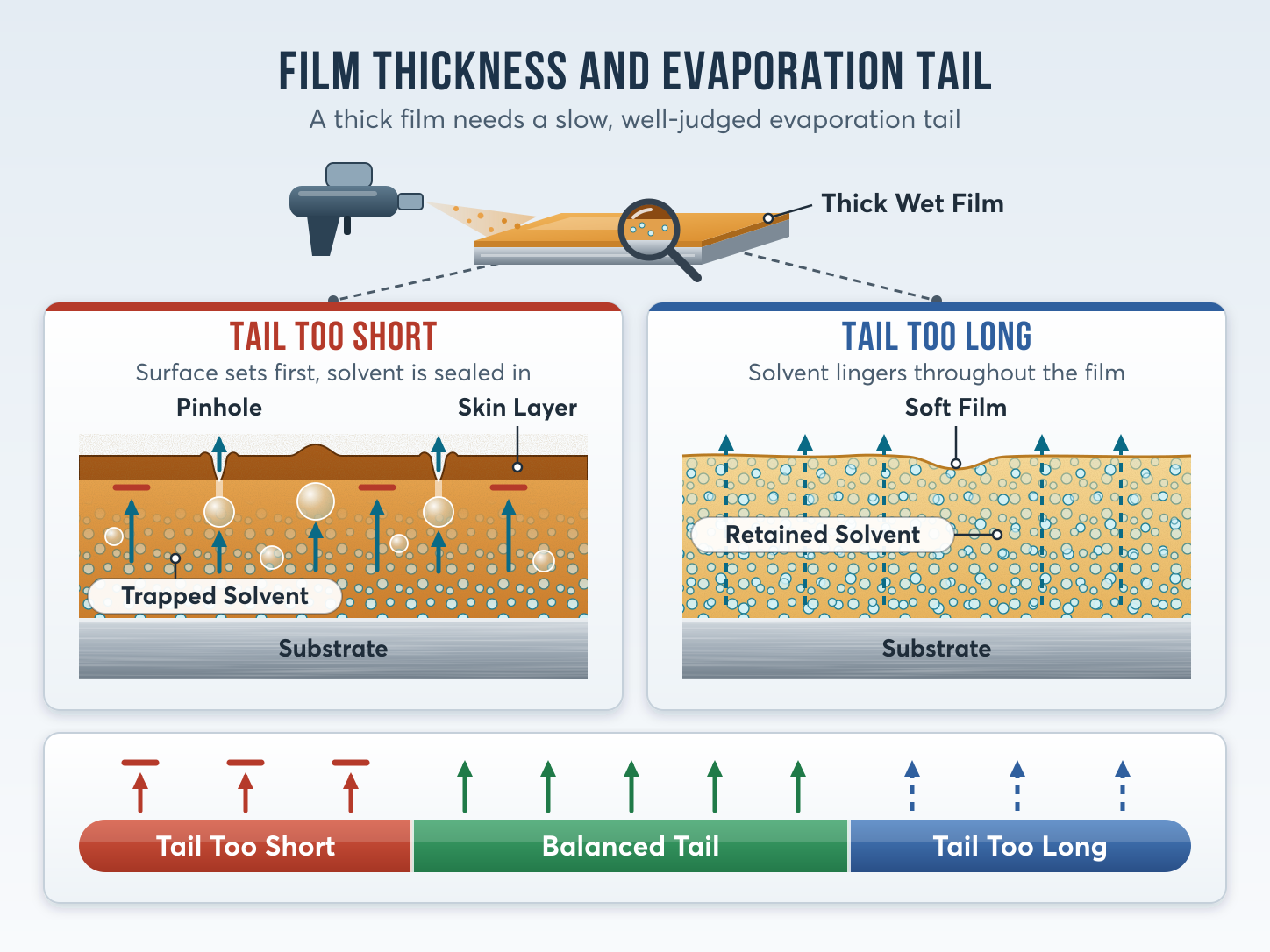
Film thickness and application method. Air spray, electrostatic spray and dipping give wet films with different thicknesses and evaporation times. A thick film needs a slow evaporation tail at a reasonable level: too short, and solvent is trapped under the skinned-over surface and causes pinholes; too long, and the film retains solvent and stays soft. Electrostatic spray also requires a blend with suitable conductivity, information that equipment suppliers and paint suppliers usually have available.
Purity, moisture content and impurities. Chemicals with the same name but from different lots can differ in purity, moisture content and impurities. These parameters should be read from the TDS and COA of each lot, especially moisture content when used in 2K isocyanate systems. Impurities containing OH groups, or slow-evaporating residues, also shift the evaporation curve away from the original trial results. Thinner selection by resin system should also be checked against the guidance in the article on paint thinners for industrial paint by resin system.
When to adjust paint thinner composition and when not to
Adjust it when the season changes, the resin system changes, or the spray line moves to a different application method, because all three change the evaporation curve the wet film needs. Each chemical group in a paint thinner has a role:
- Aromatic and aliphatic solvents: dissolve the resin at a moderate level and balance cost; aliphatics are weaker, so the resin's tolerance limit needs to be checked.
- Esters and ketones: strong solvency, medium to fast evaporation, used to keep the resin dissolved and to adjust the front end of the curve.
- Glycol ethers and glycol ether esters: the slow-evaporating tail, extending leveling time and improving film smoothness.
Vichem distributes solvents from Maxone Asia, including slow-evaporating solvents for industrial paint. When the evaporation tail needs adjusting, we suggest sending your resin system and spray conditions so the composition can be checked before a trial batch.
Do not use a cheap thinner of unknown composition for 2K systems, because uncontrolled moisture and OH groups will consume the hardener. Do not add OH-containing solvents to isocyanate paint on your own. And do not adjust the thinner to mask a root-cause defect: if cloudiness, bubbles or poor adhesion come from the resin, an untreated surface or the hardener, changing the thinner only hides the symptom for a few batches before the defect returns.
FAQ about the chemicals in paint thinner
What chemicals does paint thinner contain?
Paint thinner is a blend of groups such as aromatic solvents, aliphatic solvents, esters, ketones, glycol ethers and glycol ether esters. The ratio between groups changes with the resin system and application method. The specific composition of each thinner should be disclosed by the supplier on the TDS.
Can one thinner be used for every type of paint?
No, because each resin system has its own polarity and its own evaporation requirements. A thinner that suits one resin can make another resin precipitate or turn the film cloudy. 2K isocyanate paint in particular requires a thinner free of water and free OH groups, which a general-purpose thinner rarely meets.
Why does paint turn cloudy or milky after thinning?
The most common cause is a strongly dissolving solvent evaporating first and precipitating the resin, or water vapor condensing into the wet film when the booth is humid. Check the compatibility of the thinner with the resin, the booth humidity and the moisture content of the thinner on the COA of each lot.
Does paint thinner affect the gloss of the paint film?
Yes. Gloss depends on whether the wet film has enough time to level before film formation, and on whether the resin is still dissolved in the final stage. A reasonable slow fraction gives a smooth, glossy film, while solvent that evaporates too fast leaves orange peel and a dull film.
Conclusion
Paint film quality depends on the solvents keeping the resin dissolved and leaving the film in the right order, so a thinner that only reduces viscosity is not enough. The whole blend needs to be assessed against the actual application conditions of the line.
- A thinner is a blend, and each solvent group has its own role in dissolving and evaporation.
- Solvency and evaporation rate must be balanced: sag resistance is traded against smoothness and gloss.
- Adjust the composition to the resin system, booth temperature, booth humidity and film thickness.
- Check the TDS and COA of each lot, especially moisture content for 2K isocyanate systems.
Send your resin system, spray method and photos of the film defects so the Vichem technical team can work with you to match the solvent composition to your line.
Vichem is a distributor of chemical additives and equipment from leading brands such as Covestro, Sinopec, TotalEnergies Corbion, Bühler and Tinox in the Vietnamese market.
For more information about our products, please contact us through the following channels:
- Hotline: 08 1790 1790
- Zalo OA: Vichem JSC
- Email: contact@vichem.vn
- LinkedIn: Vichem JSC
- Website: www.vichem.vn
- Facebook: Vichem JSC