When ethanol-based flexo ink dries slowly on the press, the cause is usually a flexo ink solvent blend with too much slow-evaporating content, ethanol contaminated with water, or a dryer and press speed that cannot keep up. Slow-drying flexo ink is easy to confuse with retained solvent in ink, so confirm which defect you have first. Before you change the ink, check the ethanol water content, the retarder solvent ratio, and the dryer temperature and airflow. These three factors decide whether the ink is still wet or already dry when the web leaves the press.
Slow drying and retained solvent in ink are two different defects
These two defects, slow drying and retained solvent in the ink, are often lumped together because both leave a problem roll after the dryer. But the solvent sits in a different place in each, and the fix is different.
Slow drying: the ink is still wet when the printed film leaves the dryer. On the line, you see ink transfer to guide rollers, smearing at contact points, and ink offsetting onto the back of the adjacent film layer at rewind. The defect shows up at the press, within the first few minutes of running.
Retained solvent: the surface is dry and not tacky, but solvent is trapped under the ink film. "Retained solvent" is the amount of solvent left in the ink film and substrate after drying that has not yet escaped. This defect usually appears later: the roll has a strong solvent odor when opened, or the ink and laminating adhesive show poor bonding and delamination during lamination.
Why the distinction matters: the two defects call for opposite fixes. Slow drying needs faster evaporation: reduce the slow-evaporating solvent, raise the drying input, or run slower. With retained solvent, stronger drying can make the surface skin over too early and trap the solvent underneath, which makes the defect worse.
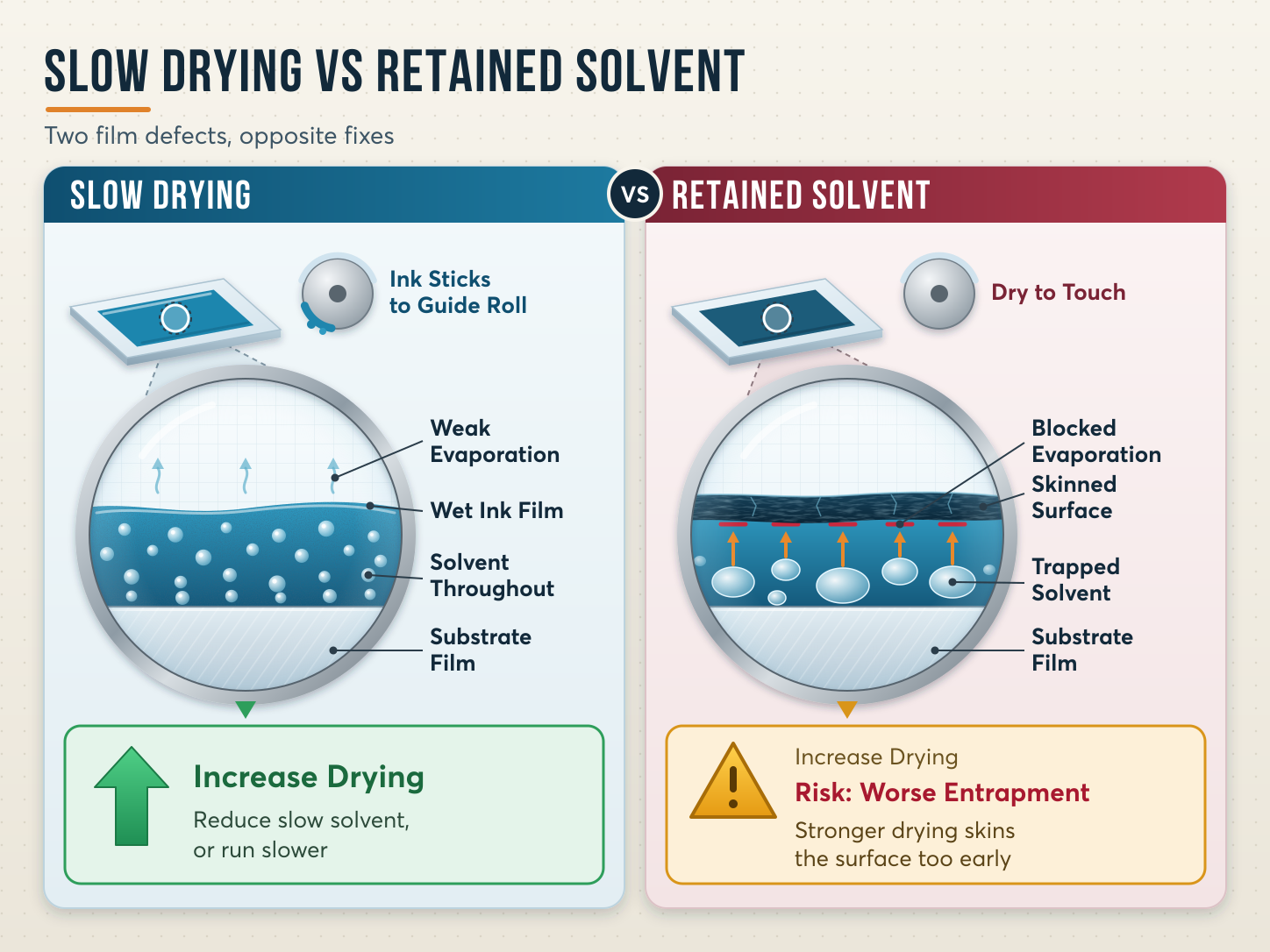
A roll that is still tacky when it comes off the press is slow drying. A roll that is dry but smells strongly after a few hours in storage has retained solvent. If you confuse the two, you adjust the wrong variable: treating retained solvent as slow drying leads you to raise the heat, while treating slow drying as retained solvent leads you to overlook the solvent blend and the dryer as the cause.
Why ethanol-based flexo ink dries slowly on the press
Ethanol in packaging ink is a fast-evaporating organic solvent, so clean ethanol is rarely the cause of slow drying. The defect appears when the solvent blend contains components that extend evaporation time, or when press conditions do not let the solvent escape in time inside the dryer. Three groups of mechanisms need to be considered.
Ethanol contaminated with water. Ethanol absorbs moisture from the air, so drums left open, poorly sealed storage, or an uncontrolled alcohol source all raise the water content. Water evaporates more slowly than ethanol and needs more heat to change to vapor. Late in drying, the solvent left in the ink film is richer in water, so water slows the whole ink film even when the initial amount is small. The composition of the solvent blend sets the overall evaporation rate, as the article on how the chemical composition of thinner determines paint film quality explains for coatings in general.
Too much retarder solvent. To keep ink from drying on the anilox roll and plate during the run, operators often add retarder solvent. This solvent evaporates slowly, so each addition extends the evaporation tail of the blend. The ink does not dry on the roll, but it also does not dry in time in the dryer, and what remains can be trapped in the film as retained solvent.
Press conditions and substrate. Ink dries when solvent leaves the film during the time the film spends in the dryer. Low dryer temperature, airflow too weak to carry solvent vapor away, or a short dwell time because the press runs fast will all let the ink leave the dryer still wet. Non-porous films such as OPP and PET do not absorb solvent into the substrate the way paper does, so all of the solvent must escape through the ink surface. A thick ink layer, common with dark colors or high-volume anilox rolls, lengthens that escape path. Ink layer thickness therefore affects drying time as much as the solvent does.
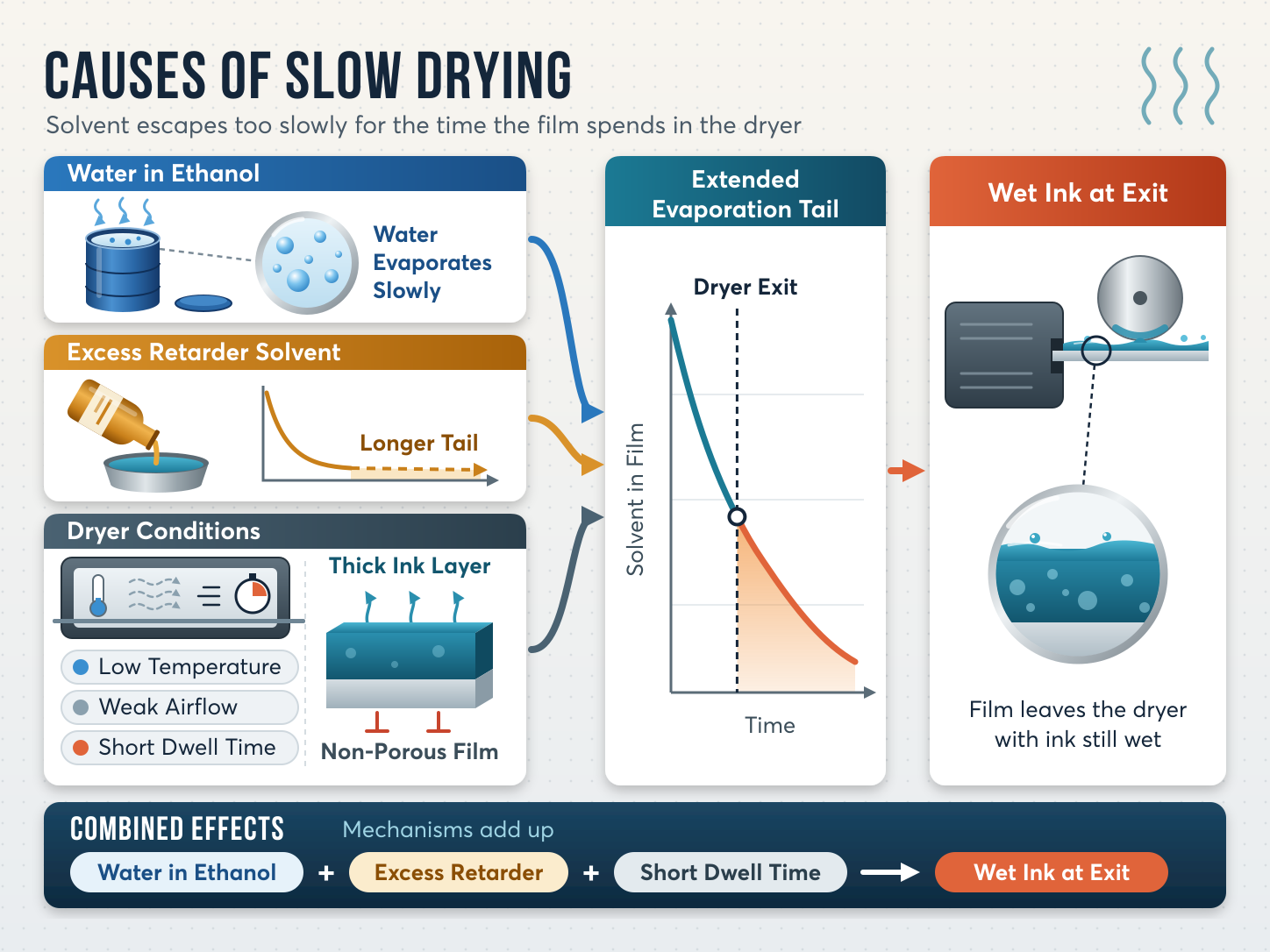
These mechanisms add up. A batch of ethanol with high water content, retarder solvent added because the roll is drying, and a fast run on a humid day is the combination most often seen on packaging print lines.
How to identify the cause of slow-drying ethanol-based flexo ink in your plant
Two steps show whether the cause lies in the solvent blend, the press, or the ink layer: a comparison test and a check of the signs on the line.
A test you can run yourself
You need an ink drawdown bar and a film of the same type as the job currently running.
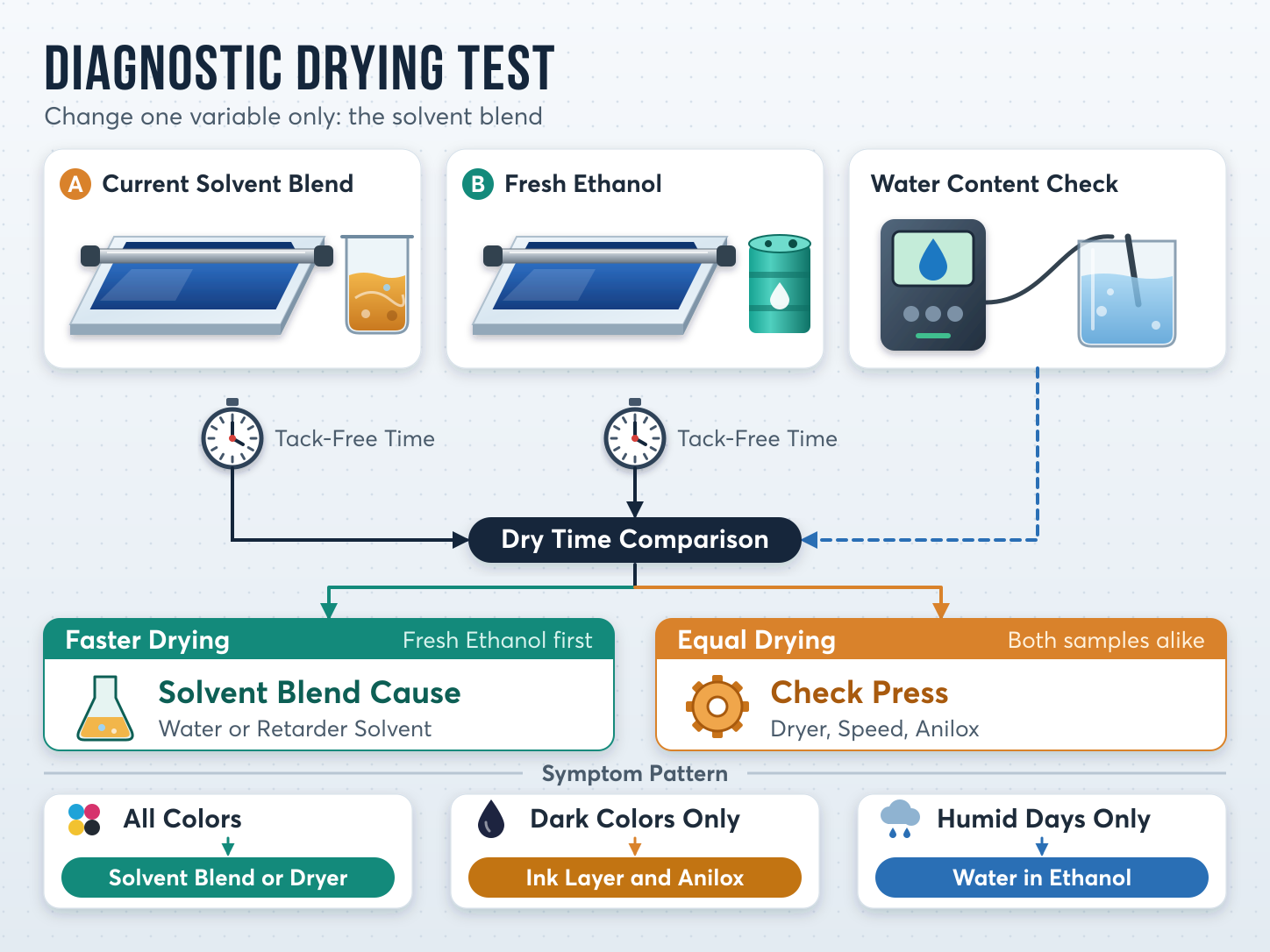
- Take ink from the drum running on the press, thin it with the solvent blend currently in use, and draw down a sample on the film with the drawdown bar.
- Take the same base ink, thin it with only fresh ethanol from a sealed drum, with the water content stated on the COA, and draw down a sample with the same bar on the same film.
- Let both samples dry under identical conditions and record the time until each is tack-free.
- Check the water content of the ethanol in use against the lot COA, or measure it in the plant with the method your QC lab already applies.
If the sample thinned with fresh ethanol dries clearly faster, the cause lies in the solvent blend: water contamination or retarder solvent. If both samples dry at about the same rate, move on to the press: dryer, speed, and anilox. When comparing samples, change only one variable, the solvent blend. A wrong thinning ratio also causes film defects, as the article on film defects from wrong thinner dilution and how to fix them describes.
Signs that tell the causes apart
- Slow drying in all colors: suspect the solvent blend or the dryer, since all colors share the same solvent system and the same drying conditions.
- Only dark colors, thick ink layer: suspect ink layer thickness and the anilox, since solvent must escape through a thicker ink layer.
- Only on humid days: suspect water getting into the ethanol, through the container or the alcohol source.
When several signs overlap, work in this order: solvent blend first, press second, because the solvent is easier to change and easier to verify.
How to fix slow-drying ethanol-based flexo ink
Deal with the solvent blend first, then adjust the press, and change one variable at a time so you know which one worked.
Flexo ink solvent side
- Use low-water ethanol, check the COA of every lot, and close the drum right after drawing from it. Do not leave an open drum next to the press.
- Reduce the glycol ether retarder to the level that just keeps the ink from drying on the roll, following the ink manufacturer's recommendation. This level varies with ink system, anilox, and press speed, so there is no single ratio.
- Consider blending in an ester that evaporates faster than glycol ether, such as ethyl acetate or n-propyl acetate, only if the ink manufacturer allows it and at the ratio they recommend. Esters change resin solubility, odor, and plate compatibility, so test a sample before running. The principle of choosing a solvent by the ink's resin system is covered in the article on how to choose a thinner by resin system.
This group of solvents is part of the solvent range Vichem distributes, supplied by Maxone Asia, with COA, SDS, and TDS for each lot. Water content and purity for each grade are stated in the lot COA and TDS.
Press side
- Raise dryer temperature and airflow, within what the substrate film can tolerate. OPP and PET shrink or distort when overheated, so follow the film's temperature limit.
- Lower the press speed to increase the film's dwell time in the dryer.
- Reduce ink layer thickness by choosing a suitable anilox, especially for dark colors, and recheck ink viscosity against the ink manufacturer's recommendation.
Risk: excessive drying causes drying-in on the roll. Hot air blowing onto the roll and plate area dries the ink right there, clogs the anilox cells, and loses print detail. Increase in steps and watch both the ink surface and the roll. If you suspect the defect is retained solvent rather than slow drying, do not simply raise the heat, because a film that skins over too early will trap solvent underneath.
Frequently asked questions about ethanol-based flexo ink
Is ethanol an organic solvent?
Yes, ethanol is an organic solvent in the alcohol group. Its molecule has a hydroxyl group, so ethanol dissolves many resins used in printing inks and mixes with water. This property explains why ethanol absorbs moisture from the air, and why water content must be controlled when thinning flexo ink.
Why does slow-drying flexo ink get worse in the rainy season?
Because high air humidity makes ethanol absorb more water. Water in the solvent evaporates more slowly than ethanol, so the ink film stays wet longer through the dryer. A drum of ethanol left open for a long time in the plant makes this worse, so check the ethanol water content when the defect appears only on humid days.
Can ethyl acetate replace ethanol to make ink dry faster?
It can be blended in or substituted, but you should not decide this on your own. Ethyl acetate is a fast-evaporating ester, so it can shorten drying time. However, the ink's resin system, viscosity, odor, and plate compatibility are designed for a specific solvent system, so follow the ink manufacturer's recommendation and test a sample.
Can I use industrial alcohol that contains water as ethanol in packaging ink?
No. Water in the alcohol extends the evaporation tail, makes the ink dry slowly, and makes it prone to offsetting at rewind. Water can also shift the viscosity and resin solubility of a solvent-based ink. Use ethanol with the water content clearly stated on the COA and check it against the ink manufacturer's requirements.
Conclusion
Slow drying in ethanol-based flexo ink usually comes from the water content of the ethanol, the retarder solvent in the thinning blend, or the dryer conditions. The first step is to determine whether the defect is slow drying or retained solvent, because the two call for opposite fixes. Then deal with the solvent blend first and the press second, and change one variable at a time so you know which one worked.
- Distinguish slow drying (ink still wet after the dryer) from retained solvent (dry surface, solvent trapped under the film).
- Check ethanol water content against the COA of each lot and keep drums sealed.
- Rebalance the retarder solvent following the ink manufacturer's recommendation.
- Adjust dryer temperature and airflow, press speed, and ink layer thickness, and avoid excessive drying that dries the ink on the roll.
Send us your ink sample, the thinner solvent you use, and your running conditions, and the Vichem technical team will help you check the cause.
Vichem is a distributor of chemical additives and equipment from leading brands such as Covestro, Sinopec, TotalEnergies Corbion, Bühler and Tinox in the Vietnamese market.
For more information about our products, please contact us through the following channels:
- Hotline: 08 1790 1790
- Zalo OA: Vichem JSC
- Email: contact@vichem.vn
- LinkedIn: Vichem JSC
- Website: www.vichem.vn
- Facebook: Vichem JSC