When a paint film sags, shows orange peel or turns milky, the cause is usually paint thinner mixing errors. They produce 5 paint film defects: sagging, orange peel, blushing, solvent popping or pinholes, and curdling or layer separation. These defects trace back to 4 causes: wrong mixing ratio, solvent that evaporates too fast, solvent that evaporates too slowly, and solvent that is incompatible with the resin. Check the mixing ratio, the viscosity after thinning, and the temperature and humidity of the spray booth.
What Are Paint Thinner Mixing Errors and How Do They Affect the Paint Film
Thinner lowers the viscosity of paint so it can be sprayed or rolled, then evaporates in sequence so the film has time to level before it dries. On the line, the viscosity after thinning decides whether the spray pattern is fine or coarse, and the evaporation rate decides whether the film has enough time to flow out flat. Evaporation rate is how fast or slow a solvent leaves the wet film, usually expressed relative to a reference solvent; this value is published in the TDS of each solvent.
Paint thinner mixing errors fall into three situations:
- Wrong quantity: too much or too little compared with the paint's TDS instructions.
- Wrong evaporation speed for the booth conditions, for example a fast solvent in a hot booth, or a slow solvent when parts go into the oven early.
- A solvent that cannot dissolve the resin of the paint system in use.
The consequences show up immediately on the line: parts must be repainted, the reject rate rises, and the film loses gloss and adhesion. Every repaint means sanding, cleaning and extra space on the hanging rack. A single mistake at the mixing stage also spreads across the whole batch, because the same pot of thinned paint is used on many parts in a row.
The same solvent can run well in the dry season and cause defects in the humid season. That is why defects are often blamed on the paint lot or the sprayer's skill, when the cause is in the mixing step.
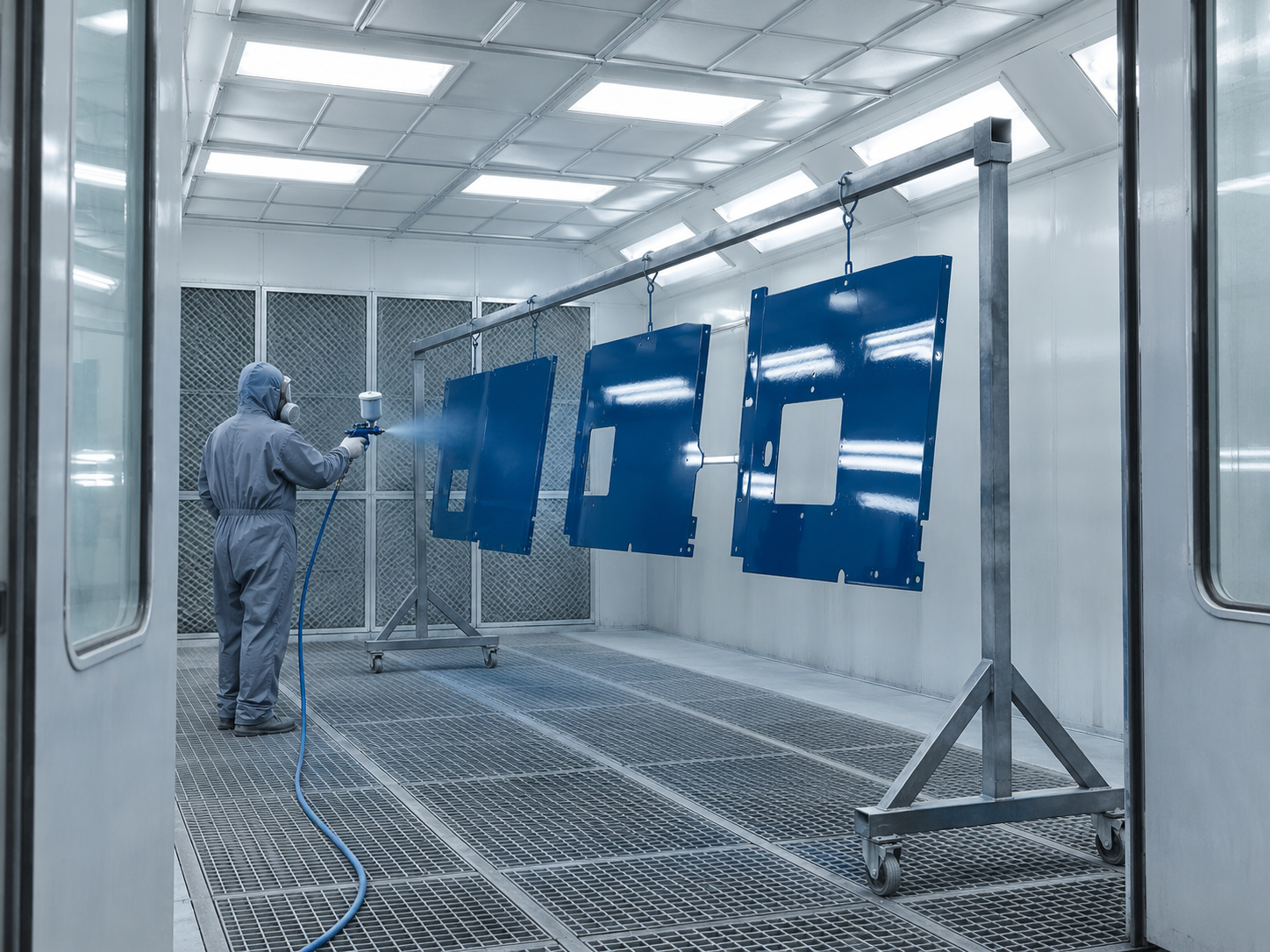
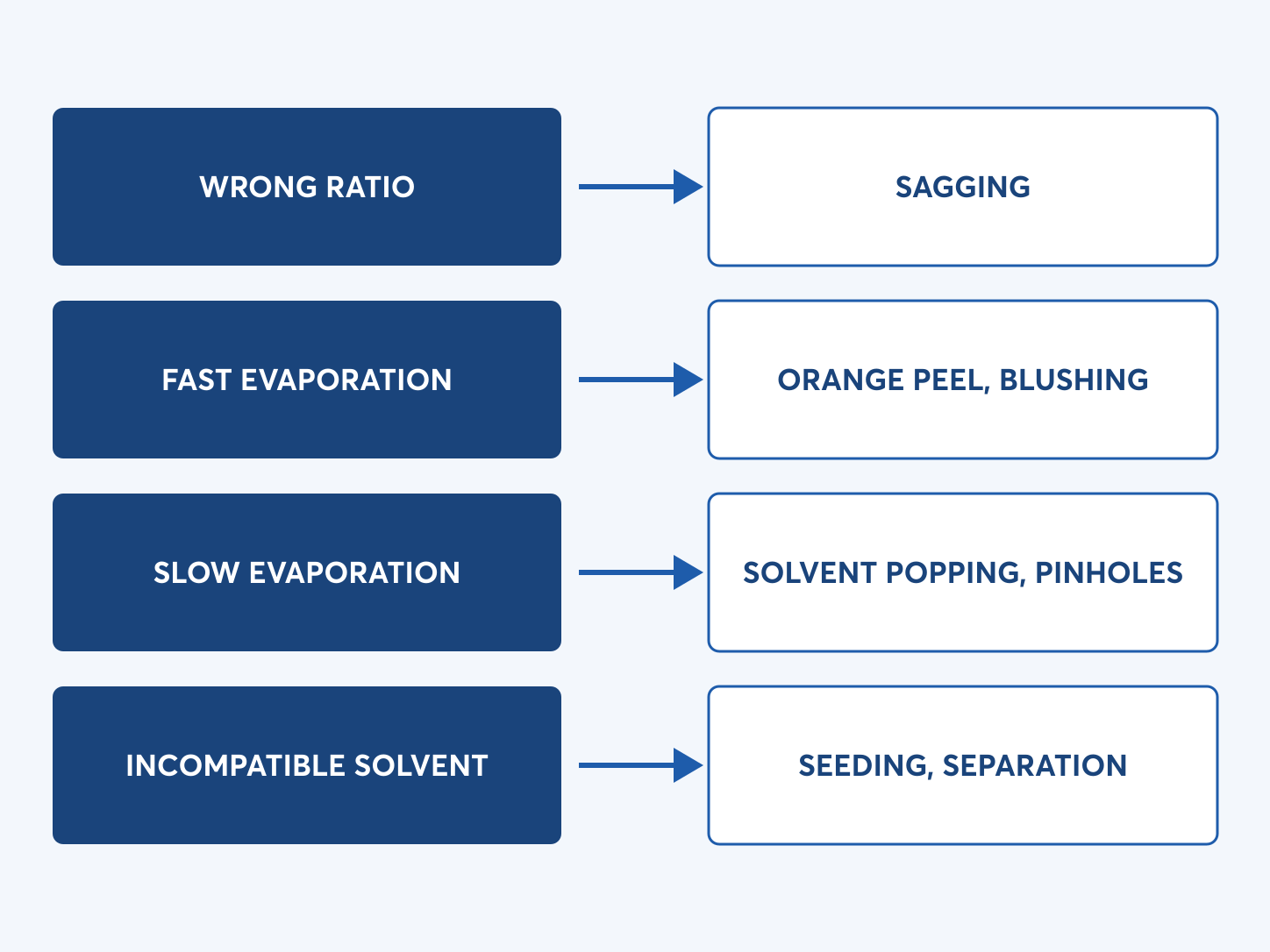
4 Causes of 5 Paint Film Defects When Mixing Paint Thinner
The five paint film defects trace back to four causes; each has its own signs, test and fix.
Cause 1 — Too Much or Too Little Thinner (Causing Sagging)
Over-thinned paint runs into drops or streaks on vertical surfaces; this is paint sagging. Paint that is too thick gives a coarse spray pattern and a rippled film that lacks flow.
Check: measure the viscosity after thinning with a viscosity cup, at the actual paint temperature, and compare it with the paint's TDS.
Fix: mix by weight or by measured volume, never by eye; measure viscosity for every batch before it goes to the line.
Risk of the wrong fix: adding thick paint to a batch that is already thin can easily throw off the hardener ratio in a 2-component system, and the film will not cure fully.
Cause 2 — Solvent Evaporates Too Fast (Causing Orange Peel and Blushing)
A solvent that evaporates too fast makes the film lose flow before it can level, leaving a rippled surface like orange skin. Fast evaporation also removes heat and cools the wet film surface; when humidity is high, moisture condenses into the film and the paint turns milky, known as blushing.
Check: match the time the defect appears against the temperature and humidity of the spray booth. Orange peel with correct viscosity, or blushing on humid days, points to this cause.
Fix: switch to a slower-evaporating solvent, or add a slow solvent to the thinner blend.
Risk: slowing the blend too much creates Cause 3, so change in steps and test on a sample part.
Cause 3 — Solvent Evaporates Too Slowly (Causing Solvent Popping and Pinholes)
The film surface dries first, and the solvent trapped underneath is pushed out during baking, leaving bubbles or pinholes (tiny holes the size of a needle point on the surface).
Check: defects increase with thick films or when parts enter the oven early.
Fix: rebalance the solvent's evaporation rate, allow more flash-off time before baking, and reduce the thickness of each coat.
Risk: raising the oven temperature to force-dry makes the defect worse, because the skin on the surface forms faster and traps solvent beneath it.
Cause 4 — Solvent Incompatible with the Resin (Causing Curdling or Separation)
When the solvent cannot dissolve the resin, solvent shock occurs: the resin precipitates into particles, and the paint curdles or separates right in the can. The principles for matching solvents to each resin system are covered in choosing the right solvent for each paint resin type.
Check: mix a small trial amount, leave it to stand and observe after a period of time.
Fix: use the correct solvent type as recommended in the paint's TDS.
Risk: filtering out the particles and using the paint anyway still gives a film with poor adhesion and low gloss, because the precipitated resin is no longer in the film.
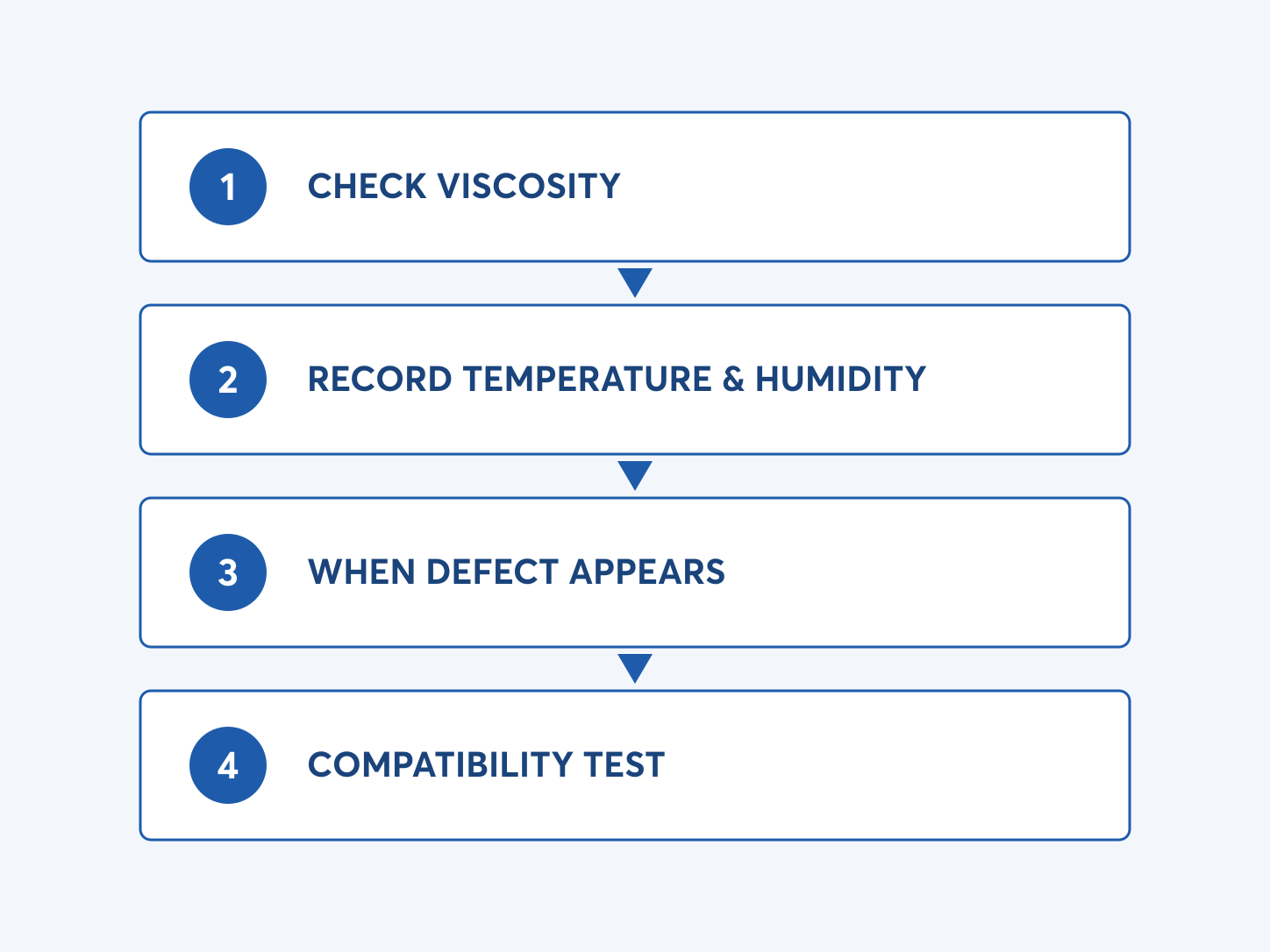
Quick Diagnosis of Paint Film Defects Caused by Paint Thinner
Follow the order below to rule out each cause with measurements, instead of changing solvents by feel. Work on the batch that is actually defective, before remixing.
- Measure the viscosity after thinning with a viscosity cup, at the actual paint temperature, and compare it with the paint's TDS. Viscosity outside the stated range points to a wrong thinner quantity; if viscosity is correct and the defect remains, go to the next step.
- Record the temperature and humidity of the spray booth when the defect occurred. Defects in a hot booth, strong airflow or high humidity usually belong to Cause 2; defects in a cool booth with a thick film usually belong to Cause 3.
- Identify the stage at which the defect appears: right at spraying (coarse spray, curdling), during flash-off (orange peel, blushing, sagging), or only after the oven (solvent popping, pinholes). This timing narrows down the cause fastest.
- Mix a small sample with the solvent in use, leave it to stand and observe. A sample that turns cloudy, curdles or separates points only to Cause 4.
Record the results of the four steps on one sheet per batch. When a defect recurs, the sheet shows at once which condition changed between the good batch and the defective one.
How to Prevent Paint Thinner Mixing Errors on the Paint Line
Prevention starts at the mixing step, because three of the four causes originate there.
- Standardize the mixing procedure: weigh each component, measure viscosity, and log every batch together with booth temperature and humidity. The batch log lets you trace back when a defect appears days later.
- Select by resin system and by season: the thinner must dissolve the resin of the paint system; how to select by resin system is in the article on thinners for industrial paint by resin system. Plants should keep two options ready: a fast-evaporating solvent group for the dry season and a slow-evaporating group for the humid season or a hot booth. These solvent groups by evaporation rate are found in the solvent catalogs of suppliers such as Maxone Asia.
- Read the solvent TDS correctly: the specifications to read are relative evaporation rate, boiling range, purity and water content. Water content matters especially for isocyanate-cured systems, because water reacts with isocyanate groups and generates gas bubbles.
- Keep supply consistent between lots: request a COA for every lot. A lot with a different composition or water content changes the actual evaporation rate of the thinner blend, and defects appear even though the mixing procedure has not changed.
When considering a switch to bio-based solvents, check the same set of specifications again, because evaporation rate and resin solvency differ from the previous solvent. The article on how to choose bio-based solvents to replace petroleum-based solvents sets out the points to compare.
Frequently Asked Questions About Paint Thinner
How Much Thinner Should You Add?
The right amount is the amount that brings the viscosity after thinning into the range stated in the paint's TDS; there is no single ratio for all paint systems. Mix by weight, measure with a viscosity cup at the actual temperature, and log every batch. The specific ratio is in the TDS of the paint you are using.
Can the Same Thinner for Paint Be Used for Every Type of Paint?
No. Thinner for paint is a solvent blend chosen for each resin system. A type that dissolves one resin well can make another resin precipitate. Two-component systems cured with isocyanate also need a solvent with low water content. Check the solvent recommendation in the paint's TDS before use.
Why Does Paint Blush When the Weather Is Humid?
A fast-evaporating solvent lowers the temperature of the wet film surface below the surrounding air. Water vapor that meets the cold surface condenses and is trapped, leaving a cloudy layer after drying. The higher the humidity, the greater the risk; a slower-evaporating solvent helps reduce this.
Does Adding More Thinner Reduce Paint Adhesion?
It can, if you go beyond the instructions. Over-thinning makes the film thinner, so less resin remains per unit area, and a wrong solvent type can be trapped in the film. The right solvent type, mixed in the right amount, has little effect on adhesion.
Conclusion
The five paint film defects caused by paint thinner mixing errors all trace back to four specific causes, and each cause can be checked with measurements on the line.
- 5 paint film defects trace back to 4 causes: mixing ratio, evaporation too fast, evaporation too slow, and incompatibility with the resin.
- Measuring viscosity after thinning and recording booth conditions are the first two checks.
- Select the solvent by resin system and environmental conditions, and read the evaporation rate, boiling range, purity and water content on the TDS correctly.
Send us photos of the defect, the paint system in use and the booth conditions, and the Vichem technical team will check the cause with you.
Vichem is a distributor of chemical additives and equipment from leading brands such as Covestro, Sinopec, TotalEnergies Corbion, Bühler and Tinox in the Vietnamese market.
For more information about our products, please contact us through the following channels:
- Hotline: 08 1790 1790
- Zalo OA: Vichem JSC
- Email: contact@vichem.vn
- LinkedIn: Vichem JSC
- Website: www.vichem.vn
- Facebook: Vichem JSC