When solvent-based paint sagging appears after thinning, the cause is usually a solvent ratio above the recommendation, or a solvent that evaporates too slowly for the spray conditions. The fix is to bring the ratio back to the TDS value and choose a solvent with a suitable evaporation rate (how fast or slow a solvent leaves the film). Check the viscosity after thinning, the solvent evaporation rate, the wet film thickness and the shop temperature.
Sag from thinning and sag from excess film thickness are two different defects
Both defects cause paint sagging when spraying, and the runs look almost the same on the part. The root causes differ, so the fixes differ too. Mistaking one for the other is why many plants adjust the formulation and still see the runs come back in the next batch.
Sag from thinning. The viscosity after thinning is lower than the paint system needs for the film to hold on a vertical surface. The paint sags even in thin sprayed coats. The runs form wide curtains along the vertical surface and often repeat on many parts from the same batch. The cause is in the paint can, so changing the spray gun or the operator almost never makes the runs disappear.
Sag from excess film thickness. The viscosity is correct, but overlapping coats, a gun held too close to the part or a slow gun speed put more paint at one spot than the film can hold. The runs are then local, forming drips or short curtains, concentrated at corners, edges and recesses where paint pools. From the same paint batch, the thinly sprayed areas stay smooth.
Two short questions separate the two defects:
- Runs appear in thin-film areas too and repeat across parts: suspect viscosity after thinning.
- Runs appear only where paint pools or where coats overlap: suspect spray technique.
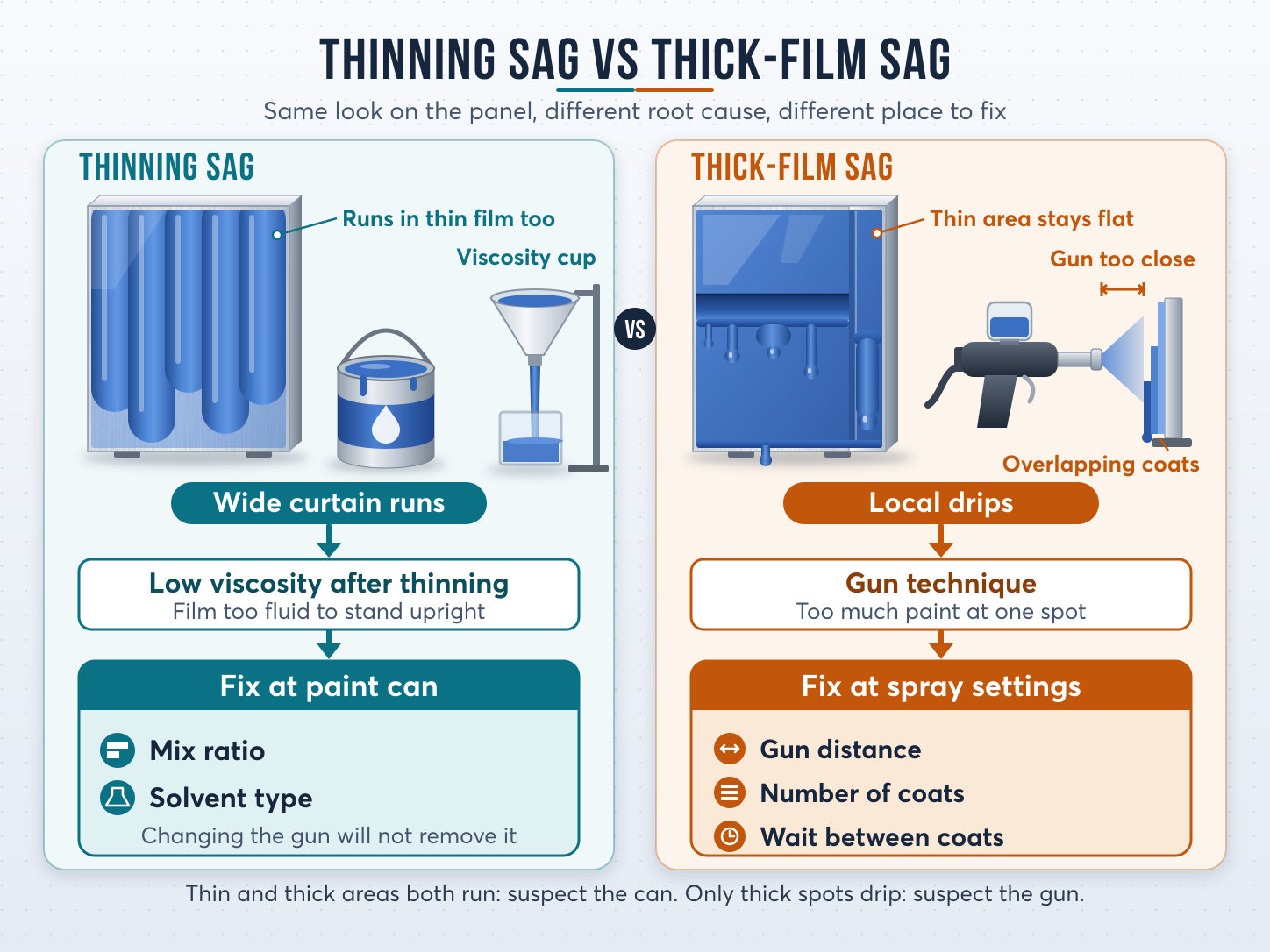
Sag from thinning is fixed at the paint can, through the ratio and the solvent type. Sag from thick film is fixed in the spray settings: gun distance, number of coats and flash-off time between coats. The sections below focus on the first defect.
Why solvent-based paint sags after thinning
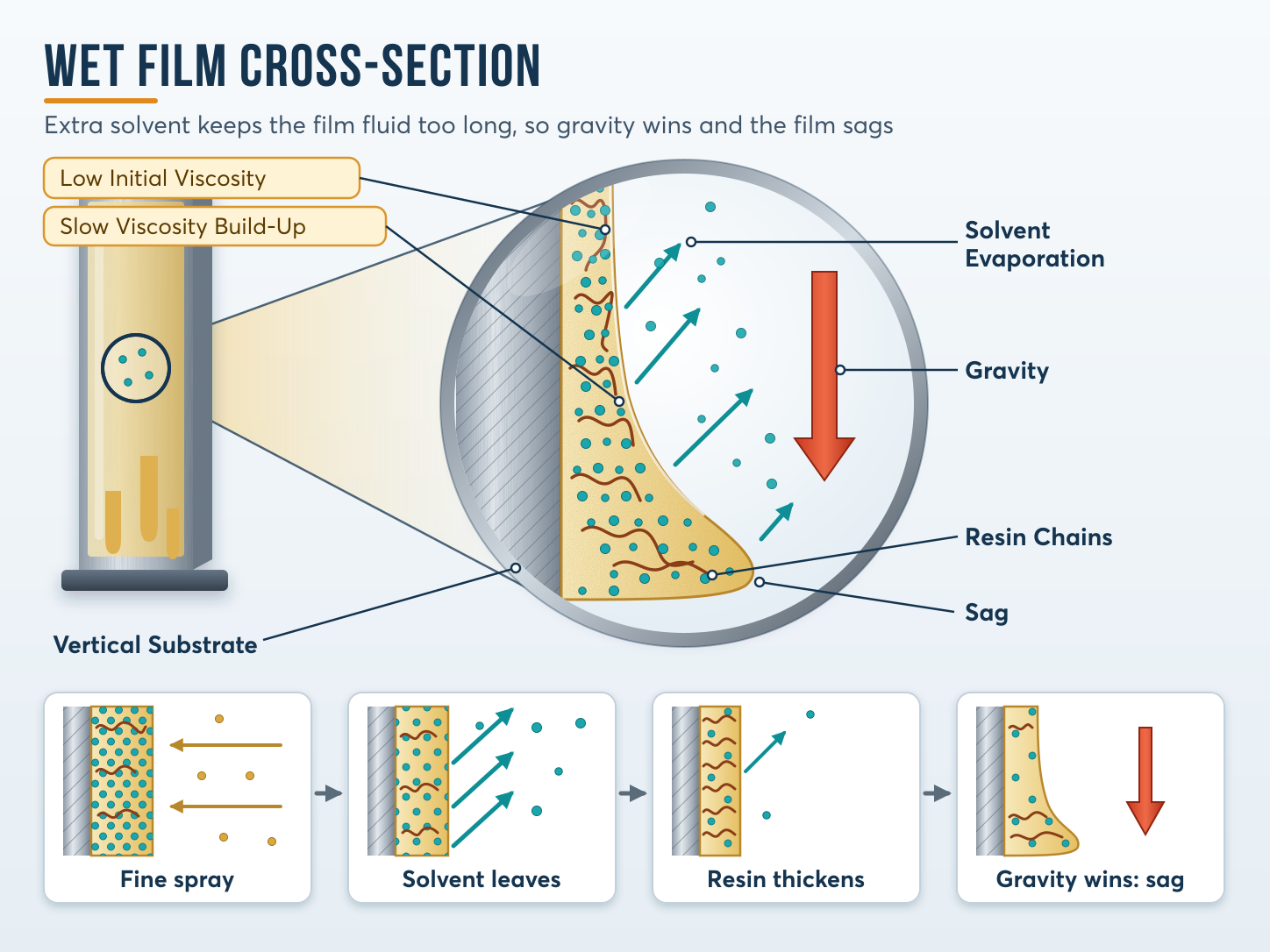
Paint sags after thinning when gravity pulls the wet film down faster than the film's viscosity builds up. Solvent lowers viscosity so the paint can be sprayed, but a wet film holds on a vertical surface only when viscosity rises quickly after the paint leaves the gun. The sequence is as follows: the droplet reaches the part, solvent evaporates, resin concentration in the film rises, viscosity rises and the film sets. The two processes run in parallel, and runs appear when gravity wins.
Evaporation rate is how fast or slow a solvent leaves the film at the same temperature and airflow. It is published in the TDS of each solvent. A slow-evaporating solvent keeps the film liquid for longer. That time helps the film level, but it also gives gravity more time to pull the film into runs.
Adding too much solvent works against the film on both sides of this contest. The starting viscosity is already low. The amount of solvent that must leave the film is also larger, so the film takes longer to reach a viscosity high enough to hold. On the line, operators see paint that sprays smoothly and looks good at the moment of application, then the film starts to sag a few minutes later.
Low temperature slows evaporation. A cold shop, weak airflow or parts that are still cold after washing all extend the period in which the film stays liquid. A formulation that runs well in summer can sag in winter with no change in the paint can. The same slow evaporation at low temperature also appears in printing inks, for example when ethanol-based flexo ink dries slowly on the press.
Another cause is solvency. A solvent that dissolves the paint system's resin poorly makes the resin chains coil into clusters instead of extending evenly in solution. The system loses the rheology the formulation was designed for: the paint no longer holds a reasonable viscosity when it rests on a vertical surface, even though a cup measurement may still look normal. Solvency depends on the chemical structure of the solvent; for more detail, see the article on how the chemical composition of thinner solvents determines paint film quality.
How to tell whether solvent-based paint sagging is caused by thinning
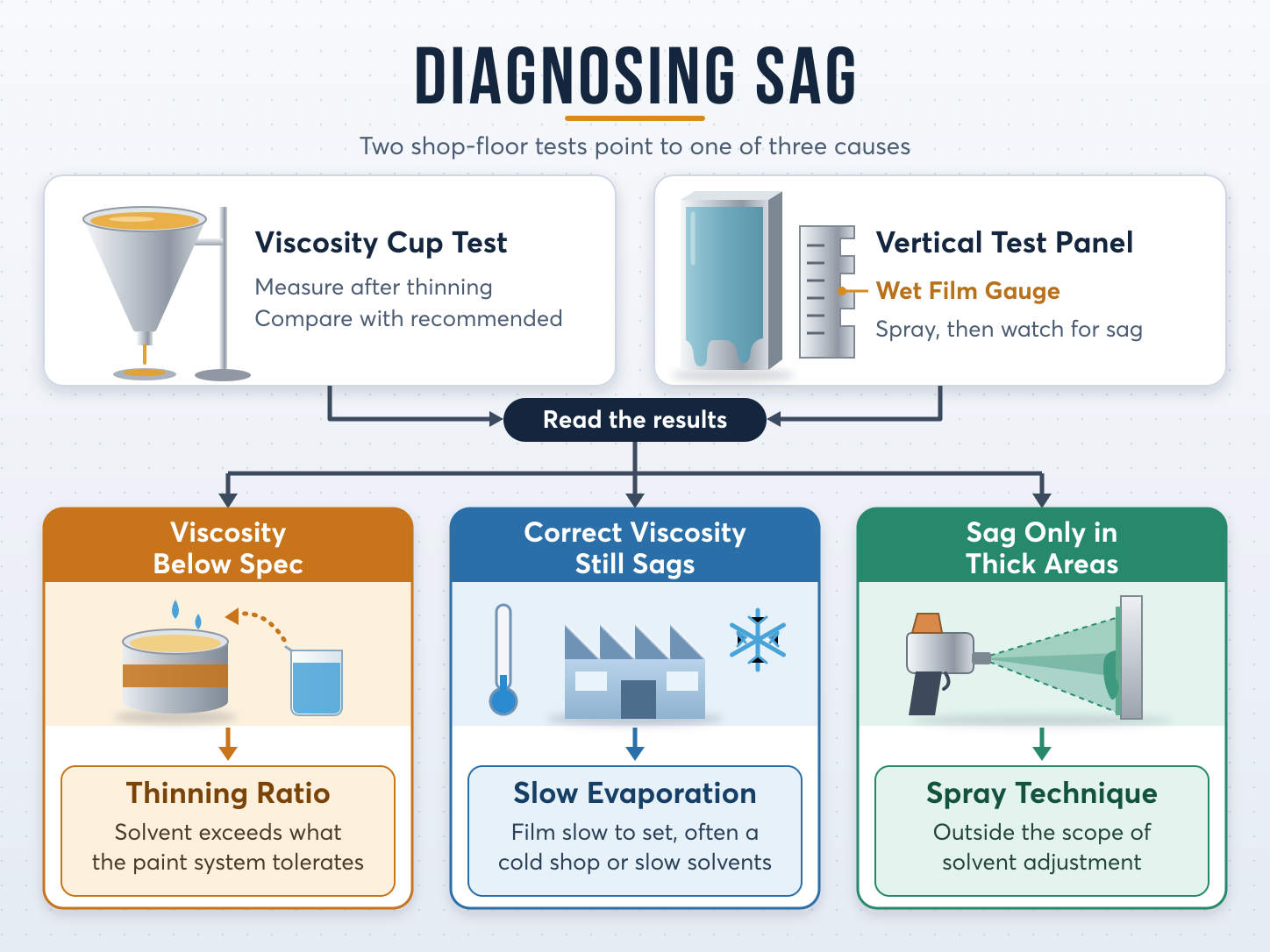
Two measurements in the shop are enough to reach a conclusion: measure the viscosity after thinning and spray a vertical test panel. Do both before adjusting any parameter.
Viscosity cup test and vertical test panel
Follow these steps on the batch that is sagging:
- Stir the thinned batch evenly, wait for air bubbles to clear, then measure viscosity with a viscosity cup at the paint temperature specified in the TDS.
- Compare the result with the recommended viscosity in the TDS. The cup type and test conditions are also stated in the TDS, and you need to use the same type to make a valid comparison.
- Spray a vertical test panel at the standard wet film thickness, checked with a wet film gauge instead of estimated by eye.
- Leave the panel standing under shop conditions and observe where the runs form and when they start.
Signs that separate thinning ratio from solvent type
The results of the two tests lead to three conclusions:
- Viscosity lower than recommended: the cause is the thinning ratio. The amount of solvent has exceeded what the paint system can tolerate.
- Viscosity correct but the paint still sags, and the film is slow to set: the cause is the solvent evaporation rate, often together with a cold shop or a blend that contains a lot of slow-evaporating solvent.
- Sag only in thick areas or where coats overlap: the cause is spray technique, which is outside the scope of solvent adjustment.
If the runs come with other film defects after thinning, you can cross-check against 5 paint film defects caused by wrong thinner mixing and how to fix them to find out which step went wrong.
How to fix solvent-based paint sagging
The fix follows the test results from the previous section: if viscosity is low, correct the ratio; if viscosity is correct but the paint still sags, correct the solvent type.
Correcting the paint thinning ratio
Weigh the solvent and the paint by mass, because volume changes with temperature and with the amount of air bubbles in the can. Record the thinning ratio on the batch sheet so it can be traced when a defect occurs. The permitted thinning range comes from the TDS of the paint and the resin in use, and the plant does not need to infer it from general experience.
Check the viscosity of every batch with a cup before it goes to the line, even when the same formulation is used every day. Paint temperature differs between the start and the end of a shift, and the measured viscosity differs with it.
Do not add solvent arbitrarily to make the paint easier to spray. When the gun is hard to spray, check air pressure, the nozzle and paint temperature first. Adding solvent to ease spraying is the fastest way to get sag in the next coat.
Correcting the solvent
When viscosity is correct but the film still sags, adjust the solvent blend according to evaporation rate and shop temperature. The two properties to read in the TDS of each solvent are evaporation rate and solvency for the paint system's resin. A cold or poorly ventilated shop needs a blend that leaves the film faster, while a hot shop can keep a share of slow-evaporating solvent so the film has time to level.
The share of slow-evaporating solvent in the blend is the first variable to check. Adjust in small steps and recheck each step with a vertical test panel and a viscosity measurement, so you know which change has an effect.
For industrial paints, Maxone Asia supplies slow-evaporating solvents such as PMA and EEP. This group is useful when the film needs to level, but their share needs to be balanced against faster-evaporating solvents according to shop temperature. The approach here adjusts only the type of thinner solvent and leaves the paint's resin system unchanged.
Frequently asked questions
How much solvent can I add before the paint sags?
There is no single ratio for every paint system. Each system has its own thinning range in the TDS of the paint and the resin. Thin within that range, measure viscosity with a cup, then spray a vertical test panel. The correct ratio is the one that gives the recommended viscosity and no sag at the standard wet film thickness.
Does thinner make paint sag?
Yes, when too much is added or when a solvent that evaporates too slowly is chosen. With the right amount and the right type, the solvent only lowers viscosity so the paint can be sprayed, then leaves the film. That is why you need to check the solvent amount and evaporation rate together when tracing the cause of sag.
Is solvent-based paint more likely to sag in cold weather?
Yes, because low temperature slows solvent evaporation, so the film stays liquid for longer. Cold paint is also thicker, which tempts operators to add more solvent to compensate, and that in itself causes sag. Measure viscosity at the paint temperature specified in the TDS.
Can sagged paint be reworked?
Yes, depending on the stage of the film. If the film is still wet, remove the paint, correct the viscosity and respray. If the film has dried, sand the runs flat and recoat according to the paint system's procedure. Check intercoat adhesion on a test panel before doing it in volume.
Conclusion
Solvent-based paint sags after thinning when viscosity falls below what the film needs to hold on a vertical surface, or when the solvent evaporates too slowly for the shop temperature. The fix runs from identifying the cause, to measuring viscosity after thinning, to adjusting the ratio or the solvent type according to the TDS. Each change needs to be confirmed on a vertical test panel before it goes to the line.
- Separate sag from thinning from sag from thick film.
- Check viscosity and evaporation rate before changing the formulation.
- Thin according to the TDS recommendation and adjust the solvent to shop conditions.
Send us the TDS of your paint system, the thinner you are using and the spray conditions on your line, and the Vichem technical team will help check the cause with you.
Vichem is a distributor of chemical additives and equipment from leading brands such as Covestro, Sinopec, TotalEnergies Corbion, Bühler and Tinox in the Vietnamese market.
For more information about our products, please contact us through the following channels:
- Hotline: 08 1790 1790
- Zalo OA: Vichem JSC
- Email: contact@vichem.vn
- LinkedIn: Vichem JSC
- Website: www.vichem.vn
- Facebook: Vichem JSC