When PLA packaging receives a failed report in EN 13432 testing, the cause usually lies in additives and non-PLA components, excessive thickness, colorants or inks containing unacceptable components, or a test sample that does not represent the real packaging. Check all components of the finished packaging, including base resin, additives, ink, adhesive and coating, rather than relying only on the resin documentation.
What it means when PLA packaging fails EN 13432 testing, and the impact
EN 13432 is the European standard for packaging that can be degraded under industrial composting conditions, and it applies to industrially compostable PLA packaging as well. The test assesses the finished packaging against requirement groups such as composition, biodegradability, disintegration and effect on compost. The specific limits for each group are set out in the text of the standard. Read the current edition and the test laboratory's report; do not take figures from secondary sources.
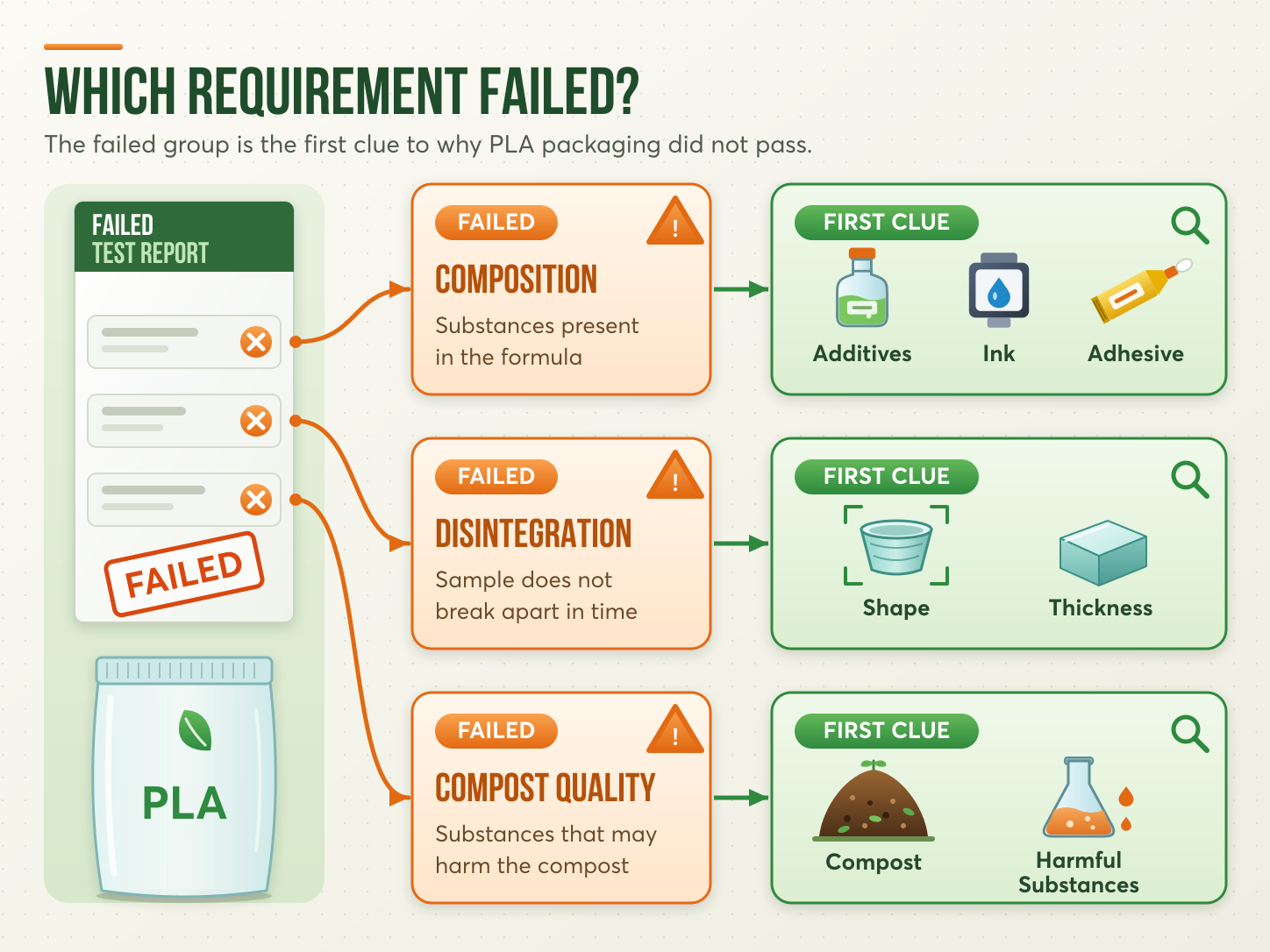
For PLA packaging, a failed report shows which requirement group was failed, and that is the first clue to the cause. A failure in the composition group is usually linked to substances present in the formulation, such as additives, ink or adhesive. A failure in the disintegration group is usually tied to the shape and thickness of the product. A failure in the compost effect group calls for a review of substances that could harm the quality of the finished compost.
The consequences for the plant show up directly on the order. The packaging cannot carry the compostable label, so the lot cannot be sold as positioned. European export orders are delayed because the customer is waiting for valid documentation. Each retest costs money for samples, laboratory fees and line time to run the samples. Compostable packaging documentation applies to the specific packaging that was tested, so any change in formulation or thickness after testing must be checked again against the report.
4 common reasons PLA packaging fails EN 13432 testing
Cause 1 — Additives and blended polymers that do not degrade
Sign: the base resin has suitable documentation but the finished packaging fails, usually in the composition group. Extruders and film blowing lines often add masterbatch, slip agents, antiblock agents or blended polymers to improve processing and mechanical properties. These are components outside the base resin documentation, so the resin's documentation does not cover them.
Check: list every additive and blended polymer in the actual formulation, including those added at the line and those already present in color masterbatch. Ask the supplier of each component to confirm suitability in writing.
Fix: replace them with components confirmed as suitable, then retest on the finished packaging.
Risk: a rushed substitution can reduce mechanical properties, such as tensile strength, toughness or seal adhesion. Run a trial on the line before sending samples.
Cause 2 — Packaging thickness exceeds the tested thickness
Sign: the sample does not disintegrate in time during the test, even though the base material has good documentation. Thicker products have a longer diffusion path for water, heat and microbes into the core, so the core disintegrates more slowly than the surface.
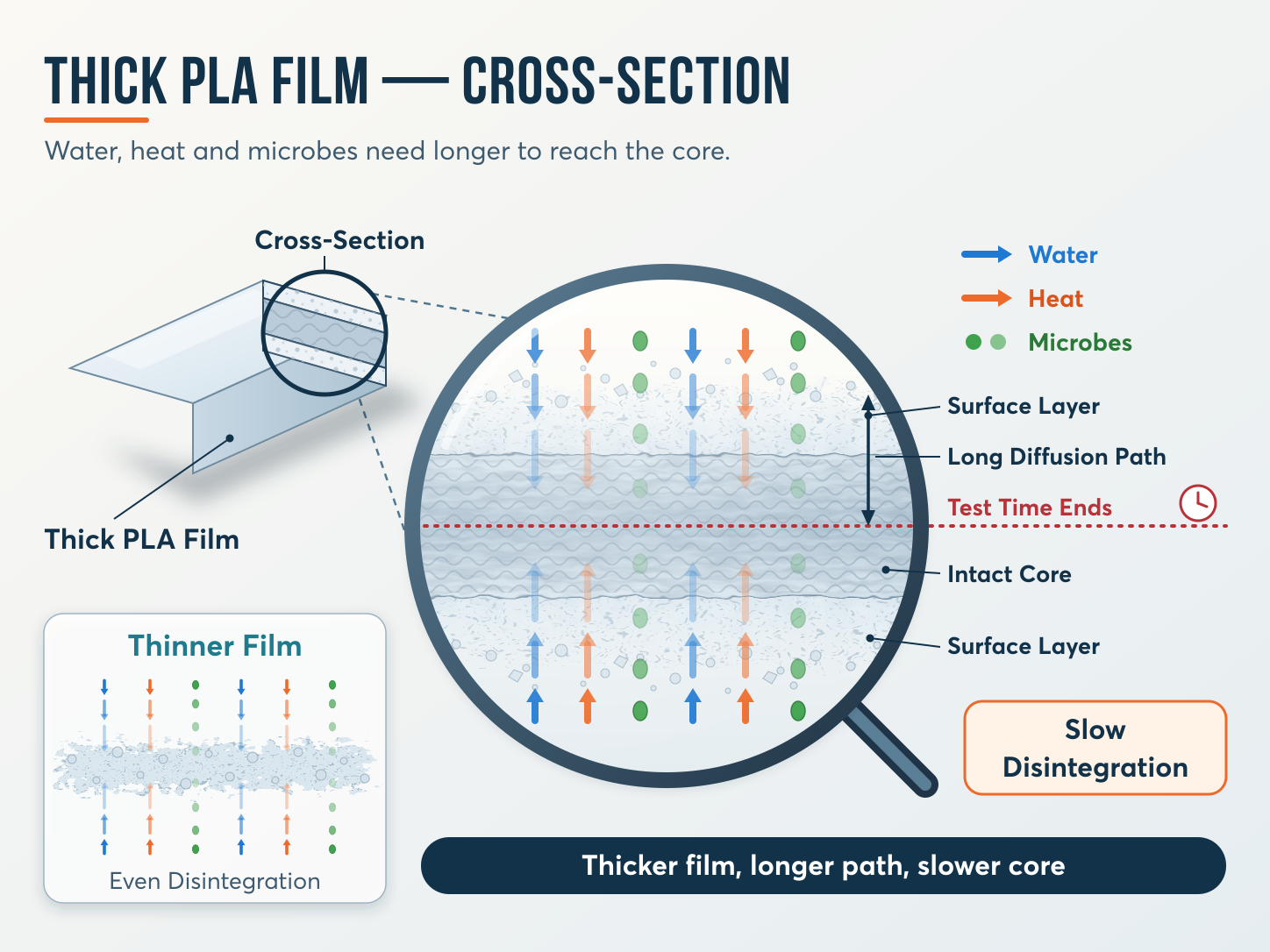
Check: compare the actual thickness of the packaging with the thickness stated in the material report. Measure at several points, such as the seal, the bag bottom and the fold area, because areas with overlapping layers are often thicker than the nominal thickness.
Fix: redesign the thickness to fall within the tested range, or test at the product's actual thickness.
Risk: going too thin impairs the packaging function, for example tearing during packing, puncturing during transport or incomplete seals. Recheck mechanical strength after reducing thickness.
Cause 3 — Ink, pigment, adhesive and coating not assessed
Sign: the report records a failure in the composition group or the effect on compost group, while the base film and thickness are already fine. Printing ink, pigment, laminating adhesive and coating sit on or inside the packaging, so all of them are part of the packaging being assessed. Some colorants can contain metals.
Check: ask the ink, pigment and adhesive suppliers for data on heavy metals and on suitability for industrial composting requirements. Compare that data with the requirements in the text of the standard.
Fix: switch to materials with suitable data, then submit the printed packaging for testing.
Risk: changing the ink can reduce adhesion, shift color or change drying time. Run a print trial and check adhesion before finalizing.
Cause 4 — The test sample does not represent the real packaging
Sign: results differ between lots, with one lot passing and the next failing, or the report does not match the goods being shipped. Test samples are often made separately in trial mode, with a simpler formulation, without printing or with a thickness different from the goods sold.
Check: verify whether the sample has the same formulation, thickness, ink, adhesive and coating as the goods sold.
Fix: submit samples from a real production lot, taken from a running line, with the lot number and formulation recorded.
Risk: the result may pass while the real goods are still non-compliant if the formulation or materials change after the report and no one rechecks. Control every change made after testing.
Quick diagnostic workflow when PLA packaging fails EN 13432
Follow this order to narrow down the cause before sending a second sample.
- Step 1: read the report to identify the failed requirement group: composition, biodegradation, disintegration or effect on compost. Each group points in a different direction. Disintegration suggests thickness, while composition suggests additives, ink and adhesive.
- Step 2: list every component of the finished packaging, including base resin, masterbatch, additives, ink, pigment, adhesive and coating. Record the supplier and the confirming document for each component.
- Step 3: compare the proven thickness in the material documentation with the thickness actually measured at several points on the packaging.
- Step 4: compare the test sample with the production lot in terms of formulation, thickness, ink and coating, then record what differs.
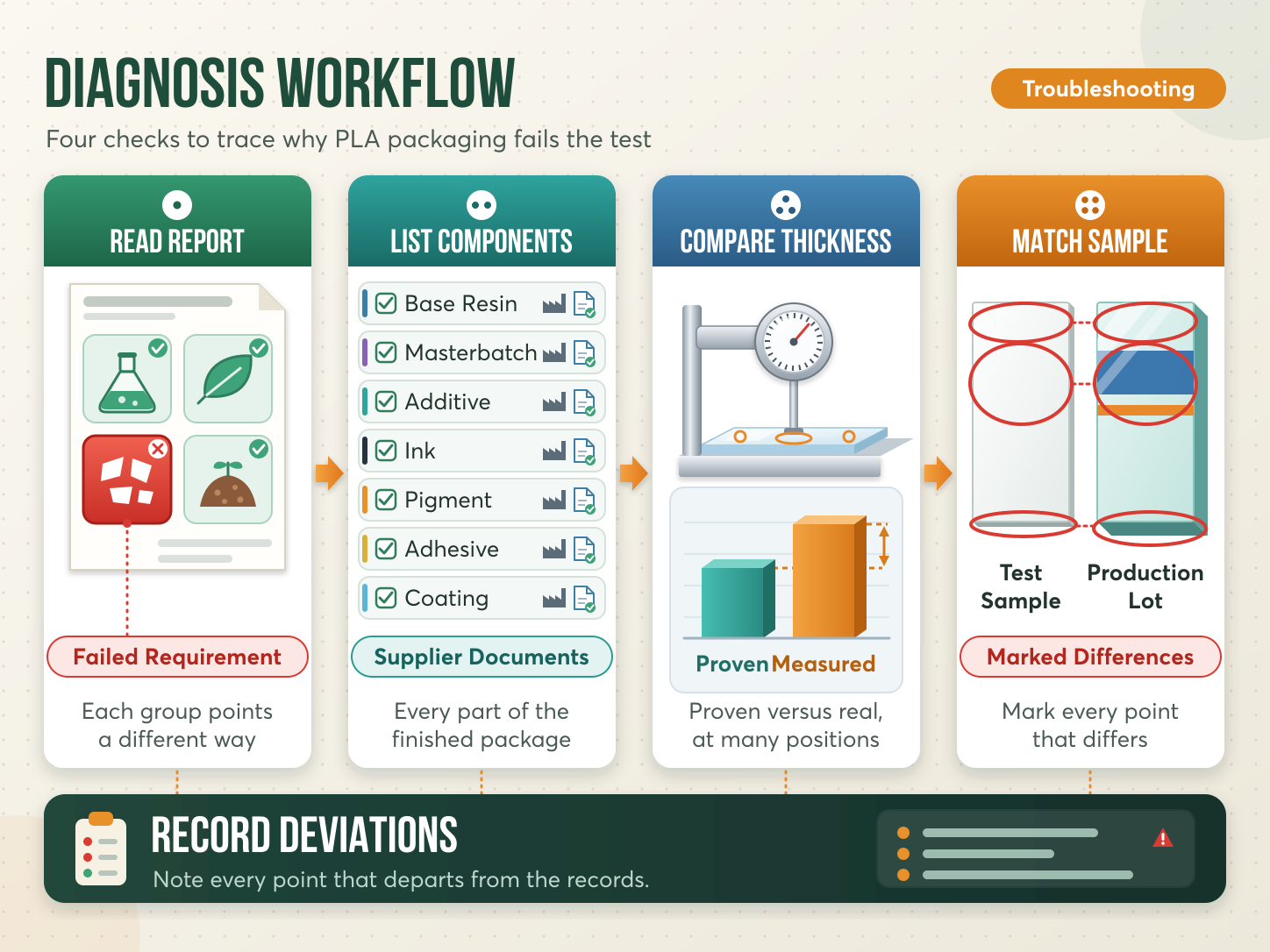
At each step, record deviations from the documentation. If all four steps fail to identify the cause, take the component list and the report to the test laboratory and ask which test failed. Only retest after correcting the deviation you found.
How to prevent PLA packaging from failing EN 13432 testing
Prevention starts with material selection. Choose a PLA bioplastic with documentation showing compliance with EN 13432 from the manufacturer, for example TotalEnergies Corbion. In the technical documents, read the thickness range and the conditions that have been demonstrated, then design the packaging to fall within that range. Any packaging with a thickness or processing condition outside the range stated in the documentation needs to be tested under real conditions.
Accompanying materials also need documentation:
- Request the corresponding documentation for ink, pigment, adhesive and coating, including heavy metal data and statements of suitability.
- Ask masterbatch and additive suppliers about suitability before adding them to the formulation.
- Record every component in a single formulation sheet for each packaging code.
On the testing side, lock the formulation before sending samples. Once the formulation, thickness, ink and coating are finalized, send samples taken from a real production lot. Any later material change must be checked against the test report before it is applied.
Finally, keep records by lot: resin lot number, ink and adhesive lot numbers, measured thickness, production date and the corresponding test report. These records allow fast traceability when a lot is questioned, instead of having to retest from scratch.
Frequently asked questions
What does EN 13432 testing check?
EN 13432 testing assesses packaging against requirement groups such as composition, biodegradability, disintegration and effect on compost. The test subject is the finished packaging, including base resin, additives, ink and adhesive. The limits for each group are set out in the text of the standard and in the test laboratory's report.
If PLA resin meets EN 13432, does the packaging pass automatically?
No, it does not pass automatically. The resin's documentation only confirms the base material, while the packaging also has its own additives, ink, adhesive, coating and thickness. Each of these factors can cause the finished product to fail a requirement group, so the actual formulation and thickness need to be checked against the documentation.
Can printing ink cause PLA packaging to fail EN 13432?
It can. Ink, pigment, adhesive and coating are all part of the packaging being assessed, so colorants containing metals or unsuitable components can cause a failure in the composition group or the effect on compost group. Ask the ink, pigment and adhesive suppliers for suitability data before printing.
Will thick PLA packaging pass EN 13432 testing?
Not necessarily; the result depends on the thickness that was tested. Packaging thicker than the thickness stated in the report is at risk of disintegrating more slowly than the test period allows. To use a greater thickness, test at the product's actual thickness instead of inferring from the report of a thinner sample.
Conclusion
PLA packaging usually fails EN 13432 testing because of one of four points that can be checked right on the line and in the materials documentation. Read the report to see which requirement group failed, then trace back to the formulation, thickness, printing materials and the submitted sample.
- The test assesses the finished packaging, not just the resin.
- Four common failure points: additives, thickness, ink, pigment and adhesive, and the test sample.
- Lock the formulation and materials documentation before testing, and keep records by lot.
Send us your test report, component list and the thickness of the packaging currently running, and the Vichem technical team will work with you to narrow down the cause.
Vichem is a distributor of chemical additives and equipment from leading brands such as Covestro, Sinopec, TotalEnergies Corbion, Bühler and Tinox in the Vietnamese market.
For more information about our products, please contact us through the following channels:
- Hotline: 08 1790 1790
- Zalo OA: Vichem JSC
- Email: contact@vichem.vn
- LinkedIn: Vichem JSC
- Website: www.vichem.vn
- Facebook: Vichem JSC