When a finished-goods batch is about to leave the warehouse and the file does not state its composition, the factory must disclose hazardous chemicals in products. Decree 26/2026/ND-CP (issued January 17, 2026) requires factories to declare and disclose information on hazardous chemicals in products before placing goods on the market (Article 29), that is, a chemical declaration before distribution. The factory should check whether it already has hazardous chemical control in manufacturing under Article 28, and note that the compliance deadline of March 1, 2026 under Clause 8, Article 30 has passed.
The technical problem when hazardous chemicals are in the product
Hazardous chemicals travel with raw materials into the production line and then remain in the finished product. A substance that was tightly controlled at the raw material store can still be present in the final product after the mixing batch, reaction step or dissolving step. It may remain unchanged, remain partly as residue, or be transformed into another substance. A raw material store that meets safety requirements does not tell you whether the finished product still contains hazardous chemicals. For this reason, chemical disclosure in products starts with the factory knowing where the substance ends up.
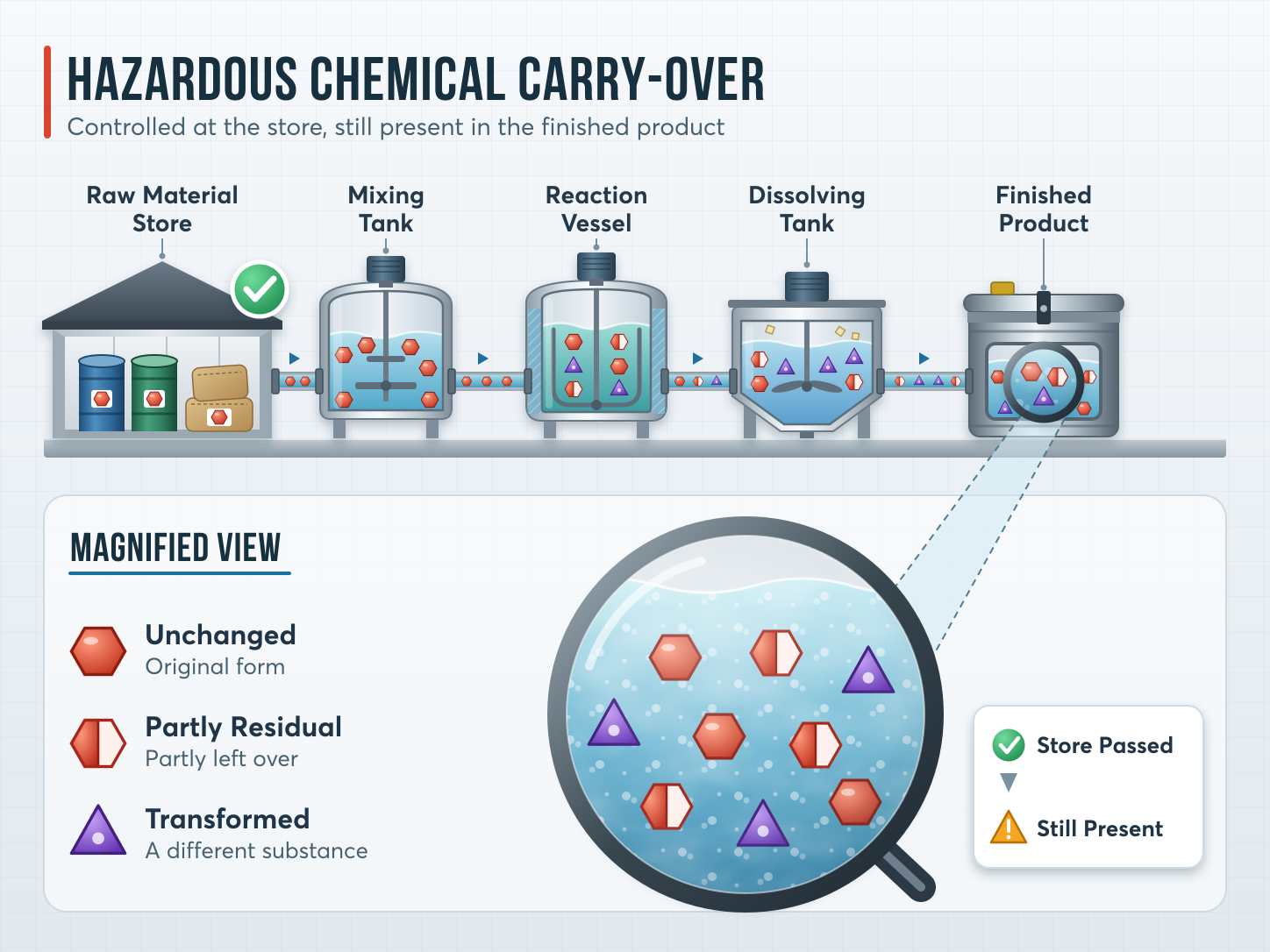
The receiving party cannot see this. A drum of finished product or a completed mixed batch does not show which substances inside are hazardous. Buyers and regulators only know when the factory discloses it. If the information stops at the factory, downstream steps such as transport, storage and use at the customer's plant have to handle the product without data on its hazard level.
For the factory, the consequence shows up in batch records. The QA department holds the SDS of each input raw material, but does not necessarily have a consolidated table of the hazardous chemicals remaining in the finished product. This gap is what Decree 26/2026/ND-CP targets in its provisions on chemicals in products.
Two separate obligations need to be kept apart. Imported chemical declaration covers chemicals when they enter Vietnam, and has its own article: how to declare imported chemicals under Decree 26 of 2026. Hazardous chemicals in products, by contrast, fall under Chapter IV of the decree and apply to what the factory makes and places on the market. A factory that both imports raw materials and sells finished goods may have to do both, at two different points in the chain.
How Decree 26/2026/ND-CP regulates the disclosure of hazardous chemicals in products
Effective date. The decree takes effect on the date of signing (Clause 1, Article 31). It was issued on January 17, 2026, so factories have now been operating under it for several months. When reviewing obligations, the factory should read the decree together with the Law on Chemicals to understand the full legal framework.
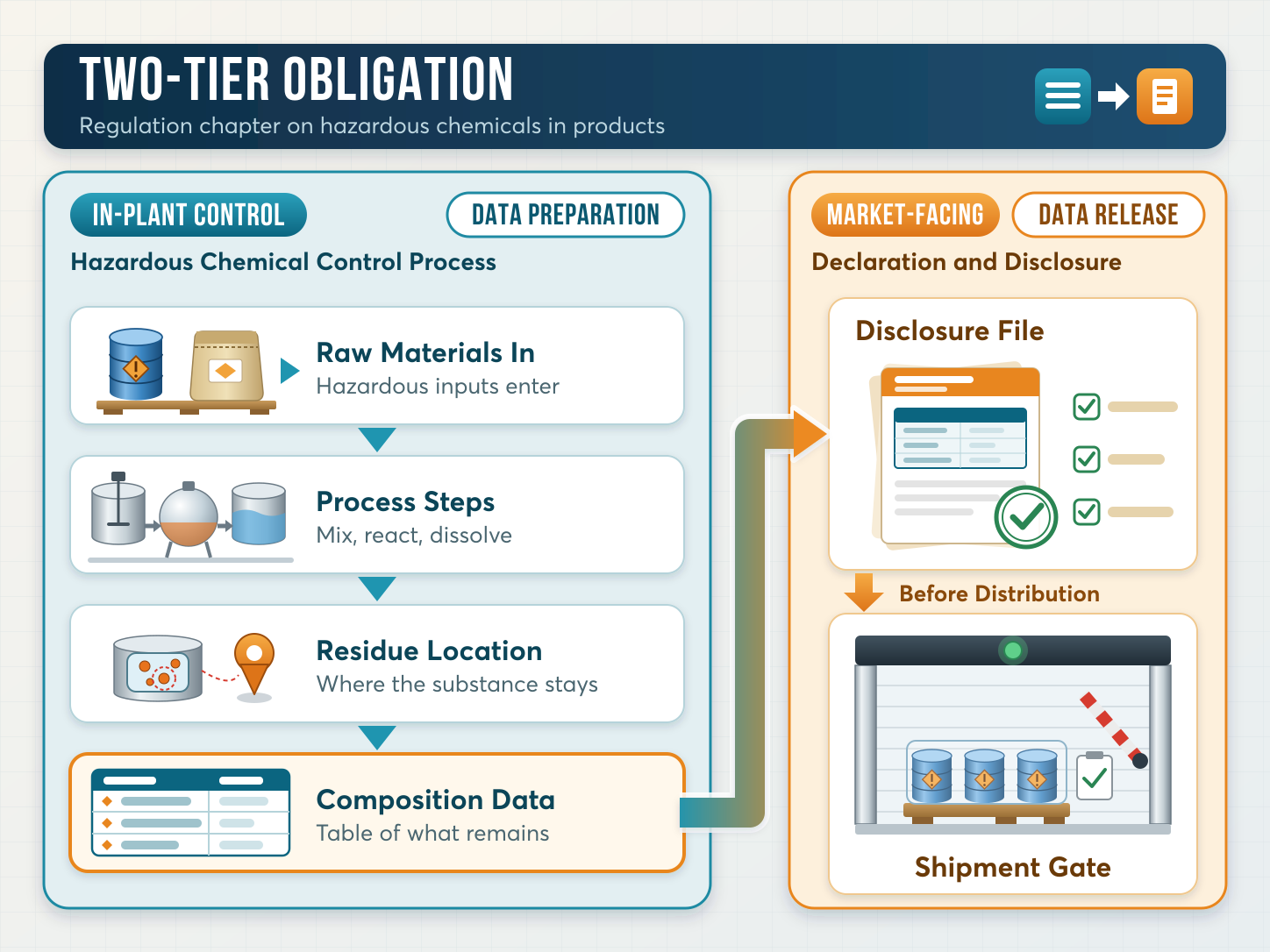
Article 28: the control process. Article 28 requires the factory to establish a process for controlling hazardous chemicals in manufacturing. In plain terms, a control process is a series of steps the factory defines for itself and carries out consistently, so that it knows which hazardous chemicals enter production, which steps they pass through and where they end up. This is how the article puts it at the level of the provision. The details of each step, the responsible person and the record-keeping method must be read in the original text, and should not be inferred from the practice of other factories.
This process is the foundation for disclosure. A factory that does not know which hazardous chemicals remain in the product cannot declare them correctly. Article 28 should therefore be understood as the step that prepares the data, and Article 29 as the step that releases the data outside the factory.
Article 29: declaration and disclosure before placing goods on the market. Article 29 requires the factory to declare and disclose information on hazardous chemicals in products before placing goods on the market. The time marker here is the moment goods leave the factory for distribution. This is an obligation to declare chemicals before distribution, so the file must be completed before the batch leaves the warehouse, not after an order arrives or a customer asks.
Trade-off. This obligation adds paperwork before each shipment: QA and R&D must review the composition, cross-check raw material data and complete the disclosure before the delivery schedule. Factories with many product codes or frequent formula changes carry a larger workload. In return, the factory avoids the risk of goods being held or penalized when circulated without disclosure. A held shipment causes real damage to delivery schedules and customer relationships, usually greater than the effort of preparing the file from the start.
Clause 8, Article 30: compliance deadline. Clause 8, Article 30 sets the compliance deadline as before March 1, 2026. This date has passed. The specific penalties, if any, must be read in the original text.
Chapter IV contains the provisions above. The text divides the obligation into two tiers: the in-plant tier (Article 28) and the market-facing tier (Article 29). The two tiers are linked through composition data.
What determines whether a factory discloses hazardous chemicals in products correctly and completely
Composition data from raw material suppliers. The accuracy of the disclosure file depends on input data, and the same data source serves both the control of hazardous chemicals in manufacturing and the declaration of chemicals before distribution. Without an SDS, hazardous chemicals in the product cannot be identified, because the factory does not know which substances the raw material contains. SDS also have their own update requirements, see chemical safety data sheets must be updated under Circular 01 of 2026. An outdated SDS, or one missing the composition section, makes the disclosure file wrong from the start.
When the formula changes, the data must change with it. When a factory replaces a raw material or switches to another supply source, the list of hazardous chemicals in the product may change. The file should be reviewed at the same time as the formula change.
Whether the Article 28 control process is maintained. A process is only useful while it is in operation. A process that was written once and left in a filing cabinet, not updated to the actual production line, will produce data that does not match the product being shipped. The question the factory should ask itself: does the data in the current process match the formula now running?
Timing of disclosure. Article 29 sets the marker as before goods are placed on the market. The factory should build disclosure into the batch release schedule, so the file is completed before the shipping date, and not handled retroactively after the goods have gone.
File details and forms. The detailed content to be declared, the forms and the receiving authority must be checked directly in the original text of Decree 26/2026/ND-CP. Do not substitute the form from a different declaration, and do not infer from how other factories do it. A factory with a chemical incident response plan should also read in parallel the chemical incident prevention and response plan due before the end of 2026, because hazardous chemical data is shared between the two tasks.
When factories must disclose hazardous chemicals in products and what to do now
A factory with products containing hazardous chemicals that are about to go to market should cross-check Article 28 and Article 29 now. The March 1, 2026 deadline has passed, so the review should go to the top of the list, ahead of batches about to leave the warehouse.
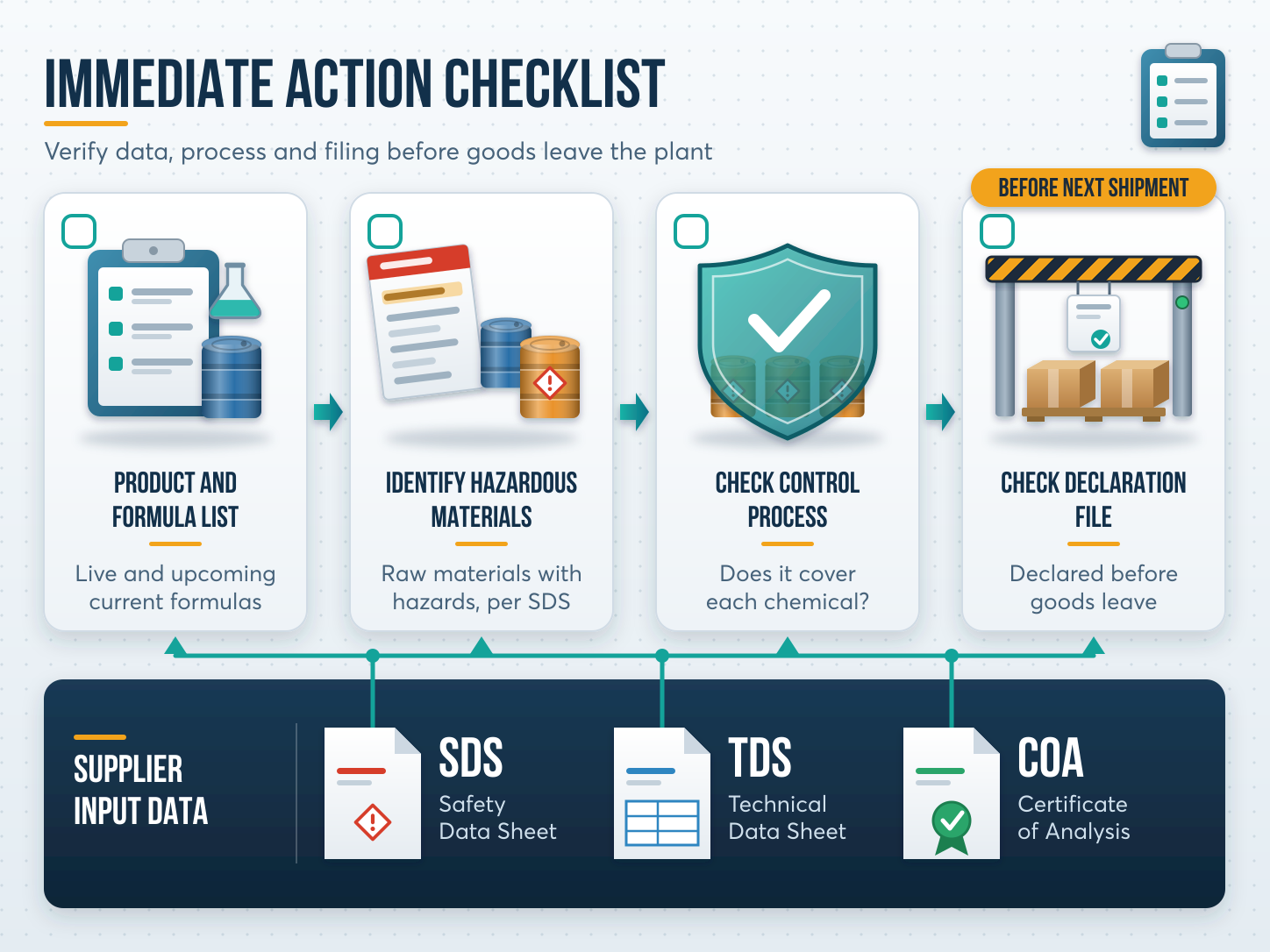
The first task is to check in the following order:
- List the products currently on or about to enter the market, with their current formulas.
- For each product, identify which raw materials contain hazardous chemicals, based on the SDS of those raw materials.
- Check the existing control process against Article 28: does the process cover the hazardous chemicals just identified?
- Check the disclosure file against Article 29, and verify that the file is complete before the shipping date of the nearest batch.
The detailed scope of application and any exemptions must be read directly in the original text. The decree may exclude some cases or provide separate rules for them, so a factory should not conclude that it is outside the scope based only on its product name or industry.
Input data from suppliers is the part the factory can act on immediately. Input chemical raw materials should come with a complete SDS, TDS and COA for each batch. The SDS shows the hazardous chemicals in the raw material. The TDS gives the technical specifications of the raw material so R&D can cross-check the formula. The COA confirms the quality of the exact batch received. These three documents are the input for the disclosure file, and should be required in full from the time the supplier is approved. A factory that lacks complete documents for the batch in use should send a request for the missing items before disclosing, because a file based on incomplete data will have to be corrected.
Factories in paints and printing inks, adhesives, lubricants or plastics can all find themselves in this situation when the finished product is a mixture of several raw materials. Disclosure depends on the actual composition, not on the industry.
Frequently asked questions
When does Decree 26/2026/ND-CP take effect?
The decree takes effect on the date of signing, under Clause 1, Article 31, and was issued on January 17, 2026. Factories should use this date as the reference point when reviewing their files, and then separately check the March 1, 2026 date in Clause 8, Article 30 to see where they stand against the compliance deadline.
Must hazardous chemicals in products be disclosed before or after selling?
They must be disclosed before placing goods on the market, under Article 29. The file must be finished before the first batch leaves the warehouse. The factory should place the disclosure step in the batch release schedule, alongside the quality check of the finished product, so the goods are not blocked at delivery.
If imported chemicals are already declared, is disclosure of chemicals in products still needed?
It may still be needed, because these are two obligations under two different groups of provisions. Import declaration covers chemicals when they enter Vietnam, while disclosure of information on hazardous chemicals in products falls under Chapter IV. The scope of application and exemptions must be read in the original text.
What is the compliance deadline for hazardous chemicals in products?
The compliance deadline is before March 1, 2026, under Clause 8, Article 30. This date has passed, so a factory with products containing hazardous chemicals about to go to market should review its process under Article 28 and its file under Article 29 now. How the deadline applies to each case must be checked against the original text.
Conclusion
Factories must disclose hazardous chemicals in products because Decree 26/2026/ND-CP requires this information to reach buyers and regulators before goods are distributed. Hazardous chemicals remain in the finished product where no one can see them unless the factory discloses them, and the compliance deadline has passed.
- Basis: Decree 26/2026/ND-CP, Chapter IV, effective from the date of signing (Clause 1, Article 31).
- Article 28: control process for hazardous chemicals in manufacturing. Article 29: declaration and disclosure before distribution.
- The compliance deadline of before March 1, 2026 (Clause 8, Article 30) has passed, so a review is needed now.
Send us the list of input raw materials with the current SDS, TDS and COA for your line, and the Vichem technical team will help cross-check the composition data source for your disclosure file.
Vichem is a distributor of chemical additives and equipment from leading brands such as Covestro, Sinopec, TotalEnergies Corbion, Bühler and Tinox in the Vietnamese market.
For more information about our products, please contact us through the following channels:
- Hotline: 08 1790 1790
- Zalo OA: Vichem JSC
- Email: contact@vichem.vn
- LinkedIn: Vichem JSC
- Website: www.vichem.vn
- Facebook: Vichem JSC