When colored plastic stains paper, hands or white plastic parts in contact with it, the fix for pigment migration in plastic is to choose a pigment with low solubility in the plastic matrix and additives, and to cut back the plasticizer or mobile additives that carry the color out. Before you switch pigments or materials, check the base resin, whether it contains a plasticizer, the processing temperature and the pigment loading in the formulation.
Migration and surface blooming on plastic are two different defects
Migration and surface blooming on plastic are often lumped together in incident reports, but they look different on the product and are fixed differently. Classifying the defect correctly at the start saves you several trial batches spent in the wrong direction.
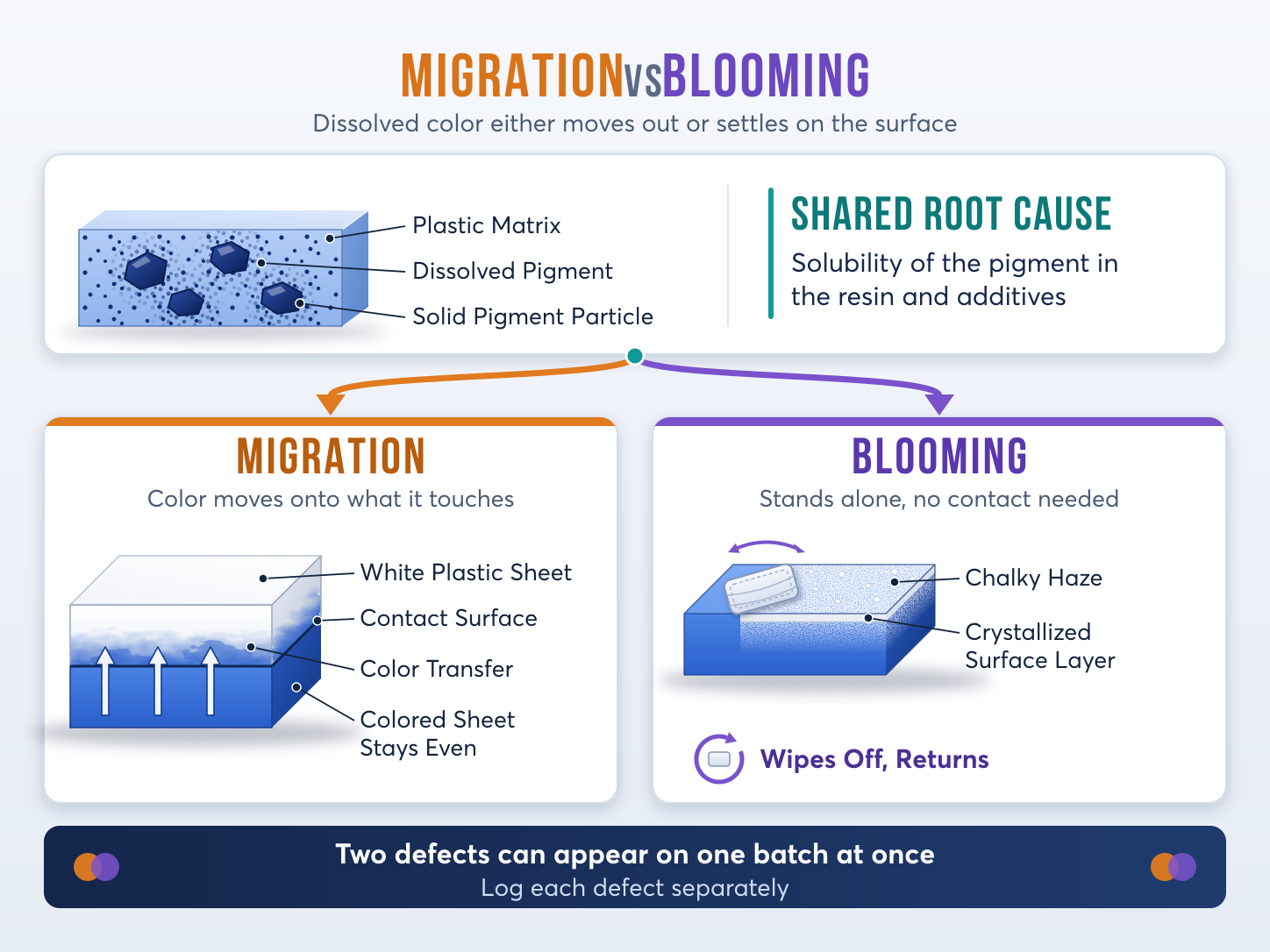
Migration (bleeding) is color transferring from the product to something in contact with it: a stacked white plastic sheet, interleaving paper, packaging, a coating layer or a person's hand. The typical sign is a color stain spreading onto the other surface, usually clearer when the two surfaces are pressed together for a long time or kept in a hot warehouse. The product itself may still look evenly colored.
Blooming is pigment accumulating and crystallizing into a colored dust layer right on the product surface. The telltale sign is that it wipes off and then returns after a few days or weeks. The surface feels chalky or hazy, and the color looks paler or shifts in shade from the outside. This dust layer sits on the product and needs no contact with any other object.
Both defects share the same root cause: the solubility of the pigment in the plastic matrix and additives. The dissolved portion of the color moves through the plastic and then either transfers to a contacting object (migration) or stops and crystallizes at the surface (blooming). A single lot can therefore show both defects at once, but they are recognized differently on the line and in the warehouse, and you should record each defect separately.
Why pigment migration in plastic happens
The root of the defect is that pigment does not stay entirely put as solid particles in the plastic matrix. Organic pigments are partly soluble in the plastic matrix: a small fraction of the color molecules dissolves into the plastic and additives, much as sugar dissolves in water, while the rest remains as dispersed particles. The solid particles are held fixed in the matrix, but the dissolved portion can move.
The dissolved portion diffuses from a high-concentration zone (inside the product) to a low-concentration zone (the surface or a contacting object). This process is slow in rigid plastic, so the defect often shows only after the goods have shipped, reached the customer, or even after several weeks in storage. Inorganic pigments barely dissolve in the plastic matrix, so this mechanism is uncommon with them.
Resin systems with soft additives favor diffusion. The plasticizer in soft PVC is a liquid or semi-liquid sitting between the polymer chains. It acts as a solvent: pigment dissolves into the plasticizer more easily than into the resin, and the color is carried along as the plasticizer moves. Other mobile additives, such as lubricants, waxes or antistatic agents, can play the same role.
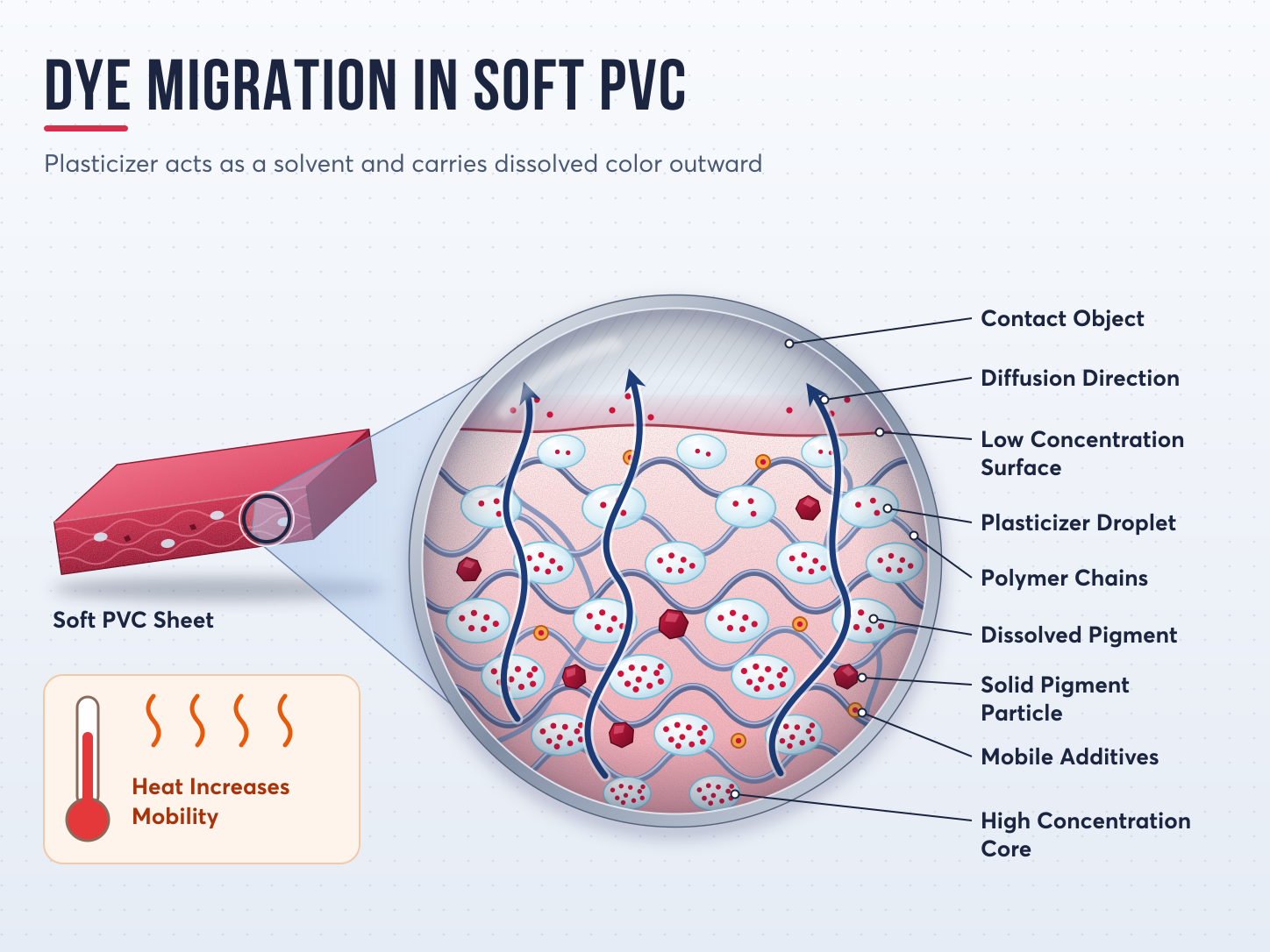
The softer the matrix, the more mobile the polymer chains and the faster the color diffuses. High temperature increases both the mobility of the matrix and the solubility of the pigment, so products stored hot, or stacked right after demolding, migrate more easily.
Two factors sit directly in the formulation and processing:
- Pigment loading above the solubility limit: when the amount of pigment added exceeds what the plastic matrix and additives can hold in dissolved form, the excess is pushed to the surface and crystallizes, which shows up as blooming. Running a deeper shade by raising the loading is a common situation.
- Processing temperature too high: at high temperature, more pigment dissolves in the matrix. On cooling, the matrix can no longer hold that amount of color, so it becomes oversaturated and separates out over time.
Both factors increase the amount of dissolved color in the plastic, which means more color available to move. On an extruder or injection molding machine, the result is a product that looks acceptable straight out of the mold, but the defect appears only after it has cooled, been packed and sat in the warehouse.
How to find the cause of color migration in plastic
Before you change the pigment, determine whether the defect comes from the pigment or from the plastic formulation. The two checks below can be done right in the plant's test lab.
Contact press test with a white sample
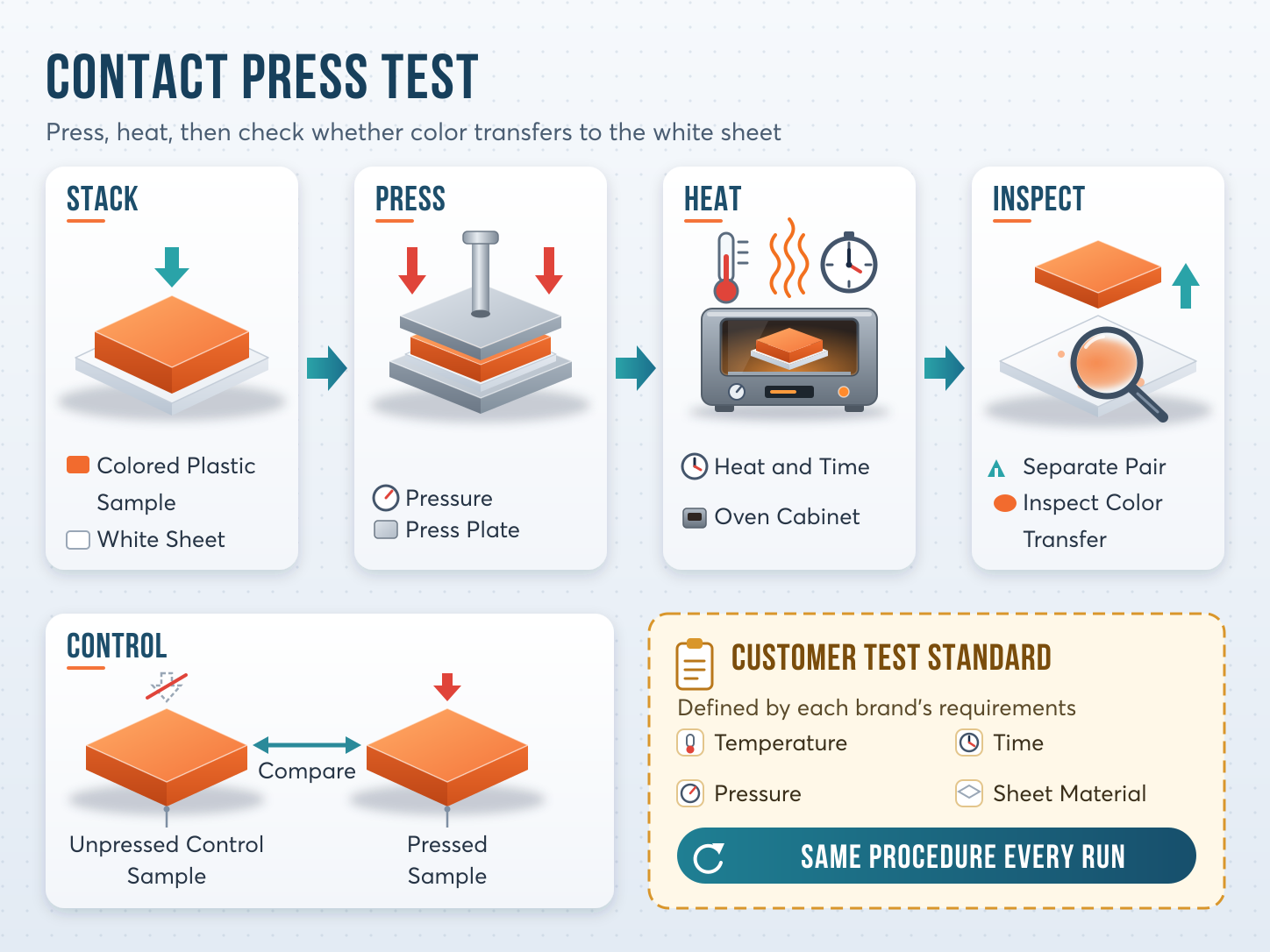
The principle of the test: press the colored plastic sample against a white plastic sheet or white paper, hold it at high temperature for a period of time, then see whether the color has transferred to the white sample. High temperature speeds up diffusion, so the defect shows after a short time instead of after weeks of waiting.
The standard method follows the customer's in-house test standard: temperature, time, pressing pressure and the white sample material depend on each brand's requirements. Use the same procedure for every test so you can compare between formulations. Also keep an unpressed control sample for color comparison.
Signs that separate a pigment cause from a plastic formulation cause
Compare the defect across the resins and formulations currently running:
- Only occurs in plasticized plastic: points to the additive system. With the same pigment, a rigid resin with no plasticizer shows no defect, meaning the plasticizer is acting as a solvent that carries the color.
- Occurs in many different resins: points to the pigment itself. This pigment dissolves too much in the resins you are using.
- A colored dust layer that wipes off and returns: this is blooming, usually tied to a pigment loading above the solubility limit or overheated processing.
If the color spreads unevenly as streaks or spots instead of transferring uniformly, also check the dispersion step, because agglomerated particles create color streaks too. These defects are described in 5 pigment dispersion defects in paint and how to fix them; the same dispersion principles apply when coloring plastic.
How to fix pigment migration in plastic
The fix splits into two sides: switching to a migration-resistant pigment, and adjusting the formulation and processing. Run the contact press test after each change, changing one variable at a time so you know which one works.
Fixes on the pigment side: migration-resistant pigments
The first option is to move to a pigment with higher migration resistance in the exact resin you are using. This resistance depends on the pigment and resin pair, so a grade that holds up in one matrix may not hold up in another, especially when the matrix contains a plasticizer.
When comparing pigment grades for plastics, read two items on each grade's TDS: the migration resistance rating and the resin used in testing that rating. Compare ratings only when the test resin is the same as or close to yours. Also check whether the TDS includes a note about plasticizers.
If the required color allows it, consider an inorganic pigment, because its solubility in the plastic matrix is very low. Inorganic pigments have their own limits in color range and brightness; the selection principles for this group, although written for exterior paint, can be found in how to choose inorganic pigments for exterior paint.
Vichem distributes organic and inorganic pigments for paint and plastics from the supplier Zealan. When you send a replacement request, include the base resin, the plasticizer system, the target color and a description of the defect, so our technical team can recommend a suitable type and support sample trials.
Fixes on the plastic formulation and processing side
If the defect occurs only in plasticized matrices, or the pigment is already the right type and the defect persists, adjust the formulation and the line:
- Reduce the pigment loading to a level the resin can hold. If the color turns pale, consider combining it with another colorant instead of only raising the loading.
- Review the type and amount of plasticizer. A plasticizer with poor compatibility with the resin tends to move out and drag color with it; reducing the amount or changing the type can reduce migration.
- Lower the processing temperature within the permitted limits of the resin and additives, so the color does not become oversaturated on cooling.
- Check dispersion. Coarse pigment particles are hard to disperse evenly, so operators often raise the loading to make up the color. Milling methods and particle fineness are discussed in how to choose a pigment milling method for industrial paint.
- Retest with the contact press test using the same procedure as before, to compare results before and after the adjustment.
Frequently asked questions
Which pigments are least prone to migration in plastic?
Pigments with low solubility in the plastic matrix and additives migrate less, and inorganic pigments are generally less soluble than organic pigments. For organic colors, choose a grade whose TDS migration resistance rating was tested in a resin like yours, then confirm it with the contact press test.
Why is soft PVC more prone to migration?
Soft PVC contains a liquid plasticizer sitting between the polymer chains. Pigment dissolves into the plasticizer more easily than into the resin, and the soft matrix lets the color diffuse quickly. When the product touches another object, the color leaves with the plasticizer.
How do you fix surface blooming of plastic pigment?
First reduce the pigment loading to a level the resin can hold, since blooming is the excess crystallizing out on the surface. Then check the processing temperature and the type of plasticizer. If the dust layer keeps coming back, switch to a pigment that is less soluble in that matrix.
Does raising the processing temperature increase pigment migration?
Yes, because high temperature makes more pigment dissolve in the plastic matrix. When the product cools, the dissolved color exceeds what the matrix can hold and is likely to separate out or move to a contacting object. Lowering the temperature within the resin's permitted limits is therefore one step to check.
Conclusion
Migration in plastic comes from pigment that is partly dissolved in the plastic matrix and additives and then moves out. Determine whether the defect is migration or blooming, run the contact press test to find the source, then choose a fix on the pigment side or the formulation side.
- Tell migration apart from blooming before you act.
- The root cause is the portion of pigment dissolved in the plastic matrix and additives.
- Run the contact press test first, then change the pigment or adjust the formulation.
Send us the base resin, plasticizer formulation, processing conditions and photos of the defect, and the Vichem technical team will work with you to check the cause and recommend a suitable pigment.
Vichem is a distributor of chemical additives and equipment from leading brands such as Covestro, Sinopec, TotalEnergies Corbion, Bühler and Tinox in the Vietnamese market.
For more information about our products, please contact us through the following channels:
- Hotline: 08 1790 1790
- Zalo OA: Vichem JSC
- Email: contact@vichem.vn
- LinkedIn: Vichem JSC
- Website: www.vichem.vn
- Facebook: Vichem JSC