In the interior paint industry, film-forming resin is one of the most critical components. It determines the adhesion, hiding power, and smoothness of the paint layer after application. Choosing the wrong type of resin may cause the paint surface to deteriorate quickly or experience peeling after a short period of use.
Today, the market increasingly favors interior paints with low VOC content, low odor, and improved safety for living spaces. Therefore, water-based acrylic resin systems are being widely used in many premium interior paint formulations.
RESINS USED IN INTERIOR PAINTS
In paint formulations, resin is the component that binds pigments, extenders, and other additives together to form a complete film after drying. In the coating industry, resin is commonly referred to as a binder or resin.
For interior paints, resin not only helps the coating adhere to wall surfaces but also directly influences the final appearance of the project. Smoothness, hiding power, and stain resistance are all related to the type of resin used in the formulation.
According to many technical coating references, acrylic resin is currently one of the most widely used resins in modern water-based paints due to its excellent film-forming properties and high stability.
WHY IS RESIN IMPORTANT IN INTERIOR PAINTS?
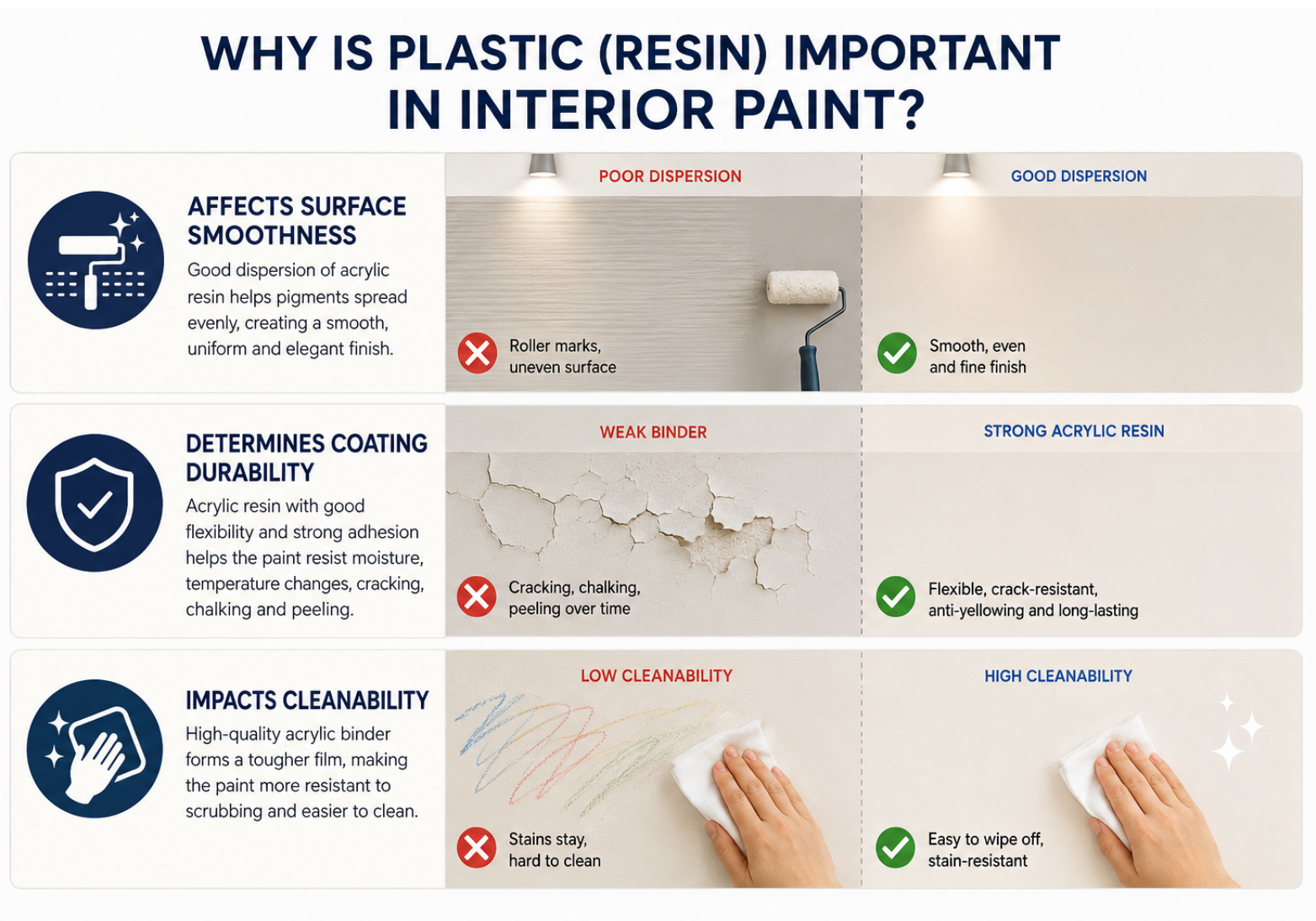
Impact on Surface Smoothness
Interior paints require a uniform coating with a smooth appearance when viewed directly under light. If the resin has poor dispersing capability, the paint film may develop roller marks or an uneven surface.
Modern acrylic systems help pigments disperse more consistently during application. This results in a flatter and smoother paint film after drying. Many acrylic emulsions are also designed to improve matte finish and uniformity for premium interior paints.
Determines Coating Durability
Interior paints are frequently exposed to humidity, temperature fluctuations, and periodic cleaning. If the resin has weak binding performance, the paint layer may chalk or peel over time.
Acrylic resins offer better elasticity than many traditional vinyl systems. This helps maintain coating stability under changing environmental temperatures. In addition, acrylic provides better crack resistance and yellowing resistance compared to many low-cost resin systems.
Influence on Washability
Today’s consumers are concerned not only with color but also with the cleanability of interior paints. Paints with good washability typically use high-quality acrylic binders. In fact, many all-acrylic systems can significantly improve scrub resistance and wash durability for interior paints.
COMMON TYPES OF RESINS USED IN INTERIOR PAINTS
Acrylic Resin
Acrylic is currently the most widely used resin group in the water-based paint industry. This type of resin offers excellent film-forming ability, high durability, and strong resistance to yellowing over time.
The major advantages of acrylic include strong adhesion, good alkali resistance, and low VOC content. This is also why many international coating manufacturers focus on developing water-based acrylic systems for interior paints.
Styrene Acrylic
Styrene acrylic is a resin system combining styrene and acrylic monomers. This type of resin is commonly used in economy and mid-range paint segments.
Its greatest advantage is cost-effectiveness and relatively easy processing. However, the color retention and weather resistance of this system are generally lower than those of pure acrylic. Styrene-acrylic binders are typically suitable for contractor paint lines that require optimized production costs.
Vinyl Acrylic
Vinyl acrylic was once widely used in low-cost water-based paints. This resin system offers low production costs and easy manufacturing. However, its moisture resistance and durability are not as high as those of pure acrylic systems. Under prolonged humid conditions, the paint film may deteriorate more quickly.
Many coating references indicate that paint manufacturers are gradually reducing the proportion of vinyl in premium interior paint lines to improve long-term coating durability.
Modified Alkyd
Some specialty coatings still use modified alkyds to enhance gloss and film hardness. However, alkyd systems generally have higher VOC content compared to water-based acrylic systems.
According to many international coating references, the current trend is reducing the use of solvent-based alkyds in interior spaces due to increasingly strict VOC regulations.
IMPORTANT CRITERIA WHEN SELECTING RESINS FOR INTERIOR PAINTS
When selecting resins for interior paints, manufacturers must consider multiple technical factors. The first is film-forming capability. A high-quality resin helps create a uniform paint surface while minimizing pinholes and roller marks.
Next is adhesion performance, which is essential for maintaining long-term coating stability on cement walls or putty surfaces. In addition, VOC content has become an increasingly important consideration.
Stain resistance and washability are also critical for modern interior paints. Consumers now prefer paint products that are easy to clean and maintain surface cleanliness for a longer time.
RESIN TRENDS IN THE INTERIOR PAINT INDUSTRY
The coating industry is rapidly shifting toward waterborne systems to reduce environmental impact and improve user experience. According to various coating market reports, waterborne acrylic and styrene acrylic are currently the fastest-growing resin groups in the architectural paint sector.
Beyond low VOC performance, chemical manufacturers are also focusing on developing multifunctional binders. Some modern resin systems can enhance stain resistance, improve hiding power, and reduce the amount of TiO₂ required in paint formulations.
CONCLUSION
Resin is the core component that determines the quality of interior paints. Among current resin systems, water-based acrylic remains the most suitable option thanks to its excellent film-forming performance, low VOC content, and high durability.
Current market trends increasingly favor low-odor, easy-to-clean, and environmentally friendly paints. This has driven growing demand for high-quality acrylic binders in the interior coatings industry.
For paint manufacturers, selecting the right resin not only improves product quality but also enhances market competitiveness.
VICHEM – AUTHORIZED DISTRIBUTOR OF CHEMICAL ADDITIVES FROM LEADING BRANDS SUCH AS COVESTRO, SINOPEC, BUHLER,… IN VIETNAM
Vichem is an authorized distributor of chemical additives from leading brands such as Covestro, Sinopec, Buhler,… in the Vietnamese market. We not only provide high-quality products but also deliver after-sales services that meet international standards.
For more information about our products, please contact us through the following channels:
📞 Hotline: 08 1790 1790
📧 Email: contact@vichem.vn
🔎 LinkedIn: Vichem JSC
🌐 Website: www.vichem.vn
📌 Facebook: Vichem JSC