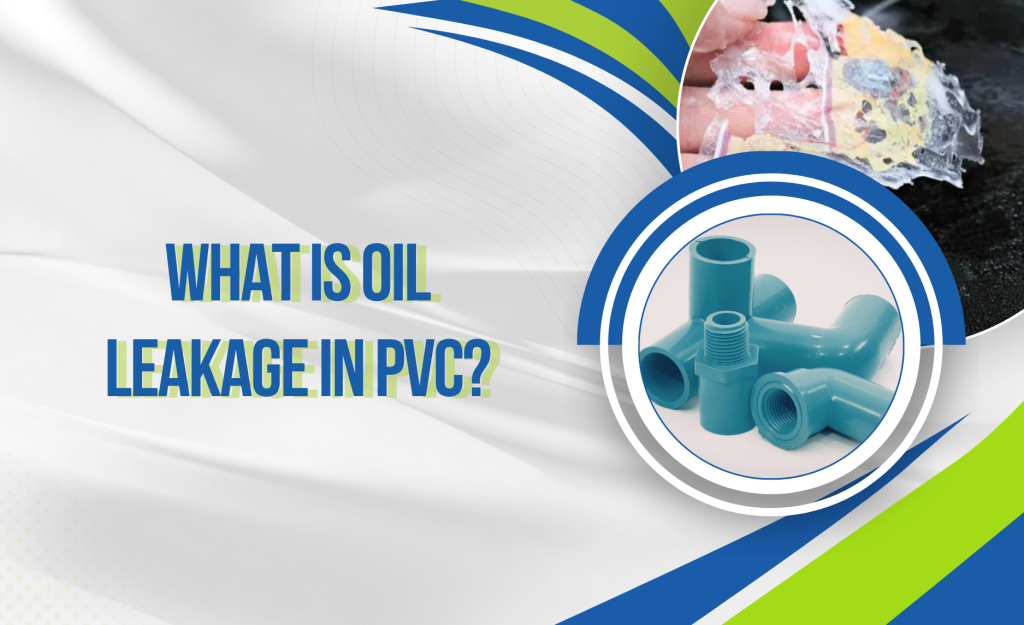
In the production of flexible PVC, plasticizers are indispensable components. They make the material more flexible and easier to process. However, the use of plasticizers also introduces an important technical issue—oil bleeding.
This phenomenon occurs quite frequently in practical manufacturing. It not only affects the product surface but also impacts durability and performance. If not properly controlled, businesses may face significant risks in quality and cost.
WHAT IS OIL BLEEDING IN PVC?
Oil bleeding in PVC is the process in which plasticizers migrate from inside the material to the surface. This process is also referred to as plasticizer migration. It is an undesirable but fairly common characteristic in flexible PVC products.
Under normal conditions, plasticizers are distributed between polymer chains, helping the material remain soft and flexible. However, when influenced by environmental factors or improper formulation, these molecules can separate and move outward.
The most visible sign is a greasy or sticky surface. In some cases, a thin oil layer may appear. The surface tends to attract dust and loses its aesthetic quality. This phenomenon can occur immediately after production or after a period of use.

CAUSES OF OIL BLEEDING
Temperature
Oil bleeding in PVC is influenced by various factors, with temperature being the most significant. As temperature increases, the polymer structure expands, creating internal voids. This allows plasticizer molecules to migrate more easily.
Humidity
Humidity is another important factor. In high-humidity environments, migration occurs more rapidly. Water can act as a medium that facilitates the movement of plasticizer molecules within the material structure.
Resin quality
The quality of PVC resin also plays a major role. If the polymer structure is non-uniform, the material will contain more voids, which facilitate plasticizer migration. In contrast, high-quality resin has a denser structure and retains plasticizers more effectively.
Plasticizer type
The type of plasticizer used is also critical. Some plasticizers have low compatibility with PVC, making them more prone to separation. Additionally, excessive plasticizer content can disrupt system balance, leading to phase separation and oil bleeding.
Moreover, contact with other materials can also trigger this phenomenon. Plasticizers may migrate into adhesives, coatings, or adjacent materials. This not only reduces PVC quality but also causes defects in related materials.
IMPACT ON PRODUCT QUALITY
Oil bleeding directly affects the quality of PVC products. As plasticizers are lost, the material becomes harder. Flexibility decreases, and the risk of cracking increases. This shortens the product’s lifespan.
The product surface is also significantly affected. The presence of an oily layer reduces aesthetic quality. Dust easily adheres and is difficult to clean. In many applications, this is unacceptable.
Additionally, oil bleeding complicates processing. The oily layer can reduce the adhesion of paints or adhesives, leading to defects in finishing processes.
Some plasticizers may also pose health concerns. When they migrate into the environment, they can accumulate and cause long-term effects. Therefore, controlling oil bleeding is not only a technical issue but also a matter of safety.

DETECTION AND EVALUATION METHODS
In practice, oil bleeding can be identified through direct observation. The surface may feel slightly sticky to the touch and appear glossier than usual. In some cases, visible oil traces can be observed.
However, accurate evaluation requires more advanced testing methods. Thermal aging tests are commonly used. Additionally, the remaining plasticizer content in the material can be analyzed.
Regular inspection helps detect issues early, which is especially important in large-scale production. It allows businesses to minimize risks and additional costs.
SOLUTIONS TO CONTROL OIL BLEEDING
Controlling oil bleeding requires a multi-faceted approach. First is selecting appropriate plasticizers. Those with high compatibility with PVC are less likely to migrate. Plasticizers with higher molecular weight are also more stable within the material.
The formulation must be optimized. Plasticizer dosage should be carefully calculated. Excessive use increases the risk of oil bleeding, while insufficient use affects mechanical properties.
Raw material quality must also be strictly controlled. PVC resin should have a stable and uniform structure to better retain plasticizers and reduce migration risks.
Environmental conditions during production and storage are equally important. Temperature and humidity should be controlled at appropriate levels to minimize external impacts.
In addition, the use of stabilizing additives is an effective solution. Some additives help retain plasticizers within the polymer structure, improving durability and product lifespan.
CONTROL TRENDS IN THE PLASTICS INDUSTRY
The plastics industry is undergoing changes to minimize oil bleeding. One clear trend is the use of environmentally friendly plasticizers. These are not only safer but also more stable.
At the same time, polymer technology is improving. New materials are better at retaining plasticizers, significantly reducing migration.
Businesses are also placing greater emphasis on quality control. Raw materials and finished products are tested more rigorously to ensure compliance with technical standards and market requirements.
CONCLUSION
Oil bleeding in PVC is a common but controllable issue. It originates from the migration of plasticizers within the material. If not properly managed, it can significantly affect product quality and durability.
To minimize risks, businesses must focus on raw material selection and formulation optimization. At the same time, controlling production conditions and conducting regular testing are essential.
In an increasingly competitive market, effectively controlling oil bleeding helps improve product quality and build long-term credibility.
VICHEM – AUTHORIZED DISTRIBUTOR OF CHEMICAL ADDITIVES FROM LEADING BRANDS SUCH AS COVESTRO, SINOPEC, BUHLER,… IN VIETNAM
Vichem is an authorized distributor of chemical additives from major brands such as Covestro, Sinopec, Buhler,… in the Vietnamese market. We not only provide high-quality products but also deliver international-standard after-sales services.
For more information, please contact us via:
📞 Hotline: 08 1790 1790
📧 Email: contact@vichem.vn
🔎 LinkedIn: Vichem JSC
🌐 Website: www.vichem.vn
📌 Facebook: Vichem JSC