In the materials and industrial chemicals industry, fillers play a highly important role. This component not only helps optimize production costs but also directly affects the properties of the final product.
One of the parameters commonly mentioned when evaluating fillers is oil absorption. This parameter is widely used in the paint, plastic, rubber, and composite industries.
However, many businesses consider it merely a technical value. In reality, oil absorption reflects many material characteristics. This parameter is associated with particle structure, surface area, and interaction capability within dispersion systems.
WHAT IS OIL ABSORPTION?
Oil absorption is the ability of a filler to retain oil under specified conditions. This parameter is usually expressed as the amount of oil required to form a mixture with a certain level of plasticity.
In practice, the measurement is commonly carried out by mixing oil with filler powder until a stable agglomerated state is achieved. Each type of filler possesses a different oil absorption capacity. This depends on the particle structure and surface area of the material.
Generally, fillers with porous structures or large surface areas tend to exhibit higher oil absorption.
WHY IS THIS PARAMETER IMPORTANT?
Oil absorption is not merely a technical parameter in product documentation. It also reflects the interaction capability of fillers within a material system. When fillers absorb more oil, the formulation system requires a greater amount of resin or solvent to achieve suitable viscosity. This directly affects production costs and processability.
In many cases, oil absorption is also related to the dispersibility of materials. If the particle structure is overly complex, the dispersion process becomes more difficult to control. In addition, this parameter also affects hardness, mechanical strength, and the stability of the final product.
RELATIONSHIP WITH PARTICLE STRUCTURE
Particle structure is a major factor affecting the oil absorption of fillers. Materials with complex particle shapes generally possess larger contact areas. This increases their ability to retain oil on the surface. Conversely, particles with dense structures and smooth surfaces usually exhibit lower oil absorption.
Particle size also plays an important role. As particle size decreases, the specific surface area increases. This results in a higher amount of oil required during the dispersion process. In the materials industry, this factor must be tightly controlled to ensure production system stability.
EFFECT ON SYSTEM VISCOSITY
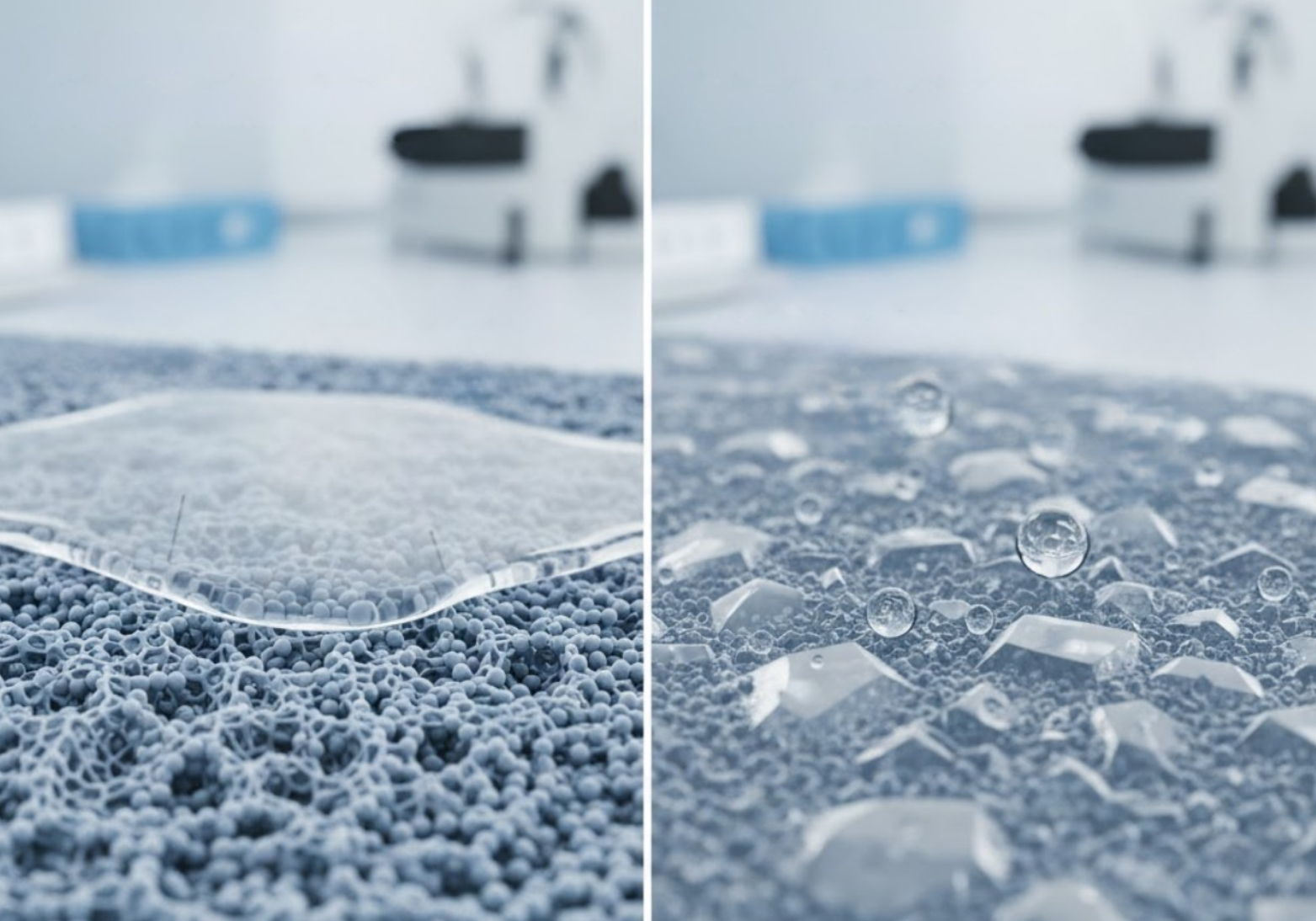
Oil absorption directly affects the viscosity of material systems. When fillers absorb more oil or resin, the amount of free liquid phase within the system decreases. As a result, the mixture becomes more viscous.
In the paint industry, excessively high viscosity may create difficulties during application. It can also affect the flowability and hiding power of the paint film.
For plastics and rubber, systems with high viscosity require greater processing energy. This may increase operational costs during manufacturing. Therefore, selecting suitable fillers is extremely important for controlling the rheological properties of material systems.
EFFECT ON MECHANICAL PROPERTIES
In many industrial applications, fillers do not only serve the purpose of reducing costs. They also directly influence the mechanical strength of products. Fillers with suitable oil absorption help enhance bonding capability within the material system. This contributes to improved hardness and product stability.
However, if oil absorption is excessively high, the system may require a larger amount of resin to completely cover the particle surfaces. This may alter the original formulation ratio. At the same time, it can affect the mechanical performance of the final product.
In the technical rubber industry, controlling this parameter is highly important to ensure load-bearing capability and elasticity.
APPLICATIONS
Paint Industry
In the paint industry, oil absorption is a parameter that is very tightly controlled. It directly affects viscosity, hiding power, and the application properties of the product.
If fillers exhibit excessively high oil absorption, the paint system will require additional resin or solvent to achieve the desired stability. This not only increases costs but may also affect the gloss and durability of the dried paint film.
Conversely, fillers with low oil absorption generally make the system easier to disperse while also improving processability in industrial production.
Plastics and Composite Industry
In the plastics industry, oil absorption significantly affects material processability. Fillers with complex structures often increase the melt viscosity of plastics. This impacts extrusion and injection molding processes.
For composites, this parameter is also related to the wetting capability between the resin matrix and fillers. If the absorption capacity is excessively high, the material system may require a larger amount of resin matrix to maintain uniformity. This changes both the cost structure and the mechanical properties of the final product.
Rubber Industry
The rubber industry extensively uses technical fillers. In rubber systems, oil absorption affects mixing capability and compound stability.
Certain highly structured fillers help enhance the mechanical properties of products. However, they also increase the demand for plasticizing oil during processing. This must be balanced to ensure both production efficiency and final product quality.
In technical rubber products, selecting the appropriate filler can directly influence tensile strength and abrasion resistance.

DEVELOPMENT TRENDS
The materials industry is currently moving toward high-performance fillers with more optimized surface structures. Many new materials are being developed to better control oil absorption while still maintaining the necessary reinforcing capability.
In addition, the trend toward VOC reduction and energy optimization in manufacturing has made rheology control more important than ever. As a result, oil absorption continues to be a key parameter in industrial material research and development.
CONCLUSION
The oil absorption of fillers is a highly significant parameter in the industrial materials sector. This parameter reflects interaction capability, surface structure, and directly influences the properties of manufacturing systems.
From paints to plastics, and from rubber to composites, oil absorption affects both processability and final product quality. A proper understanding of this parameter helps businesses select more suitable materials while optimizing production efficiency and costs.
VICHEM – AUTHORIZED DISTRIBUTOR OF CHEMICAL ADDITIVES FROM MAJOR BRANDS SUCH AS COVESTRO, SINOPEC, BUHLER, … IN VIETNAM
Vichem is an authorized distributor of chemical additive products from leading brands such as Covestro, Sinopec, Buhler, … in the Vietnamese market. We not only provide high-quality products but also deliver after-sales services that meet international standards.
For more information about our products, please contact us through the following channels:
📞 Hotline: 08 1790 1790
📧 Email: contact@vichem.vn
🔎 LinkedIn: Vichem JSC
🌐 Website: www.vichem.vn
📌 Facebook: Vichem JSC