In previous years, interior paints were mainly evaluated based on color and hiding power. However, current market demands have changed significantly. Users are no longer concerned only with aesthetics. They also pay close attention to durability, cleanability, and the safety level of living spaces.
This trend is driving the coating industry to develop multifunctional paint systems. One of the most prominent technologies today is nano coating. Through the application of nanomaterials, modern interior paints can improve durability, stain resistance, and antimicrobial performance effectively.
This is also why many major paint manufacturers are heavily investing in nano technology for next-generation waterborne coating systems.
WHAT IS NANO TECHNOLOGY IN INTERIOR PAINTS?
In the coating industry, nano technology refers to the use of ultra-fine material particles in paint formulations. These particles are typically only a few nanometers in size. Due to their extremely small dimensions, nanomaterials can directly affect the microstructure of the paint film.
Unlike conventional additives, nanomaterials do not improve only a single property. They can simultaneously enhance hardness, stain resistance, and coating durability. This enables coatings to perform more consistently in interior environments.
Currently, many premium coatings use nano TiO₂, nano silica, or nano silver. These materials help improve the performance of paint films. They are commonly combined with acrylic waterborne resins. This combination allows coatings to maintain low VOC levels while aligning with environmentally friendly trends.

WHY IS THE PAINT INDUSTRY PRIORITIZING NANO TECHNOLOGY?
Previously, users mainly focused on the color or price of interior paints. However, today’s market requires much more. Both residential and commercial projects demand coatings with high durability. In addition, coatings must be easy to clean and maintain long-term aesthetics.
In interior environments, wall surfaces are frequently exposed to dust and humidity. Routine cleaning processes also directly affect the paint film. If the coating structure is weak, the paint film can easily suffer from chalking. Surface smoothness also deteriorates rapidly over time.
Nano technology significantly improves the structure of coating films. Nano particles help fill voids within the coating layer. This makes the paint surface denser and more compact. At the same time, coatings become more resistant to dust and moisture penetration.
Modern coating trends also strongly emphasize health and environmental factors. Therefore, many paint manufacturers prioritize waterborne acrylic systems combined with nanomaterials. This solution helps reduce VOC emissions while still ensuring coating performance.
COMMON TYPES OF NANOMATERIALS IN INTERIOR PAINTS
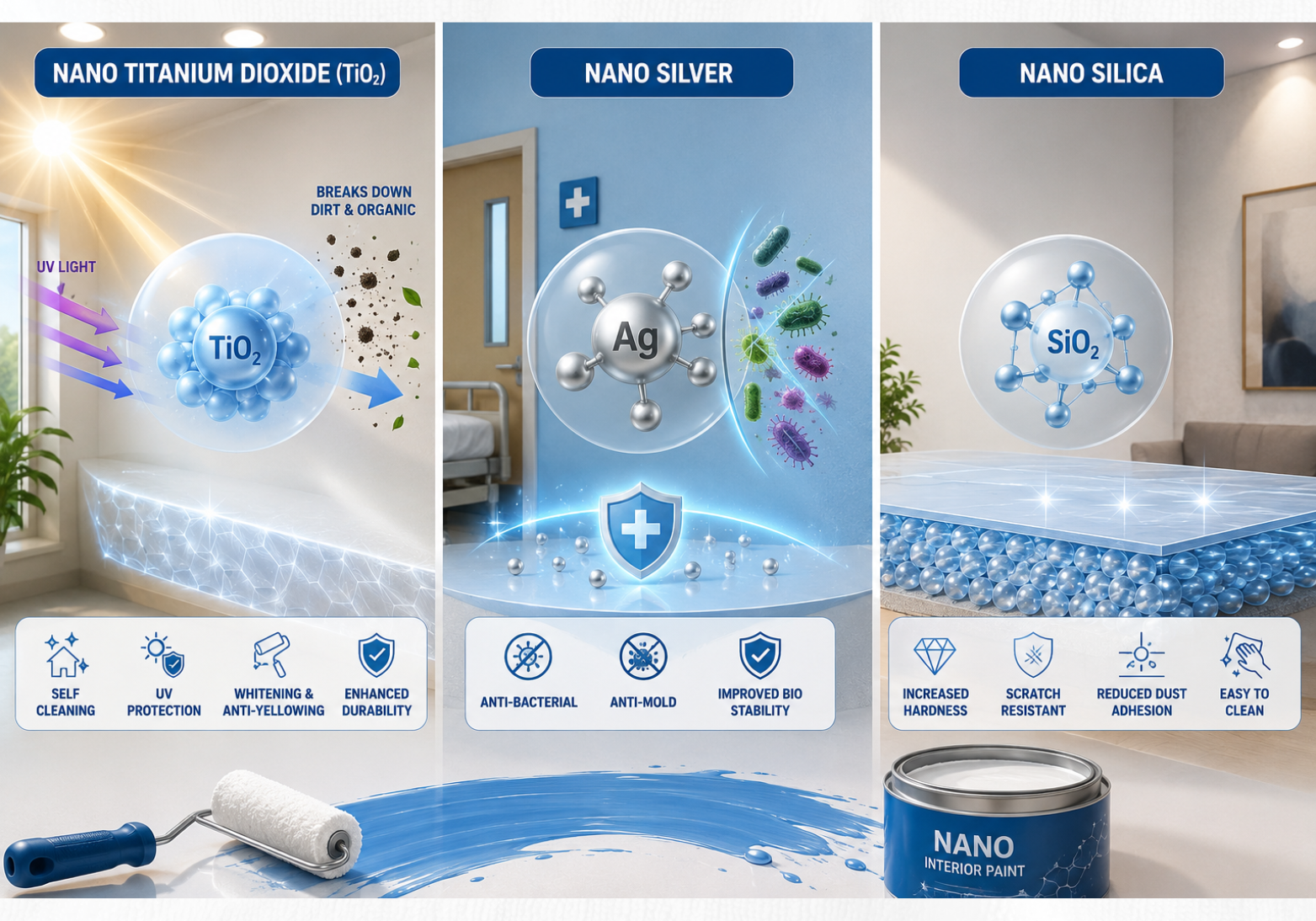
Nano Titanium Dioxide (TiO₂)
Nano Titanium Dioxide is currently the most widely used material in nano coatings. These particles are notable for their photocatalytic capability. When exposed to light, nano TiO₂ generates strong oxidation reactions. This process helps decompose dirt and organic substances adhering to the coating surface.
Nano TiO₂ supports the self-cleaning capability of coatings. In addition, this material helps increase whiteness and improve UV resistance. This is an important factor in minimizing yellowing over time.
In many modern coating formulations, nano TiO₂ is commonly combined with acrylic binders. This combination enhances the stability of the paint system. At the same time, the coating maintains better smoothness and durability under high-humidity interior conditions.
Nano Silver
Nano Silver is commonly found in premium antimicrobial paints. Nano silver particles can inhibit the growth of bacteria and mold on coating surfaces.
This technology is widely applied in hospitals and schools. In addition, nano silver is suitable for areas requiring high hygiene standards. Several coating studies indicate that nano silver can significantly reduce bacterial density on paint films.
Besides its antimicrobial properties, nano silver also helps improve the biological stability of coatings. This enables coatings to maintain quality longer in hot and humid environments.
Nano Silica
Nano Silica is mainly used to enhance the hardness of coating films. In addition, this material improves scratch resistance.
Thanks to its ultra-fine particle size, nano silica can fill microscopic voids within the coating layer. This gives the coating a denser structure. As a result, paint surfaces are less prone to dust accumulation and become easier to clean.
Many modern interior paints prioritize the use of nano silica. Besides improving durability, this material also enhances the smoothness of coating films. This creates a more premium appearance under direct lighting.
WORKING MECHANISM OF NANO COATINGS
One of the most prominent mechanisms of nano coatings is the photocatalytic effect. This mechanism is commonly found in nano TiO₂ systems. When light shines onto the coating surface, nano particles absorb energy. They then generate strong oxidation reactions.
This process helps decompose organic substances and dirt attached to the paint film. As a result, coating surfaces remain cleaner for longer compared to conventional paints.
In addition to the photocatalytic effect, many nano coatings also create superhydrophilic surfaces. When water contacts the coating layer, it spreads evenly instead of forming droplets. This allows dirt to be removed more easily during cleaning.
Nano particles also increase the bonding density of coating films. As a result, coatings achieve better water resistance. At the same time, they provide more effective stain resistance. This is why many nano paints today offer superior scrub resistance.
ADVANTAGES
Modern nano paints offer many advantages over traditional coatings. First is stain resistance. Thanks to the denser paint film structure, dirt cannot easily penetrate deep into the coating surface. This helps walls maintain cleanliness for a longer time during use.
Cleanability is also significantly improved. Nano coating systems have better scrub resistance because the paint film structure is more stable and compact.
In addition, many nano systems also provide antimicrobial and anti-mold performance. This is a factor that modern users particularly value in enclosed living spaces.
The durability of the coating film is another major advantage. Nanomaterials help coatings reduce cracking and minimize chalking. At the same time, nanomaterials also improve the UV resistance of paint films. This helps coatings maintain their aesthetics for a longer period.
DISADVANTAGES
Although nano coatings offer many advantages, the application of this technology still presents several technical challenges. The first issue is nano particle dispersion. If nanomaterials are not evenly distributed, the coating may experience particle agglomeration. This reduces the effectiveness of the coating system.
Production cost is also an important factor. High-quality nanomaterial systems are generally more expensive than conventional additives. Therefore, nano coatings are currently still concentrated mainly in the mid-range and premium segments.
In addition, the coating industry still needs strict control over the biosafety of nanomaterials. Selecting the appropriate nano system is an important factor in ensuring the long-term performance of coatings.
DEVELOPMENT TRENDS
The coating industry is currently shifting strongly toward multifunctional paint systems. This creates significant opportunities for nano technology development in the interior paint sector.
Many chemical manufacturers are now focusing on developing nano waterborne systems. The goal is to meet low-VOC and environmentally friendly requirements. In addition, coatings integrated with self-cleaning and antimicrobial properties are also growing rapidly.
In the future, nanomaterials will continue to improve coating performance. At the same time, new nano systems must still ensure user safety. This will become an important foundation for the next generation of interior paints in the modern coating industry.
CONCLUSION
Nano technology is creating significant changes in the interior paint industry. By improving the microstructure of coating films, nanomaterials help coatings become more durable and easier to clean. At the same time, coatings also provide more effective antimicrobial performance.
In modern coating trends, nano technology combined with acrylic waterborne resins is becoming a preferred solution for many companies. This solution not only improves paint quality but also better meets health and environmental requirements.
VICHEM – AUTHORIZED DISTRIBUTOR OF CHEMICAL ADDITIVES FROM MAJOR BRANDS SUCH AS COVESTRO, SINOPEC, BUHLER, ETC. IN VIETNAM
Vichem is an authorized distributor of chemical additives from major brands such as Covestro, Sinopec, Buhler, etc. in the Vietnamese market. We not only provide high-quality products but also deliver after-sales services that meet international standards.
For more information about our products, please contact us through the following channels:
📞 Hotline: 08 1790 1790
📧 Email: contact@vichem.vn
🔎 LinkedIn: Vichem JSC
🌐 Website: www.vichem.vn
📌 Facebook: Vichem JSC