In natural environments, chemicals do not always remain at their original source. Many substances can infiltrate through soil and gradually migrate into groundwater over time. This is a silent process but has the potential to cause widespread contamination.
What is concerning is that many chemicals are highly resistant to degradation. They can persist for many years in soil and underground aquifers. Once groundwater becomes contaminated, remediation is often highly complex and costly.
Currently, both the EPA and USGS consider the migration of chemicals in groundwater to be a major environmental issue. Numerous studies indicate that contaminants can travel farther than initially predicted.
DEFINITION
Chemical mobility refers to the extent to which a substance can migrate through soil and groundwater environments. This process typically occurs when water carries chemicals through different soil layers. After being released into the environment, chemicals may adsorb onto soil particles or dissolve in water. Some substances remain near the surface. However, many compounds continue to migrate deeper underground.
According to the USGS, contaminant transport depends on geological characteristics, groundwater flow, and the physicochemical properties of the chemicals. This is also one of the reasons why many areas experience persistent groundwater contamination for years.
WHY CAN CHEMICALS SPREAD THROUGH SOIL?
Water acts as the primary transport medium
Rainwater is the most important factor in the migration of chemicals. As water infiltrates the soil, contaminants can dissolve and move along with the water flow. This process occurs continuously in nature. The migration rate depends on water volume and the soil’s retention capacity.
In areas with heavy rainfall, the risk of chemicals infiltrating groundwater is generally higher. This is why chemical storage sites require strict impermeable containment systems.
Soil characteristics strongly influence migration rates
Not all soil types retain chemicals in the same way. Clay soils generally retain contaminants more effectively due to their high adsorption capacity. In contrast, sandy soils contain larger pore spaces, allowing water to pass through more quickly.
When chemicals encounter highly permeable soil layers, they can more easily migrate deeper into groundwater aquifers. This is one reason why many coastal areas face a higher risk of groundwater contamination. The USGS states that geological structure is a determining factor in the direction and rate of contaminant migration.
Chemical properties determine migration potential
Chemicals with high water solubility generally have greater mobility. Some compounds are also highly persistent in the environment and can remain for long periods.
PFAS is a typical example of a highly persistent group of chemicals. These substances can migrate through soil and groundwater for many years. Many studies now refer to PFAS as “forever chemicals” because they are extremely difficult to degrade naturally.
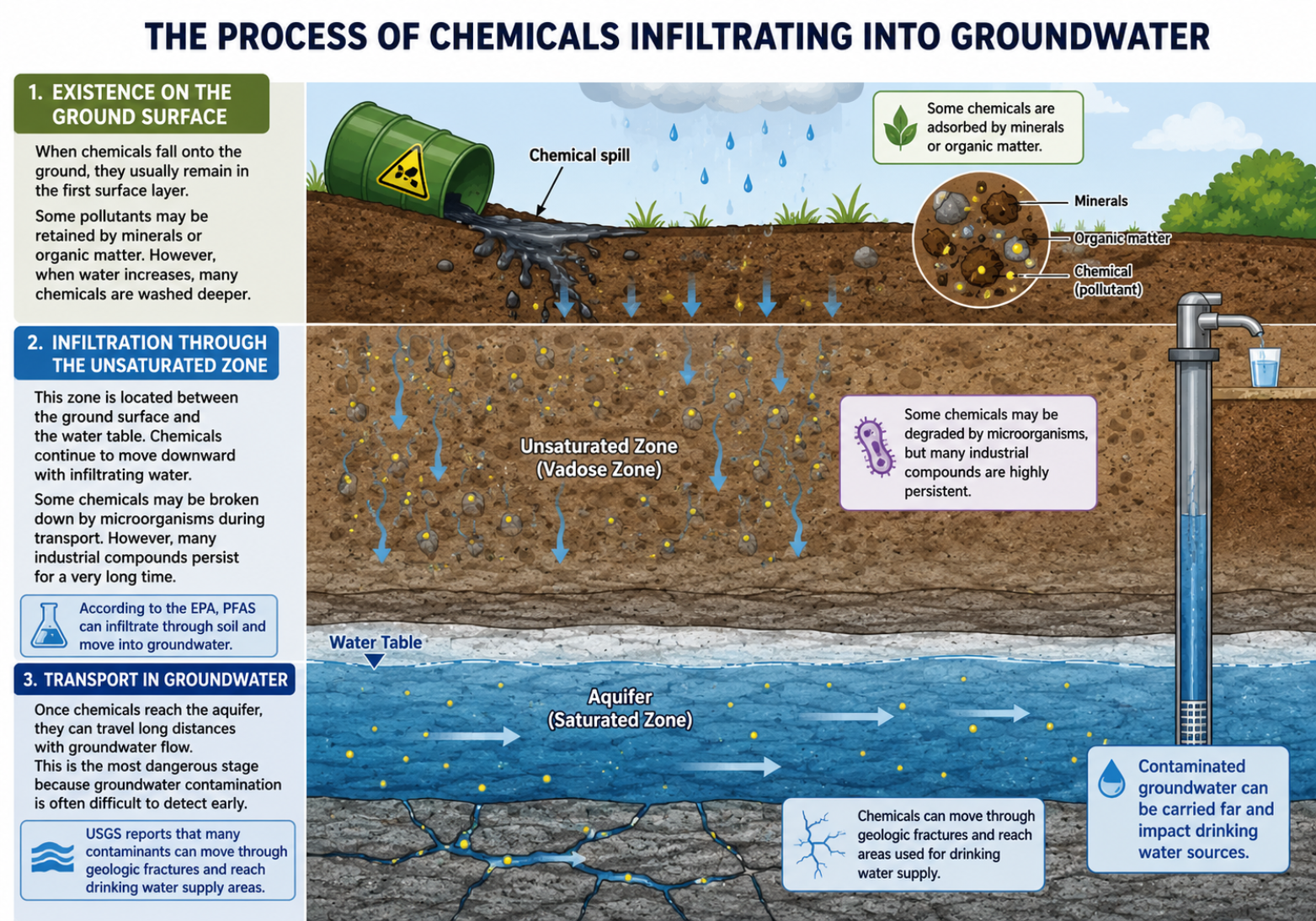
THE PROCESS OF CHEMICAL INFILTRATION INTO GROUNDWATER
Surface soil stage
When chemicals are released onto the ground, they usually remain within the topsoil layer initially. Some contaminants may be retained by minerals or organic matter. However, as water volume increases, many substances continue to be carried deeper underground.
Percolation through the unsaturated zone
This zone lies between the ground surface and the groundwater table. Within this region, chemicals continue to migrate with infiltrating water. Some substances may undergo biodegradation during transport. However, many industrial compounds remain highly persistent. According to the EPA, PFAS can infiltrate soil and migrate into groundwater aquifers.
Migration within groundwater
Once contaminants enter an aquifer, they can travel long distances along groundwater flow paths. This is the most dangerous stage because groundwater contamination is often difficult to detect early.
The USGS reports that many contaminants can migrate through geological fractures and spread to drinking water supply areas.
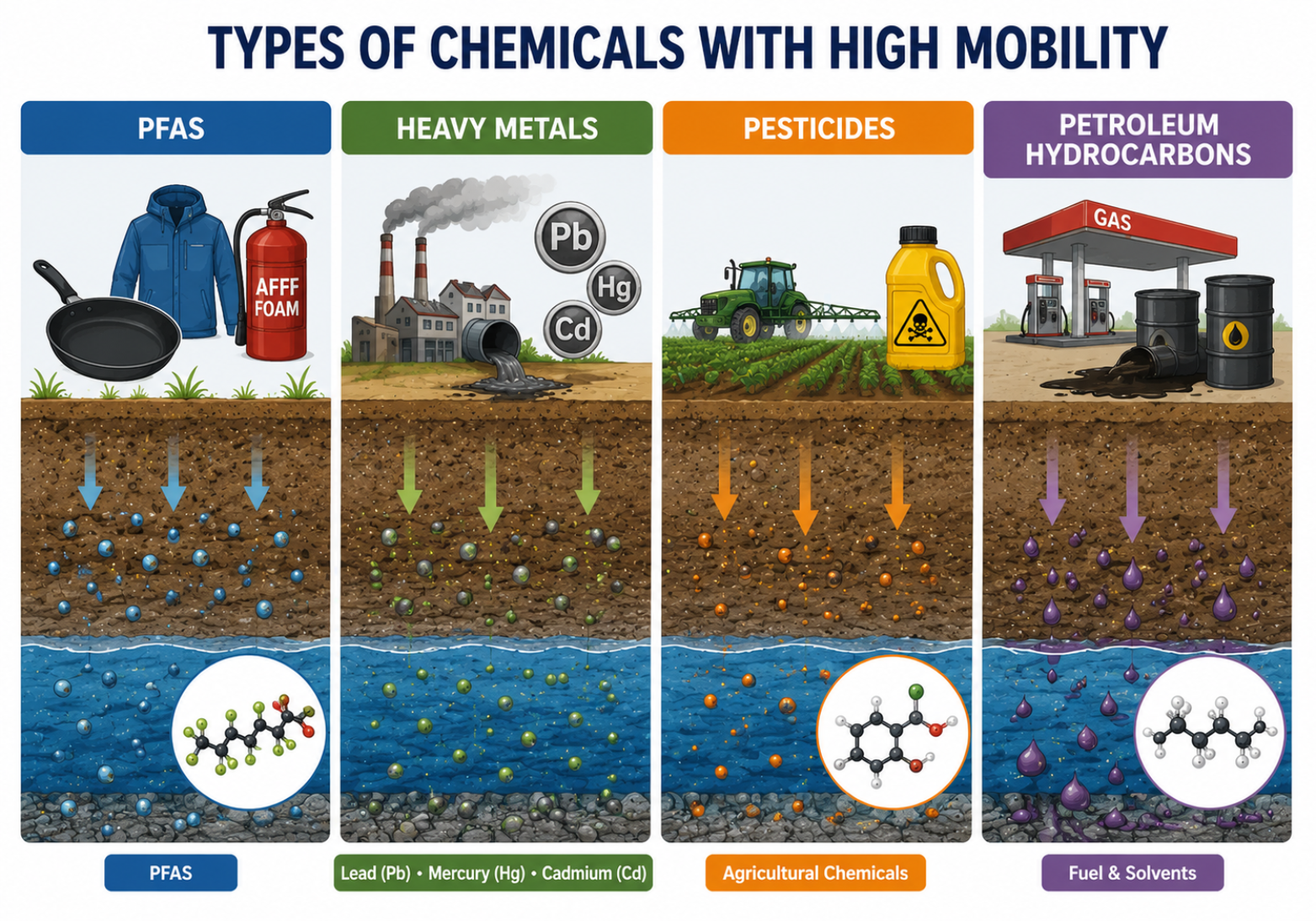
CHEMICAL GROUPS WITH HIGH MOBILITY
PFAS
PFAS is currently one of the most concerning groups of chemicals worldwide. They are widely used in non-stick coatings, textiles, and firefighting foams. The major concern is that PFAS are both highly persistent and highly mobile in water. This makes contamination control extremely difficult. Numerous studies have also detected PFAS in drinking water supplies across many countries.
Heavy metals
Lead, mercury, and cadmium are common heavy metals in industrial environments. They can persist for long periods in soil and water. Some metals readily adsorb onto soil particles and therefore migrate more slowly. However, under changing pH conditions, they may dissolve and migrate into groundwater. Heavy metals also have the potential for bioaccumulation in living organisms and food chains.
Pesticides
Many agricultural chemicals can be washed away after heavy rainfall. They migrate through soil and infiltrate groundwater sources. According to the USGS, pesticides are among the most common contaminants found in groundwater today. Some compounds can persist for years after application.
Petroleum hydrocarbons
Petroleum compounds are commonly found in fuel storage areas and gas stations. When leaks occur, these chemicals can rapidly infiltrate the soil. Some compounds are highly volatile. However, many substances continue to persist in deep soil layers and groundwater. The USGS has documented numerous cases of groundwater contamination caused by industrial solvents and fuels.
FACTORS AFFECTING CHEMICAL MOBILITY
The higher the soil permeability, the easier chemicals can migrate. This is why sandy soils generally present a higher contamination risk than clay soils. When water moves rapidly through soil, the retention capacity for contaminants decreases significantly.
In addition, when groundwater is located close to the surface, chemicals require less time to infiltrate aquifers. This is a very important factor in environmental contamination risk assessment.
Fractures in rock formations can cause chemicals to spread faster than expected. This commonly occurs in areas with complex geological conditions. The USGS states that flow through geological fractures is a major challenge in groundwater contamination control.
Some substances adsorb readily onto soil and therefore migrate more slowly. In contrast, highly water-soluble compounds can travel long distances. Short-chain PFAS are currently considered more mobile than long-chain PFAS.
IMPACTS ON THE ENVIRONMENT AND HUMAN HEALTH
Contamination of drinking water sources
Groundwater is currently an important water supply source in many regions. When contaminated by chemicals, the risk to human health increases significantly. One major concern is that groundwater contamination is often difficult to detect visually.
Impacts on human health
Many chemicals can affect the liver, kidneys, and nervous system. Some compounds are also associated with endocrine disruption and reproductive disorders. The EPA states that many studies are currently focused on evaluating the health risks associated with long-term PFAS exposure.
Impacts on ecosystems
Chemicals in soil and water can affect microorganisms, plants, and aquatic organisms. According to the USGS, many contaminants can bioaccumulate through food chains and disrupt ecological balance.

INDUSTRIES WITH HIGH CONTAMINATION RISKS
The industrial chemical sector currently poses the highest risk of chemical releases. Many solvents and additives can infiltrate soil if improperly stored.
The metallurgy and electronics industries also use significant amounts of heavy metals in production processes. Poor control measures may allow contaminants to spread into surrounding environments. In addition, modern agriculture is a major source of pesticide and nitrate emissions.
Industrial landfills and hazardous waste treatment facilities also pose long-term risks of groundwater contamination.
CONTROL MEASURES
Companies must strictly manage the storage and use of chemicals. Chemical storage areas must be equipped with appropriate leak prevention systems.
Environmental monitoring helps detect contamination risks at an early stage. This is a highly important solution in modern industrial zones. Many countries currently implement long-term groundwater quality monitoring programs to control chemical contamination.
A current trend is the replacement of persistent chemicals with more environmentally friendly materials. This helps reduce the risk of chemical accumulation in soil and water.
Wastewater and hazardous waste treatment systems must be properly designed and operated according to technical standards. If treatment is ineffective, chemicals may continue to spread into the environment for many years.
CONCLUSION
The mobility of chemicals in soil and groundwater is currently a major environmental concern. Many chemicals can spread over long distances and persist in nature for extended periods. What is particularly concerning is that groundwater contamination is often difficult to detect in its early stages. Once water sources are affected, remediation is usually highly complex and costly.
Therefore, companies must strictly control the use and treatment of chemicals in production activities. At the same time, periodic environmental monitoring also plays a very important role in reducing long-term contamination risks.
VICHEM – AUTHORIZED DISTRIBUTOR OF CHEMICAL ADDITIVES FROM MAJOR BRANDS SUCH AS COVESTRO, SINOPEC, BUHLER, … IN VIETNAM
Vichem is an authorized distributor of chemical additive products from major brands such as Covestro, Sinopec, Buhler, and others in the Vietnamese market. We not only provide high-quality products but also deliver after-sales services that meet international standards.
For more information about our products, please contact us through the following channels:
📞 Hotline: 08 1790 1790
📧 Email: contact@vichem.vn
🔎 LinkedIn: Vichem JSC
🌐 Website: www.vichem.vn
📌 Facebook: Vichem JSC