Poor pigment dispersion means the pigment particles are not separated, or they re-agglomerate after being separated. The usual causes are insufficient wetting, insufficient grinding energy, or a lack of stabilizer to keep the particles apart. To find the cause, engineers check fineness of grind with a grind gauge, track color strength over time and run a rub-out test on a wet paint film. These three results show whether the grinding process or the formulation needs adjusting.
Undispersed pigment and flocculated pigment are two different faults
The two faults are often lumped together as "poor pigment dispersion", but their causes and fixes differ.
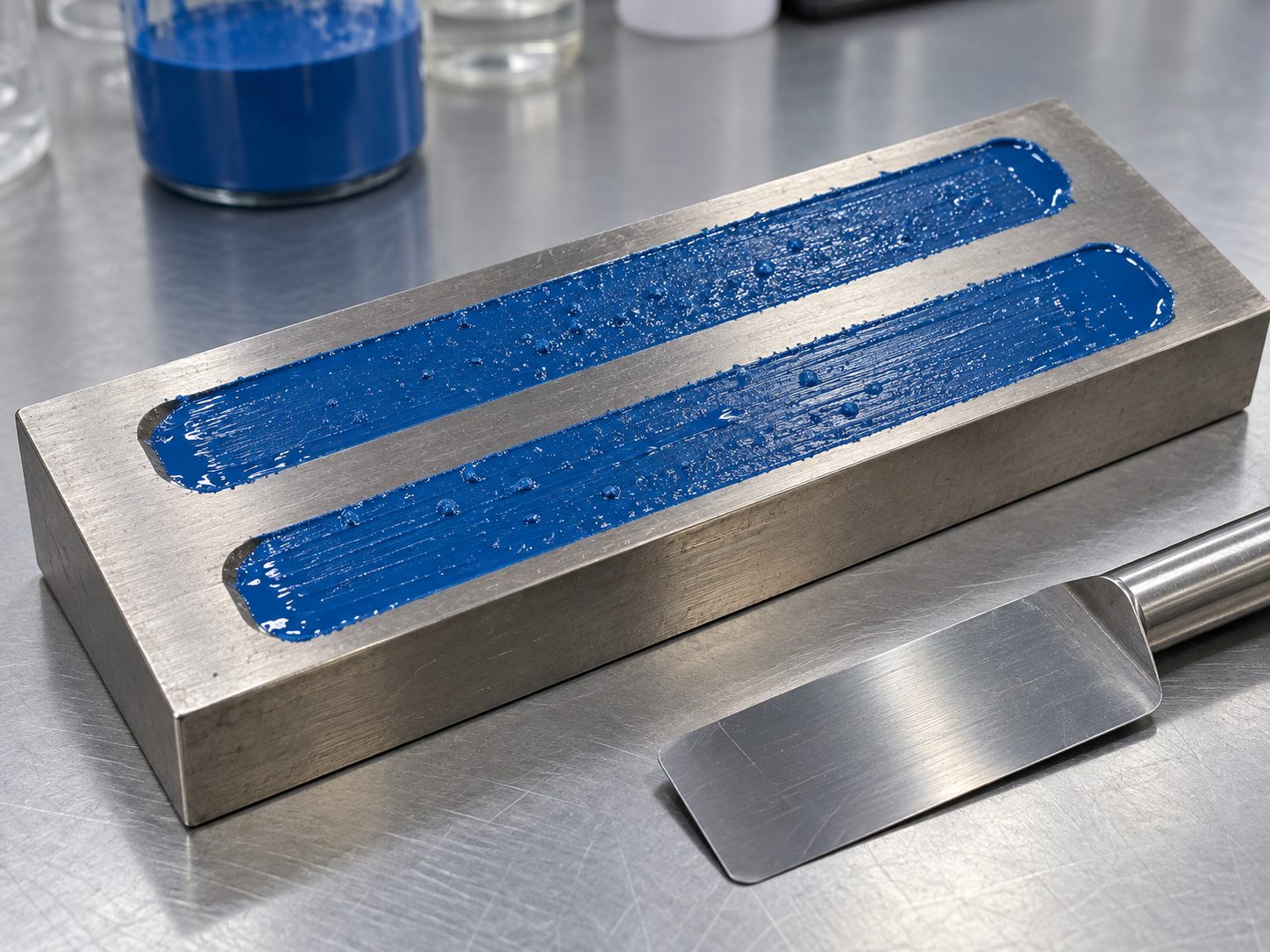
Undispersed means the pigment agglomerates were not broken down during grinding. The signs appear right after grinding: samples taken from the mill still contain coarse particles, the drawdown on the grind gauge shows specks and streaks, and the fineness of grind does not meet the formulation requirement. This fault is tied to wetting and grinding energy.
Flocculation works in the opposite direction. The batch reached the required fineness, but the separated particles are drawn back together into loose clusters during storage, dilution or mixing with resin. Typical signs are a color weaker than the sample taken right after grinding, a shift in shade, or color floating to the film surface. These clusters are weakly bound, so they do not show up in a fineness measurement and are also broken up by strong rubbing or shear. A separate test is therefore needed to detect them.
Telling the two faults apart decides where to intervene. For undispersed pigment, review the grinding step. For flocculation, review particle stabilization and the dilution method; extending grinding time in this case only adds heat and wastes energy.
The consequences of both faults are similar. Coarse particles or flocs roughen the surface, so the paint film suffers gloss reduction. The pigment does not use its full surface area, so color strength and hiding power are lower than expected. Agglomerated particles are heavier than single particles and sink, causing hard settling at the bottom of the can that is difficult to re-stir. Dispersion quality varies from batch to batch, which causes batch-to-batch color variation, something plants can hardly accept when customers approve color against a standard.
Why pigment disperses poorly in paint
Pigment dispersion goes through three consecutive stages, and the fault can lie in any of them.
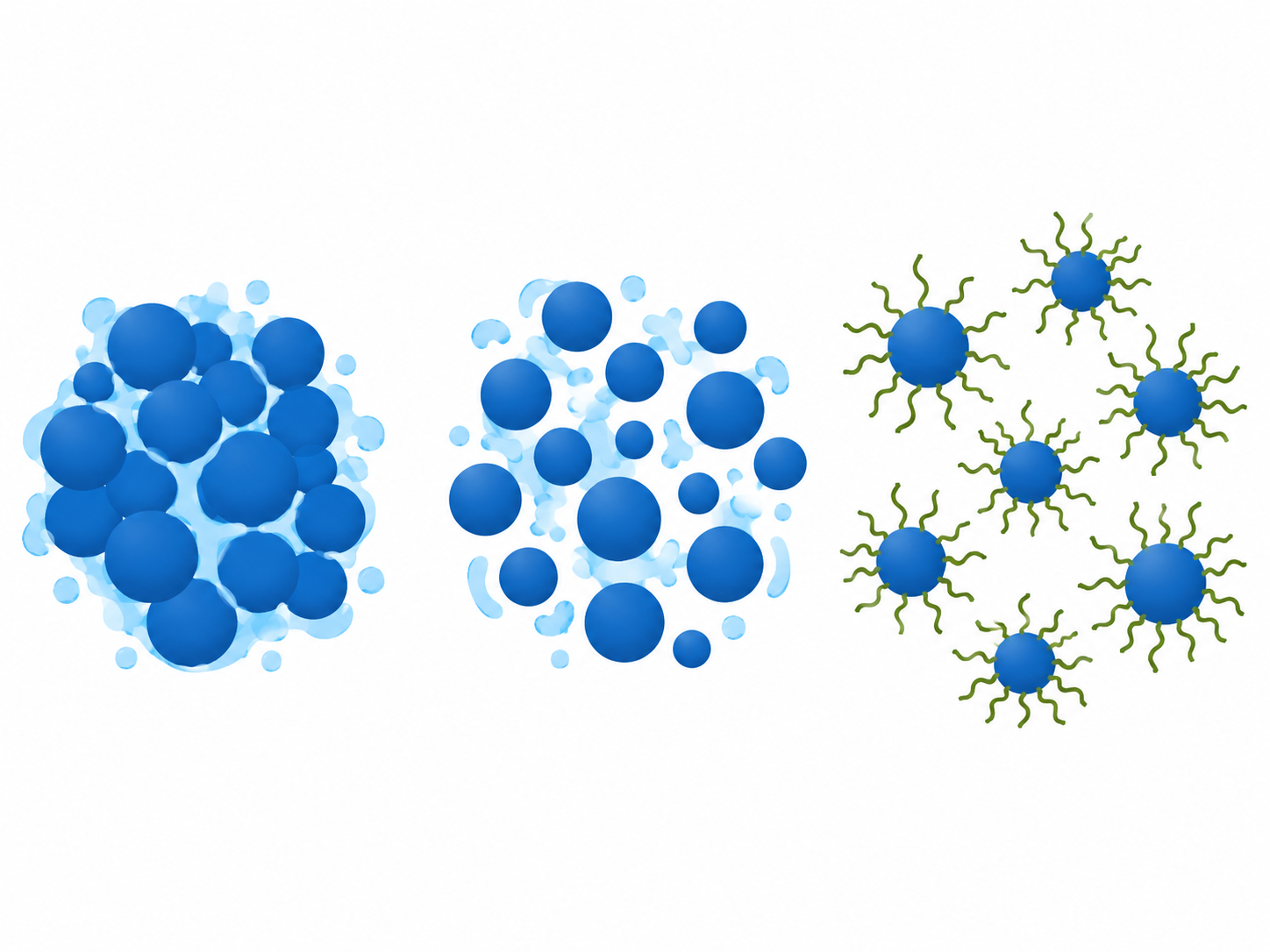
Stage one is wetting. The liquid (resin, solvent or water) displaces the air and moisture on the particle surface and in the gaps between particles. If the particles are not wetted, the grinding energy in the next stage is wasted, because the liquid cannot reach the inside of the agglomerates.
Stage two is breaking down the agglomerates. Shear and impact from the grinding equipment (beads, sand, rolls or a high-speed impeller) split agglomerates into smaller particles. Mechanical energy is effective only when the mill base viscosity is high enough to transfer force to the particles. If the mill base is too thin, the grinding media slide past each other without breaking the agglomerates; if it is too thick, it generates heat and overloads the machine.
Stage three is stabilization. Newly separated particles tend to attract each other through interparticle attraction forces. The paint system keeps them apart through two mechanisms. In waterborne systems, electrostatic repulsion works through a layer of same-sign charges around the particles that pushes them apart. In solvent-borne systems, steric hindrance works through polymer chains anchored on the particle surface that form a physical cushion and keep particles from approaching each other. Without this stage, a batch that reached the required fineness will still flocculate after grinding.
The three stages are not completely separate, and several factors affect all three:
- Pigment type. Organic pigments have small primary particles and a large surface area, so they are harder to wet than inorganic pigments: they need more liquid and more surfactant to cover the surface, and their agglomerates hold air more tightly. Inorganic pigments have a smaller surface area and are generally easier to wet, although surface properties still differ from one grade to another.
- Order of addition. Dumping powder in before the liquid and dispersant are evenly mixed creates lumps with a wet outer shell and a dry core.
- Pigment-to-resin ratio in the mill base. Too much pigment leaves too little liquid for wetting and viscosity rises sharply. Too little pigment transfers shear poorly, so grinding is inefficient.
- Grinding temperature. Heat changes viscosity, causes local solvent evaporation and can weaken the adhesion of the polymer layer on the particle surface.
The last fault occurs after grinding: solvent shock during dilution. If the solvent or resin added is not compatible with the stabilizing polymer layer, the chains collapse or detach from the particle surface, the cushion stops working and the particles flocculate. Pouring in a large amount of solvent quickly creates local zones that exceed the compatibility threshold, even though the final system may still be compatible.
How to identify the cause of poor pigment dispersion in your paint
The three tests below can be done in the plant laboratory without special equipment. Run them in order to eliminate causes one by one.
Measure fineness of grind over grinding time
Take samples at each grinding time point and measure with a grind gauge, recording the temperature and machine load at each point. If fineness keeps improving steadily across the time points, the cause may simply be insufficient grinding time. If the curve flattens and the drawdown still shows coarse particles, fineness that no longer improves indicates the system lacks wetting or stabilization, not time. Grinding further at this point only raises the temperature.
Rub-out test
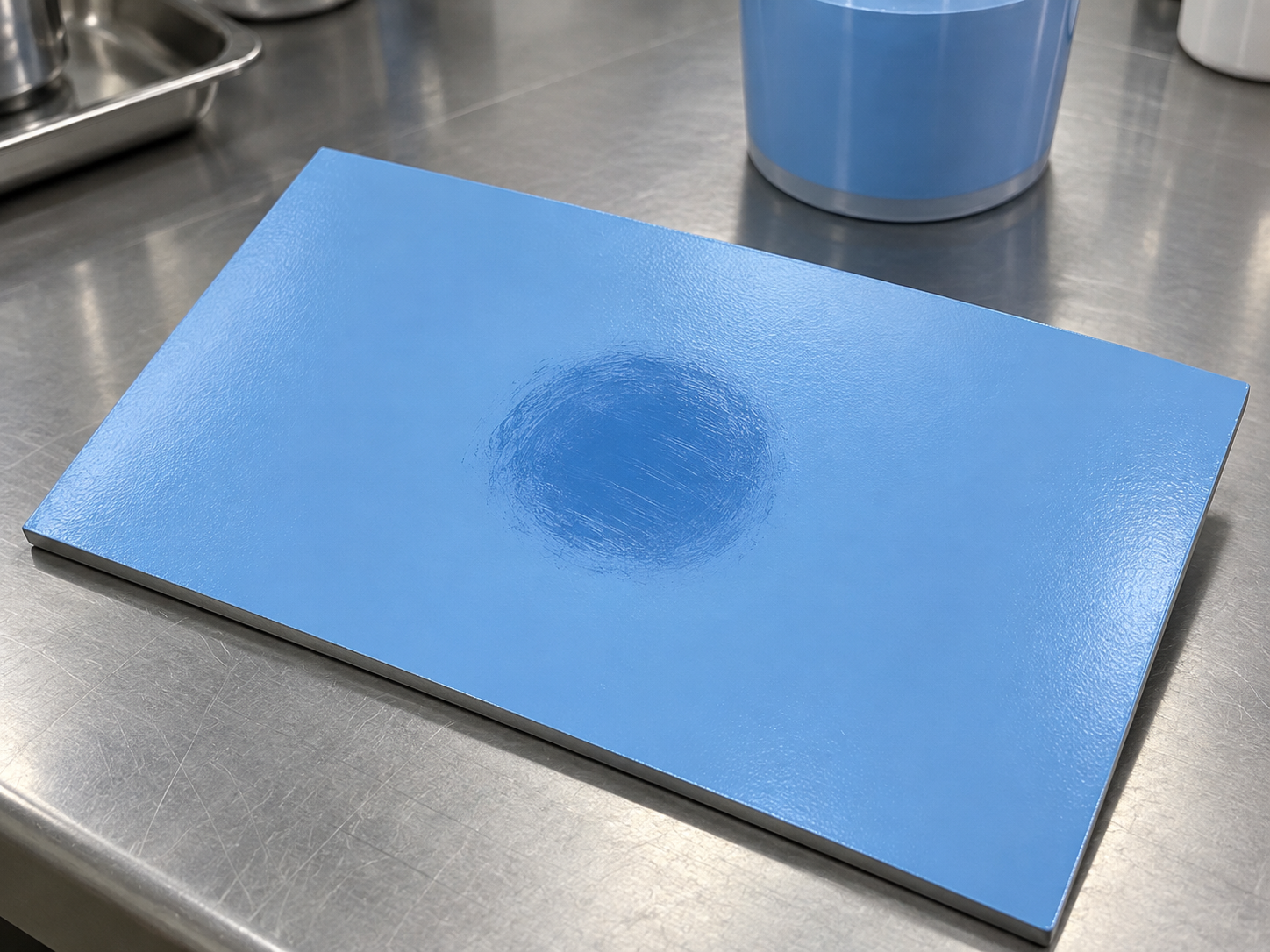
Draw down a wet paint film on a test panel, rub a small area gently with a fingertip until the film begins to set, then let it dry and compare the color of the rubbed area with the surrounding area. A rubbed area that is darker shows the pigment has flocculated: rubbing breaks up the loose clusters and the color develops again. If the two areas look the same while the fineness of grind is still coarse, the fault leans toward undispersed pigment.
Dilution test and sample storage
Split the sample in two: dilute one portion quickly and the other slowly, using the same solvent or resin. If the quickly diluted sample is weaker in color or shifted in shade while the slowly diluted one is not, the cause is solvent shock. Then store both samples at elevated temperature according to your internal procedure and observe settling, color separation or color floating over time. Record the results together with photos of the rub-out panel to compare between batches.
How to fix poor pigment dispersion
Address the process first because it costs less, and change raw materials only after operating faults have been ruled out.
Fixing the grinding process
Adjust the mill base ratio so that viscosity is high enough to transfer force to the particles without generating excessive heat. Review the speed and the load of the grinding media: unsuitable speed or load reduces the efficiency of breaking down agglomerates. Control temperature with cooling and monitor it at each sampling point. Add the pigment slowly into the liquid already premixed with dispersant so the powder wets progressively and does not form lumps. At the finishing stage, dilute slowly and stir evenly to avoid local solvent shock.
Fixing the raw material side
If the process is sound but the fault remains, review the raw materials. The dispersant (part of the defoaming and dispersing additives group) must be chosen for the right system, waterborne or solvent-borne, because the stabilization mechanisms of the two systems differ, and for the right type of pigment in use, organic or inorganic, because the particle surface determines how the dispersant anchors. Dosage is calculated on the surface area of the pigment, not on mass alone: a fine organic pigment needs more than an inorganic pigment of the same mass.
Surface-treated pigments are usually easier to disperse than untreated ones, so they are worth considering when grinding never reaches the target. When comparing grades, your team should read two parameters on the pigment TDS: oil absorption and surface area, because they indicate how much liquid and dispersant is needed for wetting. Take the specific values from the TDS of the grade in use, and compare them using the same test method.
There is a trade-off to consider: excess dispersant brings no further improvement and can reduce the water resistance of the paint film and create foam during production and application. The dosage should therefore be determined by trials within the supplier's recommended range, followed by re-measuring fineness of grind, running the rub-out test and storing samples.
Frequently asked questions
How do I know the pigment is dispersed finely enough?
Measure fineness of grind with a grind gauge and compare it with the requirement in the formulation's internal standard, then confirm with the rub-out test and sample storage. If fineness is met but the rubbed area is darker, the particles are still flocculating. Only when all three results pass can the pigment be considered sufficiently dispersed.
Why does paint lose color strength and settle at the bottom after long storage?
It is usually because the pigment particles flocculate when the stabilizing layer is not enough to keep them apart. Clusters develop color less well than single particles and are heavier, so they sink to the bottom. A dispersant that does not suit the resin or solvent system, or high storage temperature, makes this happen faster.
Are organic pigments harder to disperse than inorganic pigments?
Yes, organic pigments are generally harder. Their primary particles are small and their surface area is large, they hold air in the agglomerates, and they need more liquid and dispersant to wet. The degree varies by grade and surface treatment, so read the TDS of the grade in use.
Is adding more dispersant always better?
No. Dispersant only needs to be enough to cover the particle surface. The excess brings no further improvement and can reduce the water resistance of the paint film and increase foam. The right amount depends on the pigment surface area and is determined by trials, referring to the supplier's recommendation.
Conclusion
Poor pigment dispersion covers two separate faults: particles not broken down during grinding, and particles that flocculate after grinding. Each fault has its own signs, tests and fixes, so tell them apart before changing the formulation or the raw materials.
- Undispersed pigment shows as fineness of grind that fails right after grinding; flocculation shows as weaker color, shade shift or settling after dilution or storage.
- Dispersion goes through three stages: wetting, breaking down agglomerates and particle stabilization. Whichever stage is missing, fix that stage.
- The three quick tests are fineness measurement over time points, the rub-out test, and the dilution test with sample storage.
- Fix the process first: mill base ratio, bead load, temperature, and the method of addition and dilution. Change the dispersant or pigment last, based on the TDS and trials.
Vichem is a distributor of chemical additives from leading brands such as Covestro, Sinopec and Bühler in the Vietnamese market.
For more information about our products, please contact us through the following channels:
- Hotline: 08 1790 1790
- Zalo OA: Vichem JSC
- Email: contact@vichem.vn
- LinkedIn: Vichem JSC
- Website: www.vichem.vn
- Facebook: Vichem JSC