Chemical management in Vietnam is becoming increasingly stringent. The year 2026 marks many important changes in the legal framework. Businesses are no longer only concerned with price or supply. Compliance has become a mandatory requirement.
In practice, many businesses still confuse prohibited chemicals with controlled chemicals. This is a common mistake but carries significant risks. If misclassified, goods may be rejected or subject to penalties.
Understanding these two categories correctly is essential. This is the foundation for safe operations and sustainable development.
DEFINITIONS
What are prohibited chemicals?
Prohibited chemicals are substances that are not allowed to be manufactured, traded, or used under normal conditions. These substances have extremely high toxicity or are associated with chemical weapons. Therefore, the government imposes the strictest level of control. In certain exceptional cases, their use may be permitted. However, such use must be for research or defense purposes.
What are controlled chemicals?
In contrast, controlled chemicals are substances that are still permitted for use in production and business activities. However, they pose potential risks to human health and the environment. Therefore, businesses must meet various conditions before using them. Monitoring and management are also mandatory requirements.
DISTINGUISHING PROHIBITED CHEMICALS AND CONTROLLED CHEMICALS
The most significant difference lies in usage rights. Prohibited chemicals are generally not allowed for use in commercial activities. Meanwhile, controlled chemicals may still be circulated if they meet legal requirements.
In terms of hazard level, prohibited chemicals are extremely toxic. They can cause severe consequences even at very low doses. In contrast, controlled chemicals can be used if properly managed.
From a legal perspective, prohibited chemicals require special permits and are only allowed in limited cases. Meanwhile, controlled chemicals require business licenses and compliance with specific safety conditions.
EXAMPLES
Prohibited substances
In practice, prohibited chemicals are mainly associated with chemical weapons. For example, Sarin and VX are highly potent nerve agents. Even a small amount can cause rapid death.
Mustard gas is another typical example. It causes severe damage to the skin and respiratory system. Therefore, its production and use are completely banned in civilian contexts.
These substances do not appear in conventional industries such as paint or plastics. However, some precursors may be controlled to prevent misuse.
Controlled substances
In the paint industry, solvents such as toluene and xylene are widely used. Toluene helps dissolve resins and enhance paint gloss. However, prolonged exposure may affect the nervous system. Xylene has similar properties and is highly volatile. Therefore, both are classified as controlled chemicals.
In addition, methyl ethyl ketone (MEK) is an important solvent in the production of paints and adhesives. It increases evaporation rate and improves adhesion. However, MEK is flammable and may cause strong irritation. Therefore, its use must comply with safety regulations.
In the plastics industry, acrylonitrile is a key raw material for producing ABS plastic. This type of plastic is widely used in electronics and industrial applications. However, acrylonitrile is highly toxic with long-term exposure. Therefore, strict control is required.
In the polyurethane sector, compounds such as TDI and MDI play an important role. They are used to produce foam, coatings, and adhesives. However, these substances may cause severe irritation to the skin and respiratory system. Therefore, they fall under special control.
Formaldehyde is also commonly used in the production of plastics and adhesives. It enhances material durability. However, formaldehyde may cause cancer with prolonged exposure. Therefore, it is subject to strict control.
Refer to the chemical appendices here.
BUSINESS CONDITIONS FOR CONTROLLED CHEMICALS
To trade in controlled chemicals, businesses must meet multiple conditions. First, they must have business registration appropriate to the chemical sector.
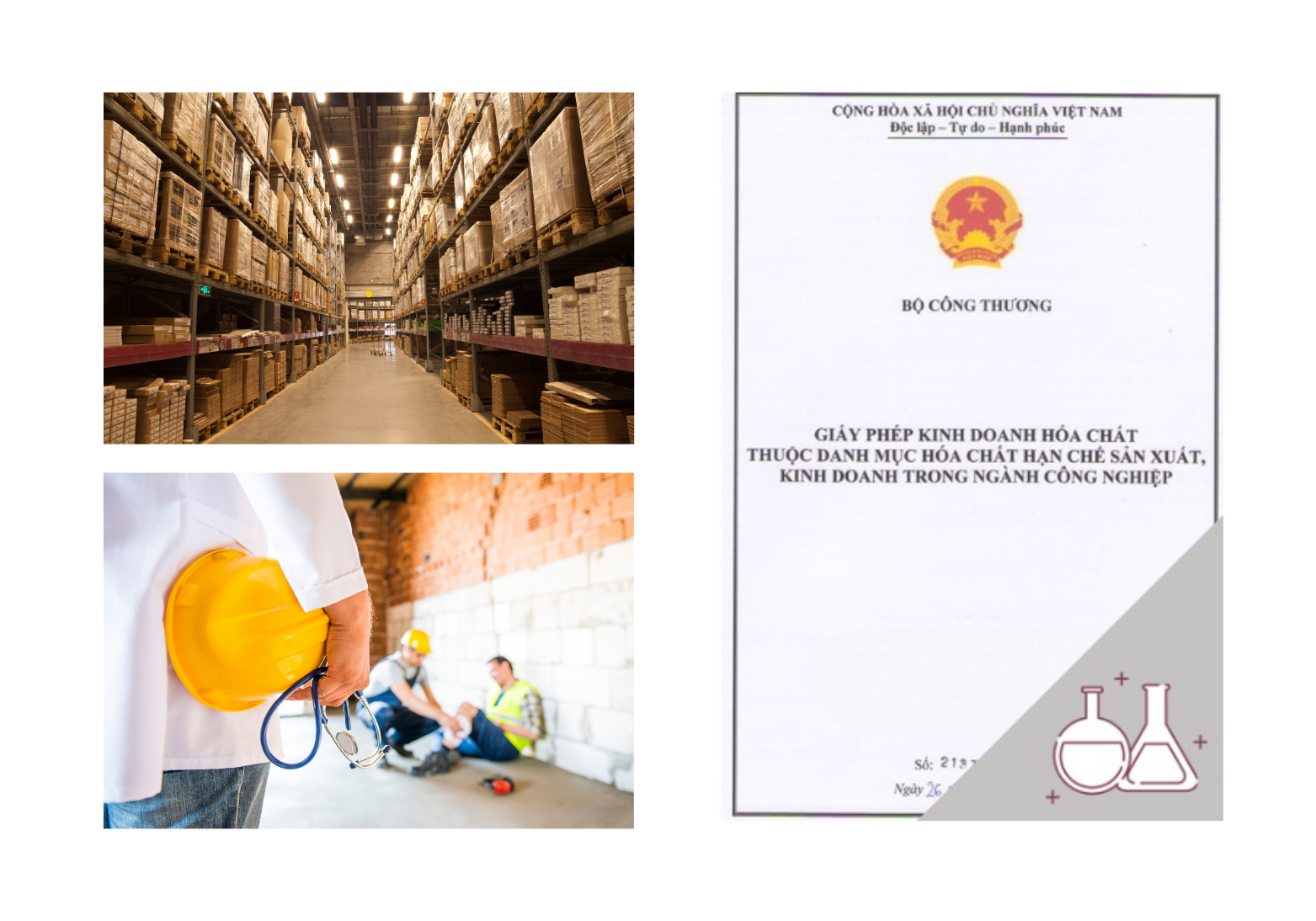
Facilities must meet safety standards. Storage warehouses must be properly designed in accordance with regulations and suitable for each type of chemical.
Personnel must also have appropriate qualifications. Responsible staff must have a solid understanding of chemistry and safety.
In addition, businesses must establish an internal management system. Monitoring of import, export, and inventory is mandatory.
RISKS OF MISCLASSIFICATION
Confusing these two types of chemicals can lead to serious consequences. Businesses may face penalties or suspension of operations.
Goods may also be detained at border checkpoints. This disrupts supply chains and increases costs.
Moreover, the company’s reputation may be affected, making long-term cooperation more difficult.
CONCLUSION
Prohibited chemicals and controlled chemicals are clearly distinct. Proper classification helps businesses avoid risks and optimize operations.
In an increasingly stringent legal environment, compliance is mandatory. This is the foundation for sustainable development.
VICHEM – AUTHORIZED DISTRIBUTOR OF CHEMICAL ADDITIVES FROM MAJOR BRANDS SUCH AS COVESTRO, SINOPEC, BUHLER,… IN VIETNAM
Vichem is an authorized distributor of chemical additive products from leading brands such as Covestro, Sinopec, Buhler,… in the Vietnamese market. We not only provide high-quality products but also deliver after-sales services that meet international standards.
For more information about our products, please contact us via the following channels:
📞 Hotline: 08 1790 1790
📧 Email: contact@vichem.vn
🔎 LinkedIn: Vichem JSC
🌐 Website: www.vichem.vn
📌 Facebook: Vichem JSC