The 2026 Chemical Annex is an important tool in chemical management. This article helps businesses identify chemical groups and the associated legal obligations. Proper understanding of the annex structure helps reduce risks and ensure compliance.
DEFINITION OF THE CHEMICAL ANNEX
The Chemical Annex is a tool for classifying and managing chemicals in accordance with legal regulations. Through the annex, businesses can determine the scope of use and applicable conditions.
Not all hazardous chemicals are prohibited. Many substances are still permitted for industrial use if control requirements are met. Businesses must strictly manage purchasing, storage, and transportation activities. Operational safety requirements are also mandatory during use.
MAIN CHEMICAL GROUPS
Basic chemicals in key industrial sectors
This group consists of fundamental chemicals in industrial production. They serve as input materials for many manufacturing industries. Common applications include plastics, coatings, industrial gases, and fertilizers. In addition, this group supports the rubber, solvent, and petrochemical industries.
Typical chemicals include anhydrous ammonia, methanol, and ethylene. It also includes propylene, xylene, and vinyl chloride. This group represents a core role in the industrial supply chain. However, it is not a group of prohibited chemicals.

Chemicals subject to conditional production and trading
This group is not prohibited but is subject to strict legal control. Businesses are not allowed to trade these chemicals as ordinary goods. Production and trading activities must meet specific conditions. Requirements include infrastructure, personnel, and safety documentation.
In addition, businesses must manage inventory and comply with relevant regulations. Common chemicals include industrial solvents and various acids, alcohols, nitriles and isocyanates, flammable gases, and toxic substances.

Chemicals requiring special control
This group includes chemicals with a high level of regulatory sensitivity. They may be misused as precursors or for illegal purposes. This group is often associated with control in production and import-export activities. Security and safety are top priorities.
Typical chemicals include toluene, acetone, methanol, formaldehyde, MDI, and ethylene oxide. This group is not equivalent to prohibited chemicals. However, businesses must strictly control documentation and usage purposes.
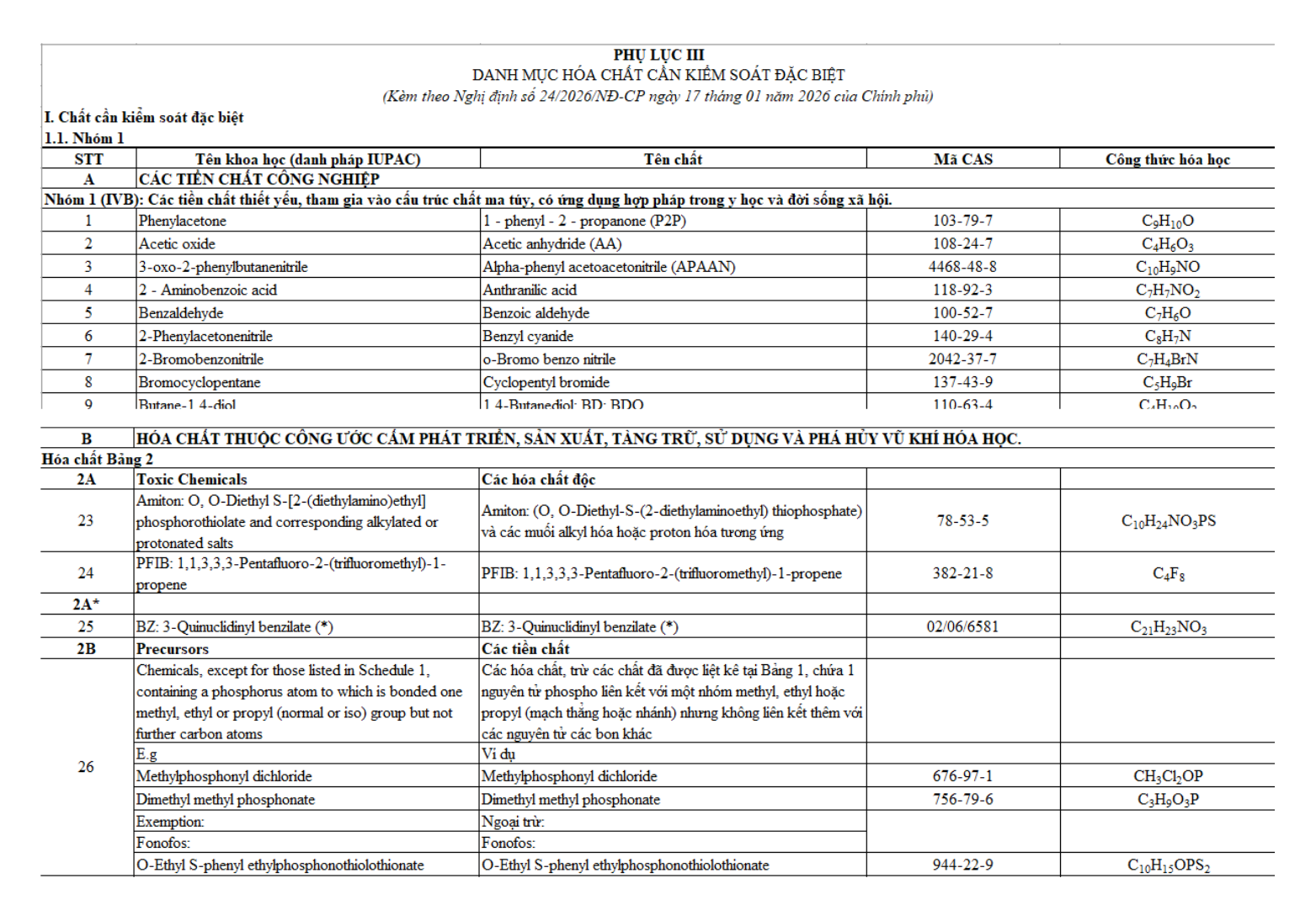
Chemicals requiring incident prevention and response planning
This group is directly related to risk management within enterprises. These chemicals pose a risk of serious incidents if not properly controlled. Businesses must develop prevention and incident response plans. Monitoring storage volume is a mandatory requirement.
Typical chemicals include chlorine, ammonia, nitric acid, acrylonitrile, and cyanide compounds. When storage thresholds are exceeded, legal obligations will change, requiring businesses to implement additional management measures in accordance with regulations.

Prohibited chemicals and minerals
This group has the highest level of control within the legal system. Substances in this group are not permitted for use under normal conditions.
It mainly includes agents related to chemical warfare and certain extremely hazardous minerals. Typical examples include Sarin, Soman, VX, amphibole asbestos, etc.

Learn more about the appendices above (in Vietnamese) here
NOTES
First, review the entire list of chemicals currently being traded or used. Do not rely solely on trade names; cross-check both scientific names and CAS numbers. Next, determine which annex each substance belongs to. A substance appearing in multiple annexes will entail multiple obligations.
In addition, check actual inventory volumes. Many businesses do not make mistakes in purchasing or trading but face issues in storage and thresholds requiring incident response planning. Finally, this document should be viewed as a risk management tool, not merely a legal reference.
CONCLUSION
The chemicals in the annex are clearly divided into five categories: key industrial chemicals, conditionally traded chemicals, specially controlled chemicals, chemicals requiring incident response planning, and prohibited chemicals.
The key point is not to review each substance in isolation. The correct approach is to consider them by management group and associated obligations. By doing so, businesses can avoid errors in trading, logistics, and legal compliance. The entire classification system is regulated under Decree 24/2026/ND-CP of the Government.
VICHEM – AUTHORIZED DISTRIBUTOR OF CHEMICAL ADDITIVES FROM MAJOR BRANDS SUCH AS COVESTRO, SINOPEC, BUHLER,… IN VIETNAM
Vichem is an authorized distributor of chemical additive products from leading brands such as Covestro, Sinopec, Buhler,… in the Vietnamese market. We not only provide high-quality products but also deliver after-sales services that meet international standards.
For more information about our products, please contact us via the following channels:
📞 Hotline: 08 1790 1790
📧 Email: contact@vichem.vn
🔎 LinkedIn: Vichem JSC
🌐 Website: www.vichem.vn
📌 Facebook: Vichem JSC