When white packaging ink has poor opacity or clogs gravure cells, choosing TiO2 for printing ink comes down to matching opacity in a thin ink layer, dispersibility, surface treatment and durability of the particle to the ink system and the end-use conditions of the package. TiO2 is titanium dioxide, the white pigment that gives ink its opacity. The deciding conditions are the printing method (gravure, flexo), whether the ink is solvent-based or water-based, and the substrate film.
Where the wrong TiO2 fails in packaging printing ink
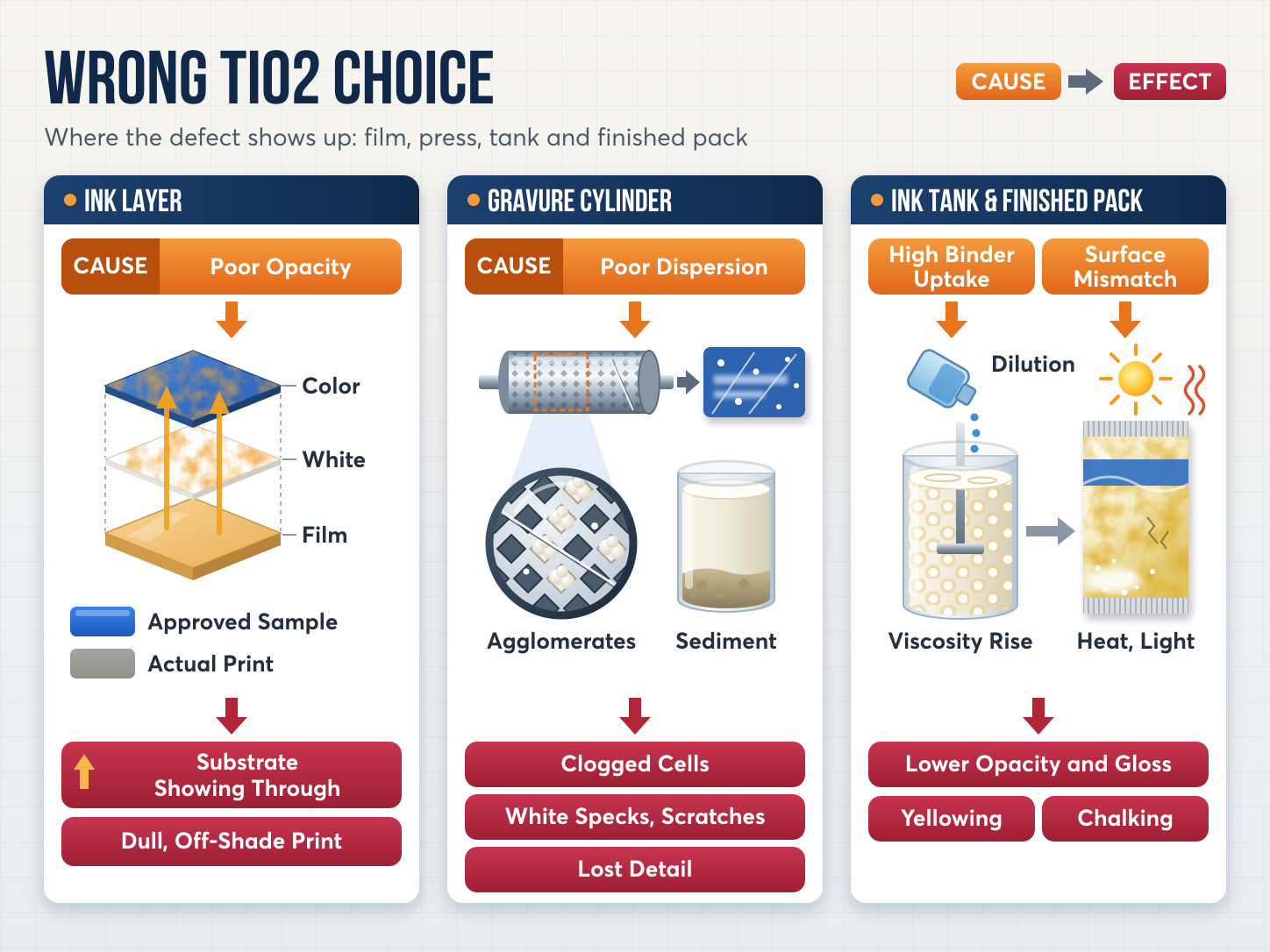
When the wrong TiO2 is chosen for packaging printing ink, the fault shows up in three places: the ink layer on the film, the printing cylinder and the ink tank. Each place gives its own sign, so a line engineer can trace the problem back to the raw material.
On the ink layer: a white backing or base layer with poor opacity lets the substrate color or the overprinted ink color show through. The print looks dull and drifts from the approved sample. Packaging ink layers are very thin, so even a TiO2 particle that does not scatter light efficiently is visible to the naked eye. If you see a similar problem in another coating, the causes of poor opacity in white coatings also show that the root cause mostly lies in dispersion and pigment selection.
On the printing cylinder: TiO2 with poor dispersion leaves agglomerates in the ink. These particles clog the cells of a gravure cylinder, causing white specks, scratch lines or blurred print, and they settle at the bottom of the tank while the ink sits on the press. In flexo, agglomerates make the ink surface uneven and easy to see in solid color areas.
In the ink tank and on the finished product: particles that absorb a lot of binder cause ink viscosity to rise, so the operator has to add solvent or water, which lowers opacity and gloss. After printing, the package meets heat during lamination and edge sealing, and light in the warehouse and on the shelf. The white layer may then turn yellow or chalk, especially when the particle surface treatment does not suit the binder system.
4 key criteria for choosing TiO2 for printing ink
All four criteria below are physical and chemical mechanisms of the TiO2 particle. Each one leads to a phenomenon you can observe on the press, and each has a matching parameter to read on the TDS.
Criterion 1 — Rutile TiO2 for printing ink or anatase
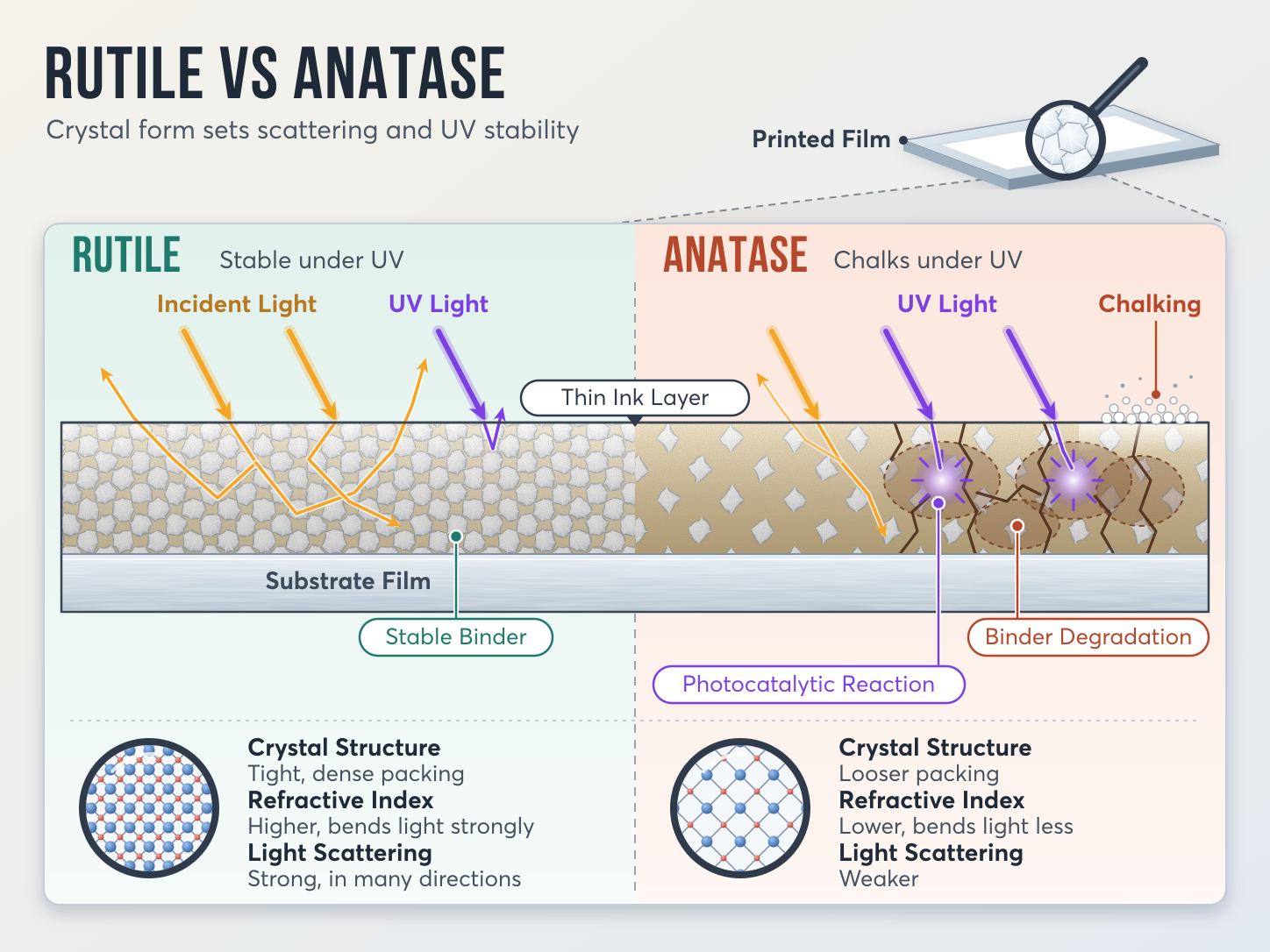
TiO2 exists mainly in two crystal forms. Rutile has a tightly packed, more stable structure. Anatase is packed more loosely and has higher photocatalytic activity.
The two forms have different refractive indices. The higher the refractive index, the more strongly the particle bends and scatters light, so at the same pigment loading the ink layer gives higher opacity. Rutile has a higher refractive index than anatase, which is why it is the form usually chosen for white ink that must hide in a thin layer.
Crystal form also determines stability under UV. Anatase readily catalyzes photocatalytic reactions, which degrade the binder around the particle and cause chalking. Rutile is more stable under these conditions and suits packaging exposed to light or heat. If you are considering sources from China, the article on how to choose rutile or anatase TiO2 goes deeper into telling the two forms apart on supplier documents.
Criterion 2 — Particle size and particle size distribution
Particle size determines how efficiently a particle scatters visible light. Each particle scatters best when its size falls within a certain range relative to the wavelength of light. Particles that are too large or too small for that range both reduce opacity at the same loading.
A narrow particle size distribution gives a more uniform ink layer. A wide distribution, or particles agglomerated into clusters, has two consequences: the thin ink layer loses smoothness, and large particles wear the cylinder and the doctor blade during the run. When reading the TDS, look for the description of average particle size and grind fineness, then confirm with a test in the same ink system.
Criterion 3 — Surface treatment compatible with the ink system
The TiO2 particle surface is usually coated with an inorganic layer, an organic layer or both. The inorganic layer shields the particle core from photocatalytic reactions, so it relates directly to weather resistance and yellowing resistance. The organic layer determines whether the particle wets out well in solvent or in water.
Solvent-based and water-based systems differ in binder, dispersant and polarity. A grade treated for one system does not necessarily wet out well in the other, and when wetting is poor, particles re-agglomerate, the ink settles and gloss drops. So choose a grade whose surface treatment matches the ink system you use, rather than choosing by the generic name TiO2.
Criterion 4 — Oil absorption and its effect on viscosity
Oil absorption indicates how much binder or solvent the particle takes up on its surface and in its voids before the ink starts to flow. Particles that absorb a lot of binder reduce the free liquid in the ink, so viscosity rises quickly as more pigment is added.
As a result, it is hard to reach a high white pigment loading at printing viscosity. To keep viscosity within what the press needs, the operator has to dilute, and the ink loses some opacity. This parameter depends on both particle size and surface treatment, so read it together with the two previous criteria rather than on its own.
How to match TiO2 for printing ink to your line
The three steps below run from press conditions to titanium dioxide trial samples for ink. Following this order helps rule out unsuitable TiO2 grades early, before you spend trial batches.
Step 1 — Define the printing method, ink system and substrate
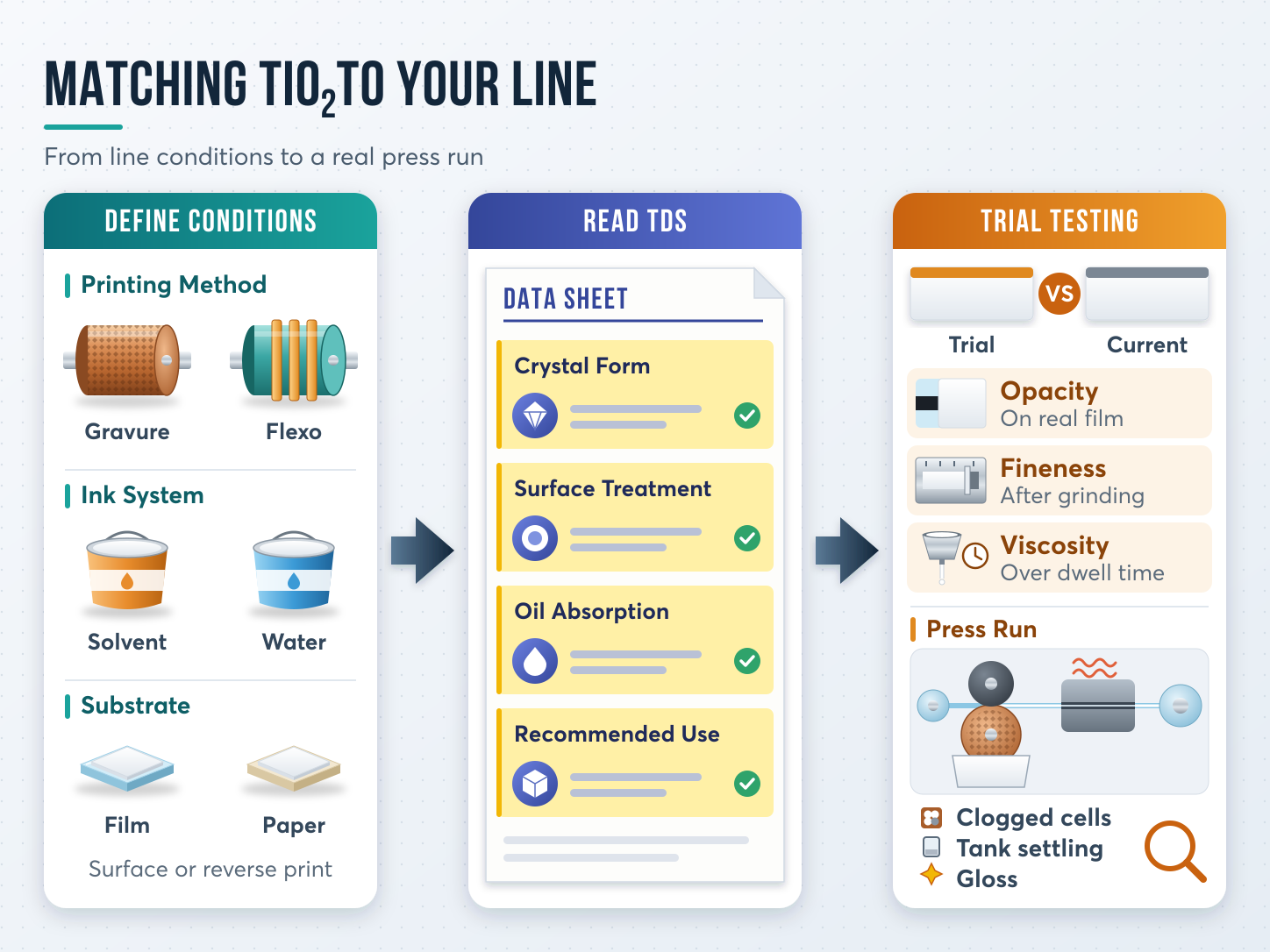
Write down three conditions before asking the supplier:
- Printing method: gravure or flexo. Gravure is sensitive to large particles and agglomerates because the small cells clog easily. Flexo is sensitive to viscosity and the uniformity of the ink layer.
- Ink system: solvent-based or water-based, together with the binder type in use.
- Position of the white layer: outer surface print or reverse (backing) print, on plastic film or paper. A reverse-printed layer inside withstands lamination and heat, while an outer layer withstands light and abrasion.
Step 2 — Read the TDS parameters
Take the TDS of each candidate grade and read four groups of information: crystal form, surface treatment (inorganic, organic), oil absorption and the manufacturer's application recommendation. The figures for each grade are in its own TDS, so compare grades against each other using the same measuring method.
The application recommendation tells you whether the grade is for printing ink, decorative paint or plastics. If the TDS does not state a suitable ink system, ask the supplier before testing.
Step 3 — Test samples and the right TiO2 grade
For printing ink, choose a TiO2 grade made for printing ink from suppliers such as Tinox and WhiteArrow, then test it side by side with the grade you use now, with the same binder and the same grinding procedure.
Three comparisons are needed: opacity of the thin ink layer on the real substrate film; fineness with a grind gauge after grinding; and viscosity at the same pigment loading and over standing time. Then run on the real press to check for clogged cells, tank settling and gloss.
Common mistakes when choosing TiO2 for packaging printing ink
The three mistakes below recur often on lines that switch or add a raw material source.
Using decorative-paint TiO2 for printing ink. Grades for decorative paint are designed for thick films, gloss and outdoor durability. In a thin-layer printing ink, the particles may be hard to disperse finely, raise viscosity quickly or be poorly compatible with the ink binder. Both being TiO2 does not mean they are interchangeable. For plastic film and masterbatch the selection criteria differ again, and you can read about how to choose TiO2 for plastic film and white masterbatch.
Comparing price only and ignoring surface treatment. Two rutile grades can differ in coating, and the coating determines wetting, ink stability and durability after printing. Ink that settles, or packaging that yellows after a few weeks, costs more than the difference in raw material price.
Not testing on a real press. Lab results with a grind gauge do not reflect printing speed, the shear at the doctor blade or the time the ink sits on the press. The test must run with the same cylinder, the same substrate film and the same drying conditions as production.
Frequently asked questions
Should titanium dioxide for printing ink be rutile or anatase?
For white packaging ink, rutile is the more common choice. Its higher refractive index lets a thin ink layer hide well, and this form is more stable under UV and heat. Anatase tends to cause chalking, so it is rarely suitable when the package must keep its whiteness for a long time.
Is TiO2 for water-based and solvent-based ink different?
Yes, mainly in the particle surface treatment. Water-based and solvent-based systems differ in polarity, binder and dispersant, so the coating on the particle must match the system in use for the particle to wet out well. Read the application recommendation in the TDS and test in your plant's own ink system.
Why does white packaging ink still have poor opacity when I add more TiO2?
Adding more pigment does not make up for poor dispersion. Agglomerated particles scatter less light than separated ones, and the rising viscosity forces dilution, which makes the ink layer thinner still. Check the fineness after grinding and the oil absorption of the grade in use before increasing the loading.
Does TiO2 wear the printing cylinder?
It can, if the ink contains large particles or agglomerated clusters. These hard particles rub against the cells and the doctor blade during printing. To reduce the risk of wear, choose a grade with a narrow particle size distribution, grind to the required fineness and recheck ink that has stood for a long time in the tank.
Conclusion
Choosing TiO2 for packaging printing ink means matching the particle's properties to the printing method, ink system and substrate film of each line, then confirming with real trials.
- Four criteria to weigh together: crystal form, particle size, surface treatment and oil absorption.
- Choose by printing method (gravure, flexo) and by solvent-based or water-based ink system.
- Read the TDS to filter candidates, then test on a real press against the grade you use now.
Send us the TDS of your current grade together with your printing method, ink system and substrate film, and the Vichem technical team will propose a suitable TiO2 grade.
Vichem is a distributor of chemical additives and equipment from leading brands such as Covestro, Sinopec, TotalEnergies Corbion, Bühler and Tinox in the Vietnamese market.
For more information about our products, please contact us through the following channels:
- Hotline: 08 1790 1790
- Zalo OA: Vichem JSC
- Email: contact@vichem.vn
- LinkedIn: Vichem JSC
- Website: www.vichem.vn
- Facebook: Vichem JSC