
During coating application processes, surface quality is always a critical factor determining the aesthetics and durability of the final product. However, even when using high-quality coating systems, many manufacturers still encounter surface defects that negatively affect the finished quality.
One of the most common defects is the fisheye defect, also known as fisheye cratering. This defect not only reduces aesthetic value but also directly impacts the protective performance of the coating film.
Understanding the root causes and implementing appropriate corrective measures can help manufacturers reduce defect rates, save costs, and improve production efficiency.
WHAT IS A FISHEYE DEFECT IN COATINGS?
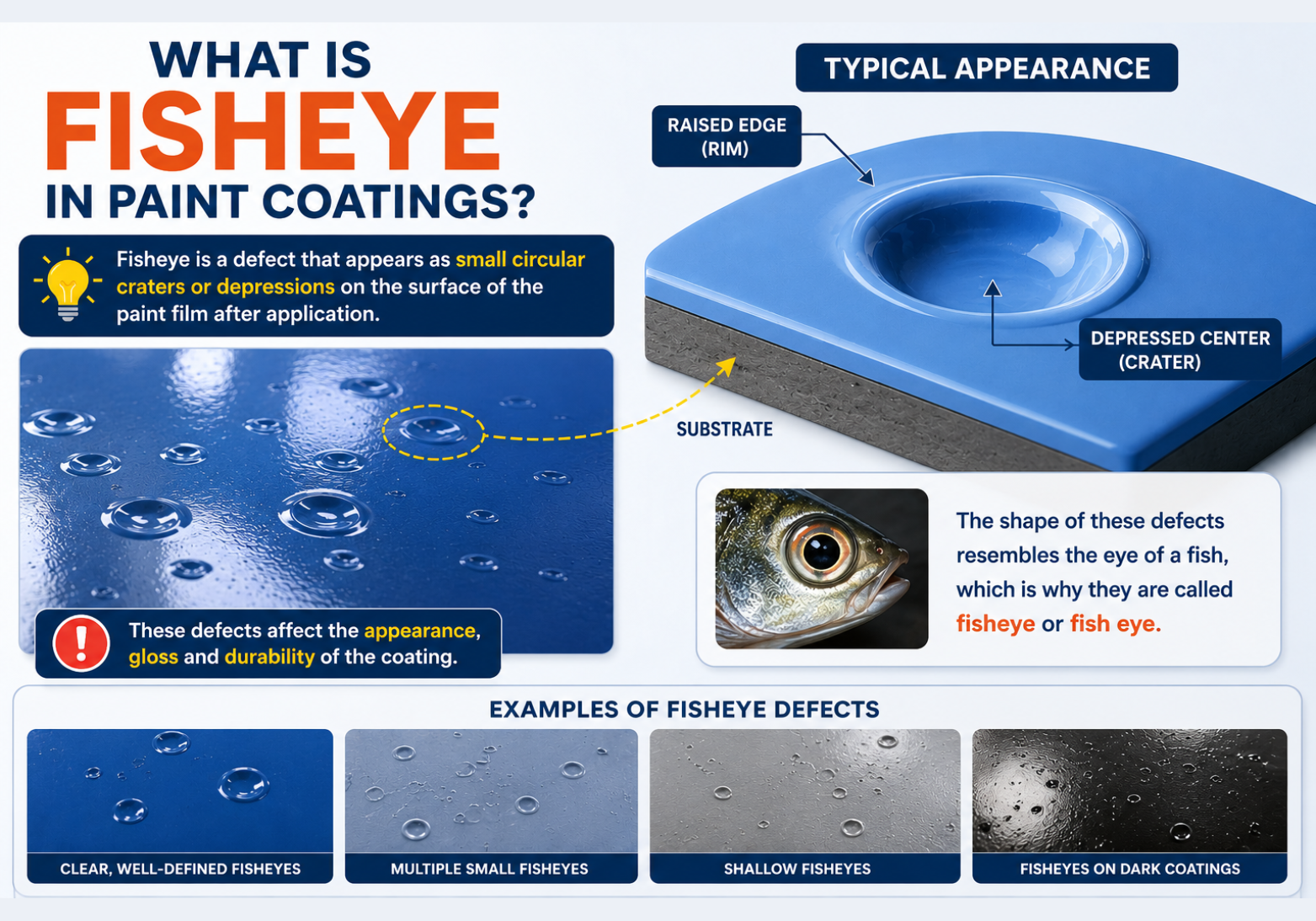
A fisheye defect is characterized by the appearance of circular depressions or small craters on the coating film surface after application. These defects typically appear as ring-shaped formations with raised edges and a sunken center. Their appearance resembles a fish’s eye, which is why they are referred to as fisheye defects.
This phenomenon occurs when the wet coating film retracts from a specific area on the substrate surface. As a result, the coating cannot spread uniformly, creating localized areas with insufficient coverage. In the industrial coatings industry, fisheye defects are also referred to as cratering, cissing, or poor wetting. It is one of the surface defects directly associated with the coating’s wetting ability on the substrate.
SIGNS OF FISHEYE DEFECTS
Appearance of small circular craters on the surface
The craters typically range from a few millimeters to several centimeters in diameter, depending on the level of contamination. The central area is usually deficient in coating or has very low film coverage.
Uneven coating surface
Instead of forming a continuous film, the coating separates into distinct areas. This significantly reduces the aesthetic quality of the product.
Appearance after coating cure
In many cases, the surface appears normal immediately after spraying. However, as the coating begins to flow, level, and cure, fisheye defects become clearly visible.
CAUSES OF FISHEYE DEFECTS IN COATINGS
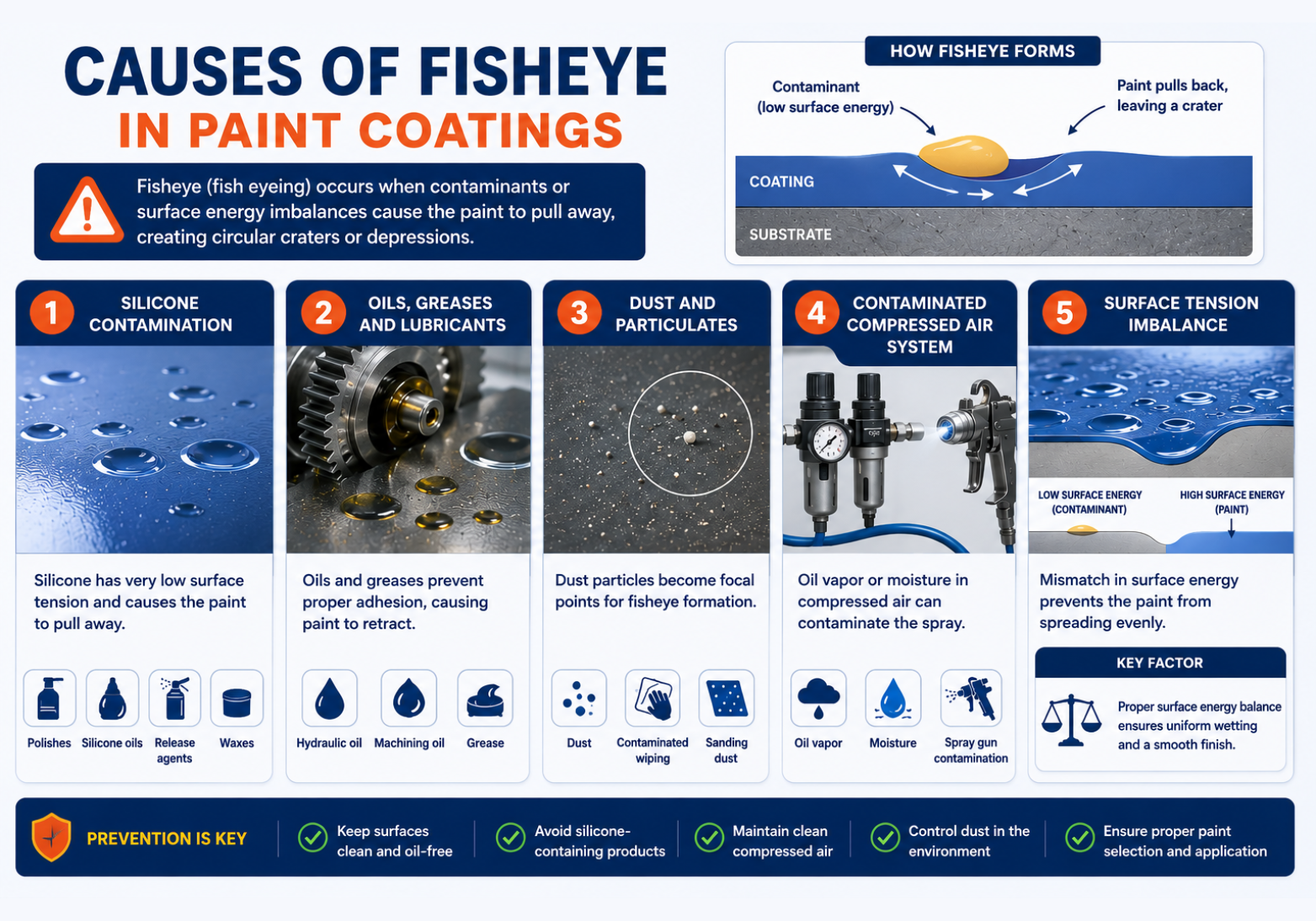
Silicone contamination
This is the most common cause in the coatings industry. Silicone has extremely low surface tension. When present on the substrate surface or within the application environment, it causes the coating to be repelled from the contaminated area.
Even a very small amount of silicone can generate numerous defects across the coating surface. Common sources of silicone contamination include polishing agents, silicone oils, release agents, and certain industrial lubricants.
Oil and grease contamination
Hydraulic oils, machining oils, and lubricating greases are common sources of coating defects. If the substrate is not thoroughly cleaned before coating application, the coating film cannot adhere uniformly. As a result, film retraction occurs at contaminated areas.
Dust and foreign contaminants
Fine dust particles can absorb oils or other low-surface-energy substances. When deposited on the substrate, they become initiation sites for fisheye formation. Dust sources may originate from the production environment, cleaning materials, or sanding operations.
Contamination from compressed air systems
Many manufacturers focus on surface preparation while overlooking their compressed air systems. If the air compressor contains oil vapor or moisture, these contaminants can enter the spray gun and cause surface defects. This is a relatively common cause in industrial coating lines.
Surface tension imbalance
A coating can only achieve proper leveling when its surface tension is compatible with that of the substrate. If there is a significant difference in surface energy, the coating film will retract and form the characteristic craters associated with fisheye defects.
IMPACT OF FISHEYE DEFECTS ON COATING QUALITY
The craters are clearly visible on the finished surface. This is particularly critical for products requiring high gloss or superior appearance quality.
At defective locations, the coating film thickness is often below specification. These areas can become initiation points for corrosion or premature coating degradation.
In addition, when fisheye defects occur, manufacturers often need to sand and recoat the affected areas. This process increases material consumption, labor costs, and production time.
CONCLUSION
Fisheye defect is one of the most common surface defects in the coatings industry. The primary causes include silicone contamination, oil and grease residues, dust contamination, and other factors that reduce the surface tension of the coating film.
Although it is a common defect, it can be effectively prevented if manufacturers maintain proper cleaning procedures, control the application environment, and properly manage equipment systems.
Identifying the correct root cause not only enables effective elimination of fisheye defects but also contributes to improving product quality, reducing rework costs, and enhancing long-term production efficiency.
VICHEM – AUTHORIZED DISTRIBUTOR OF CHEMICAL ADDITIVES FROM LEADING BRANDS SUCH AS COVESTRO, SINOPEC, BUHLER, AND MORE IN VIETNAM
Vichem is an authorized distributor of chemical additives from leading brands such as Covestro, Sinopec, Buhler, and others in the Vietnamese market. We not only provide high-quality products but also deliver after-sales services that meet international standards.
For more information about our products, please contact us through the following channels:
📞 Hotline: 08 1790 1790
📧 Email: contact@vichem.vn
🔎 LinkedIn: Vichem JSC
🌐 Website: www.vichem.vn
📌 Facebook: Vichem JSC