Liquid acrylic is often mentioned as a solution for stabilizing slurry and reducing defects in high-purity ceramic production. However, the actual role of acrylic extends beyond dispersion capability or green strength enhancement.
More importantly, acrylic can adapt to various forming methods used in ceramic processing. Each forming technology has its own requirements regarding rheology, drying behavior, and green strength. Therefore, selecting the appropriate acrylic system directly affects production efficiency and ceramic quality after firing.
WHY IS THE FORMING METHOD IMPORTANT IN CERAMICS?
In technical ceramics, forming is the stage that determines the initial structure of the material. This is the step where ceramic powders are distributed into the desired shape before drying and firing.
If the slurry or formulation is incompatible with the forming method, the ceramic can easily develop defects such as cracking, delamination, or non-uniform density. In fact, many post-firing defects originate from this stage.
Liquid acrylic provides better control over the condition of ceramic suspensions during processing. Thanks to its ability to regulate viscosity and create temporary bonding between material particles, this polymer is now widely used in many modern ceramic technologies.
FORMING METHODS UTILIZING LIQUID ACRYLIC
Tape casting
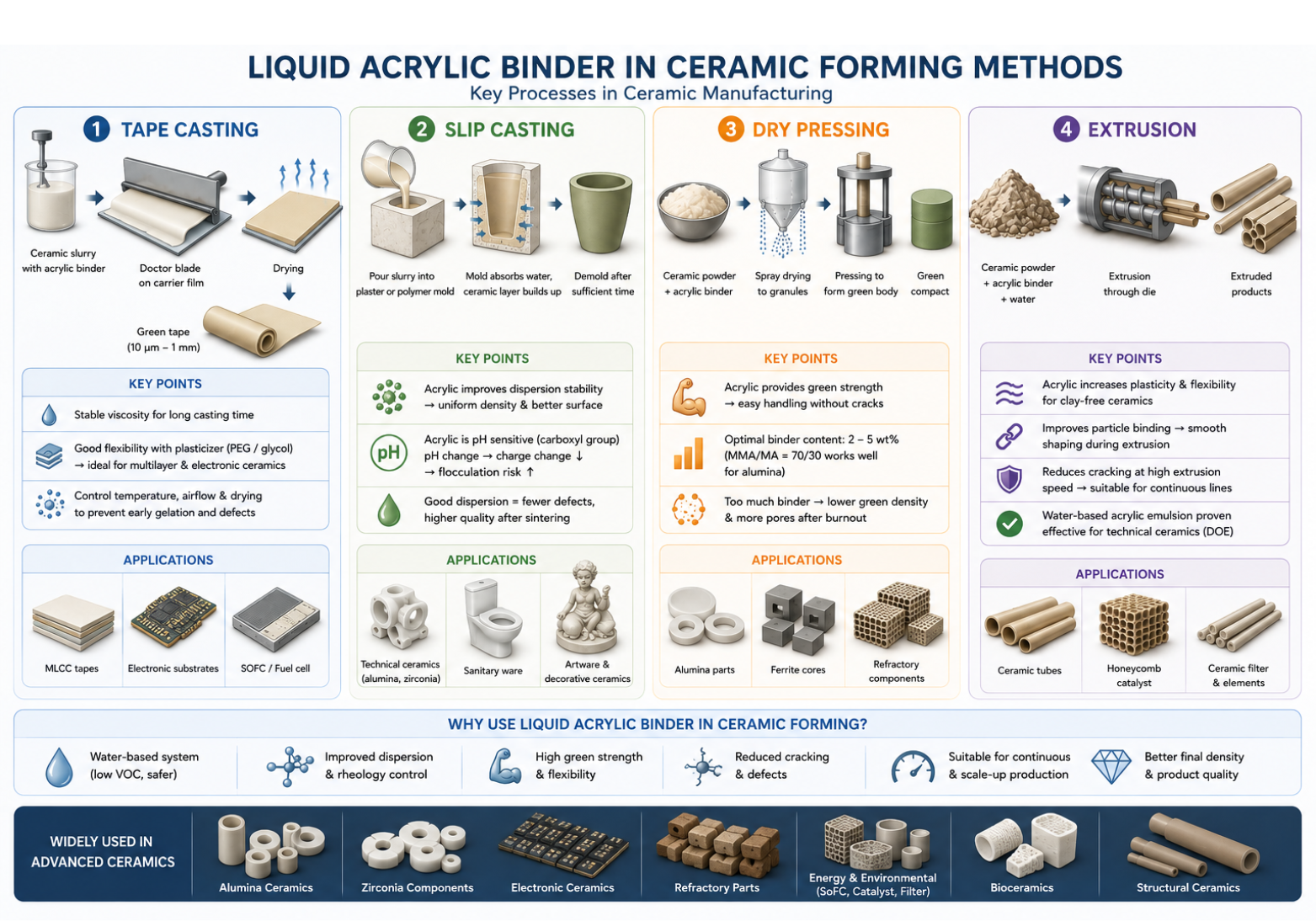
Tape casting is the most common application of acrylic binders in technical ceramics. This process uses a doctor blade to spread ceramic slurry into a thin layer on a carrier film surface. After drying, the ceramic forms a green tape with a thickness ranging from approximately 10 µm to 1 mm.
In this technology, the binder must maintain stable viscosity over an extended period. If the slurry rheology changes too rapidly, the tape layer may become non-uniform or develop air bubbles.
Water-based acrylic emulsions meet the requirements of modern tape casting quite effectively. When combined with plasticizers such as PEG or glycol, the binder system can improve the flexibility and bendability of the green tape. This is especially important for multilayer ceramics and electronic ceramics.
One common technical issue is premature gelation in water-based systems. When the slurry temperature rises excessively, acrylic may form a gel network before drying is completed. This slows water diffusion and affects production line speed.
Therefore, technicians must simultaneously control slurry temperature, airflow rate, and drying conditions to optimize the tape casting process.
Slip casting
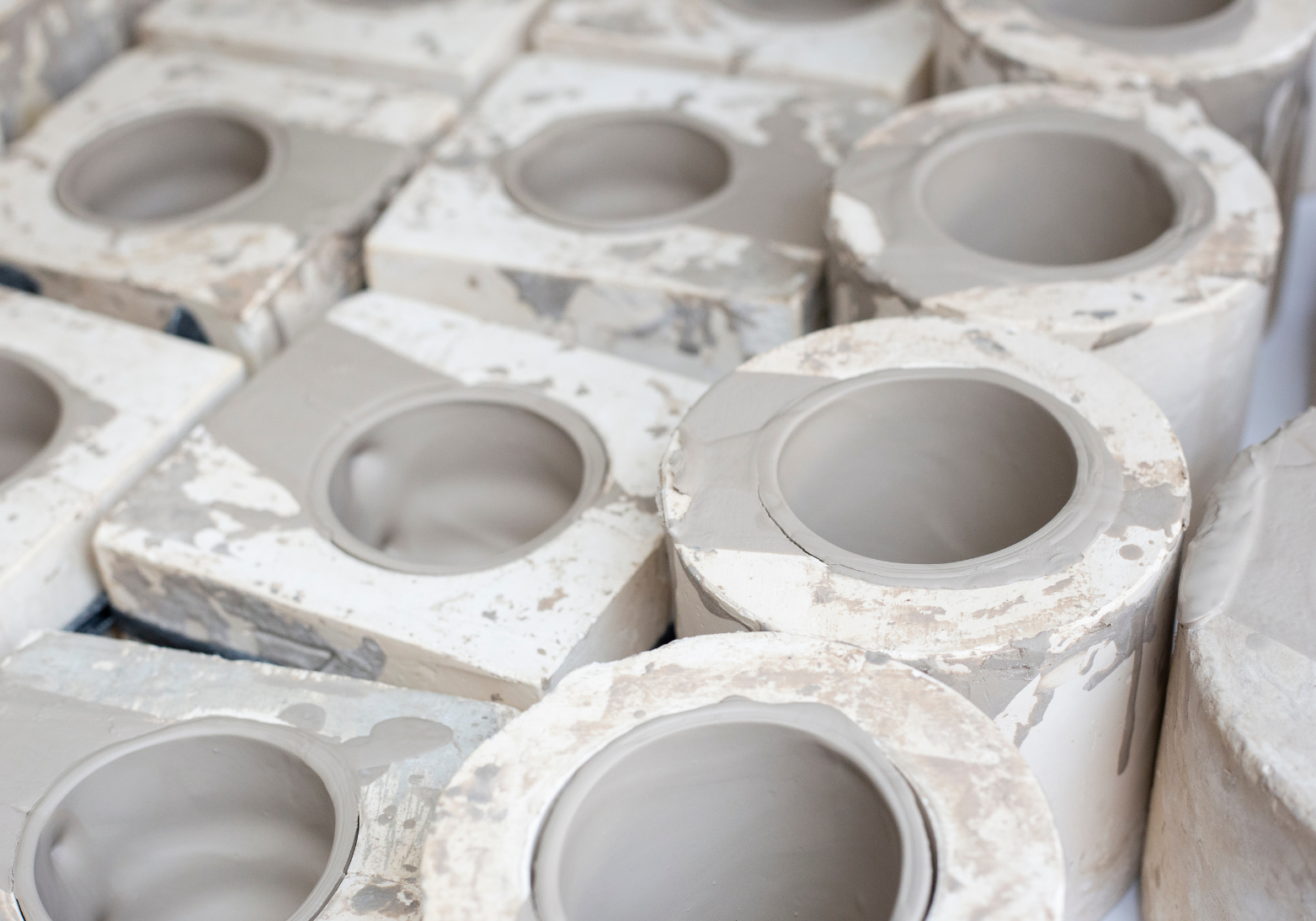
Slip casting is a traditional forming method that is still widely used in high-purity ceramics. In this process, ceramic slurry is poured into plaster or polymer molds. The mold absorbs water from the suspension, gradually forming a dense ceramic layer over time.
For slip casting, slurry dispersion stability plays a critical role. If ceramic particles agglomerate, the product may develop non-uniform density or surface defects after firing.
Acrylic binders significantly improve the dispersion capability of ceramic powders in water. This helps the slurry maintain a stable condition for a longer duration throughout the casting process.
However, acrylic is also relatively sensitive to the pH of the suspension system. Carboxyl groups in the polymer can change their ionization state when pH fluctuates. When the surface charge of ceramic particles decreases, flocculation becomes more likely to occur.
Dry Pressing
Dry pressing is a common technology in the production of technical ceramics and refractory ceramics. In this method, ceramic powder is mixed with acrylic binder and spray-dried into granules before compaction.
The primary role of acrylic in dry pressing is to provide green strength to the compact after mold release. If the binder content is too low, the compact can easily crack or chip during handling.
According to many studies by the American Ceramic Society, MMA/MA acrylic copolymers with a 70:30 ratio demonstrate good performance in high-purity alumina applications. The optimal binder content is typically within the range of 2–5% by ceramic powder weight.
If the acrylic content exceeds the appropriate threshold, the green density of the ceramic will decrease. At the same time, excess polymer increases the risk of pore formation after burnout. In practical manufacturing, optimizing binder content always requires balancing green strength and post-firing density.
Extrusion
Extrusion is commonly used to produce tubular ceramics, rods, or honeycomb structures. During extrusion, the formulation must possess sufficient plasticity to pass through the die without cracking.
Liquid acrylic is used to improve the flexibility of ceramic systems that do not contain natural clay. This is especially important for high-purity alumina and zirconia because these materials inherently have very low plasticity.
According to reports from the U.S. Department of Energy (DOE), water-based acrylic emulsion systems demonstrate effective performance in technical ceramic extrusion. The polymer improves bonding between ceramic particles during forming.
In addition, acrylic helps reduce cracking when ceramics pass through high-speed extrusion dies. This is a critical factor for continuous extrusion production lines.
FACTORS THAT MUST BE CONTROLLED WHEN USING ACRYLIC
Although acrylic offers many advantages, it still needs to be optimized for each specific ceramic system. There is no single binder formulation suitable for all forming technologies. Slurry viscosity is a parameter that must be monitored regularly. If the viscosity is too low, the ceramic will struggle to maintain its shape. Conversely, overly thick slurry can cause material distribution defects.
In addition to rheology, temperature and pH also strongly affect acrylic performance. Some polymer systems can change state rapidly when environmental conditions fluctuate. The burnout process must also be designed appropriately for each binder type. Acrylic must burn out cleanly without leaving carbon residue in high-purity ceramics.
CONCLUSION
Liquid acrylic is not merely a binder for ceramic particle bonding. This material now plays an important role in various forming technologies such as tape casting, slip casting, dry pressing, and extrusion.
Each forming method has its own requirements regarding viscosity, dispersion capability, and green strength. Therefore, selecting the appropriate acrylic system directly impacts ceramic quality before and after firing.
As the high-purity ceramic industry increasingly demands higher precision, water-based acrylic systems are becoming a key solution for optimizing production efficiency and improving technical ceramic product quality.
VICHEM – AUTHORIZED DISTRIBUTOR OF CHEMICAL ADDITIVES FROM LEADING BRANDS SUCH AS COVESTRO, SINOPEC, BUHLER,… IN VIETNAM
Vichem is an authorized distributor of chemical additive products from leading brands such as Covestro, Sinopec, Buhler,… in the Vietnamese market. We not only provide high-quality products but also deliver after-sales services that meet international standards.
For more information about our products, please contact us through the following channels:
📞 Hotline: 08 1790 1790
📧 Email: contact@vichem.vn
🔎 LinkedIn: Vichem JSC
🌐 Website: www.vichem.vn
📌 Facebook: Vichem JSC