In high-purity ceramic manufacturing, product quality depends not only on ceramic powders. The additive system used during the forming process also plays a critical role. Once the slurry becomes unstable, cracks or pores may appear after firing.
This is why many manufacturers are beginning to adopt liquid acrylic in ceramic processing. This polymer system helps achieve more uniform slurry dispersion. In addition, acrylic improves pre-firing mechanical strength and minimizes defects during drying.
WHAT IS LIQUID ACRYLIC?
Liquid acrylic is a water-based polymer system used in ceramic manufacturing processes. It commonly functions as a binder or dispersing aid in ceramic slurries.
In high-purity ceramics, slurry typically consists of ceramic powder, water, and various supporting additives. If the system is unstable, ceramic particles can easily agglomerate. As a result, the fired product may exhibit reduced strength or surface defects.
Acrylic helps improve slurry stability from the initial stage. This is why the material is widely used in alumina, zirconia, and advanced technical ceramics.
DIFFERENCES BETWEEN ACRYLIC AND TRADITIONAL BINDERS
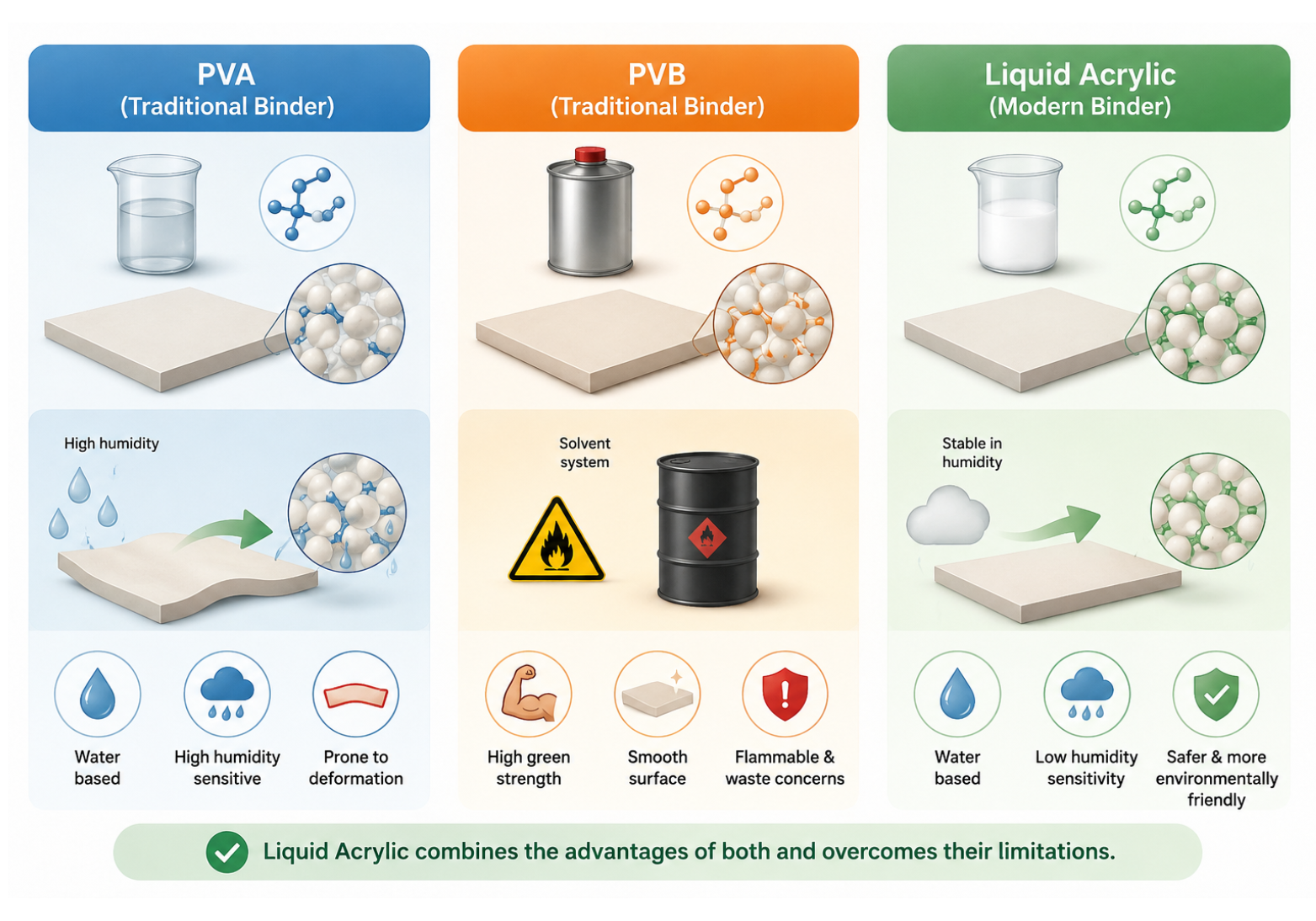
PVA (polyvinyl alcohol) was previously the most widely used binder in tape casting and slip casting. PVA dissolves well in water and creates strong adhesion between ceramic powder particles. However, PVA tends to absorb moisture from the environment, causing deformation of the green body under high-humidity conditions.
PVB (polyvinyl butyral) is commonly used in organic solvent systems. PVB provides green tapes with higher strength and smoother surfaces. However, organic solvent systems require strict fire safety and waste treatment measures.
Liquid acrylic overcomes most limitations of both materials. It performs effectively in water-based systems, is less sensitive to humidity than PVA, and does not require organic solvents like PVB.
WHY IS LIQUID ACRYLIC WIDELY USED IN HIGH-PURITY CERAMICS?
High-purity ceramics often utilize extremely fine powders. When ceramic particles are unevenly distributed, defects can easily occur during firing. In practice, many ceramic defects originate during the forming stage rather than after firing. If the slurry is too viscous or agglomerated, the material structure becomes non-uniform. This increases the risk of cracking and warping.
Liquid acrylic improves the dispersion of ceramic particles in water. As a result, the slurry maintains a stable condition for a longer period. This is especially important for technical ceramics and electronic ceramics. In addition, acrylic enhances the green strength of products before firing. During transportation or drying, the risk of cracking is significantly reduced.
THE ROLE OF ACRYLIC IN THE FORMING PROCESS
Forming is the first step in ceramic manufacturing. At this stage, the slurry is poured into molds or processed into ceramic tape depending on the production technology. If the slurry is unstable, the material will struggle to maintain its shape. In some cases, particle sedimentation or phase separation may occur during processing.
Liquid acrylic helps improve slurry uniformity. This polymer forms temporary bonds around ceramic particles. As a result, the mixture remains more stable throughout the forming process. This is also why acrylic is commonly used in technologies such as tape casting, slip casting, and ceramic coating. In technical ceramics, rheology control is always critically important.
In addition to supporting dispersion, acrylic also helps regulate slurry viscosity. When the viscosity is properly controlled, the forming process becomes more stable. At the same time, the ceramic surface after forming becomes smoother. Many studies on aqueous ceramic processing have shown that water-based acrylic systems significantly improve ceramic slurry quality.
HOW DOES ACRYLIC IMPROVE GREEN STRENGTH?
After forming, ceramics still do not possess high mechanical strength. At this stage, the material can easily crack or break during handling. Acrylic acts as a temporary binder between ceramic particles. As water begins to evaporate, the polymer helps maintain a more stable material structure.
This is especially important for thin ceramics or electronic ceramics. If the green body is too weak, the production defect rate will increase significantly.
Many modern acrylic systems also improve the machinability of ceramics before firing. As a result, manufacturers can cut or process semi-finished products more easily without damaging the material structure.
THE ROLE OF ACRYLIC DURING THE DRYING PROCESS
After forming, ceramics enter the drying stage. This is one of the stages where defects most frequently occur in ceramic production lines. When water evaporates too quickly, the material shrinks unevenly. This creates internal stress within the ceramic structure. If the stress exceeds the material limit, cracking begins to occur.
Liquid acrylic helps distribute water more evenly throughout the slurry. As a result, the evaporation rate becomes more stable during drying. This is why many manufacturers use acrylic to reduce warping and surface cracking. For high-purity ceramics, shrinkage control is extremely important.
In addition, acrylic polymers help maintain a stable microstructure during the drying stage. This allows fired ceramics to achieve better uniformity. According to many studies on aqueous tape casting, drying behavior directly affects the quality of ceramic green bodies.
HOW DOES ACRYLIC AFFECT THE FIRING PROCESS?
After drying, ceramics are fired at high temperatures to remove binders and create strong bonds between material particles. During this stage, acrylic must decompose cleanly without leaving carbon residue. If the polymer does not burn out completely, pores may form or ceramic purity may decrease.
This is why burnout control is always critical. Excessively rapid heating can prevent gases generated inside the material from escaping in time. As a result, internal cracking or microstructural defects may occur. This issue is particularly important for high-purity alumina and zirconia.
Many modern acrylic systems are specifically designed to improve clean burnout performance in ceramic processing. This helps reduce post-firing defects and improve final product quality.
CERAMIC TYPES THAT COMMONLY USE LIQUID ACRYLIC
Acrylic is currently applied in many types of technical ceramics. One of the most common groups is high-purity alumina. This ceramic is widely used in electronics and heat-resistant equipment. Since it requires extremely high uniformity, the slurry must maintain excellent stability.
In addition to alumina, zirconia also extensively uses acrylic systems. This material contains extremely fine particles that easily agglomerate in aqueous environments. Electronic ceramics are another important application area for water-based acrylic binders. For thin ceramic sheets, green strength and crack resistance are always critical factors.
In recent years, acrylic has also appeared in ceramic 3D printing and ceramic battery technologies. This demonstrates the increasingly important role of polymers in modern ceramic manufacturing.
THE TREND TOWARD WATER-BASED ACRYLIC SYSTEMS
Previously, many ceramic systems relied on organic solvent-based binders. However, VOC emissions from solvents can negatively impact both the environment and human health. This is why the ceramic industry is gradually shifting toward water-based systems. Water-based acrylic significantly reduces VOC emissions during production.
In addition to environmental benefits, water-based systems also improve operational safety. The risk of fire and explosion is much lower compared to organic solvents. Many studies now consider aqueous ceramic processing a major trend in the modern technical ceramic industry.
CONCLUSION
Liquid acrylic is becoming an important solution in today’s high-purity ceramic manufacturing industry. This polymer system helps stabilize slurry from the forming stage onward. At the same time, acrylic supports crack reduction during drying and improves ceramic quality after firing.
Throughout the forming–drying–firing process, the ability to control material structure is always critically important. This is also why many modern ceramic manufacturers are transitioning from traditional binder systems to water-based acrylic systems.
As the requirements for technical ceramics continue to increase, liquid acrylic is considered a key supporting solution for improving production efficiency and optimizing product quality.
VICHEM – AUTHORIZED DISTRIBUTOR OF CHEMICAL ADDITIVES FROM LEADING BRANDS SUCH AS COVESTRO, SINOPEC, BUHLER,… IN VIETNAM
Vichem is an authorized distributor of chemical additive products from leading brands such as Covestro, Sinopec, Buhler,… in the Vietnamese market. We not only provide high-quality products but also deliver after-sales services that meet international standards.
For more information about our products, please contact us through the following channels:
📞 Hotline: 08 1790 1790
📧 Email: contact@vichem.vn
🔎 LinkedIn: Vichem JSC
🌐 Website: www.vichem.vn
📌 Facebook: Vichem JSC