A golf ball may appear quite simple from the outside. However, internally it consists of a complex material system. Over the past decades, the golf ball manufacturing industry has transitioned from natural materials to modern polymers. This shift has significantly improved performance.
Today, materials play a central role. Manufacturers not only optimize design but also continuously refine structural configurations and material compositions. This article analyzes emerging material trends and clarifies how they influence golf ball performance.
BASIC STRUCTURE OF A GOLF BALL
A modern golf ball consists of three main technical components: the core, the mantle, and the cover.
Each component is responsible for a distinct set of properties. The core determines ball speed and coefficient of restitution. The mantle regulates spin and manages energy transfer during impact. The cover influences tactile feedback, trajectory control, and surface durability. Any material change in one layer leads to a cascading adjustment throughout the entire structural system.
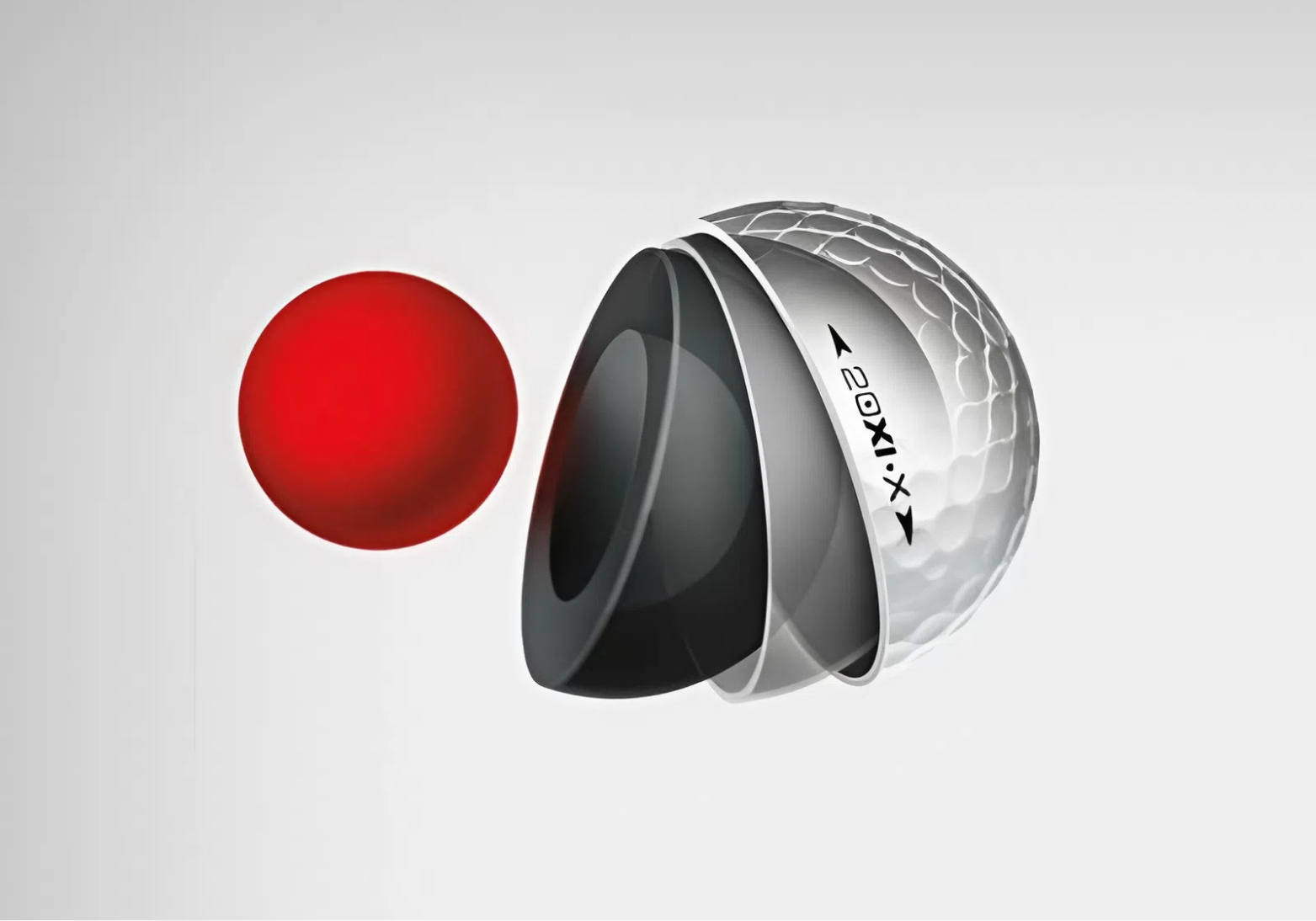
MULTILAYER MATERIAL STRUCTURE IN MODERN GOLF BALLS
A modern golf ball consists of three main technical components: the core, the mantle, and the cover.
Each component is responsible for a distinct set of properties. The core determines ball speed and coefficient of restitution. The mantle regulates spin and manages energy transfer during impact. The cover influences tactile feedback, trajectory control, and surface durability. Any material change in one layer leads to a cascading adjustment throughout the entire structural system.
Core
The core is typically made from synthetic rubber, most commonly polybutadiene. This material has high elasticity, allowing adjustment of compression and generating high ball speed upon impact.
Mantle
Surrounding the core are intermediate layers. These layers are usually made from thermoplastic polymers or ionomers. They function to regulate spin and compression, enabling the ball to adapt to different swing speeds.
Cover
The outermost layer is the cover. This layer directly affects feel and control. Premium golf balls typically use urethane. The thickness of the urethane cover usually ranges from 0.3 mm to 0.5 mm. A thinner cover allows for a larger core volume, thereby improving ball speed and coefficient of restitution.
Some manufacturers have developed proprietary urethane formulations to control spin characteristics and tactile feedback according to their specific design philosophy.
IMPACT OF MATERIALS
Distance and Spin
Ball distance largely depends on the core. The more elastic the core material, the greater the energy transfer, resulting in longer flight distance. In contrast, spin depends on the cover. Softer materials such as urethane create higher friction, allowing the ball to stop more quickly on the green.
The combination of a firm core and a soft cover is a common trend. It provides a balance between distance and control. Manufacturers are optimizing each layer with the goal of achieving maximum performance in all playing conditions.
Durability and Stability
In addition to performance, durability is also an important factor. Players expect the ball to maintain its properties after repeated use. New materials help reduce surface wear and limit deformation after strong impacts, thereby extending product lifespan.
Stability has also improved significantly. The ball maintains its characteristics even under temperature variations, which is critical in outdoor play.
BIODEGRADABLE MATERIALS
Conventional golf balls are made from synthetic rubber, plastics, and petroleum-based compounds. These materials do not degrade under normal environmental conditions. During degradation, golf balls release microplastics and heavy metals into soil and water sources. Industry reports estimate that between 300 million and 4 billion golf balls are lost globally each year.
Biodegradable golf balls are primarily made from corn starch and polyvinyl alcohol (PVA). Some products can decompose in water within two to four weeks. The decomposition time depends on temperature and microbial conditions.

DEVELOPMENT TRENDS
The high-performance golf ball manufacturing industry is expected to continue growing. The application of nanomaterials will expand into the mantle and cover layers. In addition, the trend of personalizing golf balls based on individual player characteristics is increasingly developing.
CONCLUSION
New materials are fundamentally transforming golf ball manufacturing. From multilayer structures to high-performance polymers, every factor is being optimized.
The combination of an elastic core, a flexible mantle, and a soft cover delivers comprehensive performance. Players can achieve longer distances while maintaining excellent control. In the future, material trends will continue to advance strongly. Companies need to invest in research to keep pace with the market.
VICHEM – AUTHORIZED DISTRIBUTOR OF CHEMICAL ADDITIVES FROM MAJOR BRANDS SUCH AS COVESTRO, SINOPEC, BUHLER,… IN VIETNAM
Vichem is an authorized distributor of chemical additives from leading brands such as Covestro, Sinopec, Buhler,… in the Vietnamese market. We not only provide high-quality products but also deliver after-sales services that meet international standards.
For more information about our products, please contact us via the following channels:
📞 Hotline: 08 1790 1790
📧 Email: contact@vichem.vn
🔎 LinkedIn: Vichem JSC
🌐 Website: www.vichem.vn
📌 Facebook: Vichem JSC