Using polyaspartic resin shortens the recoat interval because amine groups react with isocyanate faster than hydroxyl groups in conventional polyol systems. The actual reduction depends on resin structure, temperature, humidity, film thickness, and mixing ratio. A faster reaction also means a shorter pot life after mixing, so the benefit can only be realized when the equipment and application pace can keep up.
What determines the recoat interval
The recoat interval is not simply the point when the surface becomes tack-free. The underlying coat must be stable enough to withstand the solvent, forces exerted by application tools, and material load from the next coat without redissolving, wrinkling, scoring, or losing intercoat adhesion. If recoated too soon, the upper coat may disrupt the film beneath it. If left too long, the deeply cured surface may require preparation to ensure good adhesion of the new coat.
The recoat point therefore differs from surface-dry, handling-dry, and return-to-service times. Confusing these milestones can produce an application schedule that looks sound on paper but does not reflect the film's actual condition. The target must be clearly defined: reducing the interval between coats, the time to foot traffic, or the total time to handover.
For factory floors, every hour of waiting can extend area closures, delay equipment installation, and add application shifts. However, forcing a reaction to proceed faster without enough time for spreading, deaeration, and joint treatment merely converts waiting costs into surface repair costs. The value of a fast-curing system lies in the balance: the underlying coat reaches its recoat window sooner, while the mixture remains workable long enough for uniform application across the designated area.
Why the amine reaction is faster than the hydroxyl reaction
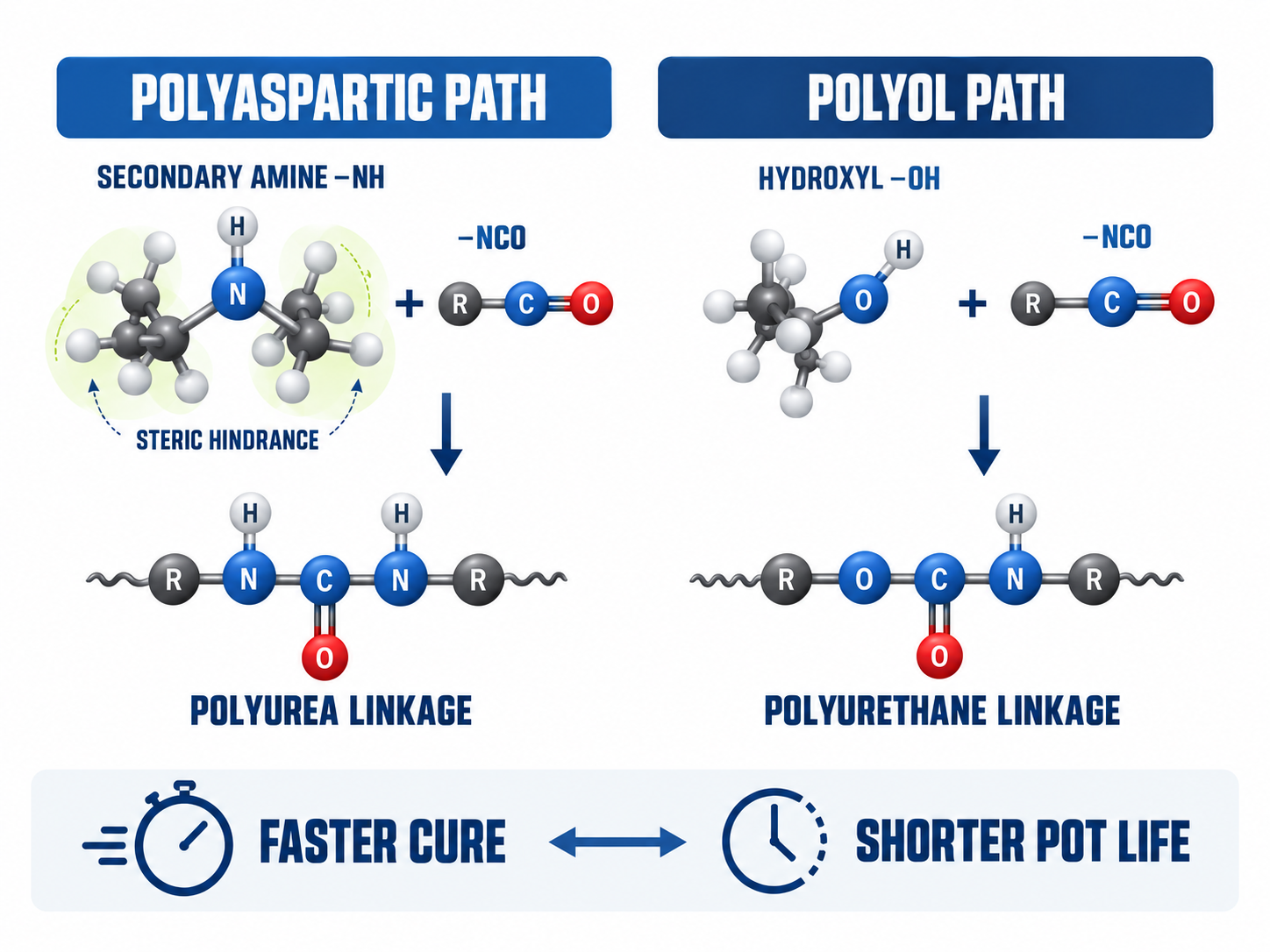
In polyol-based two-component polyurethane (2K PU) coatings, hydroxyl groups –OH react with isocyanate groups –NCO to form urethane linkages. In a polyaspartic ester, the reactive group is a secondary amine –NH, which reacts with –NCO to form a urea linkage. Under equivalent conditions, amine nitrogen is more reactive than hydroxyl oxygen, allowing the crosslinked network to develop faster.
This does not mean that every coating described as polyaspartic cures at the same rate. The rate also depends on how readily the two functional groups can approach each other, the hardener structure, reactive-group concentration, solvents, additives, and temperature. “Polyaspartic vs polyurethane” is not a comparison between a material outside the PU family and polyurethane: both react with polyisocyanate; the key difference is whether the resin carries –NH or –OH groups.
Steric hindrance keeps the reaction within a workable window
Molecular branches surrounding the amine group in a polyaspartic ester create steric hindrance. They make it more difficult for the –NH group to approach –NCO than in a less hindered amine, thereby moderating an inherently very fast reaction. Different degrees of hindrance produce different reaction profiles among resins, even within the polyaspartic family.
This mechanism explains the system's two sides. The reaction is fast enough for the underlying coat to reach a recoatable state sooner, while steric hindrance prevents the mixture from losing workability immediately after mixing. This balance must be assessed in the complete coating batch and cannot be inferred from the resin's chemical name alone.
The trade-off between curing speed and pot life
When the reaction proceeds rapidly, mixture viscosity rises sooner and pot life decreases. An oversized batch retains more heat, which may accelerate the reaction further; transporting the material from the mixing area to the floor also consumes part of the working window. If staffing and batch coverage remain the same as for a slower system, lap marks, roller marks, bubbles, or material curing inside the equipment can readily occur.
Conversely, extending the working time by changing the reaction ratio or adding components outside the formulation design may eliminate the fast-curing benefit itself and produce an unbalanced film. Recoat interval and pot life should be treated as a paired set of parameters: optimizing one always requires checking the other.
Factors that determine performance
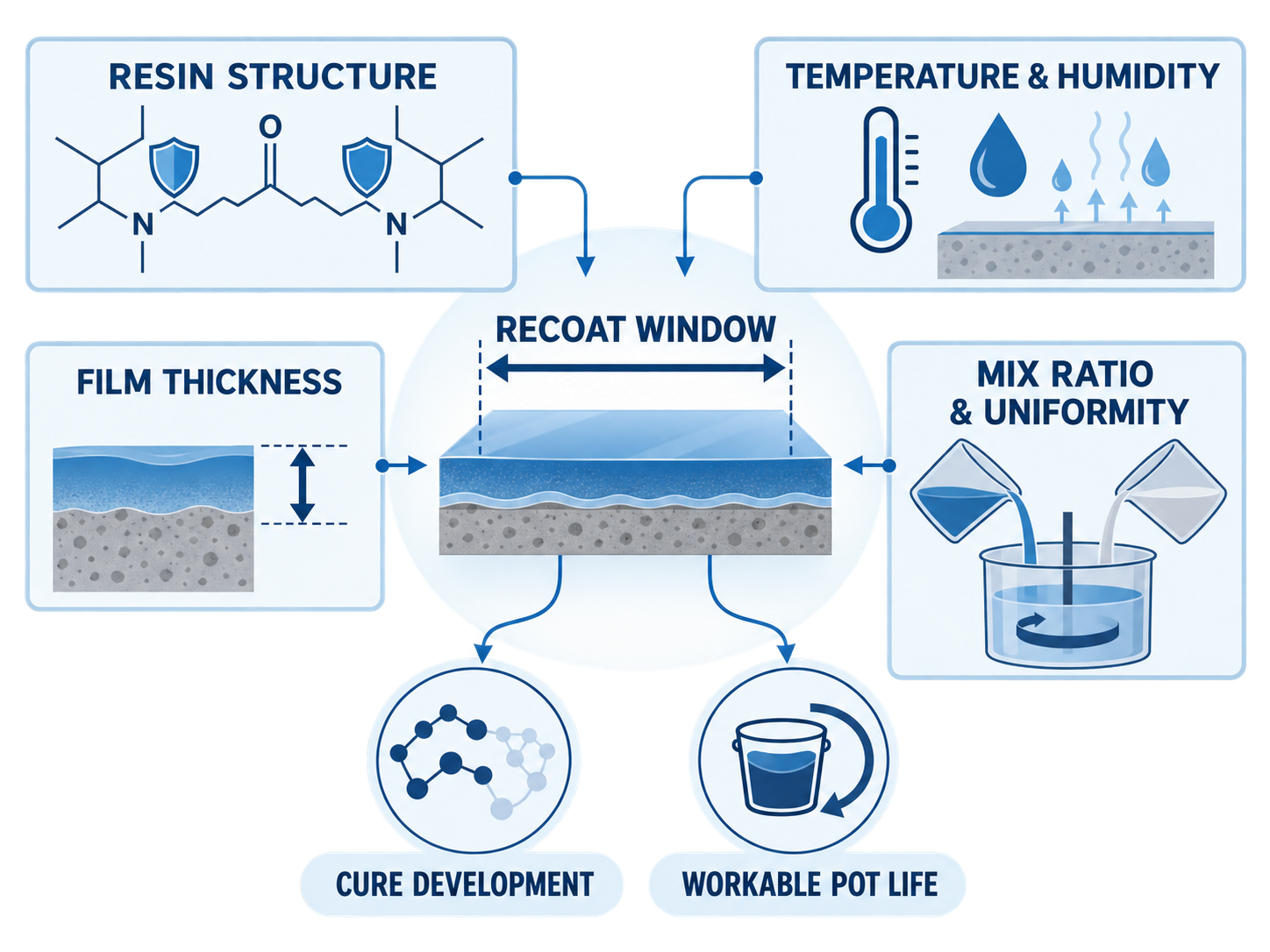
Degree of steric hindrance in the resin
Greater hindrance generally slows contact between the amine and isocyanate, helping extend the working window; lower hindrance can shift the reaction toward a faster rate. This is a property of each resin and should not be assessed by color or viscosity alone. The paired hardener and the complete formulation can still alter the result.
Ambient temperature and humidity
Higher material, substrate, and air temperatures generally accelerate chemical reactions, resulting in a shorter pot life. A cold substrate may cause film development to proceed more slowly than expected. Humidity must be controlled because isocyanate can react with water, generating gas and causing defects. Conditions must be recorded at the surface, not determined solely from room temperature.
Film thickness
A thick film differs from a thin coat in heat dissipation, gas release, and curing behavior. A successful result on a laboratory drawdown panel does not automatically translate to a thick floor coating. Testing should be performed at the intended application thickness, with both the surface and the interior of the film examined before the recoat window is established.
Mixing ratio and uniformity
The ratio between amine and NCO groups determines how many reaction sites can form. Inaccurate weighing, inadequate mixing, or material left on the container walls creates areas with excess of one component, leading to uneven curing. Do not adjust application time by arbitrarily changing the ratio; calculate it by equivalent weight and control the batching process.
When to use the system—and when not to
Is the project's actual time constraint the recoat interval
A system change should be considered when the project's critical path is genuinely the recoat window: the floor must receive multiple coats within one shift, the area must be handed over quickly, or the weather permits only a short application window. First, break the schedule down into substrate preparation, mixing, application, waiting to recoat, and curing before use. If the bottleneck lies in substrate preparation or equipment handover, a fast-reacting resin may not shorten the overall schedule.
In a test matrix, polyaspartate resins can be screened by viscosity grade while reviewing the equivalent weight, viscosity, and application stated in the TDS together. These parameters are used for calculations and sample design; they are not the drying time of the finished coating.
What does a short pot life require from equipment and application planning
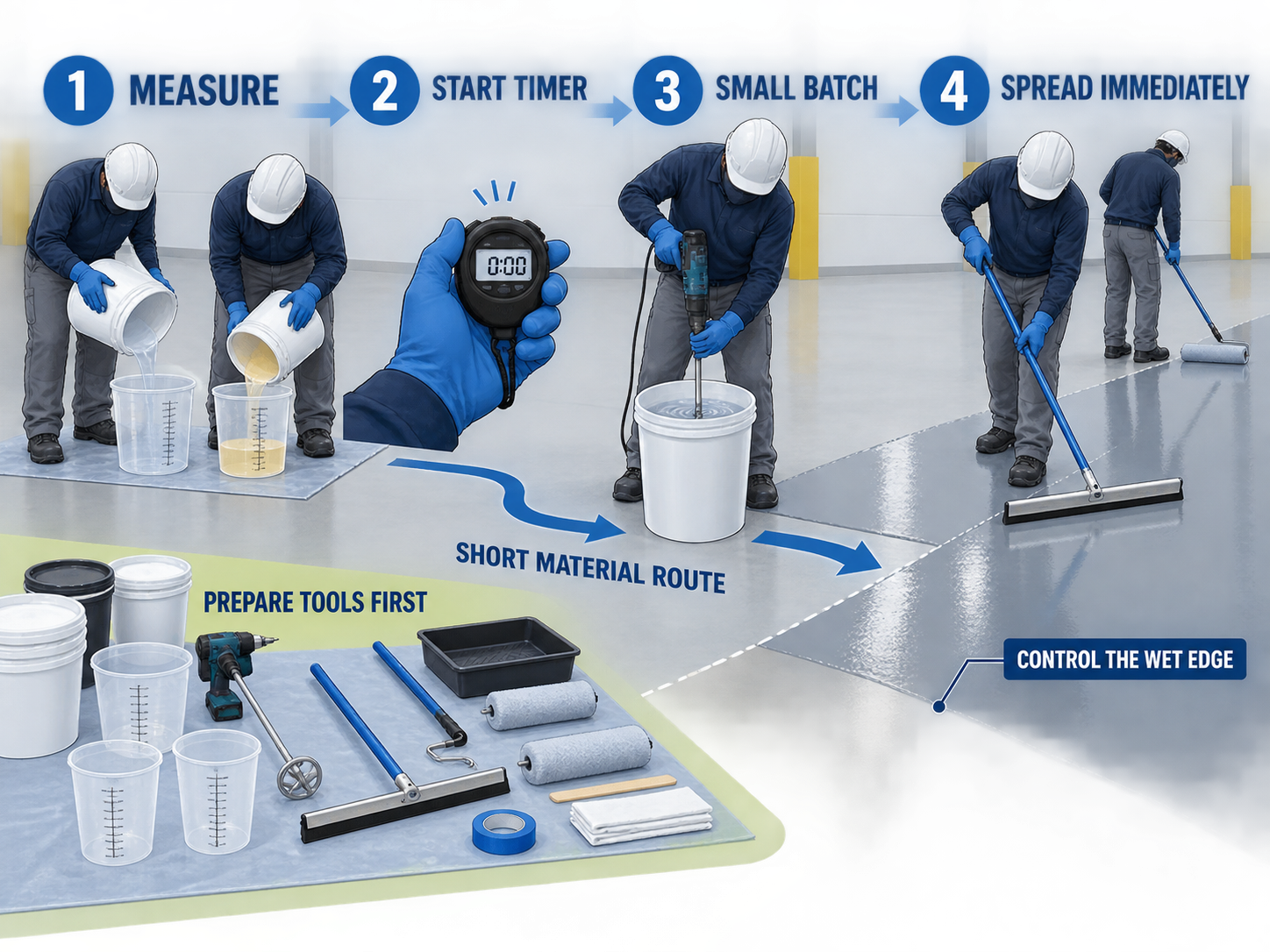
Divide the area into sections suited to the spreading rate, reduce the volume of each batch, and keep the material delivery path short. Timing must begin as soon as the two components come into contact, not when the material is placed on the floor. Mixing, squeegee, and roller tools must be ready before batching; once a batch has increased in viscosity, it must not be diluted to extend its use.
Do not change systems if the site cannot control batching accuracy, substrate temperature, mixing time, or application rate. Nor should polyaspartic be treated as the default replacement for every 2K PU system. Applications that require a long open time, involve excessively large continuous areas, or contain complex details may be better suited to a slower-reacting, more workable system.
Frequently asked questions
Can polyaspartic coatings be applied with a hand roller?
They can be roller-applied if the formulation is designed for that method and the coverage of each batch is compatible with its pot life. Conduct a trial to assess spreading, lap marks, and bubbles. Do not extrapolate the rollability of one formulation to every polyaspartic system.
How soon can a polyaspartic floor accept foot traffic?
There is no single timeframe for every polyaspartic floor. Time to foot traffic depends on the complete formulation, substrate temperature, humidity, thickness, and required load. The raw resin TDS is not a substitute for coating-system test results, so acceptance criteria must be established for the specific coating system.
Can polyaspartic be used for outdoor coatings?
A polyaspartic coating can be designed for outdoor use, but the complete system must be assessed for weathering resistance, color, hardener, pigment, and substrate. The resin name alone does not demonstrate the durability of the finished film. Test specimens should be exposed to conditions representative of the intended application.
Can the same mixing ratio be retained when changing from polyol to polyaspartic?
The ratio cannot remain unchanged based on weight alone. –OH and –NH groups have different equivalent weights, while each hardener has its own NCO content. The functional-group balance must be recalculated, followed by batch testing of viscosity, pot life, and film properties.
Conclusion
Polyaspartic resin shortens the recoat interval because amine groups react with isocyanate faster than hydroxyl groups, while steric hindrance moderates the reaction so the mixture remains workable. This benefit always comes with a shorter working window and a greater need for tight process control.
-
Identify the correct milestone to shorten: recoating, foot traffic, or handover.
-
Evaluate both the recoat interval and pot life after mixing.
-
Test at the actual thickness, substrate, and temperature using the intended application equipment.
Vichem is an authorized distributor of chemical additive products from leading brands such as Covestro, Sinopec, Bühler, and others in the Vietnamese market.
For more information about our products, please contact us through the following channels:
- Hotline: 08 1790 1790
- Zalo OA: Vichem JSC
- Email: contact@vichem.vn
- LinkedIn: Vichem JSC
- Website: www.vichem.vn
- Facebook: Vichem JSC