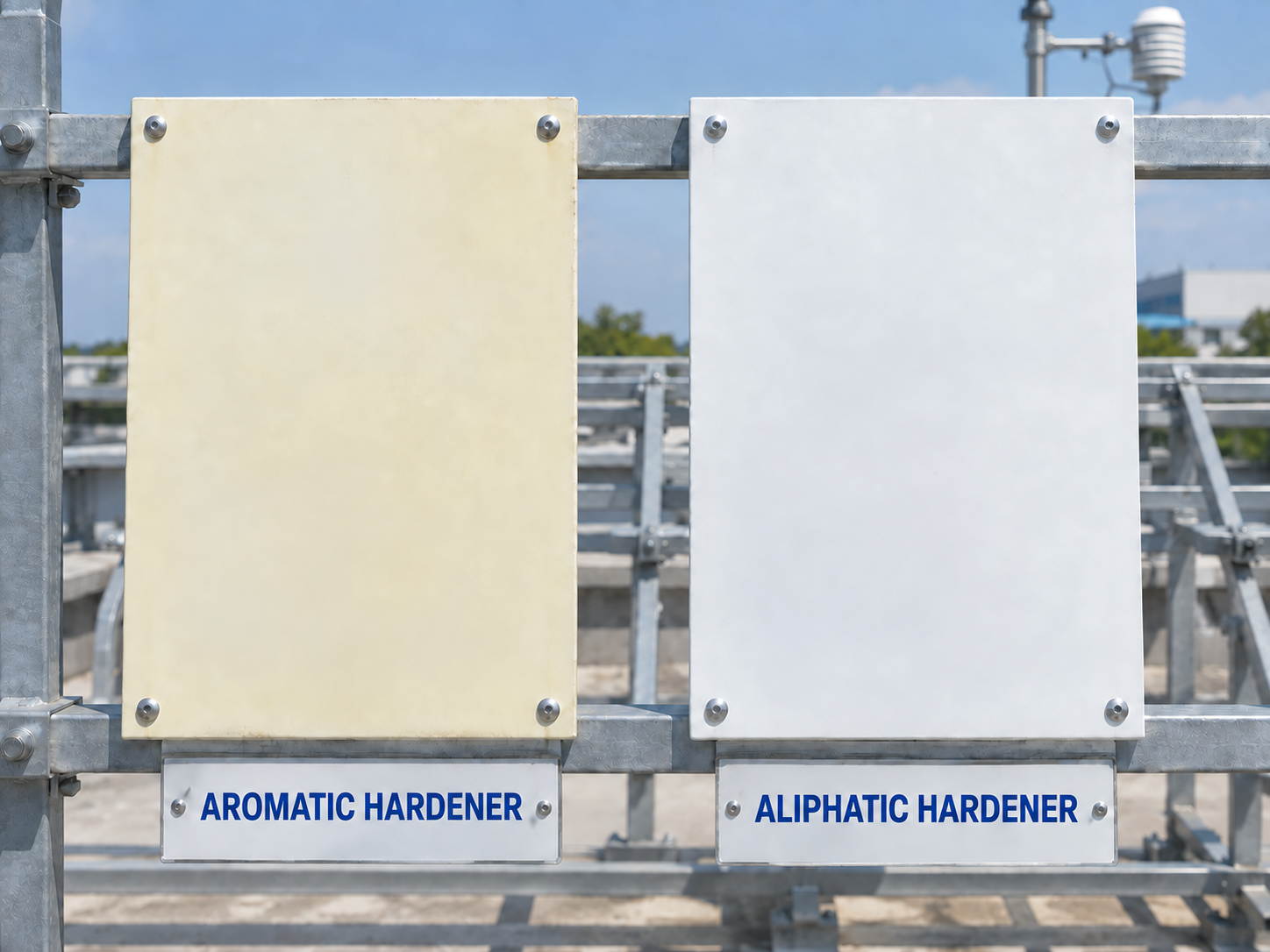
Paint film yellowing during service may be caused by aromatic hardeners, pigments with insufficient lightfastness, resin oxidation, or contaminants migrating from the substrate. The quickest way to narrow down the cause is to examine the color distribution pattern, then compare exposed and shielded areas on the same component. Once the hardener has been identified as the source of the defect, the appropriate response is to switch to a suitable aliphatic type rather than merely adjusting the color.
What Is Paint Film Yellowing, and What Are Its Effects?
Yellowing is a color change that occurs after the coating has dried, achieved the specified color, and passed inspection. During service, white may shift toward cream, pale colors may become dull, or a clear coat may develop a yellow cast. This is a change over time and is not the same as an initial color mismatch during formulation or application.
This distinction determines the direction of the investigation. If a newly formed film is already off-specification, check weighing accuracy, the color formulation, and dispersion quality. If the initial color is correct but changes in service, investigate the hardener, pigment, resin, and the potential for colorants in the substrate to migrate through the coating.
The effect is most readily observed on white coatings, pastel colors, and clear coats. On dark colors, a yellow cast may be less visible but can still alter color vibrancy. Evaluation should use a reference sample, a consistent light source, and a consistent viewing angle.
A batch of components with inconsistent color may fail inspection and require surface rework or complete recoating. On an installed project, repairs also add labor and downtime. An accurate diagnosis avoids replacing multiple raw materials when only one variable is causing the coating film discoloration.
Four Common Causes
Photodegradation of Aromatic Hardeners
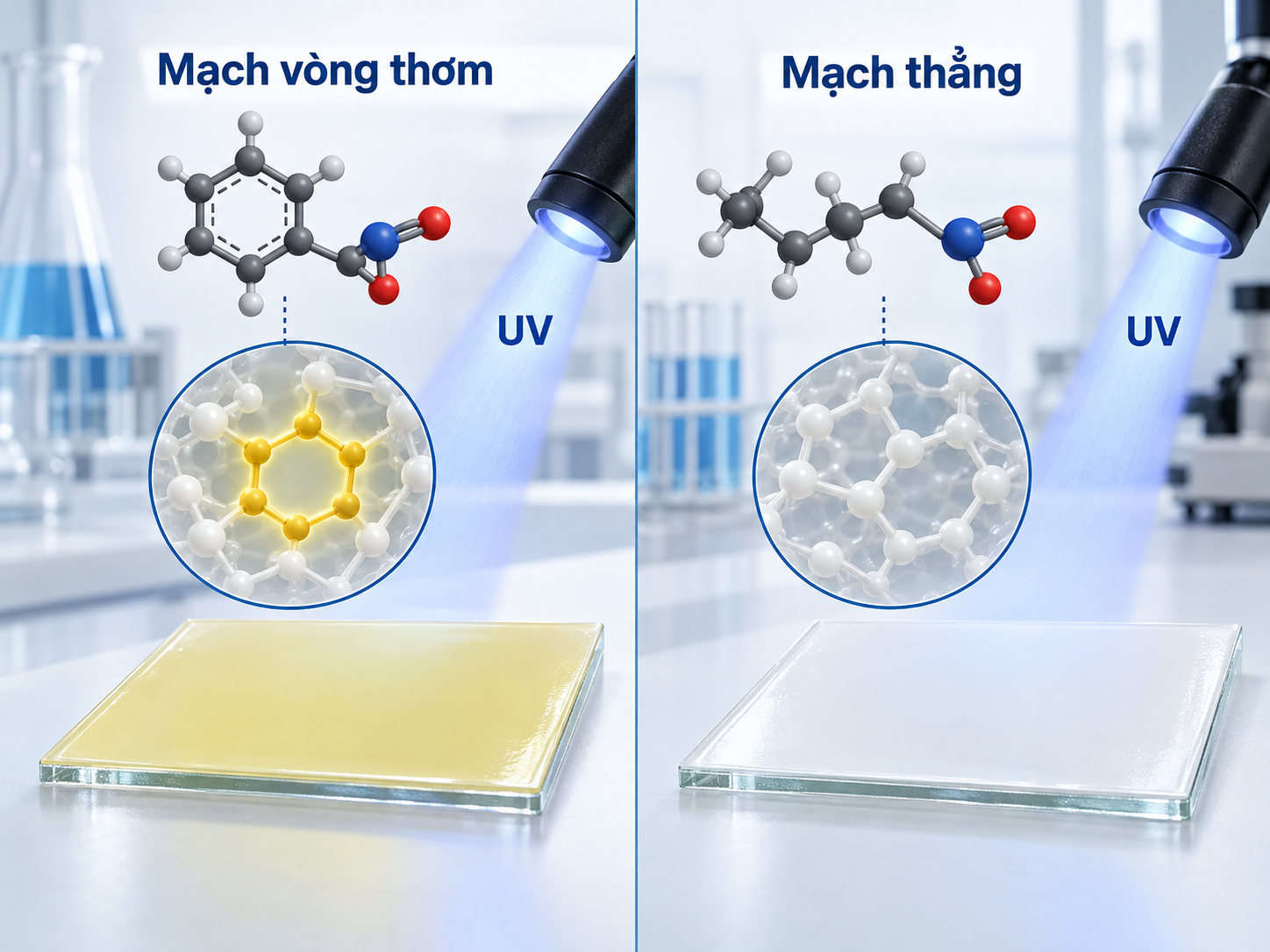
In polyurethane systems, the hardener is an isocyanate, either aromatic or aliphatic. Under UV radiation, the aromatic ring can undergo photo-oxidation, forming yellow quinone-imide and azo groups.
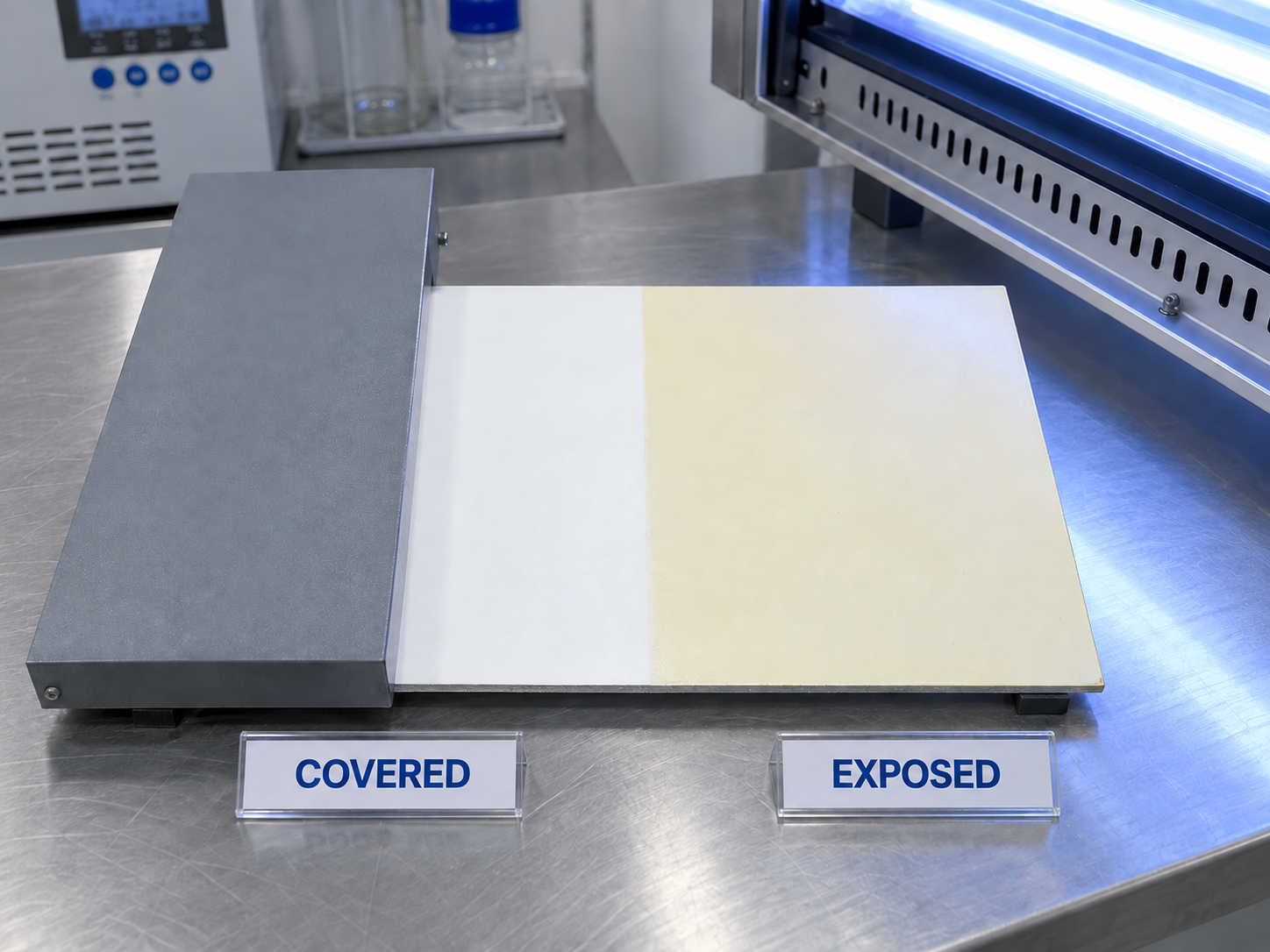
Diagnostic sign: the yellowing is relatively uniform and becomes more pronounced in exposed areas after a period of exposure. Areas beneath covers or seals, or other shielded sections, may retain color better than exposed sections.
How to check: compare exposed and shielded areas, review the TDS to identify the isocyanate structure, and prepare a pair of samples using the same coating system but different hardeners.
Corrective action: replace the aromatic type with an aliphatic type suitable for a color-retentive topcoat, then retest the complete system under conditions representative of the application.
Risk of an incorrect response: changing the pigment or resin while retaining the existing hardener only increases the number of test variables; the yellowing may reappear during the next exposure cycle.
Pigment with Poor Lightfastness
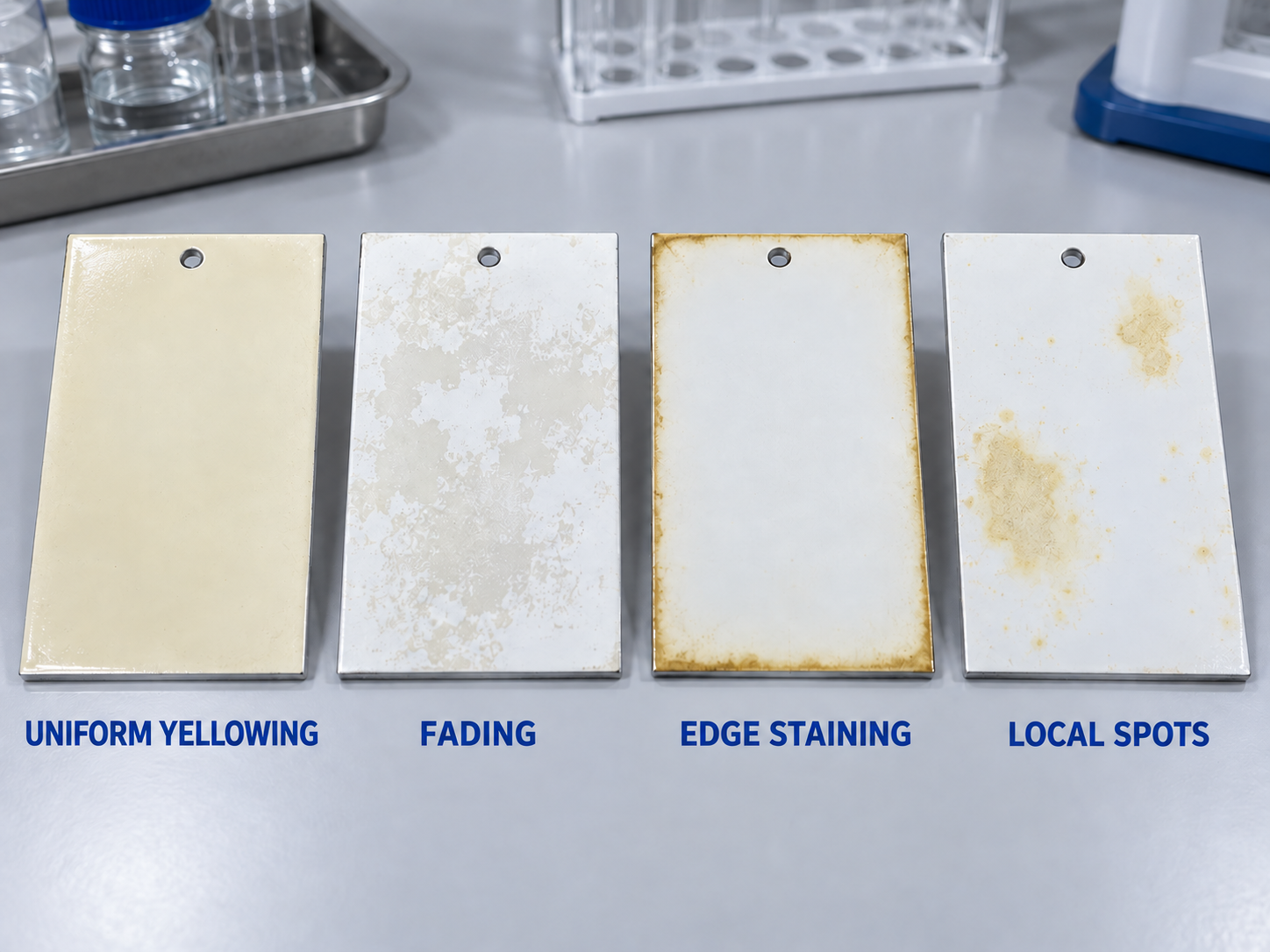
Diagnostic sign: the color loses vibrancy, fades, or changes according to the pigment's individual hue rather than developing a uniform yellow cast. Colors using the same resin and hardener may deteriorate differently.
How to check: prepare samples with the same substrate, resin, hardener, and film thickness, changing only the pigment; expose them under identical conditions and compare them with a retained reference sample.
Corrective action: select a pigment with lightfastness appropriate for the expected exposure, then reconfirm dispersion quality and film color under stable processing conditions.
Risk of an incorrect response: changing the hardener will not correct pigment fading; changing multiple pigments at once also prevents the cause from being isolated.
Oxidation of Alkyd Resin over Time
Diagnostic sign: areas with little light exposure or areas that are shielded still turn yellow, sometimes more noticeably in hot, enclosed, or poorly ventilated locations. This distinguishes the effect from photodegradation of the hardener.
How to check: compare a light-exposed sample with a dark-stored sample from the same batch, while reviewing temperature, ventilation, and storage duration.
Corrective action: select a resin that meets the color-retention requirement, control film formation and storage conditions, and confirm performance using samples monitored in a stable environment.
Risk of an incorrect response: changing only the isocyanate will not eliminate dark yellowing. Changing only the resin while continuing to expose samples to abnormal heat or poor ventilation will also distort the test results.
Rusted Steel Substrate or Substrate Migration
Diagnostic sign: yellow-brown staining is concentrated around edges, joints, pinholes, scratches, or previously rusted areas; substances migrating from the substrate create localized spots or patches.
How to check: review surface-preparation records, inspect the primer, and carefully open one defective area for comparison with an intact area and with locations where moisture or contamination may accumulate.
Corrective action: remove the rust and source of contamination, prepare the surface again, and apply a suitable barrier primer before the topcoat.
Risk of an incorrect response: coating over the rust source only hides the defect temporarily; grinding before the affected area has been defined increases the repair area unnecessarily.
Rapid Diagnostic Procedure
-
Assess the distribution pattern of the yellow cast. If the color is uniform across the film, prioritize investigation of its constituents. If staining is concentrated around edges, joints, and defects, inspect the substrate and primer first. If the surface has faded or lost vibrancy according to hue, review the pigment.
-
Compare exposed and shielded areas. Select two areas on the same component to minimize differences in formulation and application. More pronounced yellowing in the exposed area indicates that radiation plays a role; yellowing in the shielded area as well requires the investigation to include the resin and storage environment.
-
Review the TDS for the hardener in use. Determine whether the isocyanate has an aromatic or aliphatic structure. Do not infer its chemical structure from its liquid state, initial color, or the generic description “polyurethane coating hardener.”
-
Prepare a sample pair that differs only in the hardener. Keep the polyol, pigment, solvent, substrate, film thickness, and curing regime unchanged. Expose both samples under the same conditions and evaluate them at the same time. The result has diagnostic value only when all other variables are controlled.
Corrective and Preventive Measures
Switch to an Aliphatic Hardener for Exterior Coatings
When the color distribution pattern, light-shielding test, and technical documentation all point to an aromatic hardener, the solution is to switch to an aliphatic polyisocyanate. Within Covestro's range of HDI isocyanurate hardeners, solvent-free and solvent-diluted forms are options that can be included in screening for systems requiring lightfastness; final selection must be based on the complete formulation and application requirements.
According to the Covestro coating index, solvent-free and solvent-diluted HDI isocyanurate hardeners differ in NCO content, supply form, and viscosity, so they cannot be substituted at the same weight. A solvent-diluted form must be evaluated against the current TDS for the specific product rather than using specifications inferred from another product.
What Must Be Recalculated When Changing Hardener Types
Do not replace the hardener using the previous weight ratio. The formulation team must rebalance the system based on the NCO equivalent weight of the hardener and the OH equivalent weight of the resin, using the same calculation basis. Input data must come from documentation for the specific grade because differences in active content will alter the required material quantity.
The supply form also directly affects solids content, solvent level, and application viscosity. The solvent type, compatibility, and dilution level of the entire system must therefore be reviewed. Once the formulation has been balanced, monitor processability, pot life, drying progression, and cure state rather than evaluating color alone.
Prevention begins with a clearly defined lightfastness requirement when selecting raw materials. Each test campaign should include a reference sample, batch records, equivalent ratios, order of addition, and environmental conditions. Equipment must be clean to avoid contamination. For steel substrates, both surface preparation and the primer must be controlled because an aliphatic hardener cannot correct rust or migration.
Frequently Asked Questions
Do Exterior Polyurethane Coatings Always Require an Aliphatic Hardener?
An aliphatic type should be prioritized when an exterior coating must retain its color, particularly for white, pastel, and clear coatings. The decision must still account for the polyol, pigment, solvent, mechanical properties, and curing conditions. A lightfast hardener cannot compensate for poor substrate preparation.
Can a Yellowed Paint Film Be Recoated?
Recoating should be considered only after the source of the yellowing has been removed and the existing coating has been confirmed to retain adequate adhesion. Rust, migration, or a deteriorated film must be addressed first; direct recoating without a diagnosis only masks the color temporarily.
How Can the Type of Hardener in Use Be Identified?
Review the TDS for the specific product and identify the stated isocyanate type. No conclusion can be drawn from the color of the liquid, whether it is supplied as a solution, or a generic product description. If the documentation does not state the structure, ask the supplier to verify the specific grade.
Does an HDI Hardener Completely Eliminate the Risk of Yellowing?
No. HDI avoids the discoloration mechanism associated with the aromatic ring of an isocyanate, but the pigment, resin, additives, and substrate can still discolor the film. The validation sample must therefore represent the formulation, process, and service environment.
Conclusion
Yellowing caused by a hardener is usually distributed relatively uniformly and is more pronounced in exposed areas. Before changing the formulation, examine the defect pattern, compare shielded and exposed areas, review the TDS, and run paired samples in which only one variable is changed.
-
Localized yellowing around edges or joints requires inspection of the substrate and primer.
-
If an aromatic isocyanate is the cause, switch to an aliphatic type and retest the complete system.
-
When changing raw materials, recalculate the NCO/OH balance, solvent level, and viscosity.
Vichem is an authorized distributor of chemical additive products from leading brands such as Covestro, Sinopec, Bühler, and others in the Vietnamese market.
For more information about our products, please contact us through the following channels:
- Hotline: 08 1790 1790
- Zalo OA: Vichem JSC
- Email: contact@vichem.vn
- LinkedIn: Vichem JSC
- Website: www.vichem.vn
- Facebook: Vichem JSC