In the printing industry, ink stability is a critical factor that determines the quality of the final product. However, after a period of storage or during use, many businesses encounter the issue of ink color settling, causing the color to become inconsistent compared to its original state.
Although this is a relatively common phenomenon, not all companies fully understand the root causes behind this issue. In reality, color settling not only affects the appearance of printed materials but also directly impacts production efficiency, defect rates, and operating costs.
Properly identifying the causes and implementing appropriate control measures can help businesses maintain stable ink quality, minimize production risks, and improve long-term operational efficiency.
WHAT IS INK COLOR SETTLING?
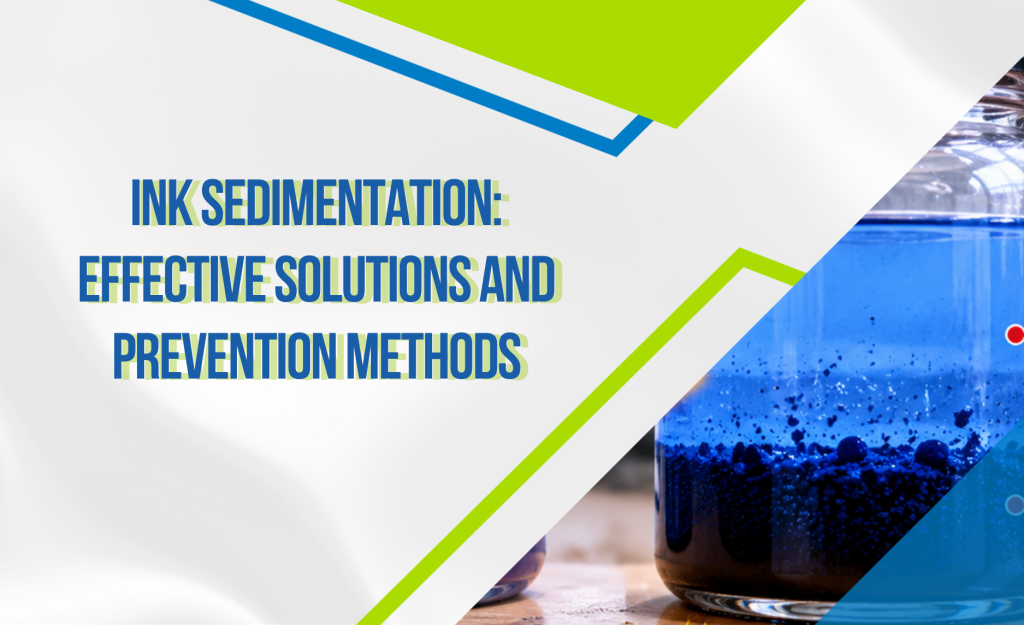
Ink color settling is a phenomenon in which pigment particles gradually separate from the ink system and migrate to the bottom of the container under the influence of gravity. Over time, these particles accumulate into a sediment layer, while the ink in the upper portion becomes lighter in color due to the reduced pigment concentration.
Under ideal conditions, pigment particles should be uniformly dispersed and remain stable throughout the entire ink system. However, when this balance is disrupted, the pigment particles begin to agglomerate and settle.
In mild cases, the sediment can be re-dispersed through mechanical stirring. Conversely, if the phenomenon persists or becomes severe, the pigment particles may form hard agglomerates. In such cases, restoration becomes difficult, and the ink quality may not be fully recoverable.
This is one of the most common issues in ink systems containing high pigment concentrations or pigments with high specific gravity.
SIGNS OF INK COLOR SETTLING
Formation of Sediment at the Bottom of the Container
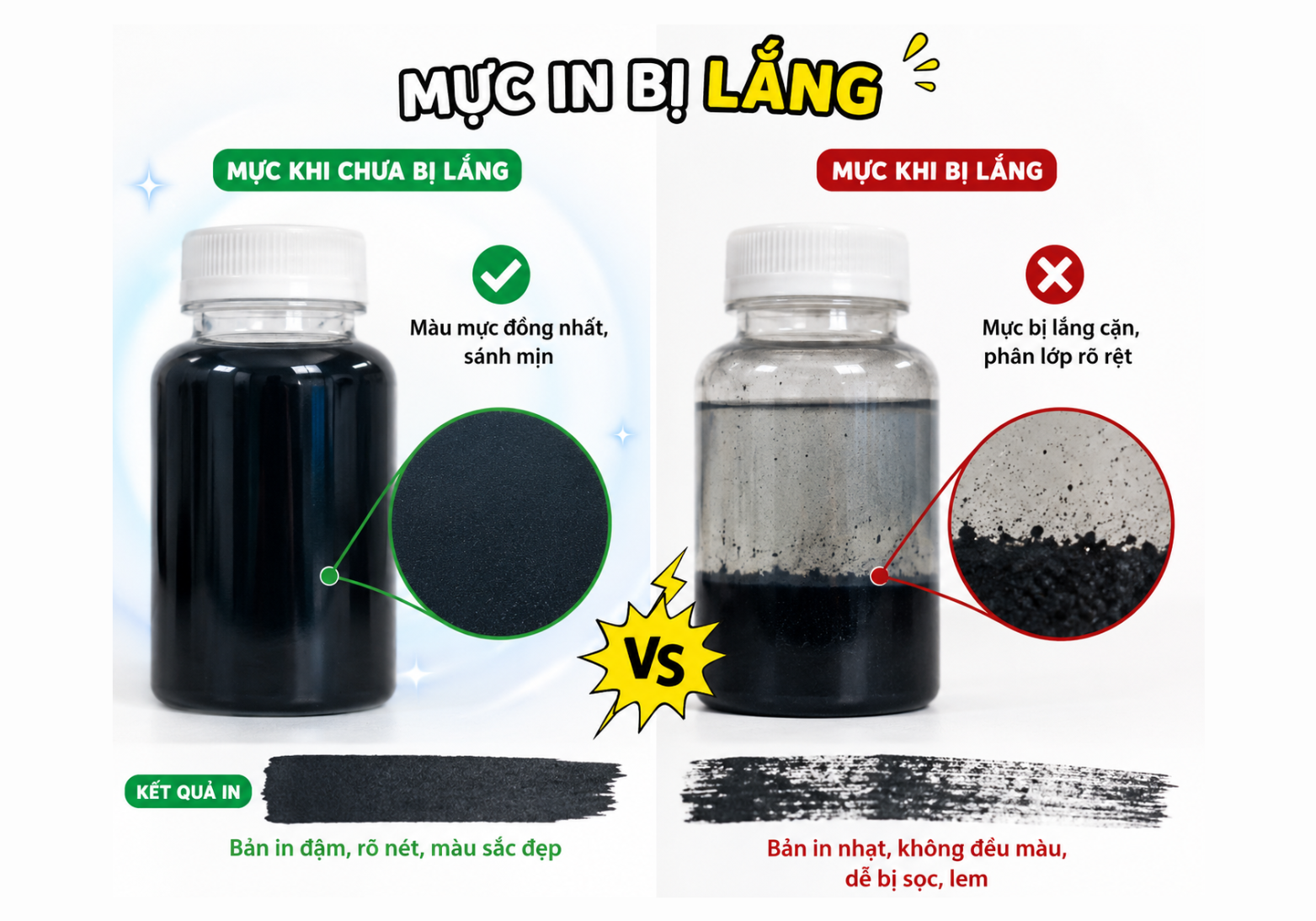
The most recognizable sign is the formation of a colored sediment layer at the bottom of the container. Initially, this sediment layer is usually thin. However, if the ink remains in storage for an extended period, the amount of sediment increases and becomes increasingly difficult to re-disperse through stirring.
Uneven Ink Color
When pigments are unevenly distributed, the color of the ink begins to change. The upper portion of the ink typically appears lighter, while the lower portion near the bottom becomes significantly darker.
This results in inconsistent color performance between usage cycles, particularly for products requiring high color accuracy.
Presence of Coarse Particles or Lumps
In many cases, color settling is accompanied by pigment agglomeration. As a result, coarse particles or pigment clusters larger than normal may appear in the ink.
These particles not only reduce print quality but may also cause clogging in ink delivery systems or printheads.
Abnormal Viscosity Changes
When the dispersion structure of the ink system is disrupted, viscosity may also change accordingly. This is an important indication that the ink system is gradually losing stability and should be inspected before being used in production.
CAUSES OF INK COLOR SETTLING
Insufficient Pigment Dispersion Quality
During ink production, pigments must be milled and dispersed to an appropriate particle size to form a stable dispersion system. However, if this process is not optimized, some pigments may remain as large particle aggregates.
Over time, these particles continue to collide and agglomerate. Once their size exceeds the suspension capability of the ink system, they begin to settle at the bottom and form a sediment layer.
Inappropriate Dispersant Concentration
Dispersants play a crucial role in forming a protective layer around pigment surfaces, preventing pigment particles from re-agglomerating after the milling process.
If the amount of dispersant is insufficient, pigment surfaces are not fully covered. As a result, the attractive forces between particles increase, accelerating agglomeration.
Conversely, excessive use of dispersants may also affect the rheological properties of the ink system. Therefore, determining the optimal dosage is always an important requirement during formulation development.
Excessive Pigment Loading
Many manufacturers increase pigment concentration to improve hiding power and color strength. However, when the pigment content exceeds the stabilization capacity of the resin and additive system, the distance between particles is significantly reduced.
As a result, interparticle interactions become stronger, increasing the likelihood of agglomeration. This is one of the most common causes of ink color settling during storage.
Use of High-Density Pigments
Certain inorganic pigments, such as titanium dioxide, have significantly higher density than the surrounding dispersion medium.
Therefore, if the ink system is not properly designed, these particles can easily settle under the influence of gravity. The settling rate increases further when particle size is larger or the viscosity of the ink system decreases.
Low Ink System Viscosity
Viscosity is a critical factor in maintaining pigment particles in suspension within printing inks.
When viscosity is sufficiently high, pigment particles remain stable throughout the system. However, if viscosity falls below the required level, the anti-settling capability of the ink decreases accordingly. As a result, pigment particles settle more rapidly during storage.
IMPACT OF COLOR SETTLING ON PRINT QUALITY
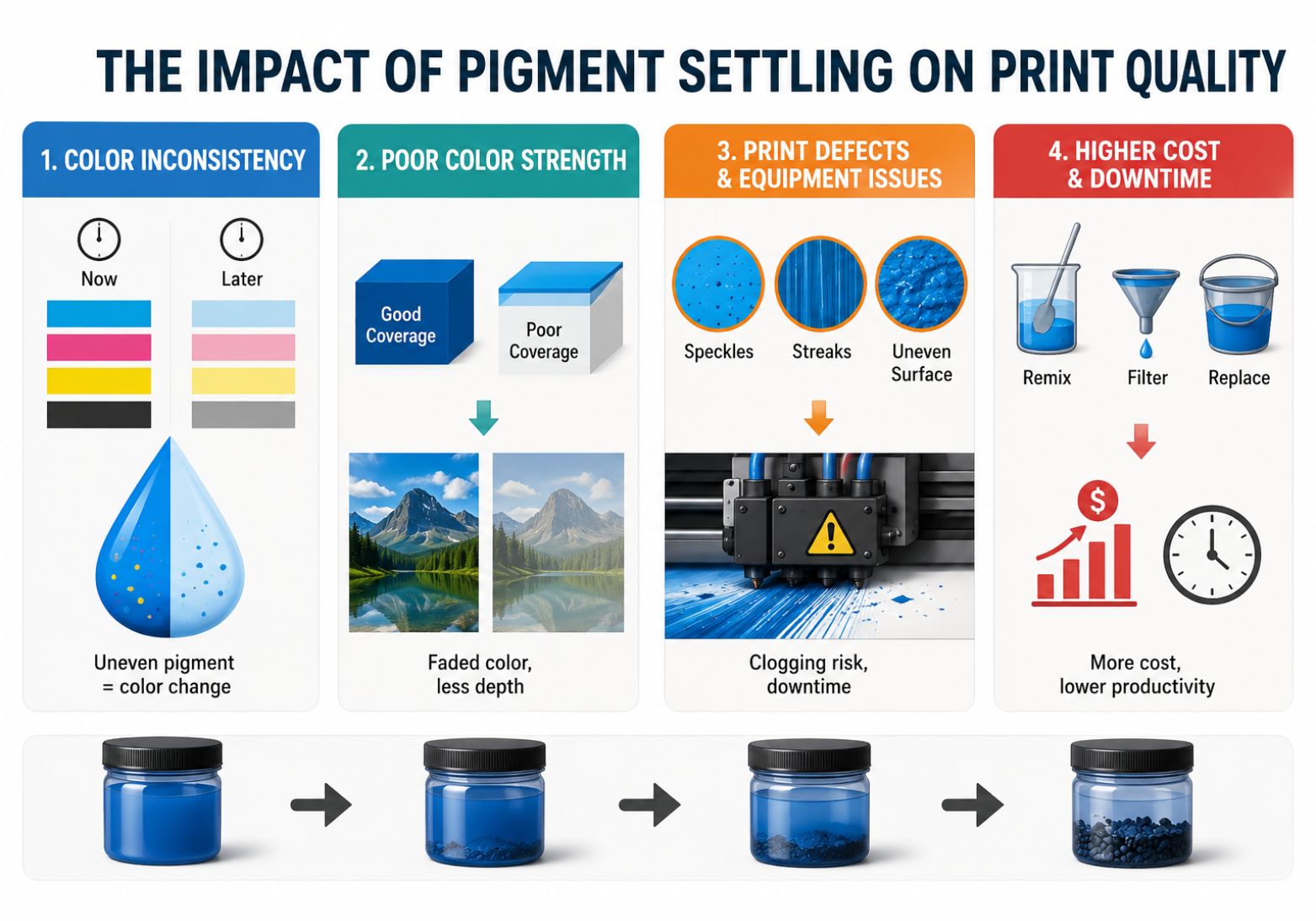
When pigment concentration is no longer uniform throughout the ink, print color will vary over time during usage. This is particularly critical in industries requiring high color accuracy, such as food packaging, cosmetics, and consumer goods labeling.
Because the upper layer of ink contains less pigment than originally formulated, the hiding power of the ink film is significantly reduced. As a result, colors appear lighter, lack depth, and fail to meet the desired quality standards.
Agglomerated pigment particles can create various print defects, including color spots, streaks, and uneven surfaces. In addition, coarse particles may clog printing equipment, particularly in digital and inkjet printing systems.
When severe color settling occurs, businesses often need to re-stir, filter the ink, or completely replace the affected batch. This not only increases raw material costs but also impacts production schedules and operational productivity.
CONCLUSION
Ink color settling is a common phenomenon, but it can significantly affect print quality and production efficiency. In practice, the causes of this issue are often related to instability in the pigment dispersion system, suboptimal additive formulations, or unsuitable storage conditions.
However, if companies effectively control the milling and dispersion process, select appropriate additives, and establish efficient storage procedures, color settling can be significantly minimized.
Investing in pigment stabilization solutions not only helps maintain color quality but also contributes to reducing production costs, improving productivity, and enhancing long-term business competitiveness.
VICHEM – AUTHORIZED DISTRIBUTOR OF CHEMICAL ADDITIVES FROM LEADING BRANDS SUCH AS COVESTRO, SINOPEC, BUHLER, AND MORE IN VIETNAM
Vichem is an authorized distributor of chemical additive products from leading brands such as Covestro, Sinopec, Buhler, and others in the Vietnamese market. We not only provide high-quality products but also deliver after-sales services that meet international standards.
For more information about our products, please contact us through the following channels:
📞 Hotline: 08 1790 1790
📧 Email: contact@vichem.vn
🔎 LinkedIn: Vichem JSC
🌐 Website: www.vichem.vn
📌 Facebook: Vichem JSC