In the industrial materials sector, requirements for durability and safety are increasingly stringent. Electrical cables must operate reliably in harsh environments. Construction materials also need to be fire-resistant and weather-resistant. CPE has emerged as an effective solution for both fields. It not only improves material performance but also extends product lifespan. The following article analyzes in depth the mechanisms, applications, and trends of CPE.
WHAT IS CPE AND ITS KEY PROPERTIES
CPE stands for Chlorinated Polyethylene, produced by chlorinating polyethylene. This process alters the polymer structure, resulting in higher durability and stability.
One important characteristic of CPE is its fire resistance. The chlorine content helps limit ignition and slows down flame propagation. In addition, CPE has good heat resistance and remains stable under various environmental conditions.
This material also exhibits high flexibility. It can maintain flexibility over a wide temperature range, which is a crucial factor for cable and outdoor material applications.
WORKING MECHANISM
CPE functions as a polymer modifier. When blended with PVC or other plastics, it helps improve the material structure. The polymer chains become more flexible.
In addition, CPE enhances stress distribution within the material. Under mechanical impact, forces are distributed more evenly. This helps reduce cracking and improves impact resistance.
In thermal environments, CPE helps materials maintain dimensional stability. It limits deformation when temperature changes, which is particularly important in electrical cables.
APPLICATIONS
In cables
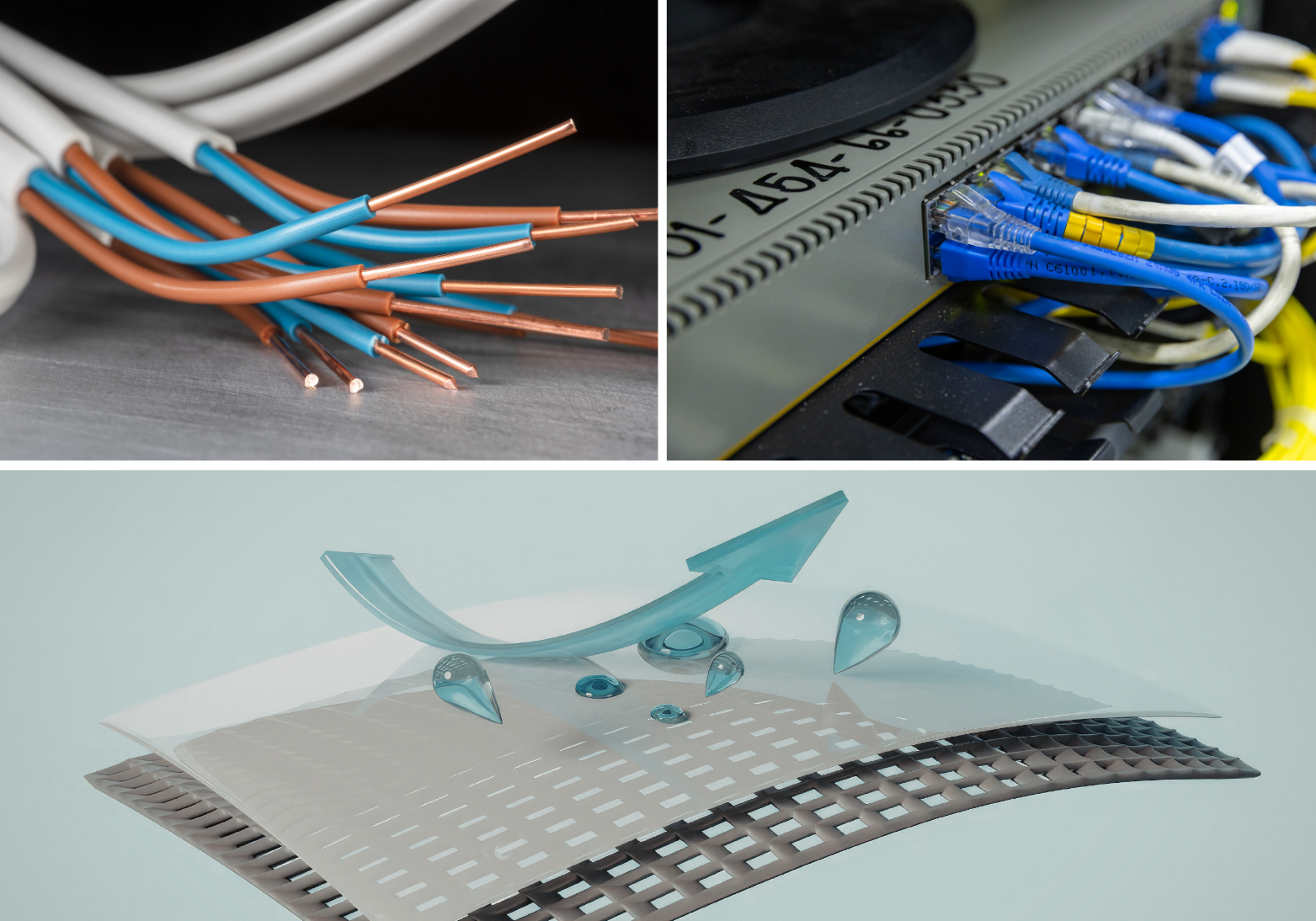
In cable manufacturing, CPE is commonly used as a protective sheath. This layer provides insulation and protects the conductive core. Thanks to its high stability, CPE helps cables operate safely over long periods.
Another important application is in fire-resistant cables. In case of fire, CPE helps slow down flame spread. This allows electrical systems to continue operating for a necessary period.
Additionally, CPE enables cables to withstand harsh environments. It offers resistance to UV radiation, moisture, and chemicals. As a result, cables can be used outdoors or in industrial environments.
In construction materials
In the construction sector, CPE is often used to modify PVC. When combined, the material becomes more flexible and durable. This enhances load-bearing capacity and impact resistance.
CPE is also used in waterproof membranes. With its water resistance, it helps protect structures from moisture and mold, which is especially important in underground constructions.
Furthermore, CPE is applied in protective surface coatings. It improves durability and resistance to aging. Outdoor structures benefit significantly from these properties.
COMPARISON OF CPE WITH OTHER MATERIALS
Compared to virgin PVC, CPE improves flexibility and impact resistance. This makes the material less prone to cracking under stress. Additionally, CPE offers better fire resistance.
Compared to rubber, CPE has superior weather resistance. It is less prone to aging under UV exposure, which extends product lifespan.
However, the cost of CPE may be higher than some other materials. Therefore, selection should consider a balance between performance and cost.
FACTORS AFFECTING THE EFFECTIVENESS OF CPE USE
The effectiveness of CPE depends on the blending ratio. If the ratio is not appropriate, the material properties may not meet requirements. Therefore, precise formulation control is necessary.
Processing conditions are also very important. Temperature and mixing time affect the polymer structure. If not properly controlled, material quality may degrade.
The quality of raw materials is another critical factor. High-purity CPE delivers better performance, directly impacting the final product.
DEVELOPMENT TRENDS
The materials industry is moving toward sustainable products. CPE is also being improved to become more environmentally friendly. Some new product lines reduce chlorine content while maintaining performance.
In addition, production technologies are helping optimize costs, making CPE more competitive in the market. This allows businesses easier access to the material.
CPE is also being researched for use in smart materials. These materials can change properties in response to environmental conditions, representing a promising future direction.
CONCLUSION
CPE is an important material in cables and construction. It enhances durability, stability, and safety, thereby improving product quality.
In the context of rapid industrial development, CPE continues to play a significant role. Proper application helps businesses optimize production efficiency and enhance competitiveness.
VICHEM – AUTHORIZED DISTRIBUTOR OF CHEMICAL ADDITIVES FROM MAJOR BRANDS SUCH AS COVESTRO, SINOPEC, BUHLER,… IN VIETNAM
Vichem is an authorized distributor of chemical additive products from major brands such as Covestro, Sinopec, Buhler,… in the Vietnamese market. We not only provide high-quality products but also deliver after-sales services that meet international standards.
For more information about our products, please contact us via the following channels:
📞 Hotline: 08 1790 1790
📧 Email: contact@vichem.vn
🔎 LinkedIn: Vichem JSC
🌐 Website: www.vichem.vn
📌 Facebook: Vichem JSC