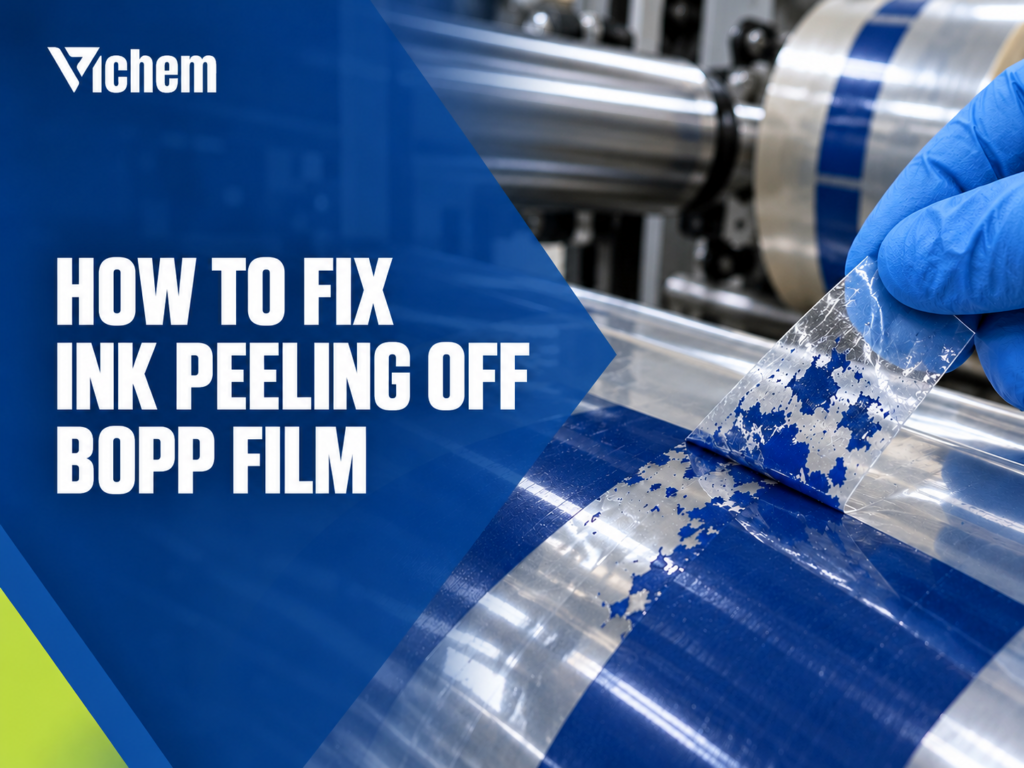
Flexo ink peels off BOPP film because the film surface is non-polar and has low surface energy, so the ink does not wet out evenly and cannot form a bond with the substrate. Corona treatment raises surface energy, but its effect decays over storage time. Before changing the flexo ink resin, measure the film's surface energy with a dyne pen and check the film's age since corona treatment.
Peeling right after printing and peeling after lamination are two different failures
Both get called "ink peeling", but they occur at different points in the process and need different fixes. Pursue the wrong one and you will burn through many trial rolls with the defect still there.
Peeling right after printing means the ink layer never anchored to the substrate from the moment it left the dryer. Typical signs: when you stick tape on a freshly printed sample and pull it off, most of the ink comes away with the tape; the ink crawls or forms pinholes in solid areas; the edges of printed areas look jagged. The cause sits at the ink–film interface: low film surface energy, decayed corona treatment, or a surface masked by additives migrating out of the film bulk. Residual solvent also leaves the ink layer soft and easy to separate.
Peeling after lamination or after storage is the case where a freshly printed sample still passes the tape test, but the ink separates from the film after lamination to another film, after time in the warehouse, or after a heating step. Here the initial bond may be enough for a quick test but not strong enough to resist the peel force of the laminating adhesive. When the adhesive's grip on the ink is stronger than the ink's grip on the film, the ink is pulled away with the laminated film. Residual solvent in the ink layer, and the heat resistance of the flexo ink during lamination or sealing, also affect the result.
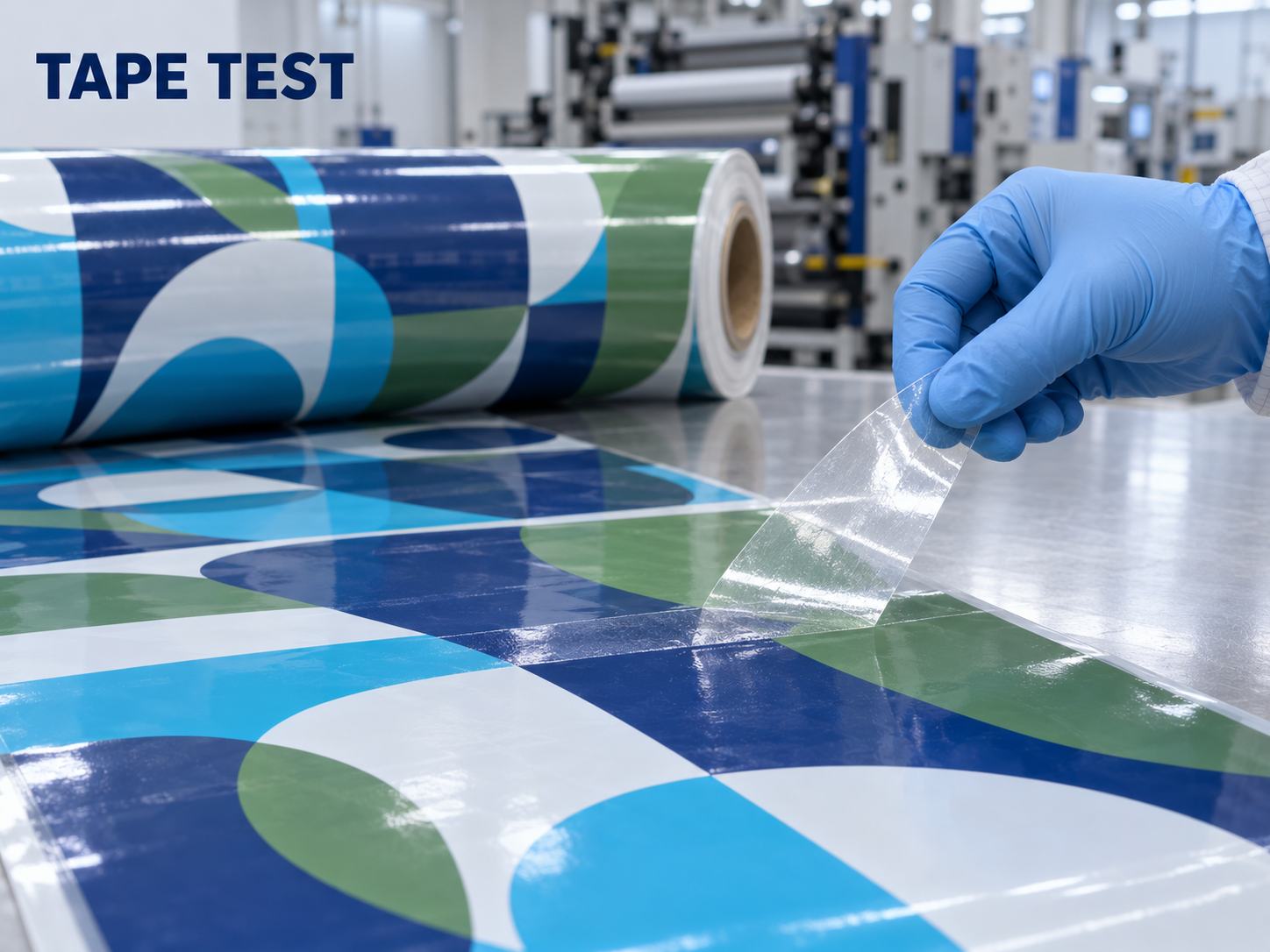
The quickest way to tell them apart is to run the tape test at three points: right after printing, after a sample hold time, and after lamination. Peeling right after printing usually points back to film treatment and ink dryness. Peeling after lamination calls for a closer look at ink–adhesive compatibility, residual solvent and heating conditions. A sample that passes at the first point but fails at a later one shows that the failure has moved to the second group.
Why BOPP film does not hold ink
BOPP is biaxially oriented polypropylene, a polyolefin. Its polymer chain contains only carbon–carbon and carbon–hydrogen bonds and carries no polar functional groups. As a result, the film has very low surface energy, and the surface offers almost no sites for ink to grip.
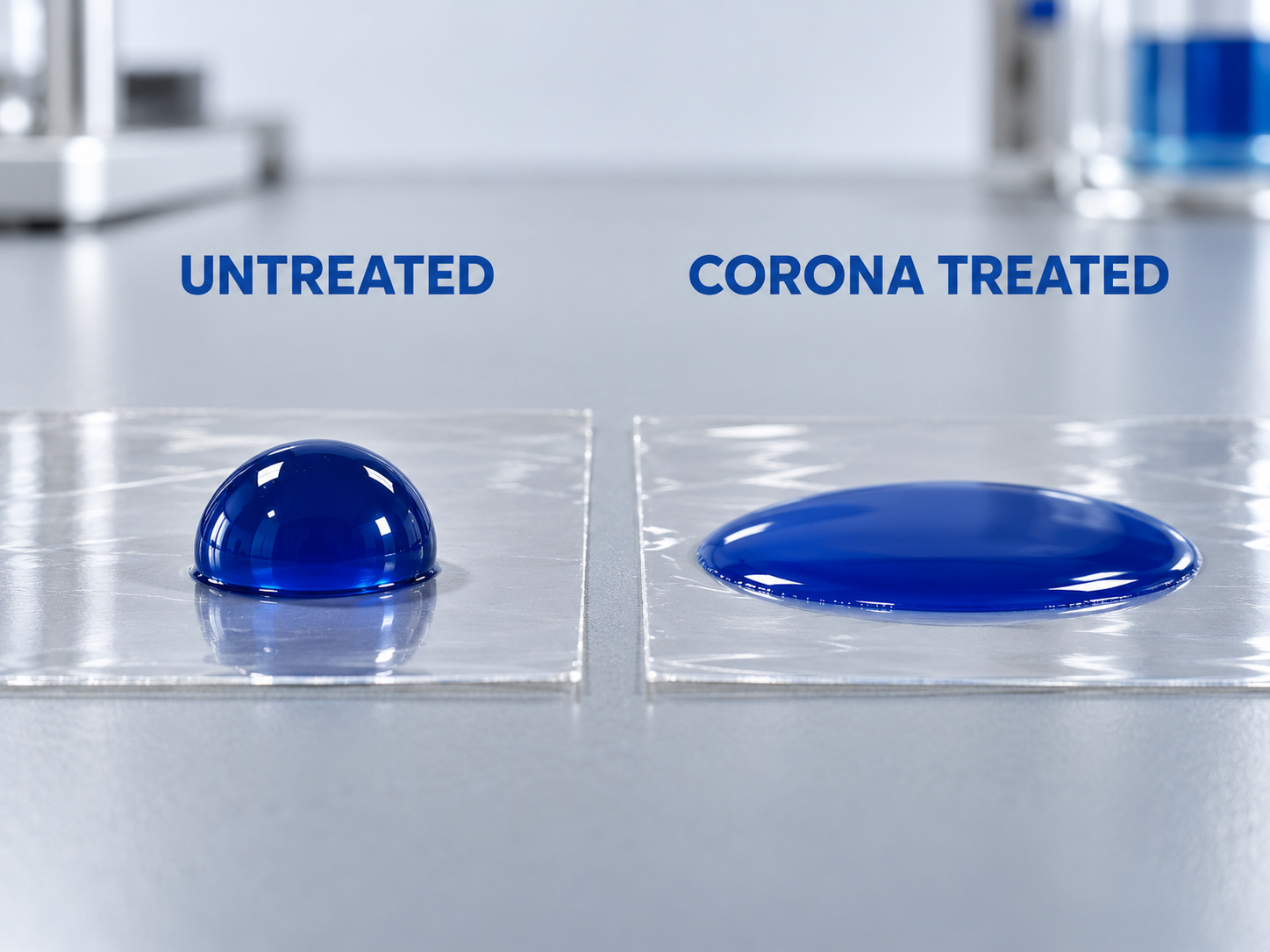
The first condition for adhesion is that the ink must wet the substrate. The ink wets when the substrate's surface energy is higher than the ink's surface tension. If the substrate is lower, the ink retracts into droplets and causes pinholes, orange peel or uneven print areas. The second condition is that, once wetted, the binder in the ink must form interactions with the surface, through polar forces or hydrogen bonding. On a non-polar polyolefin substrate, the second condition has almost no chance of occurring without treatment.
Corona treatment addresses this on the film side. High-voltage discharge oxidizes a very thin surface layer and creates oxygen-containing groups such as hydroxyl, carbonyl and carboxyl. These polar groups raise the surface energy and provide anchor points for the binder.
The problem is that the corona effect does not stay constant. The polar groups gradually rotate into the polymer bulk, short oxidized chain fragments migrate away, and additives in the film bloom to the surface and mask the groups just created. For this reason, corona effectiveness decays over storage time. The rate of decay depends on the film type, the additive package, the initial treatment level and the storage conditions. A roll that passes today may fail after a period in storage, even though the ink has not changed.
On the ink side, the binder acts as the bridge. In solvent-based flexo ink, the binder must dissolve in the system's solvents so the ink has the right viscosity and printing stability. At the same time, the binder must adhere to a low-polarity substrate, both when the film is freshly corona-treated and after the treatment has decayed. These two requirements pull in opposite directions. A strongly polar binder dissolves readily and interacts well with an oxidized surface, but wets low-energy substrates less well. A binder closer to the substrate in polarity does the opposite. So ink adhesion on plastic film is the combined result of the surface treatment level, the ink's surface tension and the binder's characteristics, and it cannot be attributed to any single factor.
How to identify the cause in your case
Before changing the ink, you need to know whether the fault lies in the film or in the ink. The two checks below can be done right in the print shop.
Measure surface energy with a dyne pen before printing
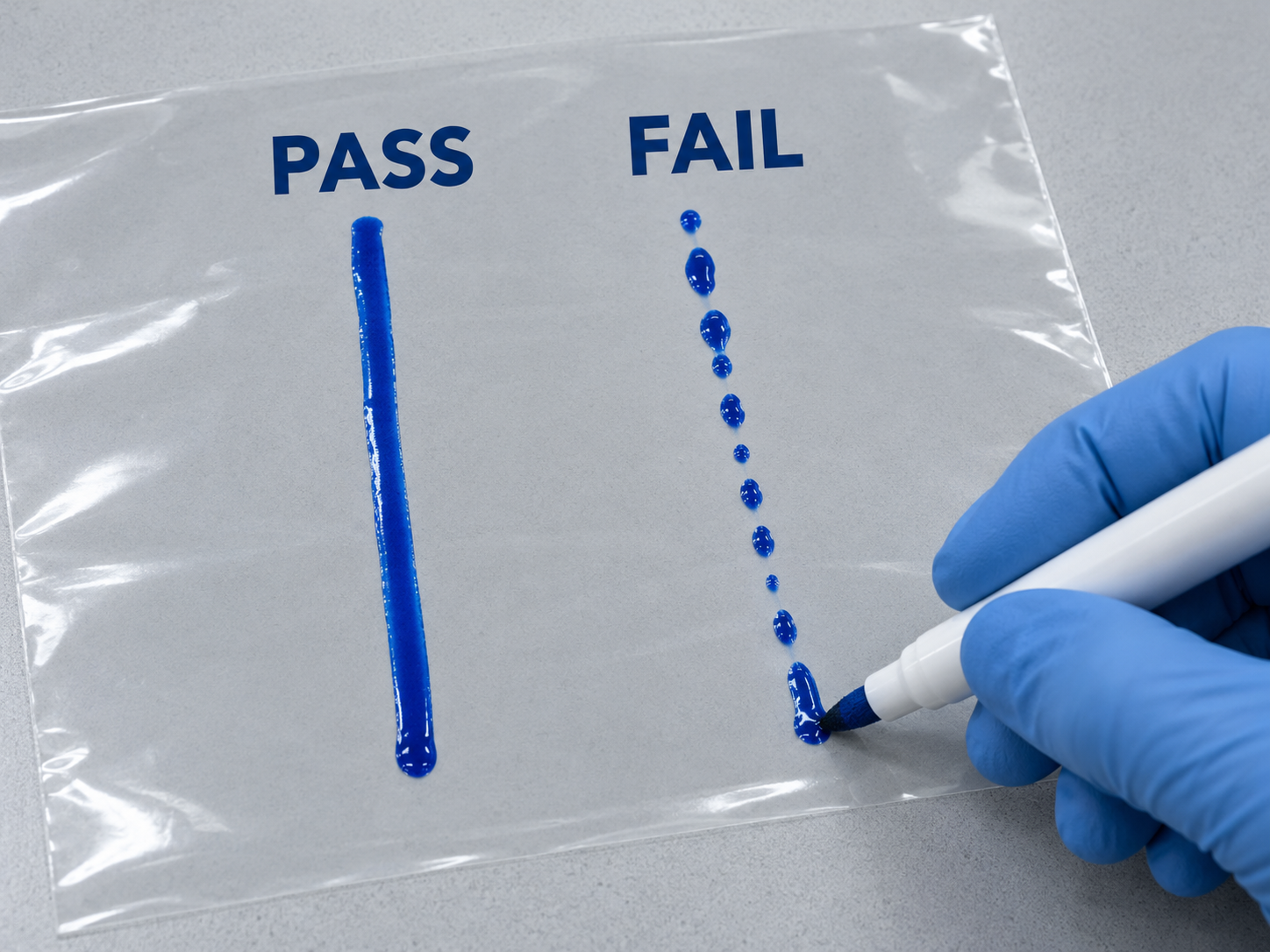
A dyne pen contains a solution with a preset surface tension, rated in dyne/cm. Draw a line on the side of the film you intend to print. If the line stays continuous for the time the pen manufacturer specifies, the film's surface energy is not lower than the pen's level. If the line beads up or breaks, the surface is below that level. Try pens of different levels in turn to narrow down the value.
A few notes on measuring:
- Measure the correct side, the one to be printed, because the film may be corona-treated on one side only.
- Measure at several positions: roll start, roll end, the middle and both edges of the web, because corona treatment may be uneven across the width.
- Keep the pen tip clean, and avoid touching the film surface before measuring.
- The dyne level you need depends on the surface tension of the ink in use. Check the ink's technical data sheet and the film supplier's recommendation; do not take one generic number for every system.
Low dyne on an unprinted roll shows the cause is in the film, and you should not change the ink until you have dealt with it.
Check film age and storage conditions from corona treatment to printing
Record the following dates for each failing roll: film production date, corona treatment date, and the date it went onto the press. You need to know whether corona treatment was done in-line at the film supplier or on your own press, because this determines how long the film has to wait.
Also record storage conditions: temperature, humidity, whether the roll is still wrapped or has been opened, and where the roll sat in the warehouse. Additive migration to the surface is affected by these conditions.
Then compare dyne between a new roll and a stored roll of the same film type. A clear drop in dyne with film age shows you need to shorten storage time or re-treat the film. If dyne is still on target but the ink still peels, shift your checks to the ink side: dryness, residual solvent, compatibility with the laminating adhesive, and the binder resin group.
How to fix it
Film side: re-treat with corona and shorten storage time
If the film has been stored for a long time and dyne has dropped, re-treating with corona just before printing is the simplest route when the press has an in-line corona unit. After treatment, re-measure with a dyne pen before running to confirm the surface has reached the required level. Check the electrodes, power and electrode-to-film gap, because dirty or misaligned electrodes cause uneven treatment across the web.
Over-treatment is also harmful. A surface oxidized too deeply forms a weak layer; the ink adheres to this layer, but the whole layer lifts off with the ink in the tape test. So raise the power step by step and re-measure after each step.
For storage, shorten the time from corona treatment to printing by scheduling film according to the print plan, using older rolls first, and keeping wrapped rolls in a warehouse with stable temperature. For rolls stored a long time, measure dyne before loading them on the press rather than relying on the production date.
Ink side: choose a binder resin group that adheres to low-polarity substrates
When the film reaches the target dyne and the ink still peels, the binder is the factor to examine. For solvent-based flexo ink, three resin groups can go into trials: solvent-based acrylic resin, solvent-based urethane resin and vinyl acrylic copolymer resin. Acrylic resin for printing ink and polyurethane resin for printing ink differ in chain structure, and therefore in polarity, solvent solubility and how they combine with the other resins in the system.
When selecting a flexo ink resin, read the parameters on the TDS of each grade under consideration: solubility and compatibility with the system's solvents, solids content, solution viscosity, the substrate applications the supplier states, and compatibility with other resins. If the ink must go through lamination or sealing, also check the heat-resistance data published in the TDS or by the supplier. For any parameter the TDS does not state, ask the supplier; do not guess.
No resin group suits every substrate. BOPP films from different manufacturers differ in treated layer and additive package, so results are only valid when tested directly on the film you actually use. Test procedure: print samples at your shop's actual dyne level, run the tape test right after printing, after a sample hold time and after lamination, then compare the resin groups under the same conditions.
Frequently asked questions
How long does corona treatment on BOPP film remain effective?
There is no fixed time limit for all film types. The rate of decay depends on the additive package, the initial treatment level and storage conditions. The reliable approach is to measure the dyne of the actual roll before printing, and to log how it changes day by day so you know how fast your film loses its treatment.
How many dyne are enough for flexo printing on BOPP?
The sufficient level depends on the ink in use. The film's surface energy must be higher than the ink's surface tension, with some margin left to offset the decay during storage. Take the specific value from the ink's technical data and the film supplier's recommendation, then confirm it with an adhesion test.
Do I need a primer for BOPP film?
There is no general answer. If the film reaches the target dyne and the ink passes the tape test after printing, after storage and after lamination, no intermediate layer is needed yet. When the film has been treated and the binder reviewed but the ink still peels, a primer is the next option to consider, with compatibility tests against the ink and the laminating adhesive.
Conclusion
Flexo ink peels off BOPP film when the film's surface energy is not enough for the ink to wet out and form a bond. The common cause is corona treatment decaying over storage time. Only when the film has reached the required dyne level and the ink still peels should you move on to examining the binder.
- Distinguish peeling right after printing from peeling after lamination or storage by running the tape test at three points, because a sample that passes the tape test right after printing can still fail after lamination.
- Measure dyne at several positions on the roll before printing, and record the corona treatment date.
- Re-treat with corona step by step and avoid over-treatment.
- Choose the binder resin group by the parameters on the TDS and test directly on the film you use.
Vichem is an authorized distributor of chemical additive products from leading brands such as Covestro, Sinopec, Bühler, and others in the Vietnamese market.
For more information about our products, please contact us through the following channels:
- Hotline: 08 1790 1790
- Zalo OA: Vichem JSC
- Email: contact@vichem.vn
- LinkedIn: Vichem JSC
- Website: www.vichem.vn
- Facebook: Vichem JSC