Choosing acrylic resin for 2K PU coatings starts with the OH value and solids content, followed by the viscosity of the supplied form. The OH value governs crosslink density, solids content determines how many reactive groups the weighed-in resin actually carries, and viscosity affects application. Do not choose by viscosity alone, because it does not tell you whether the film will be hard or flexible.
Where a wrong acrylic resin choice goes wrong
Failures tend to run in two opposite directions. An over-dense network can give a film with good hardness and solvent resistance but little ability to deform. On bent substrates, impact-loaded parts or systems with a mismatch in thermal expansion, the film is prone to crazing, cracking at the bend edge or losing adhesion after impact. This is not necessarily a curing fault; the system may have cured correctly but the hardness–flexibility balance was wrong.
In the opposite direction, low crosslink density leaves the film soft, slow to develop hardness, easily marked when stacked, or weaker in solvent resistance. Adding more hardener arbitrarily does not fix this if the number of OH groups in the resin itself is not suitable; excess NCO can also cause side reactions and make results unstable.
Application symptoms are easy to misread too. A high-viscosity resin may need extra solvent, which lowers the solids content of the finished paint and raises the risk of sagging or solvent retention. However, high viscosity does not mean a high OH value. Likewise, a fast-drying film has not necessarily reached the target crosslink density.
So three questions need to be separated: how hard or flexible the film must be, how much OH is actually in the batch, and what viscosity the system needs for application. Only after answering all three should the polyisocyanate quantity be calculated.
3 criteria that decide the choice
OH value — sets the crosslink density
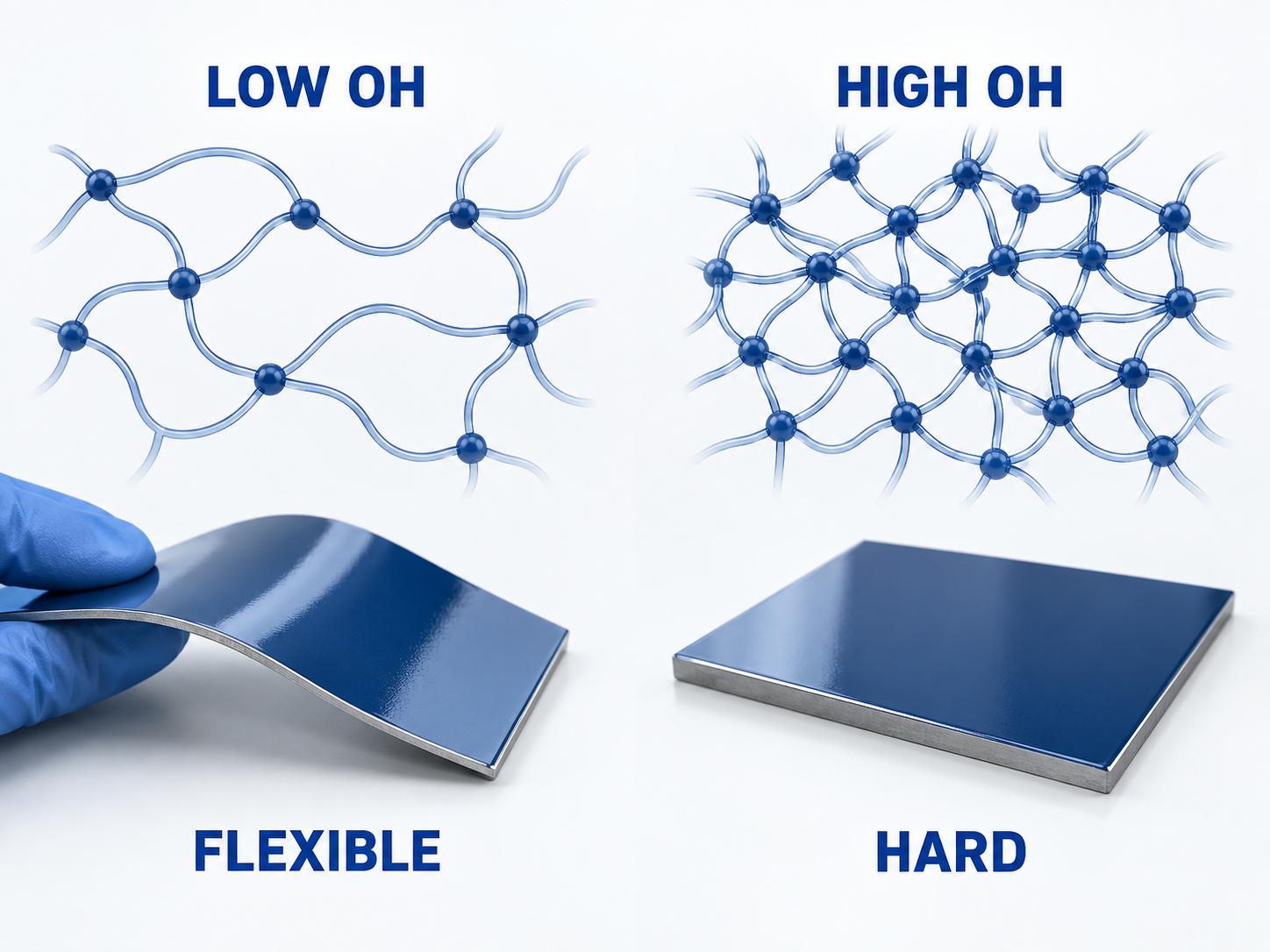
Hydroxy acrylic resin carries –OH groups along the polymer chain. When combined with a polyisocyanate, each OH group is a site that can react with NCO to form a urethane linkage. For the same mass of resin solids, more OH groups give more potential junctions and a denser polymer network.
A denser network generally supports hardness and solvent resistance and keeps the film intact. The trade-off is that the chain segments between two junctions are shorter, so the film deforms less readily and may lose flexibility. A looser network lets the chains move more, which supports bending and deformation but may fall short of the desired hardness or chemical resistance.
This trend is not a rule that holds on its own for picking a resin from a single number. Acrylic chain structure, monomer type, Tg, hardener, NCO/OH ratio, solvent and curing conditions all affect the result. The OH value is a starting point for designing crosslink density, not a certification of the performance of the finished film.
Solids content — the basis for reading the OH value correctly
The OH value in a TDS table is stated on resin solids. Commercial resins, however, are usually supplied as solutions, so one kilogram of product is not one kilogram of polymer. When two resins have the same %OH on solids but different solids content, the amount of OH groups in the same mass of supplied form will differ.
The calculation must start from the mass of resin solids: multiply the mass of the supplied form by its solids fraction. Only then use the %OH on solids to determine the amount of reactive groups. If this step is skipped and the calculation is made directly from the solution mass, the hardener quantity will be wrong; the solvent balance and the solids content of the paint will also be off.
The designation of the supplied form often hints at the solvent and solids content, but read the footnotes of the correct TDS rather than guess. When swapping a grade, update the polymer fraction, the solvent it carries and the NCO quantity required.
Viscosity — determines how much solvent must be added
Resin viscosity affects pumpability, pigment dispersion, leveling and the choice of spray equipment. If the viscosity of the supplied form is above the operating window, the formulation may need extra solvent; this lowers the solids content at application and changes the solvent release rate. Conversely, a low-viscosity resin can support higher solids but anti-sag behavior and pigment orientation still need to be checked.
Viscosity depends on temperature and measurement method. Compare values only under the same conditions, and do not use viscosity to infer hardness. After hardener, pigments and additives are added, the viscosity of the whole system can differ considerably from that of the resin alone. This parameter therefore serves application design, while film properties must be confirmed on cured samples.
How to match the criteria to your application
Step 1 — Decide whether the application leans toward hardness or flexibility
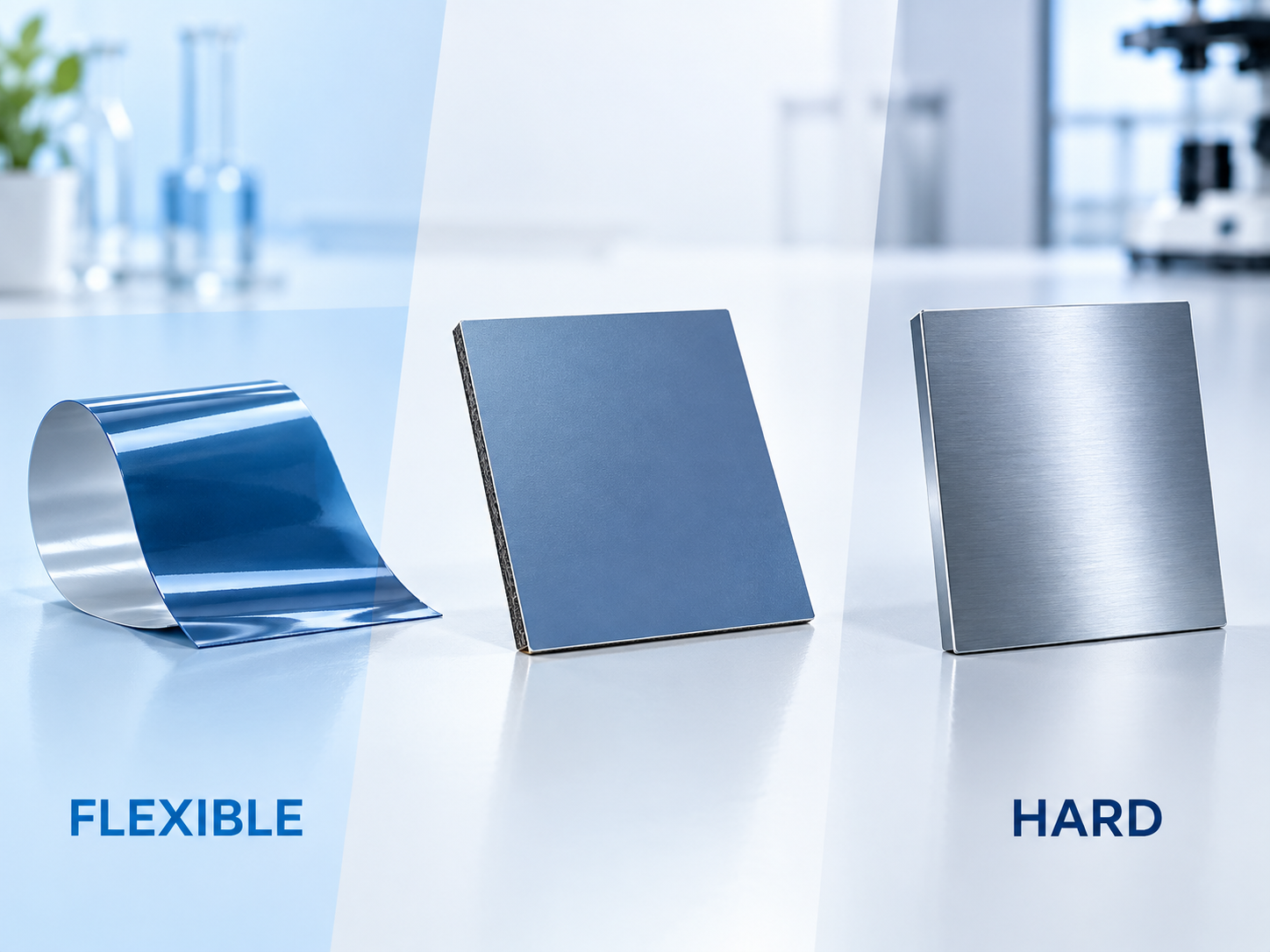
List the requirements in order of priority: surface hardness, bending, impact, solvent resistance, adhesion, gloss and outdoor exposure. A coating for machinery may need a balance of impact and chemical resistance; an automotive refinish clearcoat instead stresses appearance, hardness development and polishability.
Turn each requirement into a test on the right substrate and the right thickness. Do not substitute a "hard to the touch" impression for data. If the current sample is brittle on bending, the screening direction is to lower crosslink density or increase flexibility; if the film is soft and easily marked, check the OH content, the NCO/OH balance and the curing conditions before drawing conclusions.
Step 2 — Read %OH and solids content on the TDS of the exact grade
Read four data lines together: supplied form, %OH on solids, viscosity and solvent. Confirm the TDS version and never apply the values of one grade to another. The solvent already present in the resin must be added into the solvent balance of the whole formulation, especially when comparing options with different solids content.
The acrylic resins in the range under consideration are solvent-borne acrylic resins, including hydroxy acrylics and some thermosetting acrylics; they are not polyester resins for powder coatings. For 2K PU systems, choose only grades with suitable data for reaction with polyisocyanates.
Step 3 — Calculate the hardener by OH-to-NCO equivalents
At this step, build a screening range from hydroxy acrylic resins with different OH content on solids and different solids content, as given in their TDS. This is data for calculating the amount of OH groups and designing test samples, not a performance ranking.
The principle is to convert the resin quantity to solids, calculate the OH equivalents, then use the NCO equivalent weight of the exact hardener to determine the blend quantity at the target NCO/OH ratio. Do not fix a mass ratio, because each pair has a different supplied form and functional group content. After the calculation, pot life, viscosity, curing and film properties still have to be checked.
Common mistakes when selecting
The most common mistake is changing the grade but keeping the same weighed amount. This changes the resin solids, the number of OH groups, the solvent and the NCO/OH ratio all at once. The test result is then no longer a comparison of resins on the same basis.
The second mistake is taking the %OH of one grade and assigning it to a grade with a similar name or from the same commercial series. Functional group values belong to the exact grade and the exact TDS; a cell with no published value must be treated as no data available for calculation, not interpolated.
The third mistake is selecting by viscosity. Low viscosity may help application but proves nothing about crosslink density, hardness or durability. Nor should solvent be added until two systems reach the same viscosity and then treated as equivalent, because the solids and the solvent balance may already differ.
Finally, testing samples at a different thickness, on a different substrate or with a different curing schedule invalidates the comparison. In each round, change only the variable under evaluation and hold the hardener, equivalent ratio, substrate, thickness and curing conditions constant.
Frequently asked questions
Does a higher OH value always mean a harder film?
Not in every formulation. A high OH value creates the potential for greater crosslink density when enough NCO and suitable curing conditions are present, but the resin structure, hardener, reaction ratio and solvent also govern the film. Compare samples on the same substrate, thickness and curing schedule.
Do I need to recalculate the hardener ratio when I change the acrylic resin?
Yes, because each resin has its own solids content and %OH. The hardener quantity must be calculated from the actual OH equivalents in the resin solids and the NCO data of the exact hardener. Keeping the same weighed ratio easily leads to NCO shortage or excess.
How do acrylic and polyester resins for 2K PU differ?
The two groups differ in chain structure and property balance, although both can carry OH groups that react with NCO. They cannot be substituted at the same weighed amount. Compare functional group data, solids, solvent and film results in the actual application.
Can viscosity be used to predict the OH content?
OH content cannot be inferred from viscosity. Viscosity reflects the flow state of the supplied form and is influenced by molecular weight, solvent, concentration and temperature. The OH content must be taken from the TDS of the exact grade and calculated on solids.
Conclusion
The way to choose acrylic resin for 2K PU coatings is to start from the hardness–flexibility balance, then read %OH, solids content and viscosity together. The hardener quantity must be calculated by OH–NCO equivalents, not by copying mass ratios between grades.
- Use the OH value to design crosslink density, not as the only criterion.
- Convert the supplied form to solids before calculating.
- Compare samples under the same substrate, thickness and curing conditions.
Vichem is an authorized distributor of chemical additive products from leading brands such as Covestro, Sinopec, Bühler, and others in the Vietnamese market.
For more information about our products, please contact us through the following channels:
- Hotline: 08 1790 1790
- Zalo OA: Vichem JSC
- Email: contact@vichem.vn
- LinkedIn: Vichem JSC
- Website: www.vichem.vn
- Facebook: Vichem JSC