Choose a lubricant additive according to the harshest operating condition the oil must withstand, not according to the name of the additive group. Each group compensates for a separate limit of the base oil: viscosity that changes with temperature, oxidation after long hot service, or wear under high contact pressure. An additive designed for one type of oil usually cannot be used in another, because the two oils face different operating conditions.
What Base Oil Lacks Under Real Operating Conditions
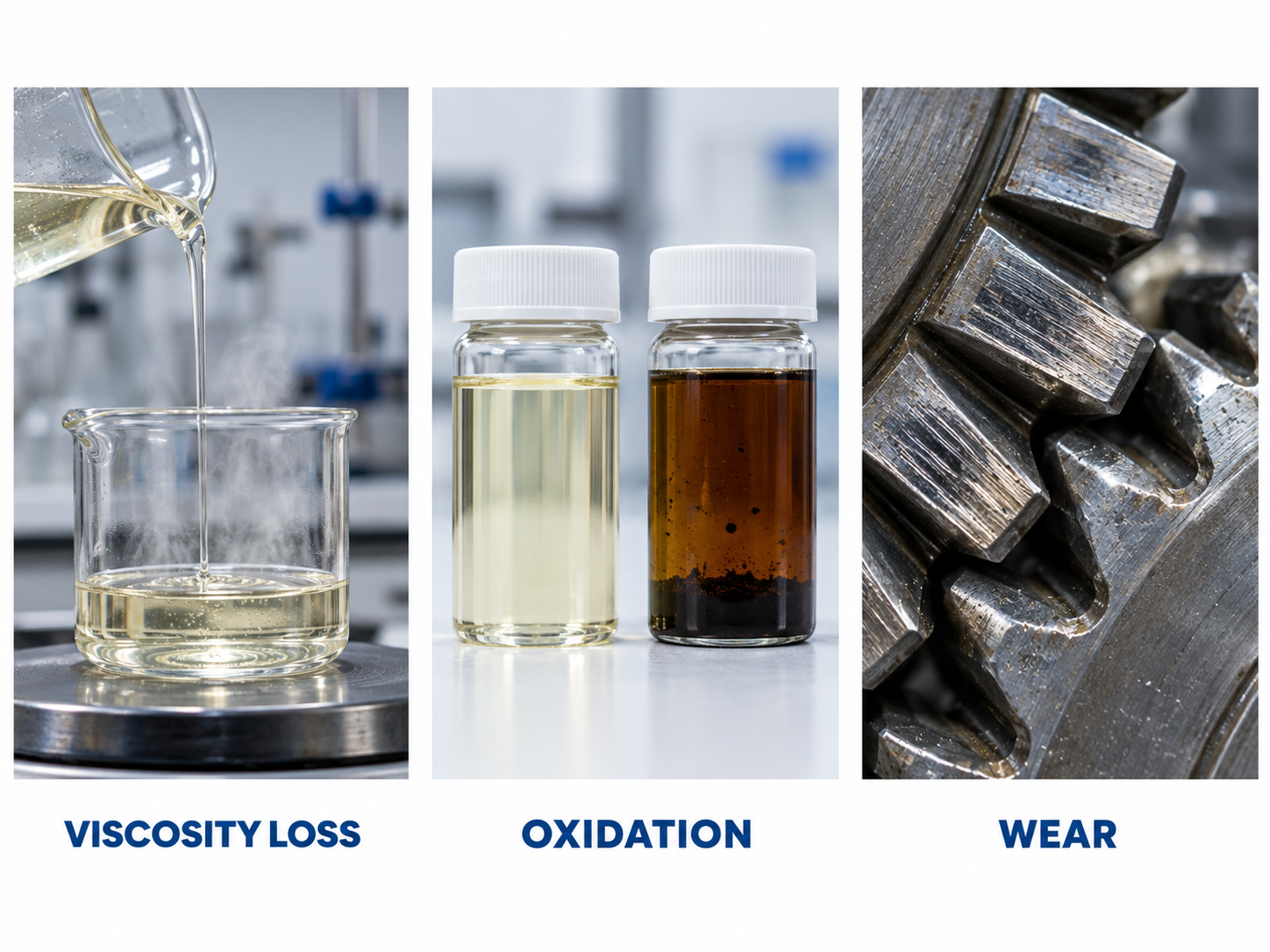
Refined base oil lubricates well under mild conditions. Once it goes into an engine, a gearbox or a hydraulic system, it shows three limits, and each limit calls for its own additive group. This is also the answer to what lubricant additives do: they cover the points where base oil cannot perform on its own.
Viscosity thins out when hot. The viscosity of every oil falls as temperature rises. If the oil is too thin, the oil film becomes thinner and the two metal surfaces are more likely to touch. If the oil is too thick at low temperature, the pump struggles to push it to the lubrication points at start-up. The viscosity index (VI) shows how much the viscosity of an oil changes with temperature: the higher the index, the more stable the viscosity.
Oxidation forms deposits and acids. Oil that runs hot and is exposed to air for a long time oxidizes. The products are acids that corrode metal, sludge and varnish that stick to surfaces, and a gradual rise in viscosity. The higher the temperature and the longer the oil change interval, the heavier the oxidation.
It cannot withstand high contact pressure. In gears, cams and bearings, the pressure at the contact point can squeeze the oil film out. Metal then touches metal, the surface is scratched and wears away step by step. Base oil has no ability to form a replacement protective layer by itself.
These three limits appear to different degrees depending on the machine and its operating conditions. For that reason, the same base oil may need additive groups in different proportions.
Four Lubricant Additive Groups and How Each Works
The four groups below are the main functional groups among lubricant additives. Each acts through its own physical or chemical mechanism, so no group can replace another.
Viscosity Index Improvers — Polymers That Uncoil When Hot to Offset Lost Viscosity
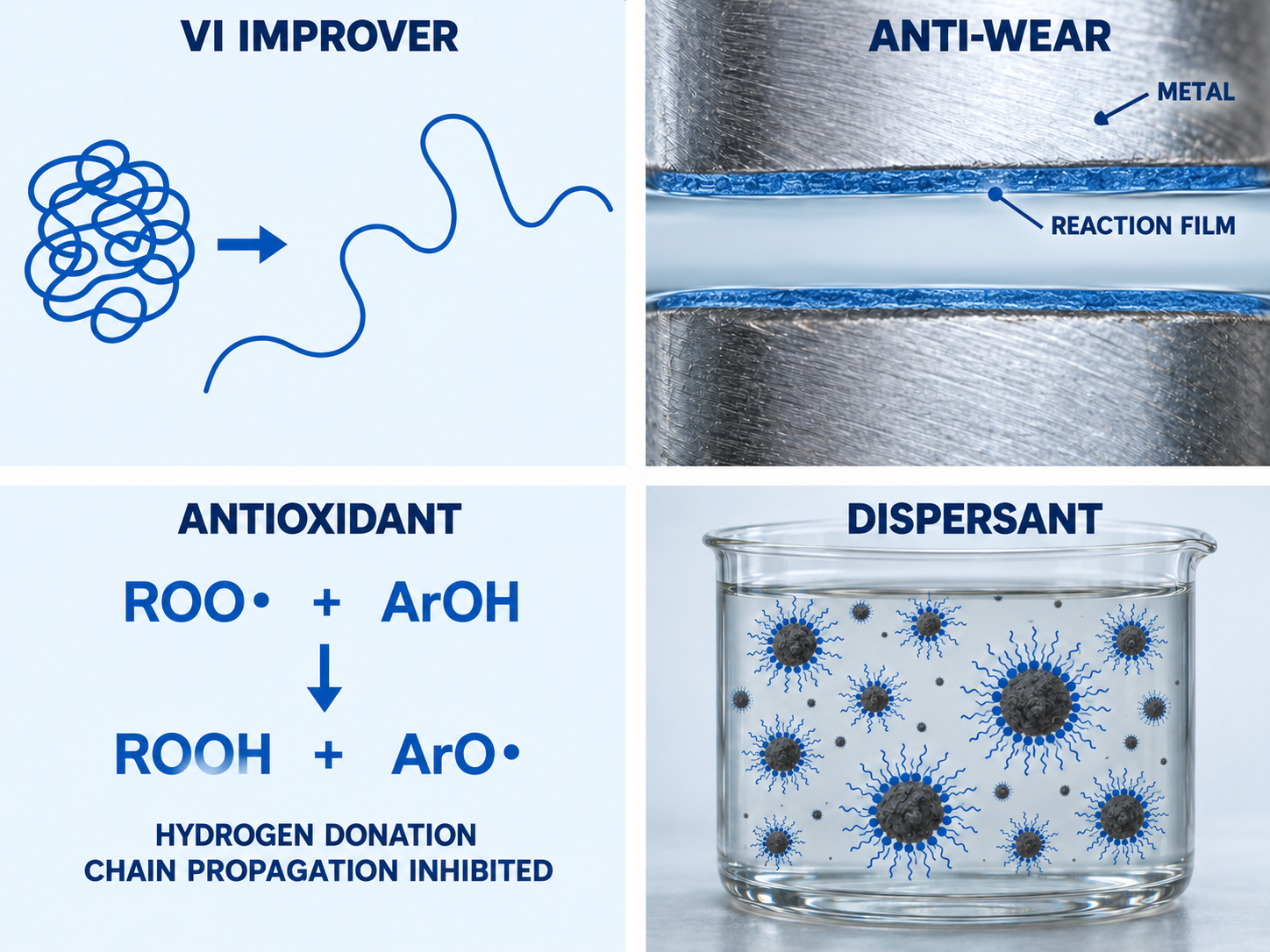
A viscosity index improver is a long-chain polymer that dissolves in the oil. At low temperature the polymer chains coil up and hinder the flow of oil very little. As temperature rises, the chains stretch out and occupy more volume, which offsets the viscosity the base oil has lost. As a result, the viscosity of the oil varies less across the working temperature range.
When selecting this group, read the TDS for the type of oil the additive was designed for and compare it with the working temperature of the machine, rather than choosing by group name.
Anti-Wear and Extreme-Pressure — A Chemical Film Formed on the Metal Surface
This group usually contains phosphorus, sulfur or zinc compounds. At hot, loaded contact points, the compound reacts with the metal surface and forms a thin film. The film wears away in place of the base metal, and it is formed again continuously as long as additive remains in the oil.
Anti-wear is used for moderate loads, while extreme-pressure is used for very heavy loads such as gears. The two levels use different active compounds, so the level of protection must be chosen according to the actual load on the machine.
Antioxidants — Breaking the Free-Radical Chain Before Deposits and Acids Form
Oil oxidation is a chain of reactions started by heat and oxygen, and its products are acids, deposits and rising viscosity. An antioxidant breaks the free-radical chain before those products build up in the oil.
The additive is consumed gradually in service. Once it is used up, the oil oxidizes much faster. This group therefore determines the service life of the oil, especially in machines that run hot and have long oil change intervals.
Detergents and Dispersants — Keeping Contaminants Suspended So They Do Not Bake On
This group keeps fine contaminants suspended in the oil so that the filter can catch them or they can be carried away at the oil change, instead of clumping into sludge and sticking to hot surfaces.
This group is needed when the machine generates soot and acids in service, as in internal combustion engines.
Each type of oil has a different main source of failure, so the additive formulation is balanced separately for each type. Lubricant additive catalogs are also divided by oil type, for example gear oil additives and hydraulic oil additives. Using the formulation of one oil in another upsets that balance, and the oil may lack a property the system needs.
How to Match an Additive to Your Oil
The three steps below go from actual operating conditions to the decision on which additive to choose.
Step 1 — Identify the Oil Type and the Harshest Operating Condition
Record the type of oil in use (engine, hydraulic, gear or other) and the harshest condition the oil meets: the highest working temperature, the pressure at the contact points, the oil change interval, and the level of moisture or dust contamination. The harshest condition determines which additive is mandatory, because oil fails at the most heavily loaded point, not at the average operating point.
Step 2 — Choose the Functional Group to Prioritize for That Condition
Compare the condition with the four groups above. If the oil thins out when hot, prioritize a viscosity index improver. If the oil runs hot and is changed infrequently, prioritize an antioxidant. If gears carry heavy loads, prioritize anti-wear and extreme-pressure additives. If the machine generates a lot of soot and acid, prioritize detergents and dispersants.
Step 3 — Additive Package or Separate Blending: What to Base the Decision On
An additive package for lubricants combines several functional groups in one product that is already balanced. Choose a package when the oil needs several functions at once and the finished oil type is clearly defined, because the package supplier has already accounted for compatibility between the active components. Check on the TDS which type of oil the package was designed for.
Separate blending suits cases where only one property needs adjusting. Single additives include many different polymers and compounds, among them polyisobutene. The role of polyisobutene in a specific type of oil must be confirmed by the supplier and checked against the TDS. With separate blending, the blender must check compatibility with the other additives personally.
Common Mistakes When Using Additives
Raising the dose in the hope of a stronger effect. The dose is published by the supplier for each package, and the package is balanced at that dose. Going beyond the recommendation upsets this balance, and there is no evidence that the effect grows with the dose. Do not raise the dose on your own.
Mixing two additive packages from two different suppliers. Each package is balanced on its own. When two packages meet, they may compete to attach to the same metal surface, or react with each other and form a precipitate. Typical symptoms are cloudy oil, sediment, or filters that clog quickly. Run a compatibility test before mixing at large scale.
Using an engine oil additive in hydraulic oil. Each package is balanced for the main source of failure of one type of oil, and that source differs between engine oil and hydraulic oil. Using an engine oil package means the hydraulic system receives a formulation balanced for a different need. Hydraulic oil needs a hydraulic oil additive designed for that system, and the TDS must be read to see which type of oil the package is intended for.
Frequently Asked Questions
Can I add an additive to oil that is already in use?
It can be done, but only if the additive is compatible with the package already in the oil and the oil has not degraded. Heavily oxidized oil cannot be restored by adding additive. Before adding, confirm the additive type with the supplier and run a compatibility test on a small quantity.
What is the difference between an additive package and a single additive?
An additive package contains several functional groups that are already balanced, while a single additive compensates for only one property, for example a viscosity-thickening additive. A package is convenient when several functions are needed at once. A single additive is more flexible, but the blender must check compatibility between components personally.
Does a higher additive dose give a better result?
There is no basis for raising the dose. The dose published by the supplier is the one at which the package is balanced, and going beyond it upsets the balance between the active components. To improve a property, identify the functional group that is missing instead of raising the dose of the current package.
Conclusion
Choosing a lubricant additive starts from the harshest operating condition of the machine, because each additive group compensates for a separate limit of the base oil. A viscosity index improver is needed when the working temperature swings widely, an antioxidant when the oil runs hot for long periods, an anti-wear additive when contact pressure is high, and detergents and dispersants when soot and acids form. A package made for one type of oil usually cannot be used in another.
- Identify the harshest operating condition before choosing an additive group.
- Read on the TDS which type of oil the additive package was designed for, rather than inferring it from the group name.
- Use the dose published by the supplier, and test compatibility before mixing packages from two suppliers.
Vichem is an authorized distributor of chemical additive products from leading brands such as Covestro, Sinopec, Bühler, and others in the Vietnamese market.
For more information about our products, please contact us through the following channels:
- Hotline: 08 1790 1790
- Zalo OA: Vichem JSC
- Email: contact@vichem.vn
- LinkedIn: Vichem JSC
- Website: www.vichem.vn
- Facebook: Vichem JSC