Food-grade silicone gaskets are widely used in the food and beverage industry. This material is commonly found in processing machinery, packaging equipment, and food transfer systems. To meet safety standards, silicone gaskets must offer high durability and stability. In addition, the material must provide excellent heat resistance and chemical resistance.
During the manufacturing process, many companies use talc as a functional additive. Talc helps improve processability and optimize the mechanical properties of silicone. Currently, talc also enhances the dimensional stability of food-grade silicone gaskets. Therefore, this additive is widely applied in the modern silicone compound industry.
WHAT IS TALC?
Talc is a natural mineral mainly composed of hydrated magnesium silicate. It is one of the softest minerals currently known. Talc has a layered structure and relatively good heat resistance. In addition, this material also possesses high chemical stability.
In the polymer industry, talc is commonly used as a functional filler. This additive helps improve various properties of base materials. Currently, talc is applied across many industries. Common sectors include plastics, rubber, and technical silicone.
For food-grade silicone applications, talc must achieve a relatively high level of purity. In addition, the additive must comply with food-contact safety standards.
WHY IS TALC USED IN FOOD-GRADE SILICONE GASKETS?
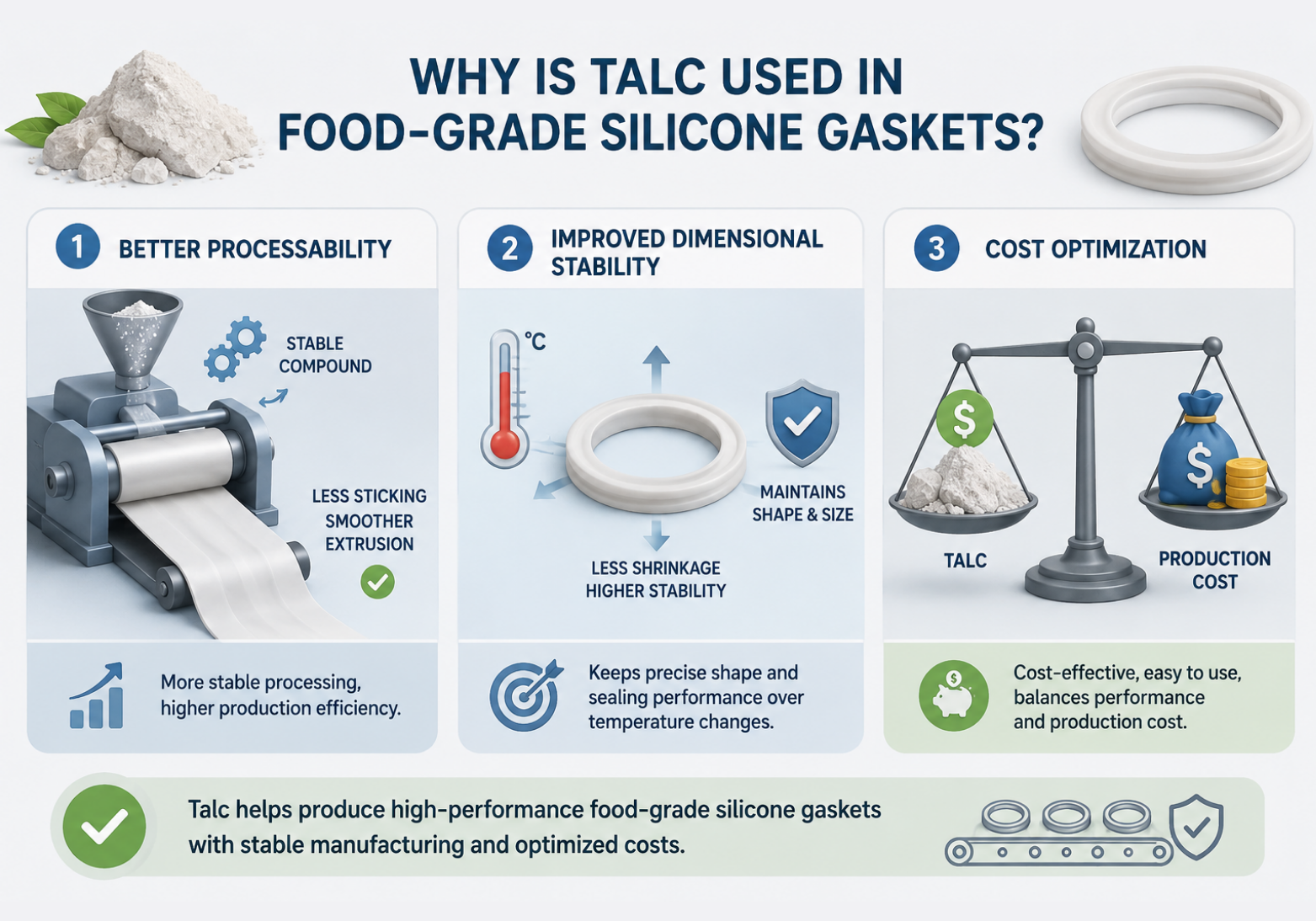
Improved Processability
During silicone compounding, talc helps improve mixture stability. As a result, the material becomes easier to control during production. In addition, talc also helps reduce stickiness during processing. This enables more stable calendering and extrusion processes.
For continuous production lines, stable processability is highly important. This factor directly affects operational efficiency.
Enhanced Dimensional Stability
Food-grade silicone gaskets often operate in environments with continuously changing temperatures. Therefore, the material must maintain high stability. Talc helps minimize shrinkage during silicone processing. At the same time, the additive improves the shape retention capability of the final product.
This is particularly important for high-precision technical gaskets. Food systems often require long-term sealing stability.
Optimized Production Costs
In addition to its technical functions, talc also helps optimize silicone compound costs. This is a key concern for many businesses. Compared to certain specialty additives, talc offers more reasonable costs. At the same time, this material is relatively easy to apply in production.
As a result, companies can better balance performance and operating costs.
IMPORTANT REQUIREMENTS FOR TALC USED IN FOOD-GRADE SILICONE
High Purity
Talc used in food-grade silicone must maintain stable purity. This helps minimize the risk of unwanted contamination.
In addition, the raw material must strictly control heavy metal content. This is an important requirement in the modern food industry.
Suitable Particle Size
Particle size significantly affects talc dispersion capability. If the particles are too large, the product surface may become uneven. Conversely, particles that are too fine may affect compound viscosity. Therefore, companies need to select the appropriate talc grade.
Stable Dispersion Capability
Talc must be evenly dispersed within the silicone matrix. This helps the product maintain more stable mechanical properties. If the additive is poorly dispersed, the gasket surface may develop defects. In addition, product durability may also decrease significantly.
Compliance with Food Safety Standards
Food-grade silicone products are often required to comply with international standards. Common examples include FDA and LFGB requirements. Therefore, the talc used must also comply with relevant regulations. This is an extremely important factor for the food and beverage industry.
APPLICATIONS
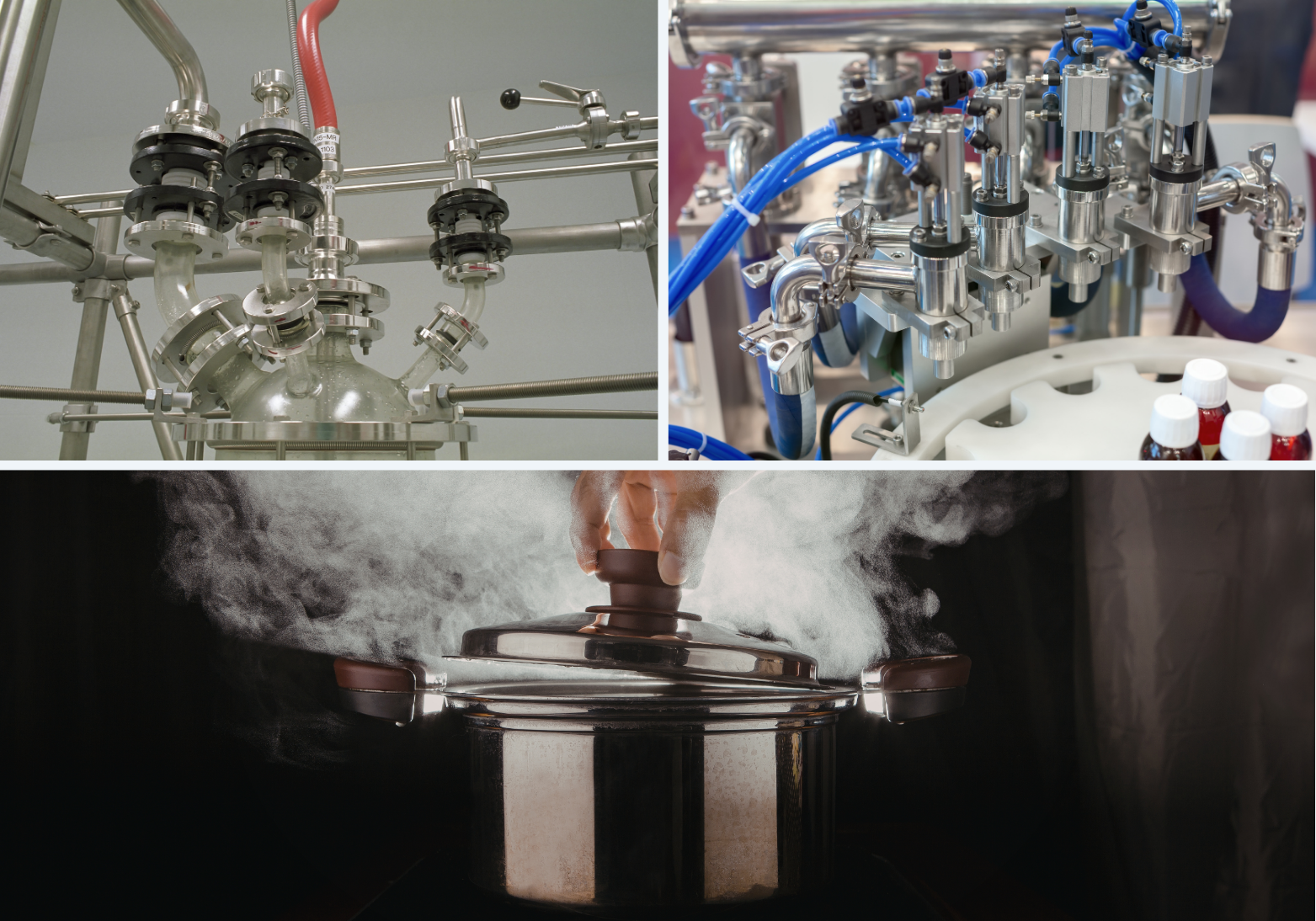
Silicone gaskets are widely used in modern food processing machinery. Common applications include valves, pumps, and pipelines. This material helps ensure sealing performance during equipment operation. At the same time, silicone gaskets offer good heat and chemical resistance.
In the beverage industry, silicone gaskets are also commonly used. Typical systems include filling and capping machines. In addition, this material is suitable for high-humidity environments. These conditions are common in industrial beverage production lines.
Many household appliances also use food-grade silicone gaskets. Common examples include pressure cookers and food storage containers. Thanks to its high durability, silicone helps products operate more reliably. At the same time, the material ensures food-contact safety.
DEVELOPMENT TRENDS
The food-grade silicone industry is currently developing toward greater safety and sustainability. Many companies are prioritizing high-performance materials. In addition, requirements for raw material purity are increasing significantly. This trend is driving demand for high-quality talc in manufacturing.
Furthermore, new compounding technologies are also developing rapidly. Companies are focusing on optimizing durability and processability. Some new silicone systems even require additives with higher dispersion capability. Therefore, technical-grade talc is playing an increasingly important role.
In the future, the food-grade silicone industry is expected to continue growing. In particular, demand for modern processing equipment is increasing considerably.
CONCLUSION
Talc plays an important role in the production of modern food-grade silicone gaskets. This additive helps improve processability and material stability. In addition, talc also enhances the mechanical durability of silicone. At the same time, companies can better optimize production costs.
However, talc used in food-grade silicone must achieve high purity. In addition, the raw material must comply with strict safety standards.
In the future, demand for high-quality talc is expected to continue increasing. This will remain an important factor for the modern food-grade silicone industry.
VICHEM – AUTHORIZED DISTRIBUTOR OF CHEMICAL ADDITIVES FROM LEADING BRANDS SUCH AS COVESTRO, SINOPEC, BUHLER, … IN VIETNAM
Vichem is an authorized distributor of chemical additive products from leading brands such as Covestro, Sinopec, Buhler, … in the Vietnamese market. We not only provide high-quality products but also deliver after-sales services that meet international standards.
For more information about our products, please contact us through the following channels:
📞 Hotline: 08 1790 1790
📧 Email: contact@vichem.vn
🔎 LinkedIn: Vichem JSC
🌐 Website: www.vichem.vn
📌 Facebook: Vichem JSC