Paper dolls and cellulose-based handicraft products are becoming increasingly popular. The growing trend toward environmentally friendly materials has strongly supported the development of the handicraft industry in recent years.
However, coating paper substrates is far from simple. The moisture absorption properties and porous surface structure of these materials make coating defects more likely to occur. Some products experience uneven coloration, raised fibers, or tiny holes on the surface. In many cases, the coating layer may also turn yellow after a short period of use.
Among all coating colors, white is considered the most challenging system to handle. White coatings require high opacity and a highly uniform surface finish. Even the smallest defect can be easily detected by the naked eye. To achieve a high-quality white coating for paper dolls and handicrafts, manufacturers must optimize raw materials, coating formulations, and production processes simultaneously.
WHY IS WHITE COATING DIFFICULT TO APPLY ON PAPER DOLLS?
Paper surfaces strongly absorb coatings
Paper and molded pulp materials have relatively high water absorption capacity. During coating application, part of the coating solution penetrates deeply into the material instead of remaining on the surface. This makes the white coating layer appear thin and lacking in hiding power. The issue becomes even more visible on dark-colored substrates.
In addition, uneven absorption can cause inconsistent coloration, resulting in patches with different brightness levels.
The material surface contains numerous cellulose fibers
Paper-based handicraft products often have relatively rough surfaces. Some surfaces may also contain loose paper fibers or cellulose dust. During coating application, these fibers may rise through the coating film. As a result, the surface loses smoothness and aesthetic quality. This is a very common defect in handmade paper doll production.
White coatings easily reveal defects
Dark colors generally conceal defects quite effectively. White coatings, however, behave in the opposite way. Even a tiny imperfection or uneven coverage area becomes immediately noticeable. This means white coating systems require much better leveling performance and higher opacity than many other colors.
COMMON DEFECTS IN WHITE COATINGS FOR PAPER HANDICRAFTS
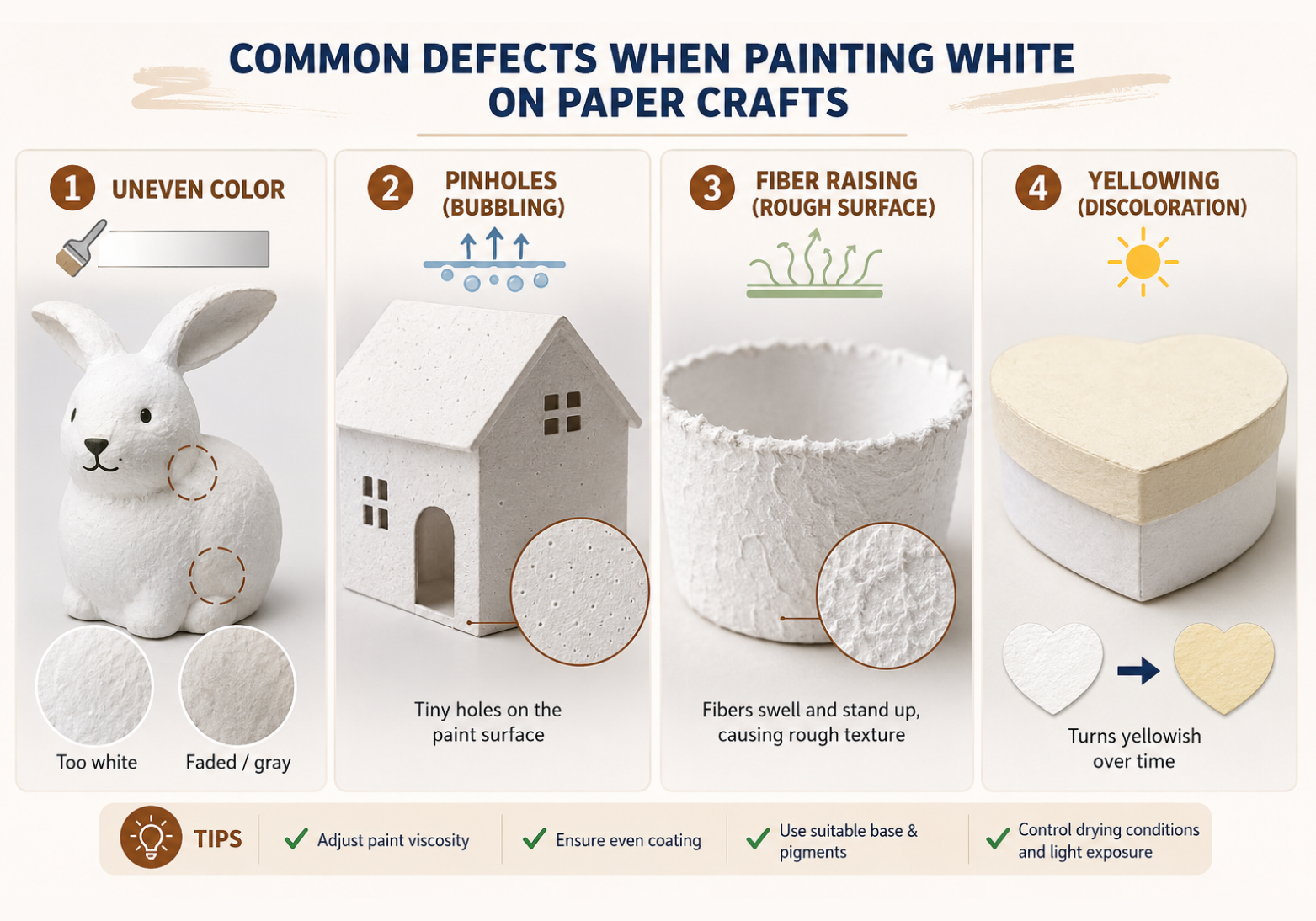
Uneven coloration is the most common defect. Some areas appear bright white while others look dull or grayish. The main cause is usually the uneven absorption capability of the substrate material. In addition, unsuitable coating viscosity can make the coating difficult to level evenly.
During the drying process, trapped air and moisture inside the material may escape outward. As gas passes through the coating film, tiny dots appear on the surface. This phenomenon is especially common with molded pulp and recycled paper materials. If not properly controlled, the white coating loses smoothness and its surface protection performance decreases.
Furthermore, cellulose fibers may swell and rise from the surface when exposed to water in the coating system. After drying, the product becomes rough and loses the desired smooth finish. This defect commonly occurs in water-based coating systems with high penetration rates.
Some products may gradually develop a light yellow tint after a period of use. This can result from poor resin quality, inadequate pigment durability, or the effects of heat and light exposure. For decorative and premium handicraft products, this issue significantly reduces aesthetic value.
IMPORTANT REQUIREMENTS FOR WHITE COATING SYSTEMS FOR PAPER DOLLS
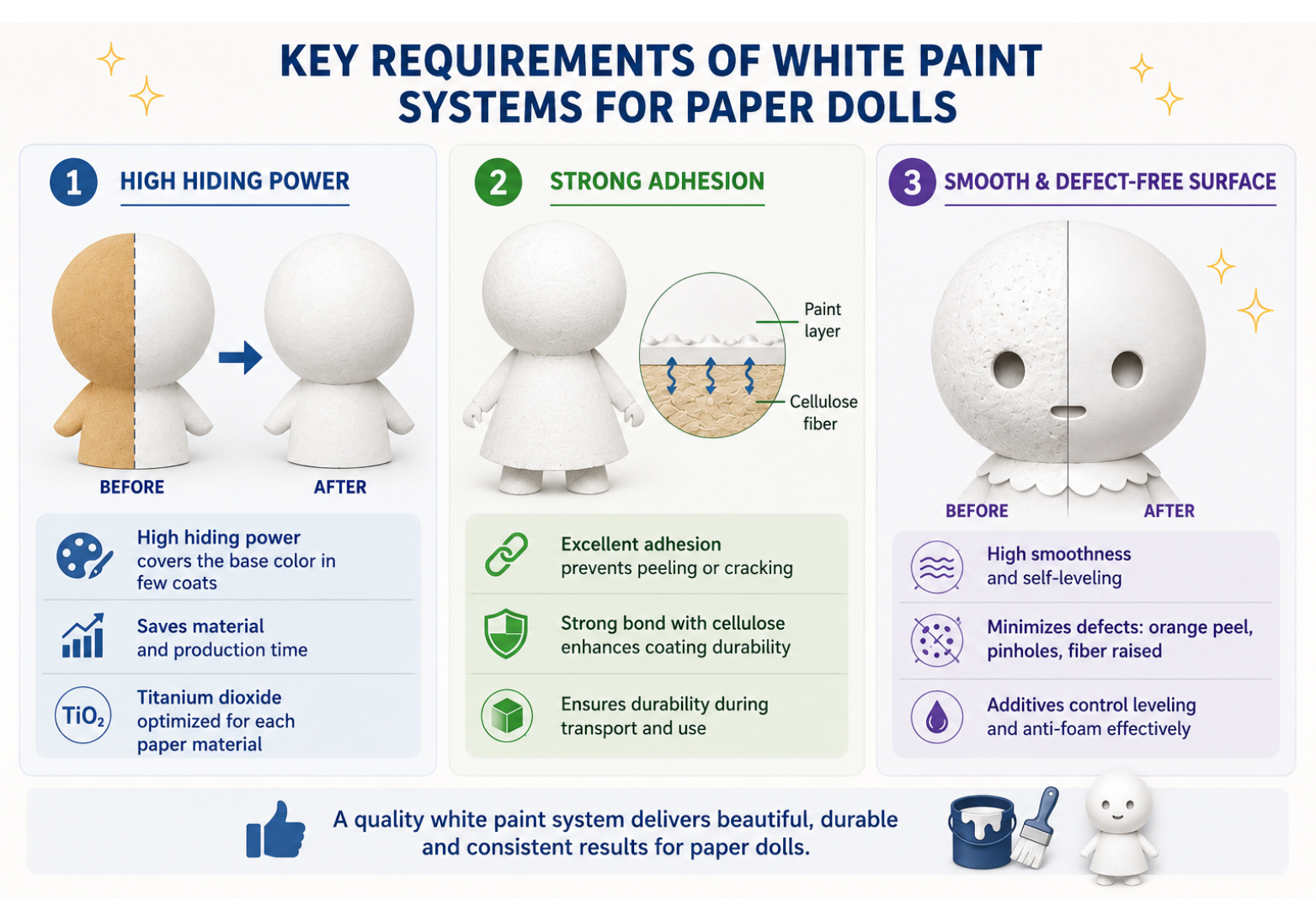
High hiding power
White coatings must effectively cover the substrate color with as few coating layers as possible. This helps reduce material consumption and shorten production time. In the coatings industry, titanium dioxide is commonly used to improve the hiding power of white coatings. However, the dosage must be optimized according to different paper substrate types.
Strong adhesion
Paper surfaces typically have high absorbency, making coatings prone to peeling or cracking if adhesion is insufficient. The resin system must bond effectively with cellulose to improve coating durability. This is particularly important for handicraft products that require transportation or frequent handling during use.
Smooth surface with minimal defects
A high-quality white coating should have excellent smoothness and good self-leveling properties. If the coating film contains waviness, pinholes, or raised paper fibers, the product will lose significant aesthetic value. Therefore, controlling leveling additives and defoaming agents is extremely important.
Long-term whiteness stability
Handicraft products are often used for display or decoration purposes. Therefore, the coating layer must maintain stable color over a long period. The coating system should minimize yellowing caused by exposure to heat and light.
NEW TRENDS IN COATINGS FOR PAPER HANDICRAFTS
The growing trend toward environmentally friendly materials is accelerating the development of the handicraft industry. Many brands now prioritize coatings with low odor, low emissions, and improved user safety.
In addition to environmental considerations, aesthetic requirements are also becoming increasingly demanding. Consumers prefer smooth, uniform white surfaces with a more natural appearance. To meet these expectations, many chemical manufacturers are developing additive systems that provide better leveling performance for cellulose-based materials.
In addition, thin-film coating technologies and bio-based coatings are also being actively researched in the packaging and handicraft industries.
CONCLUSION
White coatings for paper dolls and handicrafts are relatively difficult systems to process. The moisture absorption characteristics and porous structure of cellulose materials make coating defects more likely to occur. Without proper control of raw materials and production processes, products can easily suffer from uneven coloration, raised fibers, or pinholes.
To achieve a beautiful and long-lasting white coating, manufacturers must optimize coating formulations, additives, and processing conditions simultaneously. This is also an important development direction as the handicraft industry continues transitioning toward more sustainable and environmentally friendly solutions.
VICHEM – AUTHORIZED DISTRIBUTOR OF CHEMICAL ADDITIVES FROM LEADING BRANDS SUCH AS COVESTRO, SINOPEC, BUHLER,… IN VIETNAM
Vichem is an authorized distributor of chemical additives from leading brands such as Covestro, Sinopec, Buhler,… in the Vietnamese market. We not only provide high-quality products but also deliver after-sales services that meet international standards.
For more information about our products, please contact us through the following channels:
📞 Hotline: 08 1790 1790
📧 Email: contact@vichem.vn
🔎 LinkedIn: Vichem JSC
🌐 Website: www.vichem.vn
📌 Facebook: Vichem JSC