Elastic properties of polymers are an important mechanical characteristic. They represent the ability to deform and return to the original shape. Understanding this property helps optimize materials for various applications.
WHAT ARE THE ELASTIC PROPERTIES OF POLYMERS?
The elastic properties of polymers refer to their ability to stretch under force. When the applied force is removed, the material can return to its original state. This is a prominent feature of many polymeric materials.
Elasticity in polymers differs from that in metals and ceramics. Long molecular chains can stretch and then recoil. This mechanism creates their characteristic flexibility.
The degree of elasticity depends on molecular structure. Polymers with cross-linking generally exhibit better recovery. This determines their practical application potential.
MECHANISM OF ELASTICITY
Molecular Chain Movement
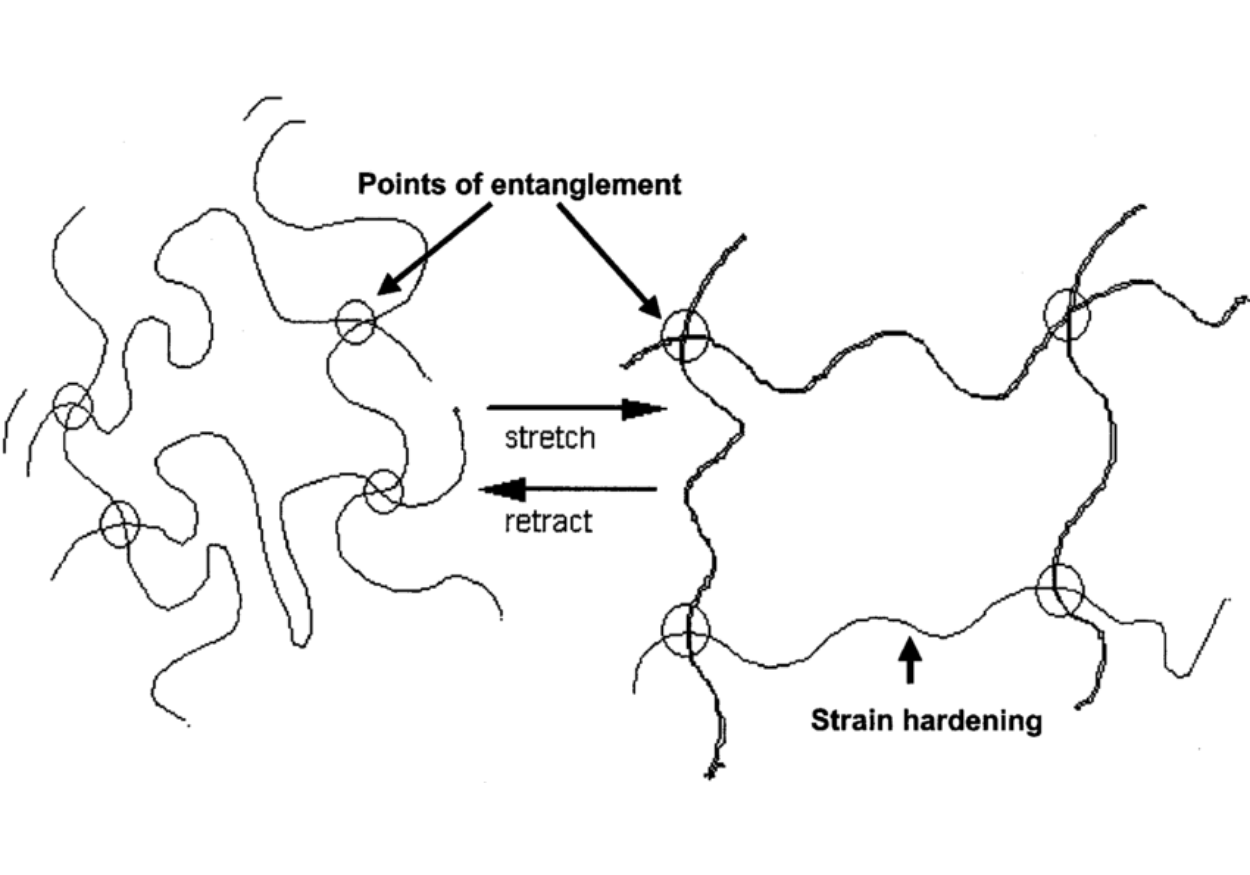
Polymer chains can coil and extend flexibly. When subjected to tensile force, the chains gradually straighten. When the force is removed, they return to their original coiled state.
This movement is reversible. No new chemical reaction occurs during the process. Therefore, the material can recover repeatedly.
The elastic properties of polymers depend on the freedom of molecular motion. Temperature and structure strongly influence this mechanism. This forms the foundation of elastomeric materials.
Role of Cross-Linking
Cross-links create a three-dimensional network structure. This network holds polymer chains together, preventing the material from flowing when stretched.
The higher the cross-link density, the greater the elastic strength. However, excessive cross-linking makes the material stiffer. A proper balance is required for optimal performance.
Vulcanized rubber is a typical example. The cross-linking process enhances recovery capability, significantly improving the elastic properties of polymers.
FACTORS AFFECTING ELASTICITY
Environmental Temperature
Temperature directly affects molecular motion. At low temperatures, polymers become more brittle, and elasticity decreases significantly.
As temperature increases, molecular chains become more flexible. The material deforms and recovers more easily. However, excessively high temperatures may reduce strength.
The glass transition temperature is an important parameter. Above this temperature, polymers exhibit better elastic behavior. Proper temperature control is essential.
Molecular Structure
Linear polymers allow sliding between chains. This increases ductility but reduces elasticity. In contrast, network polymers are stronger and more elastic.
High molecular weight enhances flexibility. Long chains create more physical interaction points, supporting recovery capability.
Molecular weight distribution is also important. A broad distribution can alter mechanical properties. Therefore, the elastic properties of polymers vary with structure.
Filler Content
Fillers are added to improve mechanical properties. However, they may reduce stretchability, affecting overall elasticity.
Some reinforcing fillers increase tensile strength by creating interactions between polymer chains and particle surfaces. Effectiveness depends on formulation ratios.
Careful selection of fillers is necessary. Balancing strength and elasticity is the main objective. This is a crucial step in material design.

METHODS FOR EVALUATING ELASTICITY
Tensile testing is a common method. A polymer sample is stretched to a defined deformation level, and recovery capability is measured afterward.
Elastic modulus is an important parameter. It reflects material stiffness and helps compare different polymers.
Compression and flexural tests are also applied. These methods evaluate behavior under various types of force, providing a comprehensive understanding of polymer elasticity.
APPLICATIONS OF ELASTIC POLYMERS
Elastic polymers are widely used in tire manufacturing. The material must withstand continuous deformation during operation. Recovery capability increases product lifespan.
In the medical field, elastic polymers are used for gloves. The material must stretch and fit closely to the hand, ensuring safety and comfort.
The construction industry also uses elastic polymers extensively. Sealants must absorb movement and prevent cracking. The elastic properties of polymers help reduce structural damage.

WAYS TO IMPROVE ELASTICITY
Adjusting cross-link density is an effective solution. The vulcanization process must be carefully controlled to achieve desired elasticity.
Selecting the appropriate base polymer is essential. Each polymer has unique characteristics, and blending requires thorough testing.
Adding plasticizing additives can increase flexibility. However, the ratio must be carefully controlled to maintain long-term stability.
CONCLUSION
The elastic properties of polymers play a crucial role in many industries. They determine deformation and recovery capability. Understanding the mechanism helps optimize material performance.
Molecular structure and environmental conditions strongly influence this property. Controlling these factors improves product quality and supports sustainable applications.
Research and innovation in polymers continue to advance. New technologies enhance both durability and elasticity. As a result, the elastic properties of polymers are continuously improving.
VICHEM – AUTHORIZED DISTRIBUTOR OF CHEMICAL ADDITIVES FROM LEADING BRANDS SUCH AS COVESTRO, SINOPEC, BUHLER, … IN VIETNAM
Vichem is an authorized distributor of chemical additives from leading brands such as Covestro, Sinopec, Buhler, and others in the Vietnamese market. We not only supply high-quality products but also provide internationally standardized after-sales services.
- Technical consulting: Support customers in selecting products suitable for their application.
- Color-matching tests: Vichem specialists perform matching tests to ensure results meet design standards.
- On-site application support: Assist customers during integration into production lines to ensure optimal performance.
For more information, please contact us:
📞 Hotline: 08 1790 1790
📧 Email: contact@vichem.vn
🔎 LinkedIn: Vichem JSC
🌐 Website: www.vichem.vn
📌 Facebook: Vichem JSC