When a plant floor has to return to service quickly and still hold its color, choosing polyaspartic resin for floor coatings comes down to four factors: the polyaspartic application time the job needs, UV color stability, film thickness, and the temperature and humidity during application. Polyaspartic floor coatings belong to the polyurea family but react more slowly than traditional polyurea floor coatings, so applicators have enough time to roll or squeegee. When selecting polyaspartic for industrial plants, read these parameters on the TDS of each resin and test them under the plant's actual conditions before applying over a large area.
Where the wrong polyaspartic resin for floor coatings fails
Polyaspartic resin is a polyaspartic ester resin, a sterically hindered amine that reacts with isocyanate to form a polyurea film. This reaction is faster than the polyol–isocyanate reaction in conventional PU, so the floor cures sooner and the plant is down for a shorter time. Each ester structure has a different degree of hindrance, so each resin gives its own reaction speed and working time.
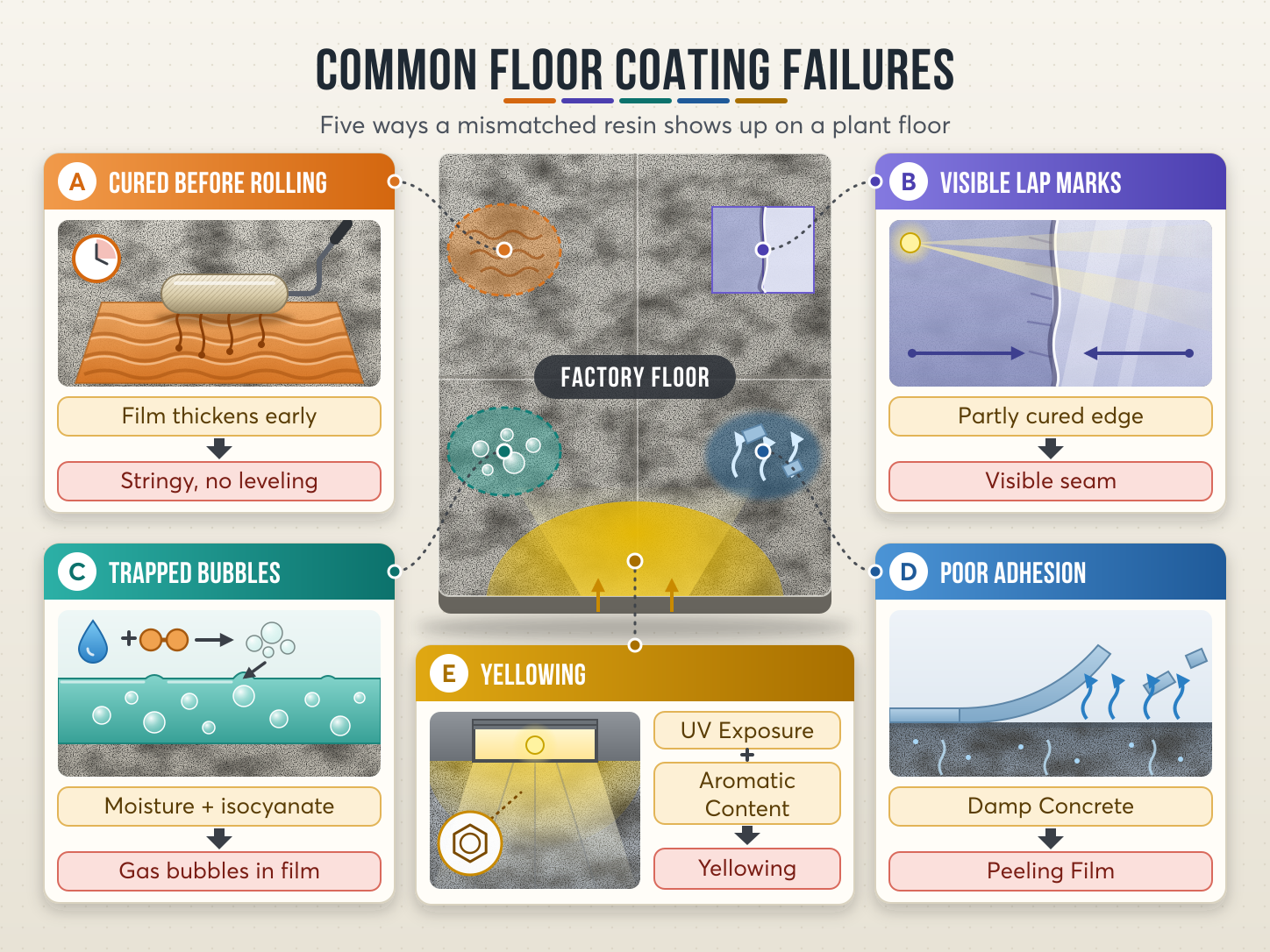
That speed helps when planning plant downtime, but it is also the main source of failures when the wrong resin is chosen. Common failures on plant floors:
- Mix cures before rolling is finished: the film thickens while the applicator is still rolling, the surface strings, and it no longer self-levels.
- Lap marks: the next section meets a section that has already partly cured, leaving a clear boundary under raking light.
- Trapped bubbles: a film that is too thick or cures too fast holds bubbles before they can escape, and isocyanate reacting with moisture also generates gas.
- Poor adhesion on damp concrete: moisture vapor from the substrate keeps the coating from bonding to the concrete and makes the film peel off in patches.
- Yellowing in areas exposed to sunlight: a film containing an aromatic component gradually turns yellow at plant doors and loading areas.
Most of these failures show up after the floor has been handed over, and fixing them means grinding and recoating whole sections. So the resin must be matched to the floor conditions at the selection stage, before placing the order.
Four criteria that decide the choice of polyaspartic resin for floor coatings
Reaction speed and polyaspartic application time
The polyaspartic ester structure sets the reaction speed with isocyanate: the larger the sterically hindering group, the slower the amine reacts. A fast-reacting resin returns the floor to service sooner and suits plants that can only stop briefly, but it shortens the applicator's working time. A slower resin gives more time to roll and handle joints, at the cost of a longer wait before the floor can take load.
Compare the pot life of the mix with the area covered per batch and the number of applicators rolling. A large batch on a wide floor needs a longer working window than a small batch in a narrow area.
UV stability and color retention
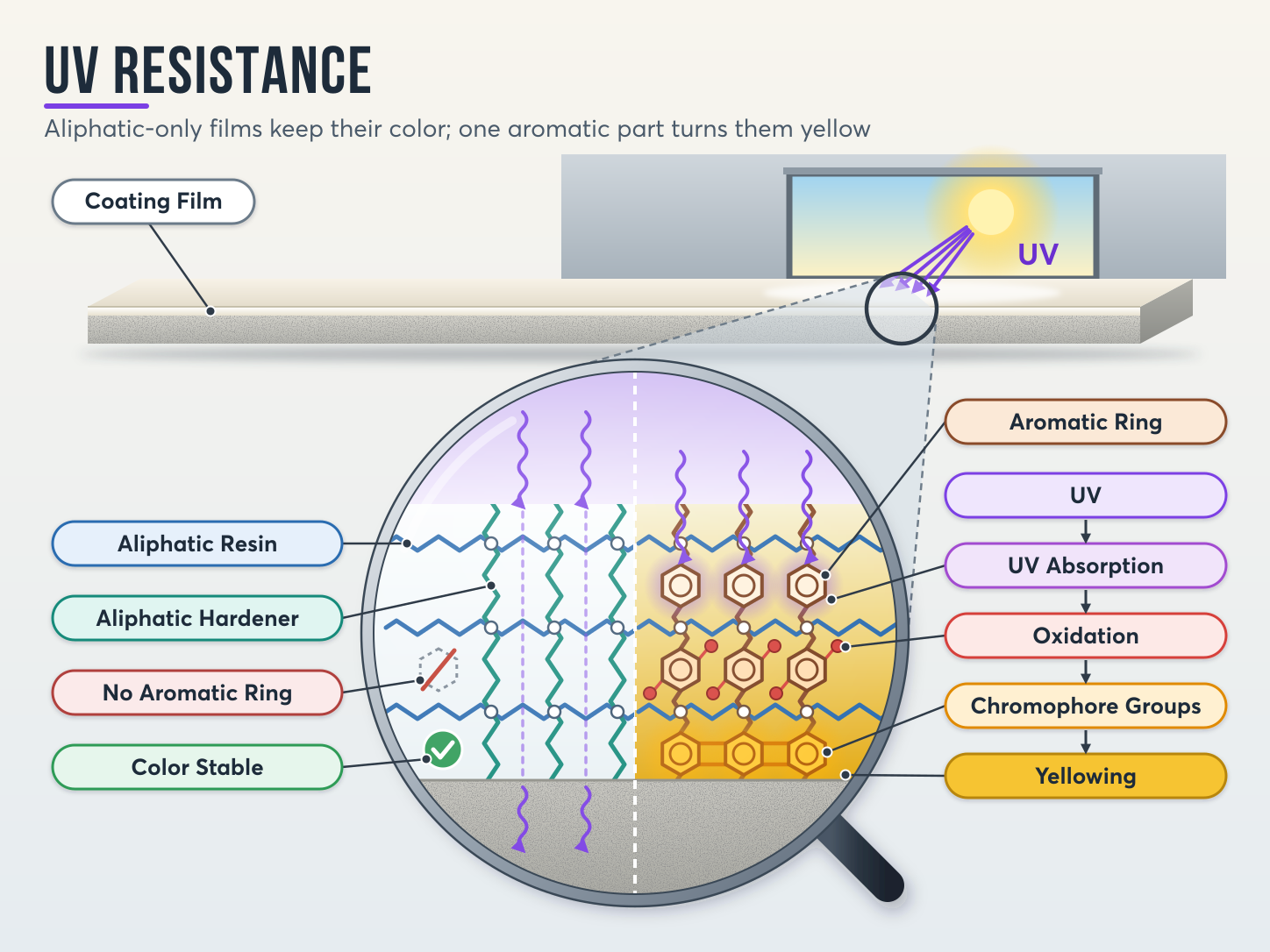
Both the resin and the hardener must be aliphatic, with no aromatic rings, for the film not to yellow. A single component containing an aromatic ring is enough: the ring absorbs UV and is oxidized into chromophore groups, so the film gradually yellows near doors, under skylights or outdoors. Indoor floors without direct sunlight are less affected, but light-colored floors should still use a fully aliphatic system.
For light-colored floors, the white pigment also has to be the right type. The principles for choosing white pigment are covered in the article how to choose TiO2 for packaging inks.
Viscosity, solids content and film thickness
High solids content reaches the required film thickness with fewer coats and gives lower VOC. Viscosity determines self-leveling and bubble release: low-viscosity systems level easily and release bubbles quickly, while high-viscosity systems hold thickness but trap bubbles in the film more easily.
Both parameters are published in the TDS of each resin, so read them alongside the film thickness your floor needs. Adding solvent at will to lower viscosity can cause sagging or a shortfall in thickness, a problem analyzed in the article fixing solvent-based paint that sags after thinning.
Sensitivity to temperature and humidity during application
Higher temperature speeds up the reaction, so with the same resin, a midday shift in the hot season has a shorter working window than an early-morning shift. Humidity causes a side reaction: isocyanate reacts with water to form carbon dioxide, which creates bubbles in the film.
Water also comes from the substrate. You must assess the moisture of the concrete substrate before rolling the primer, because moisture vapor rising from the slab causes both bubbles and poor adhesion.
How to match polyaspartic resin to your plant floor
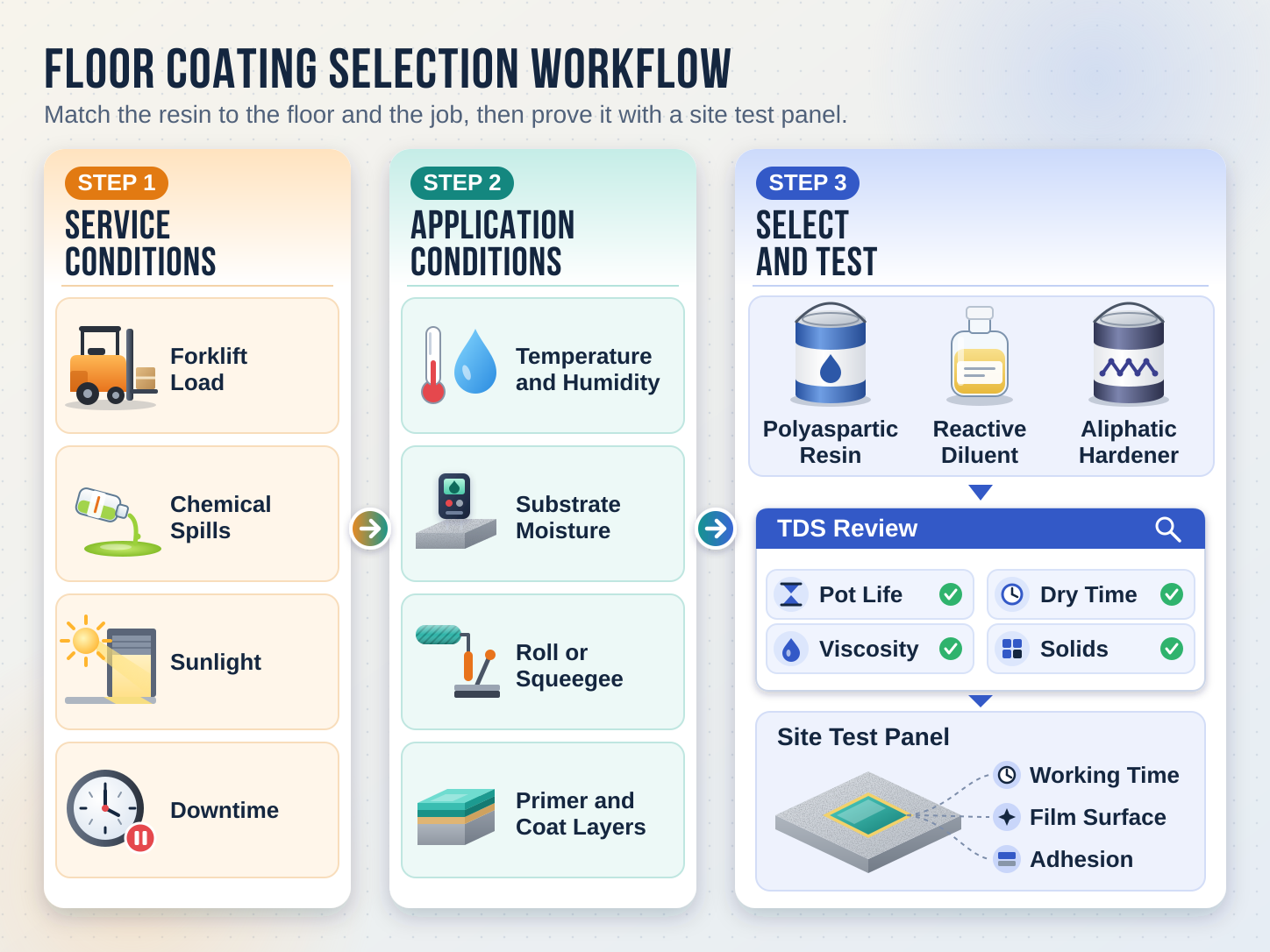
The three steps below, written for anyone selecting polyaspartic for industrial plants, go from service conditions, through application conditions, to selecting the resin and testing a sample.
Step 1 — Define the floor's service conditions
Record the demands the floor film has to withstand:
- Load and traffic density of forklifts.
- Chemical spills on the floor: which chemicals, and how long they stay before being wiped up.
- Sunlight reaching the floor, including areas near doors and loading zones.
- The permitted plant downtime from application until forklifts can run again.
Step 2 — Define the application conditions
Record the conditions on site:
- Air temperature and humidity in the plant for each application shift.
- Moisture of the concrete substrate and the surface condition after grinding.
- Application method: roll or squeegee, batch size, number of applicators.
- Number of coats required and the primer system used on the substrate.
Step 3 — Select the resin and test a sample
From the two steps above, choose a set of three materials: the polyaspartic resin, a reactive diluent, and an aliphatic (HDI) isocyanate hardener from Covestro. The reactive diluent lowers viscosity while still taking part in the film, so it keeps solids content and limits VOC. The aliphatic hardener must go with the resin for the film to hold its color.
Open the TDS of each type and read four parameters: pot life of the mix, dry time, viscosity and solids content. Compare each parameter against the conditions recorded in the two previous steps, then apply a test panel on site, at the real temperature and humidity, using the same rolling or squeegee method you plan to use. Observe the applicator's working time, the film surface and the adhesion to the substrate after drying.
Common mistakes when choosing polyaspartic resin for floor coatings
Choosing by dry speed alone. The fastest-drying type shortens plant downtime, but applicators cannot finish rolling in time and joints show clearly. Choose the speed by area per batch and number of applicators, not by dry time alone.
Using an aromatic hardener for the topcoat. An aliphatic resin paired with a hardener containing aromatic rings still yellows under UV, because the aromatic ring sits in the film. For a surface coating, both components must be aliphatic.
Ignoring hot-season temperature. A plant with a metal roof can be much hotter than during a trial run in the cool season, which shrinks the working window. The test panel should be run under the hottest conditions in which the floor will be applied.
Skipping the primer and substrate moisture. A damp concrete substrate, or one without a suitable primer system, causes poor adhesion and bubbles even when the resin is right. Pigmented coatings also suffer from pigment migration, a mechanism analyzed in the article fixing pigment bleeding in plastics.
Frequently asked questions
Can Covestro polyaspartic be used for floor coatings?
Yes, if you choose the right resin and hardener for floor coatings. Covestro supplies polyaspartic resins and aliphatic isocyanate hardeners for coatings. Each type has its own intended use, so confirm it on the TDS and apply a test panel on site before applying over a large area.
How does polyaspartic differ from epoxy for plant floors?
It differs in curing mechanism and color retention. Epoxy cures with amines, while polyaspartic reacts with aliphatic isocyanate to form polyurea and usually cures faster. Bisphenol-based epoxy contains aromatic rings and so yellows easily under UV, while aliphatic polyaspartic systems hold color better.
Can polyaspartic floor coatings be applied in hot, humid weather?
Yes, but it has to be controlled. High heat speeds up the reaction and shortens working time, and moisture makes isocyanate react with water and form bubbles. Measure the substrate moisture, choose a resin with a suitable reaction speed, and test a sample under the actual site conditions.
Is polyaspartic a polyurea floor coating?
Yes, polyaspartic is a branch of polyurea. Both form urea linkages from amines and isocyanates. Polyaspartic uses a sterically hindered amine, so the reaction slows just enough for applicators to roll or squeegee, while traditional polyurea reacts very quickly.
Conclusion
Choosing polyaspartic resin for floor coatings means matching reaction speed, UV stability, solids content, viscosity and the plant's own application conditions, then verifying with a real sample. Choosing by a single parameter, especially dry speed, can easily lead to lap marks, bubbles or yellowing after handover.
- Choose by four criteria: reaction speed, UV, solids content with viscosity, and application conditions.
- Both resin and hardener must be aliphatic if color must be retained.
- Assess substrate moisture and hot-season temperature before settling on a resin.
- Always test a sample under the real site conditions.
Send us your floor's service conditions and application conditions, and the Vichem technical team will recommend a suitable polyaspartic resin.
Vichem is a distributor of chemical additives and equipment from leading brands such as Covestro, Sinopec, TotalEnergies Corbion, Bühler and Tinox in the Vietnamese market.
For more information about our products, please contact us through the following channels:
- Hotline: 08 1790 1790
- Zalo OA: Vichem JSC
- Email: contact@vichem.vn
- LinkedIn: Vichem JSC
- Website: www.vichem.vn
- Facebook: Vichem JSC