After understanding what animal feed is and evaluating whether self-production is effective, one key takeaway is that livestock production efficiency depends heavily on feed quality. Therefore, the industrial feed production sector has continuously evolved, transitioning from manual processes to fully automated and digitalized systems. Modern technology not only ensures product consistency but also enhances safety and optimizes production costs.
OVERVIEW
Industrial feed production technology is a combination of processes, equipment, and control systems used to transform raw materials into complete feed for livestock.
Unlike manual mixing methods, industrial production requires high precision at every stage. Each step—from raw material intake to final packaging—must be strictly controlled to ensure consistent quality across production batches.
MODERN INDUSTRIAL FEED PRODUCTION PROCESS
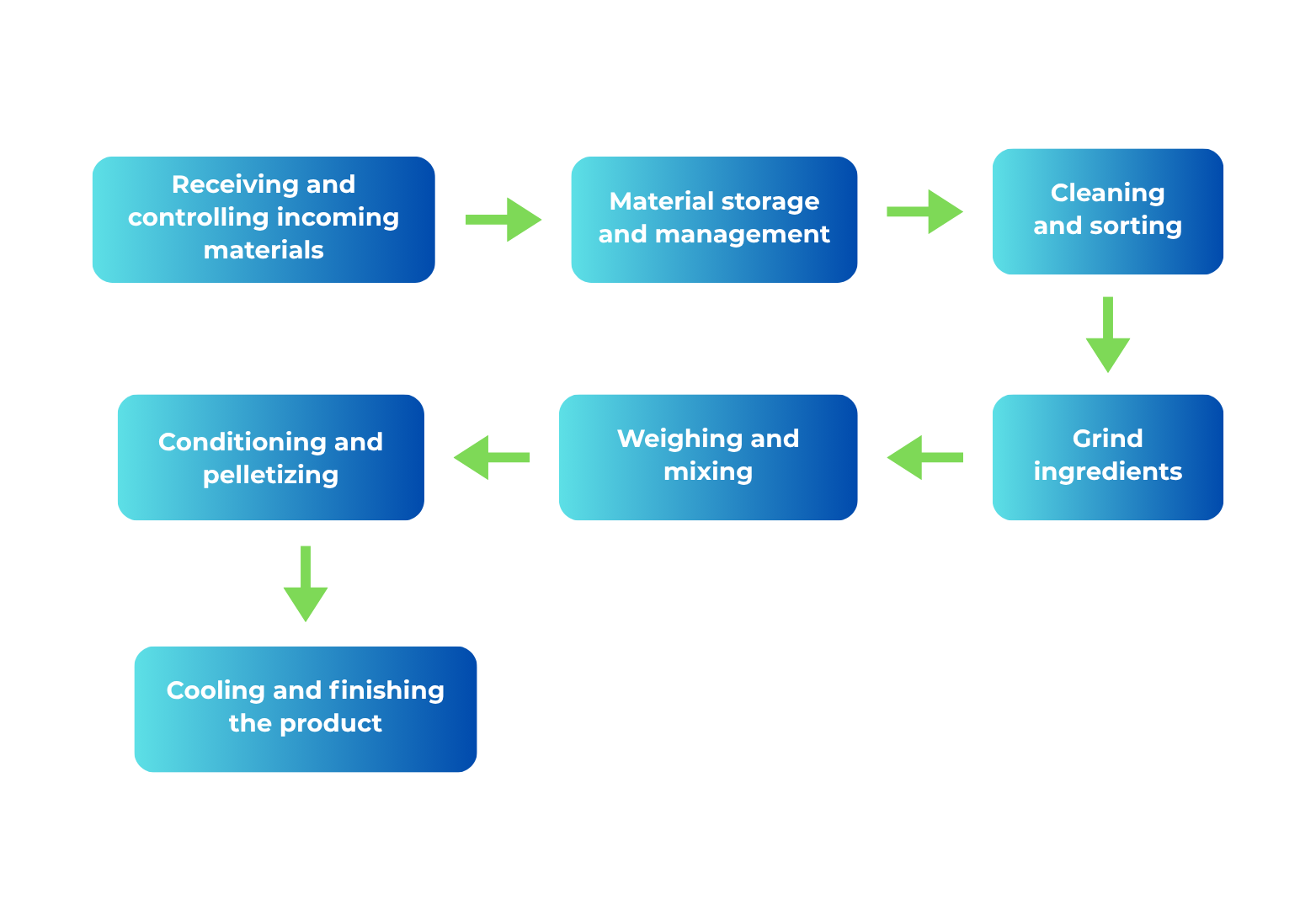
Raw material intake and control
All processes begin with raw materials. Modern intake systems can handle a wide range of materials, from grains to by-products.
The key at this stage is quality control from the outset. If raw materials do not meet standards, the entire downstream process will be affected. Therefore, factories typically integrate inspection and cleaning systems at the intake stage.
Storage and material management
After intake, materials are stored in silo systems or specialized warehouses.
According to Bühler’s design, storage systems are not merely for holding materials but also regulate material flow throughout the process. Grouping materials (macro, micro, additives) helps optimize subsequent mixing stages.
Cleaning and classification
Before entering production, materials must be cleaned to remove impurities, metals, or unwanted objects.
This step is crucial to protect downstream equipment and ensure product safety. Screening, separation, and magnetic systems are commonly used to achieve high efficiency.
Grinding
Grinding reduces particle size, thereby improving digestibility for livestock.
In modern systems, grinding machines not only ensure fineness but also provide uniform particle size distribution. This is critical because particle size directly affects nutrient absorption efficiency.
Weighing and mixing
Weighing and dosing are performed with high precision, especially for micro-components such as vitamins and minerals. Even small deviations at this stage can significantly impact feed quality.
After weighing, materials are transferred to mixing systems. Modern mixers can complete the process quickly while maintaining high uniformity, ensuring that each feed pellet has the same nutritional composition.
Conditioning and pelleting
After mixing, materials are treated with heat and moisture before pelleting.
The conditioning process improves binding properties and digestibility. The material is then formed into pellets or crumbles. Pelleted feed not only facilitates transportation but also reduces losses during use.
Cooling and finishing
After pelleting, the product is hot and must be cooled.
This process stabilizes pellet structure and extends shelf life. The product may then be coated with additional nutrients or packaged depending on requirements.
QUALITY CONTROL IN MODERN PRODUCTION
Quality is not only checked at the end but monitored throughout the entire process.
According to inline measurement systems, parameters such as moisture, protein, and fat can be tracked in real time during production. This allows timely adjustments to formulations, reduces raw material waste, and ensures products meet required standards.
In addition, cross-contamination control and hygiene are emphasized. Modern designs minimize material residues, thereby reducing the risk of contamination.
LINK TO PRACTICAL LIVESTOCK PRODUCTION
Referring back to the question of self-producing feed, the difference becomes clear.
While manual mixing makes it difficult to control nutrition and quality, industrial production technology enables near-complete control over the entire process. This explains why large enterprises invest heavily in modern production systems instead of relying on manual methods.
However, this does not mean that small-scale models cannot adopt such approaches. In practice, many farms are gradually adopting technology at appropriate scales, improving efficiency without requiring excessive investment.
CONCLUSION
Modern industrial feed production technology not only ensures high-quality products but also plays a decisive role in business efficiency and competitiveness.
From raw material control and process optimization to automation and data application, the entire system is designed with a single goal: to produce the most consistent, safe, and efficient feed for livestock.
In the future, the combination of technology and nutritional expertise will continue to shape the livestock industry. Enterprises that invest early in modern systems will gain significant long-term competitive advantages.
VICHEM – AUTHORIZED DISTRIBUTOR OF BUHLER INDUSTRIAL AND AGRICULTURAL MACHINERY IN VIETNAM
Vichem is an authorized distributor of Bühler industrial and agricultural machinery and equipment in the Vietnamese market. We not only provide high-quality products but also deliver after-sales services that meet international standards.
For more information about our products, please contact us via the following channels:
📞 Hotline: 08 1790 1790
📧 Email: contact@vichem.vn
🔎 LinkedIn: Vichem JSC
🌐 Website: www.vichem.vn
📌 Facebook: Vichem JSC