When gravure ink dries in the cells or the package smells after printing, the cause usually lies in how the packaging ink solvent was selected. A gravure ink solvent should be chosen by its ability to dissolve the ink resin, an evaporation rate that matches press speed and drying, and the amount of residual solvent left in the film. These parameters are read from the TDS (the supplier's technical data sheet) and must be verified on the press with the exact film being printed.
Where a wrong gravure ink solvent causes failures
Gravure printing uses a metal cylinder engraved with small cells. Liquid ink sits in the cells, transfers to the plastic film, and the film then passes through a dryer where the solvent evaporates. The solvent decides where along this path the ink stays liquid and where it dries, so errors from a wrong choice show up immediately on the press and on the finished roll.
Dot loss from ink drying in the cells. If the solvent evaporates too fast, the ink thickens on the cylinder and the cells gradually clog. Dots fade and then disappear, the doctor blade no longer wipes clean, and it leaves streaks on the film. Operators often have to wash the cylinder mid-run, which costs running time.
Blocking, odor and high residual solvent. If the solvent evaporates more slowly than the dryer can handle, the remainder is trapped in the ink layer. The finished roll tends to stick on the reverse side, the package has an off-odor, and residual solvent on the packaging increases. For food packaging, odor directly affects whether the converter is accepted by its customers.
Film swelling and poor ink adhesion. Some solvents attack the surface of the plastic film or swell it slightly, so the ink adheres unevenly or delaminates during lamination. Conversely, a solvent that does not dissolve enough of the ink resin makes the ink hazy, causes precipitation and gives poor gloss.
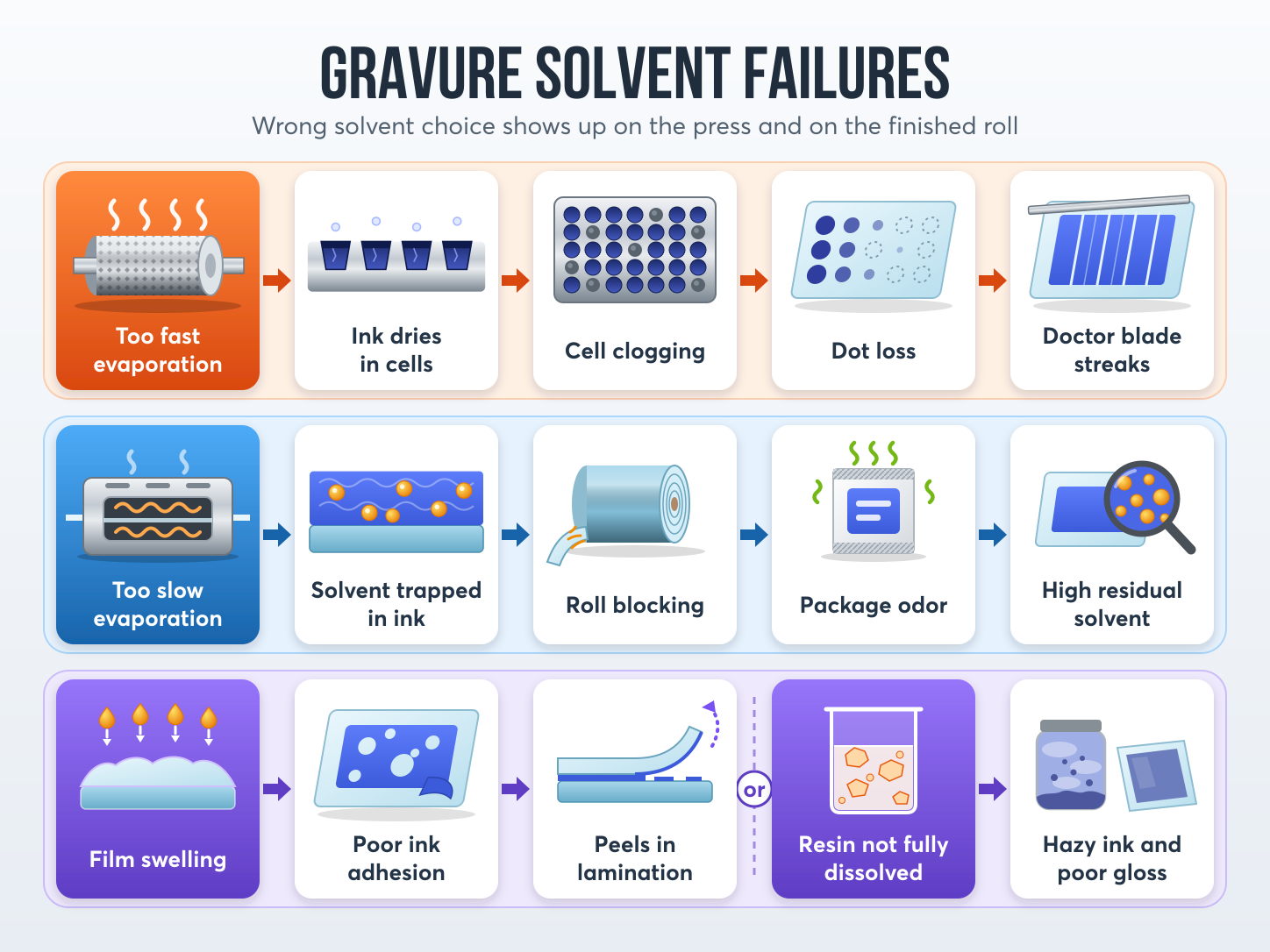
These three defect groups share one root: the solvent does not match the resin system, the film type and the line conditions. All four criteria below should therefore be considered before choosing.
Four deciding criteria for choosing a gravure ink solvent
Solvency for the ink resin
The polarity of the solvent must suit the resin system in the ink, for example polyurethane (PU), nitrocellulose (NC) or polyvinyl butyral (PVB). When the resin dissolves completely, the ink solution is clear and stable and gives a glossy ink layer. When the resin dissolves poorly, the ink turns hazy, may precipitate on standing or when workshop temperature changes, and the ink film loses gloss.
When thinning, the added solvent must preserve the solvency of the system, not just lower the viscosity. The chemistry behind this is covered in more detail in the article on how thinner solvent composition determines film quality. The converter should ask the ink maker which solvent system the ink was designed to run in.
Evaporation rate of ink solvent versus press speed
The evaporation rate of the ink solvent must match press speed and drying capacity. If the solvent evaporates too fast, the ink dries in the cells and on the doctor blade. If it evaporates too slowly, the dryer cannot remove it all, the ink is still wet at the nip roll, and solvent is trapped in the film.
In practice, operators rarely use a single solvent. They blend a fast solvent with a slow solvent to bring the evaporation rate of the mixture to the required point. A fast press usually needs a faster-evaporating blend, while a slow press or a short dryer needs a blend that evaporates more evenly. Slow drying also occurs in other systems, such as ethanol-based flexo ink drying slowly on the press, and the same principle of balancing fast and slow solvents applies.
The evaporation index of each solvent is published in the supplier's TDS, and it must be read together with the measurement method stated there.
Residual solvent on packaging and odor
Slow-evaporating solvent is easily retained in the ink film, because molecules must diffuse through an ink layer that is becoming denser before they can escape. The retained portion causes odor on food packaging and can weaken the bond between layers during lamination, leading to delamination.
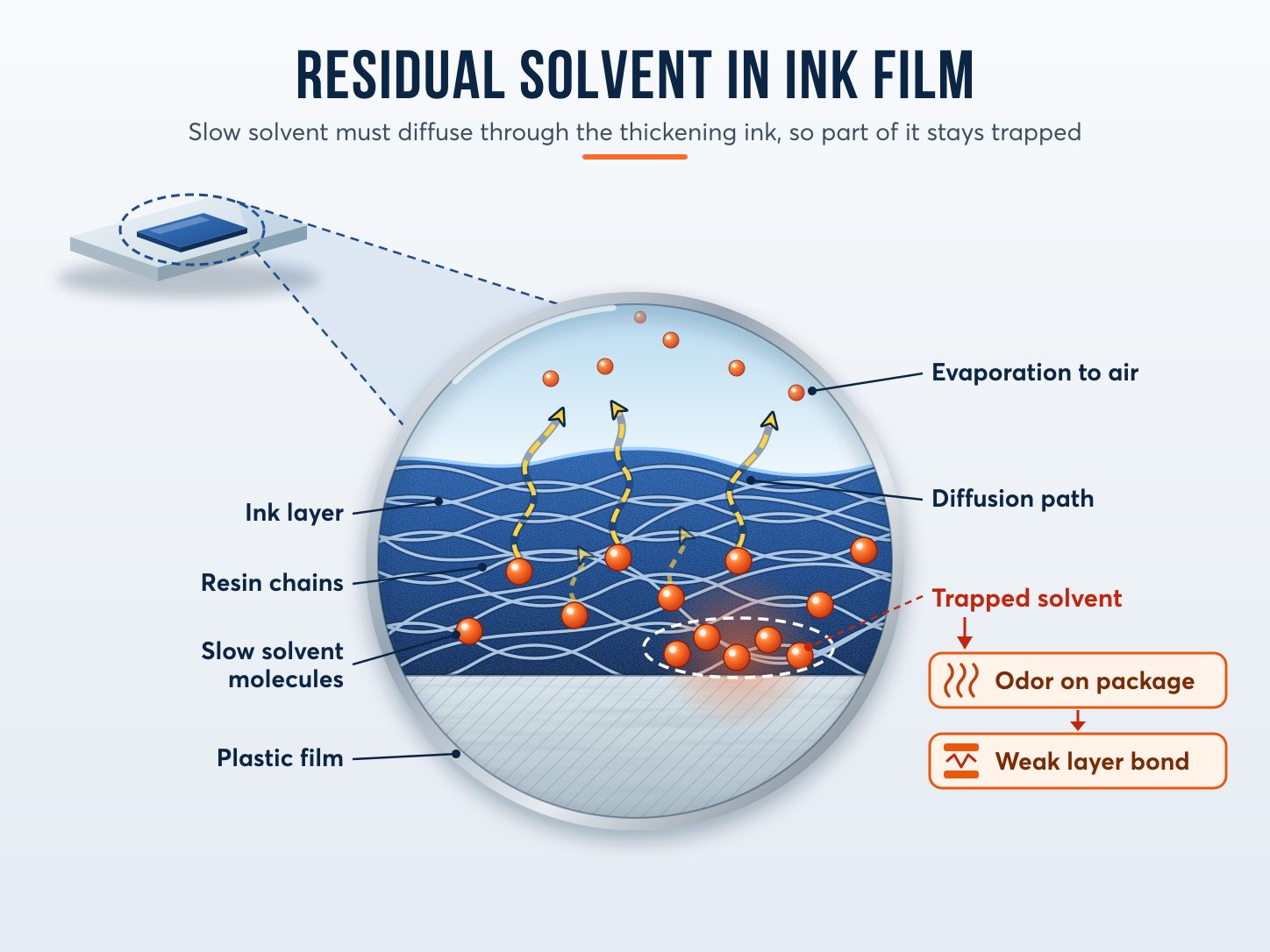
For this reason, adding a slow solvent to fix drying on the cylinder always carries a residual solvent risk. The acceptable residual level is set by the customer and the contract, so the converter should ask the brand owner before finalizing the formulation.
Compatibility with plastic film and customer requirements
A solvent for printing on plastic film must suit the film itself, because OPP, PET and PE films react differently to solvents. Some solvents swell or attack the film surface, causing poor ink adhesion or film distortion in the dryer. Corona-treated and untreated films also give different results with the same blend.
Beyond technical requirements, there are brand owner requirements. Some customers do not allow toluene in their packaging. The converter should have this list on hand when choosing the solvent system, to avoid changing the formulation after trials have already been run.
How to match a solvent to your gravure printing line
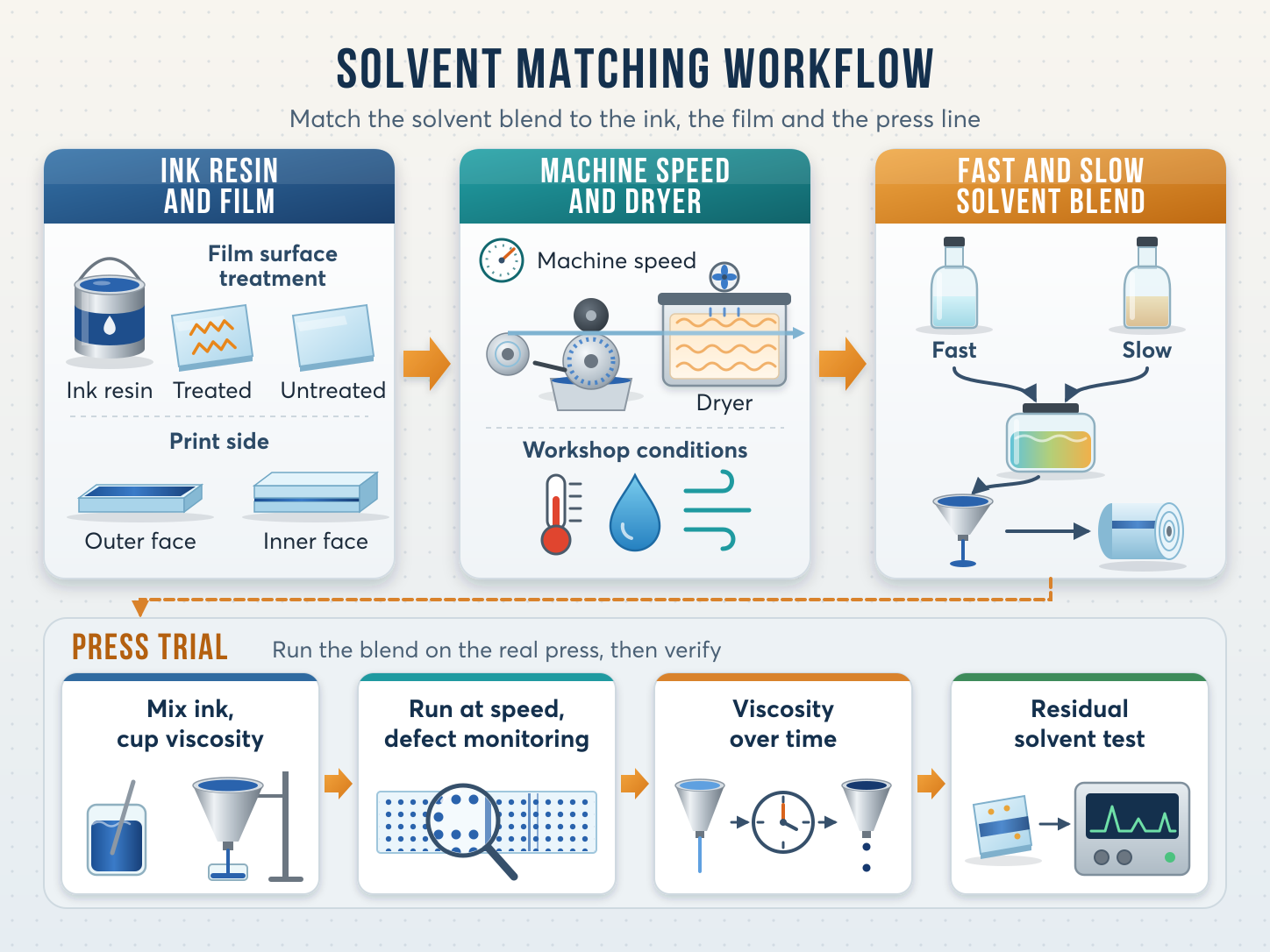
Step 1 — Identify the ink resin system and the film type
Get the resin system in use and the recommended solvent range from the ink maker. Record the film type, whether it is surface-treated, and whether the ink layer is on the outer side or the laminated inner side. These two pieces of information eliminate, from the start, solvents that cannot dissolve the resin or that damage the film.
Step 2 — Identify press speed, drying capacity and workshop conditions
Record the maximum press speed in use, the length and capacity of the dryer, and the air flow. Workshop temperature and ventilation directly affect the actual evaporation rate: the same solvent evaporates faster in hot weather and slower when the workshop is cool or humid. A fixed solvent formulation for the whole year therefore often fails to hold results.
Step 3 — Select the solvent and run a trial
From the two steps above, choose a blend of fast and slow solvents. When a slow-evaporating component is needed so that the ink does not dry on the cylinder, the converter can consider solvents such as PMA and EEP supplied by Maxone Asia, a group of slow-evaporating solvents used in industrial coatings. A trial must confirm the result on the line's own ink and film system.
Read three parameters on the TDS: evaporation rate, purity and moisture content. High moisture content can make the ink hazy or cause defects when the ink contains water-sensitive resin.
Then run the trial in this order:
- Make up the ink with the chosen solvent blend, measure the cup viscosity and record it.
- Run the press at production speed and watch for dot loss, blocking and doctor blade streaks.
- Re-measure the cup viscosity over time to see whether the ink thickens in the ink tray.
- Send finished-product samples for residual solvent testing and compare with the customer's requirements.
Common mistakes when choosing a gravure ink solvent
Choosing by price alone. A cheaper solvent with high moisture content, low purity or an evaporation rate that varies between lots will cause press stops, cylinder washing and scrap, and this cost is usually larger than the saving on the unit price. Two lots of the same grade still need to be checked against the COA.
Using one solvent for both hot and cold seasons. Workshop conditions change with the season, so the actual evaporation rate changes too. A blend that runs well in the cold season may dry on the cylinder in hot weather. Keep two solvent formulations, or adjust the fast-to-slow ratio by season.
Adding slow solvent to fix dot loss without checking residual solvent. This makes the ink dry more slowly on the cylinder, so the dots are retained. But more of the slow solvent also stays in the film, and odor and residual solvent increase. Each time the ratio is adjusted, samples need to be sent for re-testing.
Ignoring moisture content. Moisture in the solvent, or absorbed from the air into the ink, makes the ink hazy, precipitates the resin and reduces gloss. Keep solvent drums and ink trays tightly closed, and check moisture content on the TDS and COA when receiving goods.
These defects are often mistaken for ink problems, when the cause lies in the solvent blend. Over-thinning also reduces viscosity and film properties, by the same mechanism that causes solvent-based paint to run after thinning.
Frequently asked questions
What is thinner for gravure ink?
Thinner is a solvent or solvent blend used to thin the ink to printing viscosity. The thinner must dissolve the ink resin and have an evaporation rate that suits the press. Ink makers usually recommend a thinner composition, and the converter adjusts the fast-to-slow ratio to workshop conditions.
Why does gravure ink dry on the cylinder?
The usual cause is a solvent that evaporates too fast for the workshop conditions, especially in hot weather or strong airflow. The ink thickens in the cells and on the doctor blade, causing dot loss. The remedy is to add a slow-evaporating solvent at a controlled ratio, then check residual solvent.
Can gravure printing be done without toluene?
Yes, if the ink resin system dissolves in the replacement solvent system. Confirm with the ink maker and run a trial, because solvency, evaporation rate and adhesion to the film all change when toluene is removed. Many brand owners require this for their packaging.
How is residual solvent on packaging tested?
Test it by sending finished-product samples to a laboratory that has a method for analyzing the solvent remaining in the ink film, usually gas chromatography. The acceptable level is set by the customer or by regulations that apply to the product. Test whenever the solvent formulation changes.
Conclusion
Choosing a gravure ink solvent is a balance between resin solvency, an evaporation rate matched to the press, the amount of residual solvent and compatibility with the film. Each line has its own press speed, dryer and workshop conditions, so no single solvent formulation works for every press.
- Consider all four criteria: solvency, evaporation, residual solvent, film compatibility.
- Blend a fast solvent with a slow solvent to match press speed and adjust by season.
- Always run a trial on the real press with the exact ink and film in use, then test residual solvent before finalizing the formulation.
Send us your line's ink resin system, film type and press operating conditions, and the Vichem technical team will recommend a suitable solvent.
Vichem is a distributor of chemical additives and equipment from leading brands such as Covestro, Sinopec, TotalEnergies Corbion, Bühler and Tinox in the Vietnamese market.
For more information about our products, please contact us through the following channels:
- Hotline: 08 1790 1790
- Zalo OA: Vichem JSC
- Email: contact@vichem.vn
- LinkedIn: Vichem JSC
- Website: www.vichem.vn
- Facebook: Vichem JSC