When pigment ink settling occurs after storage, the cause is usually pigment that was not dispersed and stabilized well enough, or ink viscosity that dropped in a hot warehouse. This is a question of pigment dispersion stability in ink. The fix has to come from two sides: formulation or dispersion, and storage conditions. Before making any change, check whether the sediment is soft or hard, the fineness of the ink after grinding, and the warehouse temperature.
Soft and hard settling in pigment ink are two different faults
For ink settling during storage, separate soft settling from hard settling right at the start. The two point to different groups of causes and lead to different fixes.
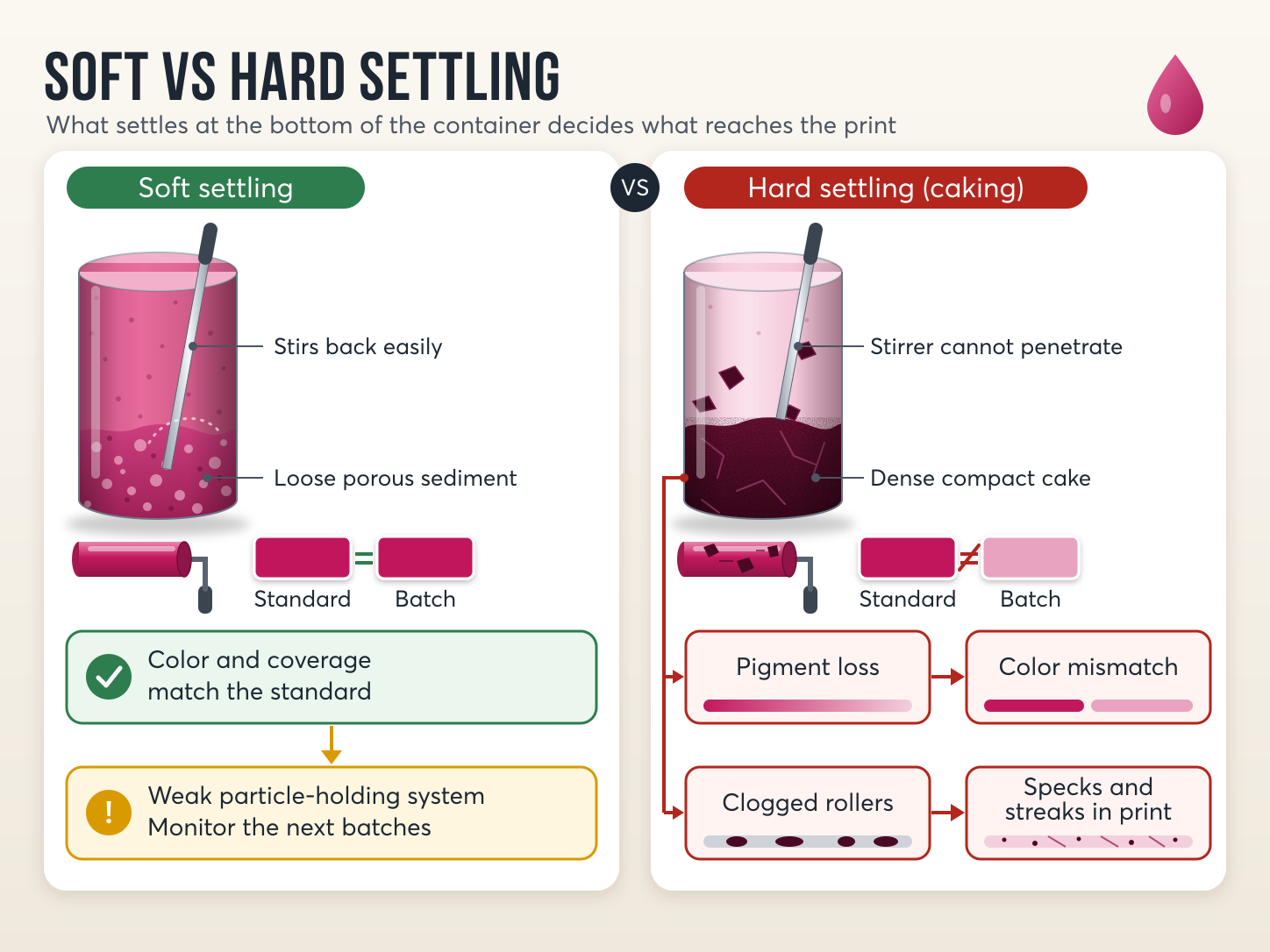
Soft settling: the pigment sinks to the bottom of the drum, but the sediment is still loose. When you stir it back with a rod or a mixer, the ink becomes uniform again, and color and coverage return to the standard sample. Softly settled ink can usually be used after thorough stirring, but it is a signal of a weak particle-holding system, so watch the following batches.
Hard settling (caking): the bottom layer is compact, a stirring rod cannot penetrate it or only lifts it out in chunks, and lumps remain after long stirring. The consequences on the line are clear. The actual pigment content of the ink is depleted, so the ink no longer matches the standard color. Hard chunks get carried up and clog the printing rollers and ink rollers, and the print film shows specks and streaks.
Two other phenomena are easily mistaken for pigment settling:
- Solvent separation: a thin solvent layer floats on the surface, while the pigment has not necessarily sunk to the bottom. This is related to the balance between resin, solvent and pigment, or to solvent evaporating through a lid that does not seal. Packaging ink that separates this way can usually be stirred back, but if it repeats across many drums, review the formulation.
- Flocculation: pigment particles attract each other and form loose clusters inside the ink. The ink may not have settled yet but is already weaker in color and lower in gloss, and these clusters settle faster than single particles.
Each phenomenon has its own mechanism. Adding solvent or stirring longer before you know which one you are dealing with can easily cause color errors without solving the cause.
Why pigment ink settles during storage
Ink is a suspension: solid pigment particles held in a medium of resin and solvent. This system is not thermodynamically stable, so pigment ink sedimentation is a matter of time, because the particles tend to sink sooner or later. The ink maker's task is to extend that time, and the three groups of causes below determine how long the system holds the particles.
Gravity and density. Pigment particles are heavier than the surrounding resin and solvent medium, so they are always pulled downward. According to Stokes' law, the settling rate of a particle increases when the particle is larger and when the density difference between the particle and the medium is greater. The settling rate decreases when the medium viscosity is higher. So coarse particles and low viscosity are the two conditions that make ink settle fast. A high-density pigment settles faster than a light pigment in the same system if the particle size is the same.
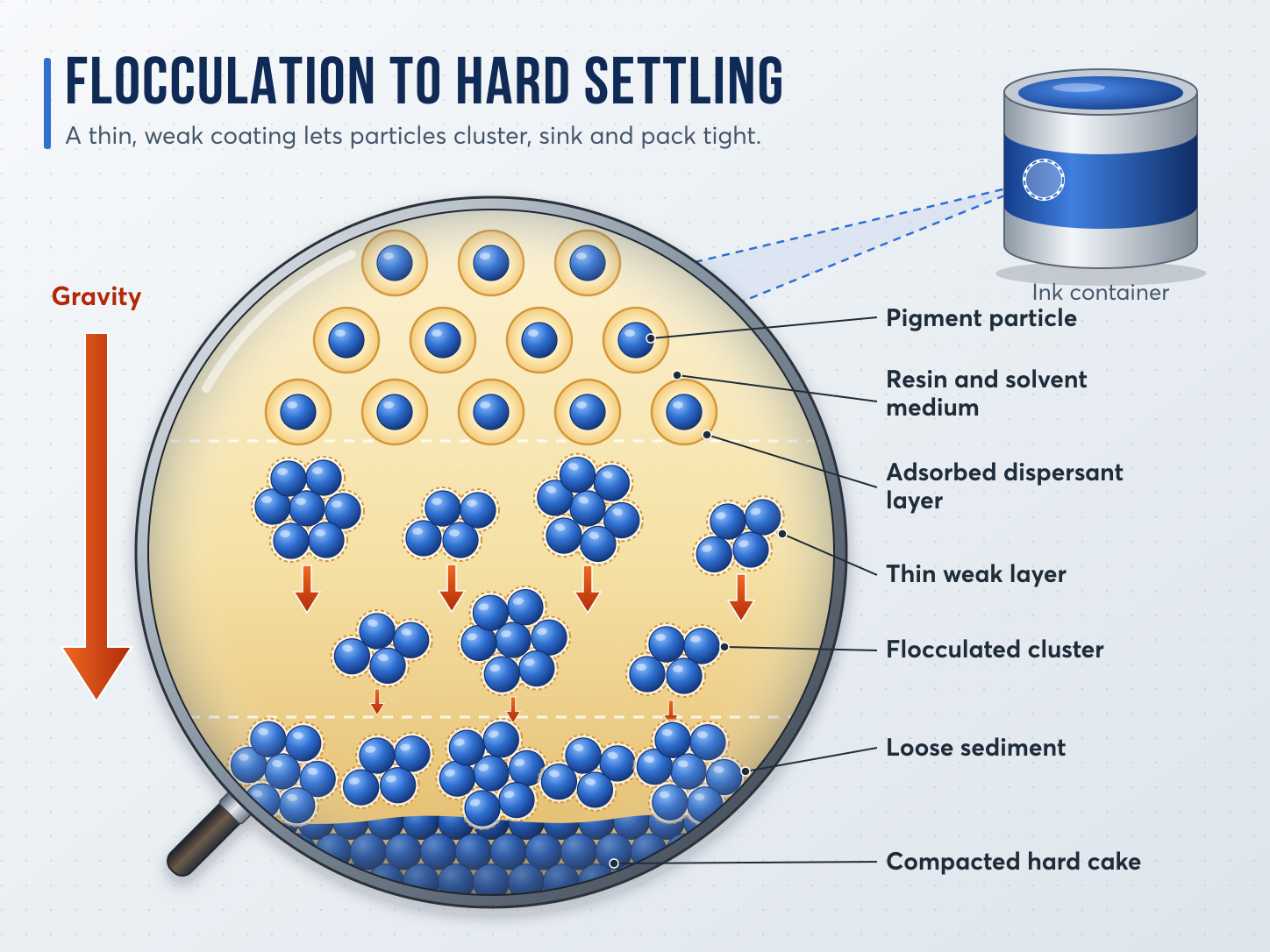
Insufficient dispersion or flocculation. After grinding, some particles remain stuck together in clusters because the shear was not high enough to break them apart. A cluster behaves like one large particle and settles fast. For particles that have been separated, the resin or dispersing aid must adsorb around each particle as a layer thick enough to keep the particles apart. When this layer is thin, weakly bound or incompatible with the pigment, the particles attract each other and flocculate. Flocculated clusters are heavier, settle faster and drop to the bottom as a loose layer. The weight of the layers above presses the particles tightly together, and hard settling forms once the particles are packed so closely that stirring cannot separate them.
Storage conditions. A hot warehouse lowers the viscosity of the medium, so particles sink faster than when the ink was freshly made. Solvent evaporating through a lid that does not seal shifts the balance between resin and solvent. The resin layer around the particles may shrink, or the resin may separate from the liquid phase and the ink begins to separate into layers. A drum left for a long time without being turned also lets the sediment sit still and compact gradually, because no stirring has broken it up while it was still soft.
In practice these three groups often add up. A batch with slightly insufficient dispersion can still pass outgoing inspection. That batch then goes into a hot warehouse with a lid that does not seal, and after some time it has caked at the bottom of the drum. This is why the first task is to determine which side the fault lies on.
How to identify the cause of pigment ink settling in your case
To know whether hard settling in pigment ink comes from dispersion or from storage, you need two simple tests and one fineness measurement. All three can be done in your plant's lab.
Standing and re-stir test
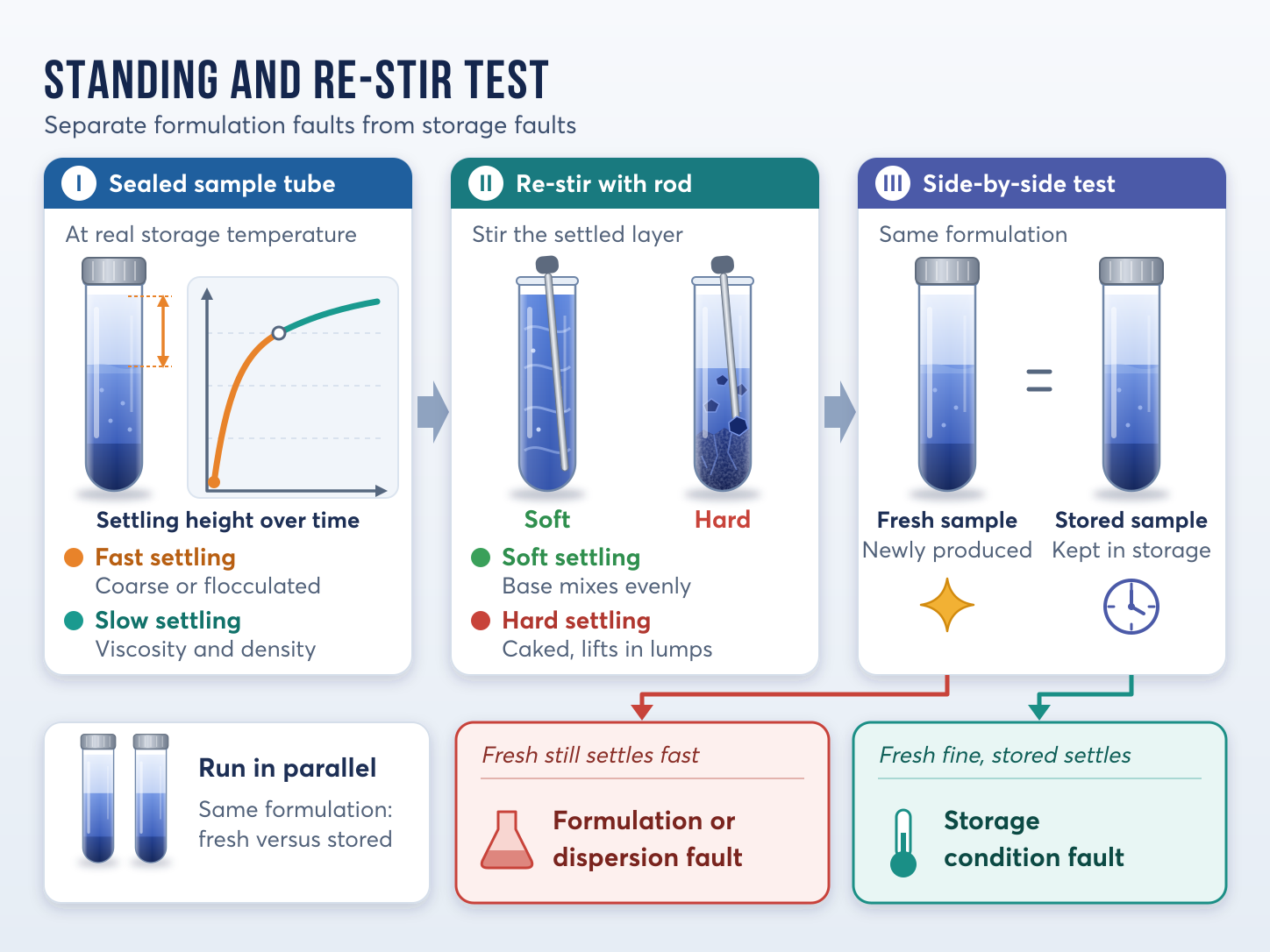
Fill a transparent tube with a sample, seal it, and leave it undisturbed at the actual warehouse temperature. Observe and record the settling height over time: fast settling right from the start indicates coarse or flocculated particles, while settling that slows down over time is usually due to viscosity and density.
Then re-stir with a rod. If the bottom layer disperses evenly, it is soft settling. If it has caked and comes out in chunks, it is hard settling.
Run the test in parallel on a freshly made sample of the same formulation and a stored sample. If the fresh sample still settles fast, the fault lies in the formulation or dispersion. If the fresh sample is stable but the stored sample settles, suspect the storage conditions.
Signs that separate a dispersion fault from a storage fault
Measure fineness with a grind gauge (a Hegman gauge, a steel bar with a groove that gets progressively deeper, used to read the largest particle size). If the ink has coarse particles right after grinding, it is a dispersion fault, and you should also cross-check against pigment dispersion defects in paint and how to fix them, because the mechanism on the mill is the same. If the batch met the fineness requirement at release but settled after sitting in a hot warehouse, the fault lies in the storage conditions.
Rub-out test: draw down a wet ink film on paper or a test panel, then rub a small area with a finger until the ink begins to set. If the rubbed area is darker than the area next to it, the pigment clusters have been broken apart by the rubbing force, which is a sign of flocculation. If the two areas look the same, the system most likely is not flocculated, and you should focus on density, viscosity and storage.
How to fix pigment ink settling
Once you know where the fault lies, treat that side first and only then turn to the other side.
Fixing the formulation and dispersion side
If the ink is coarse right after grinding, extend or adjust the grinding process until it reaches the target fineness of each ink system. Check the compatibility between the pigment and the resin and solvent system in use, because a weakly bound resin layer around the particles is a cause of flocculation. The interaction between the pigment and its surrounding medium also causes other defects, for example pigment migration in plastic products, so check both at the same time. Next, adjust the viscosity or rheology of the ink to keep particles suspended longer, while keeping the viscosity within the range the press can run.
When you change the pigment source, read four items on the TDS: particle size, density, oil absorption and recommended ink system. Particle size and density determine the settling rate. Oil absorption shows how much resin the pigment needs to be wetted, so it affects the viscosity during grinding. Inorganic pigments usually have a higher density than organic pigments, so when choosing inorganic pigments for paint or ink, compare density and particle size on the TDS, as covered in the article on choosing inorganic pigments for exterior paint. Test samples in parallel with the pigment currently in use, with the same grinding process and the same storage conditions. Zealan pigments are one source that can go into a parallel trial, and you should compare their TDS values with those of the old pigment before starting the trial.
Solvent is also part of this formulation. Solvent type and evaporation rate affect viscosity and the resin balance, so adjust it only after checking the factors above.
Fixing the storage side
The steps below apply to finished-ink storage:
- Close the lid tightly after each time ink is taken out, so the solvent does not evaporate and the system balance does not change.
- Keep the warehouse cool, and keep drums away from heat sources and direct sunlight, because heat lowers viscosity.
- Issue stock on a first-in, first-out basis, and read the storage life on the TDS of each ink.
- Turn the drums periodically so the sediment does not sit still and compact gradually.
For ink that has hard-settled, stir at high speed to break up the cake, then filter before use. Do not send it straight to the press: undissolved hard chunks will clog the printing rollers and ink rollers. Re-check the fineness and color of the ink after stirring against the standard sample before putting it into production.
Frequently asked questions
Can pigment ink that has settled be reused?
Softly settled ink can be reused after thorough stirring and a color check against the standard sample. Hard-settled ink needs high-speed stirring and then filtering, followed by a re-check of fineness and color. If the bottom layer does not fully disperse or the color has shifted, discard that batch instead of sending it to the press.
How long can pigment ink sit before it starts to settle?
This time depends on each ink system, so there is no single benchmark. Read the storage life on the TDS of the ink in use, then compare it with the warehouse temperature and how the lid is closed. A standing test on your actual sample shows how long your system holds the particles.
Why does white ink settle more easily than colored ink?
White titanium dioxide pigment has a high density compared with most organic pigments, so the downward pull is stronger in the same medium. White ink therefore needs its viscosity maintained and more thorough stirring. The density and particle size values are published in the TDS of each white pigment.
Does adding solvent reduce ink settling?
No. Adding solvent usually makes the ink settle faster because viscosity drops, and solvent also upsets the balance between resin and pigment. It is suitable only for adjusting viscosity at printing, following the plant's standard procedure. Do not use solvent to fix settling.
Conclusion
Pigment ink settling in storage must be handled according to the correct type of fault: soft settling, hard settling, solvent separation or flocculation, and only then the formulation and the warehouse. Three tasks, in this order:
- Distinguish soft settling from hard settling before treating the ink.
- Measure fineness and run the standing test to separate a dispersion fault from a storage fault.
- Correct the formulation or dispersion and control the warehouse at the same time.
Send a sample of the settled ink, together with your storage conditions and grinding process, so the Vichem technical team can work with you to check the cause.
Vichem is a distributor of chemical additives and equipment from leading brands such as Covestro, Sinopec, TotalEnergies Corbion, Bühler and Tinox in the Vietnamese market.
For more information about our products, please contact us through the following channels:
- Hotline: 08 1790 1790
- Zalo OA: Vichem JSC
- Email: contact@vichem.vn
- LinkedIn: Vichem JSC
- Website: www.vichem.vn
- Facebook: Vichem JSC