When you need to decide on a white pigment for a paint system, the choice of rutile vs anatase TiO2 depends on where the paint will be used: rutile for exterior paint and high hiding power requirements, and anatase grade titanium dioxide for interior products where a bluish white and cost take priority. With Chinese titanium dioxide, also check the particle surface treatment and batch-to-batch consistency through the TDS (technical data sheet) and the COA for each batch.
Where the paint film fails when you pick the wrong TiO2: rutile or anatase
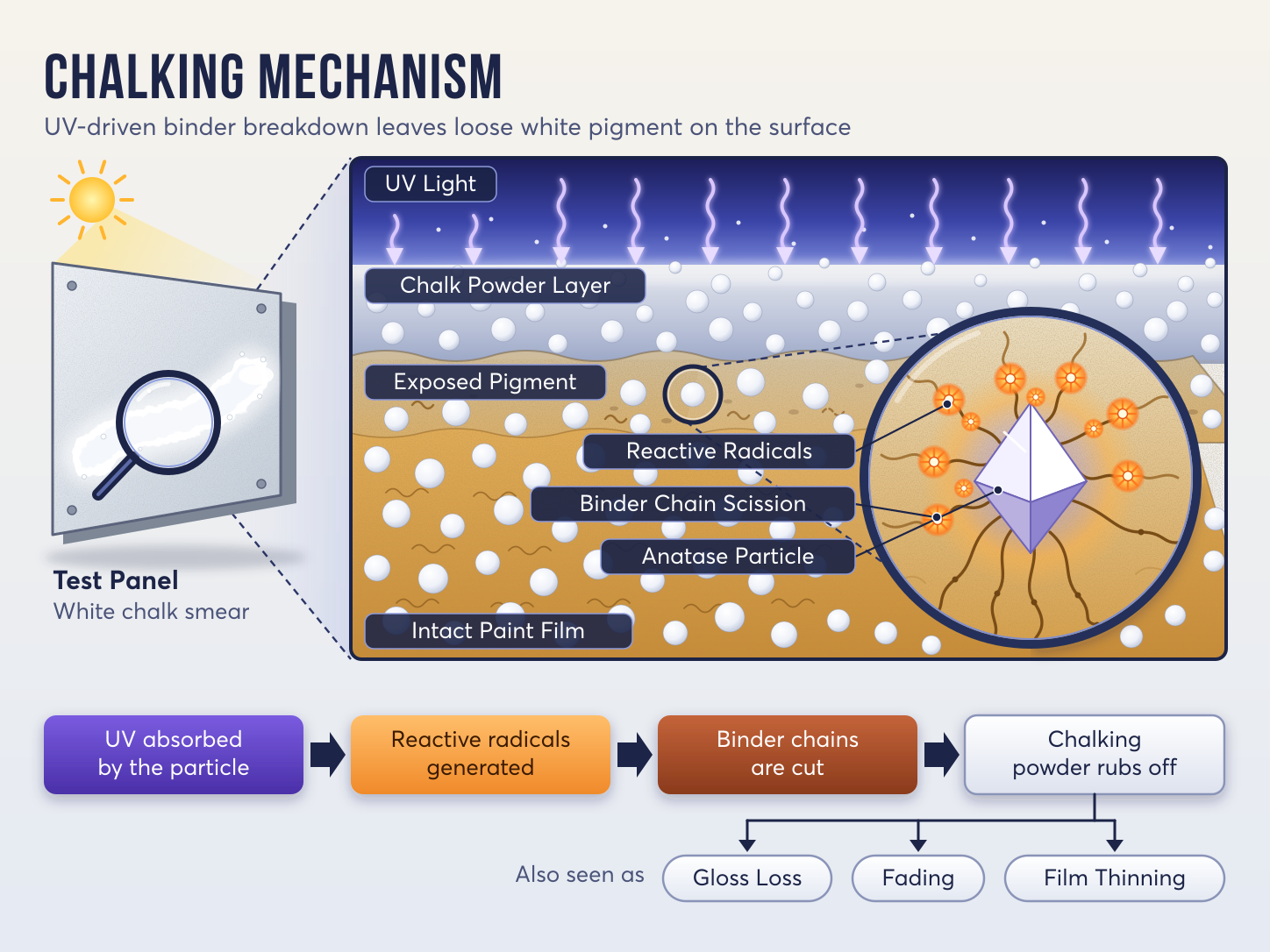
The most common mistake is using anatase in exterior paint. Under UV, anatase has high photocatalytic activity: the TiO2 particle absorbs UV and generates reactive radicals, and these radicals attack the binder around the particle. The resin chains are cut and lose their bond to the pigment, so the surface degrades from the outside in.
The result, visible on an exposure test panel or a real facade, is chalking: when you wipe the surface by hand, a white powder comes off, because pigment particles are exposed once the resin around them breaks down. Early gloss loss, fading color and a thinning film come with it.
The opposite mistake also costs money, though less visibly. Using rutile in a product that sees no sun, such as low-cost interior paint, means paying extra for a property you do not use. Rutile also has a slightly yellowish white compared with anatase, so in interior white paint that needs a bright bluish white, users may notice the difference.
The third group of failures comes from the supply source: inconsistent batches. The crystal form carries the same name, but the next batch has a different particle size, purity or surface treatment from the previous one. The line then sees color shift between paint batches, hiding power that changes at film application, and the color-matching team has to keep adjusting the formulation to compensate.
4 criteria for choosing rutile vs anatase TiO2
The four criteria below help you choose TiO2 for paint in the order they should be considered: service environment first, then optical performance, then surface treatment, and finally supplier consistency.
Criterion 1 — Service environment: indoor or outdoor
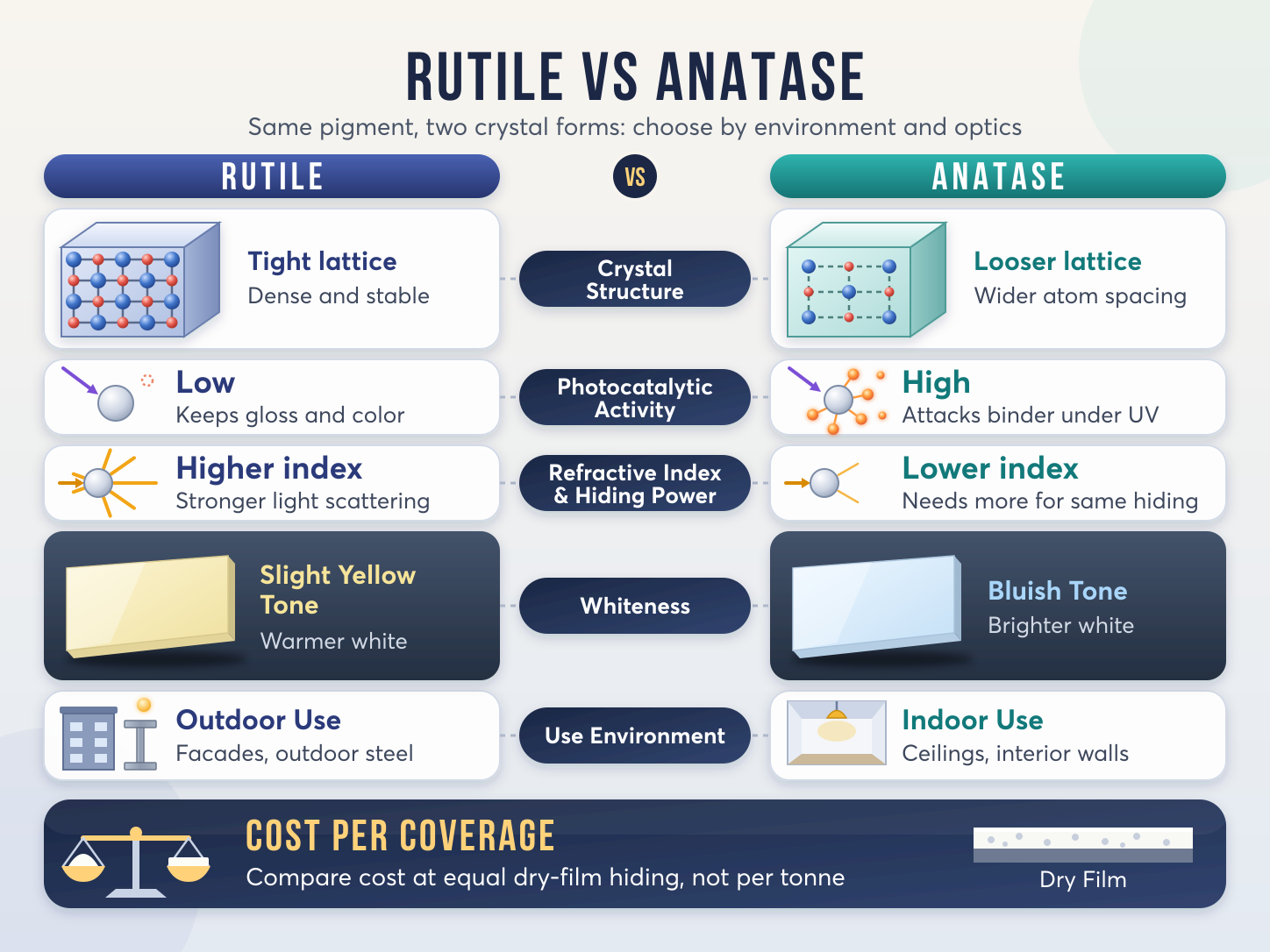
Crystal structure determines how active the particle is under UV. The rutile lattice is denser and more stable, so it has lower photocatalytic activity and the paint film keeps its gloss and color longer in sunlight. Anatase is more active under UV, so the binder is attacked faster. That is why rutile TiO2 for exterior paint is usually the default choice.
Accordingly, facade paint, exterior steel structure paint and weather-resistant industrial paint need rutile. Ceiling paint, interior wall paint and products with no direct sun exposure can use anatase without the risk of chalking.
This principle applies to every substrate used outdoors. Plants that make outdoor pipes, trims or profiles can read more about how to choose TiO2 for outdoor PVC products to compare requirements between paint and plastics.
Criterion 2 — Hiding power and whiteness requirements
Hiding power comes from the particle's ability to scatter light. Rutile has a higher refractive index than anatase, so it scatters more strongly and hides better at the same loading. For topcoats that must hide the substrate in few coats, rutile lets you keep the white pigment level lower for the same hiding.
Anatase gives a bluer white, which suits interior paint and products where users prefer a bright white impression. In return, you need to use more of it to hide the substrate to the same degree.
For this reason, do not compare the price of the two grades per ton. Compare the cost of reaching the same hiding power on the dry film, because the amount of pigment needed differs between the two forms.
Criterion 3 — Surface treatment and binder system compatibility
Commercial TiO2 particles are usually coated with an inorganic layer, an organic layer or both. The inorganic layer shields the particle surface, reducing photocatalytic activity and chalking. The organic layer improves wetting and dispersion in the binder and prevents lumps during grinding.
Waterborne and solventborne systems need different treatments, because the polarity of the medium differs. Even within rutile, a grade treated for waterborne systems may disperse poorly in a solventborne system, leading to long grinding times, fineness out of specification and low film gloss. If you are also reviewing the diluent solvent system, diluent solvent mixing errors also affect the film surface and are worth checking in parallel.
The practical conclusion: the same crystal form with a different treatment performs differently. A poorly treated rutile can still chalk earlier than a well-treated one, and this is a point the TDS must answer.
Criterion 4 — Batch-to-batch consistency from Chinese suppliers
Chinese sources vary widely in production processes and supply grades. Even when labeled "rutile" or "anatase", purity, particle size and surface treatment can still differ between plants, and even between batches from the same plant.
Therefore, a passing sample does not guarantee that later batches will pass. You need to compare the COA of each batch with the COA of the approved sample, and record the parameters that determine color and hiding power. Plants making masterbatch or plastic film face a similar problem and can refer to how to choose TiO2 for plastic film and white masterbatch.
How to match rutile vs anatase TiO2 to your paint product
The three steps below run from the end product's requirements to a real sample trial, so that the decision rests on data from the paint system you actually use.
Step 1 — Define the service environment and weather durability requirements of the end product
State clearly whether the product is used indoors or outdoors, the level of sun and rain exposure, the required film life, and whether the end customer has its own exposure standard. These requirements decide the crystal form right away: for outdoor or weather-resistant industrial use, choose rutile; for indoor use, consider anatase.
Step 2 — Read the TDS: crystal form, TiO2 content, surface treatment type, oil absorption, recommended use
For each candidate grade, read the five items below and compare them with the requirements from step 1:
- Crystal form: rutile or anatase, stated in the TDS and not only in the trade name.
- TiO2 content: check against the COA to verify purity.
- Surface treatment type: inorganic, organic or both.
- Oil absorption: affects viscosity during grinding and the pigment volume in the film.
- Recommended use: waterborne or solventborne, exterior or interior paint.
A TDS lists values for each individual grade, so compare two grades using their own documents.
Step 3 — Run sample trials and pilot runs, then choose rutile TiO2 for exterior and industrial paint or anatase TiO2 for interior paint and indoor products; require COA, SDS and TDS for each batch
Make samples in the plant's own binder and grinding process, and compare fineness, hiding power, color and gloss against a control sample. Exterior paint should also go through exposure testing or accelerated weathering using a method the customer accepts.
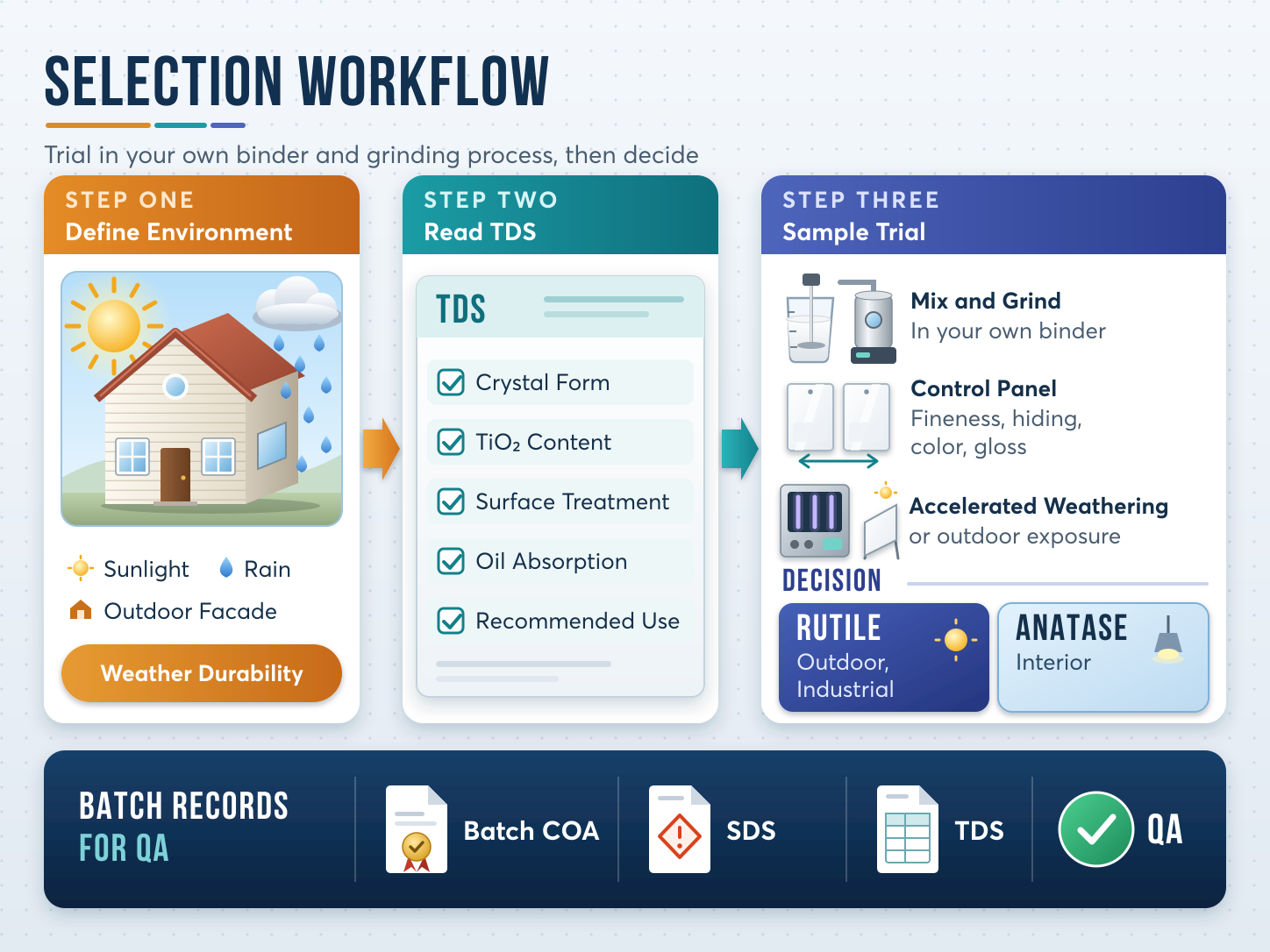
After the sample trial, choose rutile for exterior and industrial paint and anatase for interior paint and indoor products. Two suppliers, Tinox and Whitearrow, offer rutile and anatase TiO2 for paint, so they can be added to the trial list for comparison with your current source.
When approving a supplier, require a COA, SDS and TDS for every batch so the QA team can cross-check each delivery.
Common mistakes when choosing rutile vs anatase TiO2 from China
Comparing price per ton only. A low price per ton can mean a higher pigment loading to reach the same hiding power. The real cost sits in each square meter of dry film, so you need to calculate hiding power measured on the sample.
Using anatase in exterior paint because it is cheaper. The initial saving is wiped out by chalking and gloss loss, and by the time the defect shows, the product is already with the customer. Repainting or handling a complaint costs more than the raw material price difference.
Approving a sample once and not checking the COA of later batches. A passing sample proves only one batch. Without a process to compare the COA of each batch afterward, color deviation builds up until a paint batch is rejected.
Overlooking the surface treatment. Choosing the right crystal form but the wrong treatment for a waterborne or solventborne system still causes poor dispersion and low gloss, so check the surface treatment entry on the TDS from the start.
FAQ on rutile and anatase TiO2
How do rutile and anatase TiO2 differ when used in paint?
Rutile has better UV durability and stronger hiding power, so it suits exterior paint. Anatase gives a bluer white and has higher photocatalytic activity, so it suits indoor products. The difference comes from crystal structure, which determines how the particle scatters light and reacts to UV.
Can anatase grade titanium dioxide be used in exterior paint?
Usually it should not be. Anatase is highly active under UV and degrades the resin in the paint film, leading to chalking and gloss loss. Surface treatment reduces this effect, but for exterior paint rutile remains the safer choice and exposure testing is needed to confirm it.
Can Chinese TiO2 be used in industrial paint?
It can, if the grade has been verified. Quality varies between plants, so you need to read the TDS, trial samples in the real paint system and compare the COA of each batch. The decision should rest on test results from your plant, not on country of origin.
Can rutile and anatase be blended in the same formulation?
Yes, usually in interior paint when you need to balance bluish white, hiding power and cost. However, the anatase portion still has photocatalytic activity, so do not blend them for products exposed to sun. The blend ratio must be trialed on real samples.
Conclusion
Choosing rutile vs anatase TiO2 starts with the paint's service environment, followed by hiding power requirements, surface treatment and supply consistency.
- Outdoor use with high hiding power: rutile; indoor use, prioritizing bluish white and cost: anatase.
- Surface treatment matters as much as crystal form.
- With Chinese sources, trial samples and check the COA of each batch.
Send us the paint system you use and your weather durability requirements, and the Vichem technical team will suggest a suitable type of TiO2 and support sample trials.
Vichem is a distributor of chemical additives and equipment from leading brands such as Covestro, Sinopec, TotalEnergies Corbion, Bühler and Tinox in the Vietnamese market.
For more information about our products, please contact us through the following channels:
- Hotline: 08 1790 1790
- Zalo OA: Vichem JSC
- Email: contact@vichem.vn
- LinkedIn: Vichem JSC
- Website: www.vichem.vn
- Facebook: Vichem JSC