To choose TiO2 for PVC used outdoors, give priority to the rutile crystal form, a surface treatment that lowers photoactivity, and documented weathering test results. Initial whiteness does not tell you how long a product will last in sunlight. Read the surface treatment type and the outdoor-use recommendation on the TDS, then run a trial on an extrusion line with the heat stabilizer system you already use.
Where outdoor PVC products fail when the wrong TiO2 is chosen
White outdoor PVC products rarely fail right after installation. The defects appear gradually over several sunny seasons, once the surface has gone through many cycles of UV, heat and rain. Common signs include:
- Chalking: wiping the surface leaves white powder on your hand, because the resin around the particles has degraded and exposed the TiO2 particles.
- Yellowing: the color shifts from white to ivory and then yellow, as the PVC chains oxidize and form conjugated double bonds.
- Loss of gloss: the surface roughens over time and reflection is no longer even.
- Brittleness: profiles crack easily on impact or when screwed in, even though they were ductile at extrusion.
These failures differ from TiO2 dispersion defects in plastics, which already have their own article and are not repeated here. Dispersion defects show up as streaks, specks or an uneven surface right after extrusion. With the failures covered in this article, the product passes at the factory and then degrades with sun exposure, so an initial check on the line cannot detect them.
TiO2 is a whitening and opacifying agent, but under UV it behaves as a semiconductor. The particle absorbs UV photons and generates electron–hole pairs at its surface. In the presence of moisture and oxygen, these pairs produce reactive free radicals right next to the particle. The radicals attack the surrounding PVC chains, causing chain scission and forming oxidation products. This phenomenon is called photocatalytic activity.
The root cause therefore lies in the TiO2 grade itself: at the same pigment loading, a grade with high photoactivity degrades the resin around the particle faster instead of protecting it. Choosing TiO2 for outdoor PVC means choosing a grade that keeps photoactivity low, and that depends on the crystal structure and the surface treatment, the first two criteria in the next section.
3 criteria for choosing TiO2 for PVC
Rutile or anatase crystal form
Commercial TiO2 comes in two main crystal forms, rutile and anatase. They share the same chemical formula but differ in atomic arrangement, which leads to different optical properties.
Rutile has a more stable structure and lower photoactivity, so it generates fewer free radicals under UV. Rutile also has a higher refractive index and scatters light more strongly, giving better opacity under the same dispersion conditions. Anatase has markedly higher photoactivity; in a plastic matrix exposed to sunlight, this speeds up chalking and yellowing. For this reason, anatase is not suitable for outdoor PVC.
On the TDS, this information is usually found in the description or composition section, where the crystal form is stated as rutile or anatase. If the TDS does not state it, ask the supplier before the grade goes into trials. Note also that many TiO2 grades designed for interior paint or other applications may be of a form that is unsuitable for outdoor plastics. The generic name "titanium dioxide" on a document is not enough to draw a conclusion.
Surface treatment
Untreated rutile TiO2 particles still show photoactivity at the surface. Manufacturers address this by coating the particle with one or more layers. The inorganic coating, usually based on oxides such as alumina or silica, forms an inert barrier around the crystal core. This barrier keeps free radicals generated in the core from reaching the resin, and limits electrons and holes from reaching the surface to react with water and oxygen.
The outermost organic treatment has a different role: it makes the particle surface compatible with PVC and the lubricants in the formulation, helping wetting and dispersion during mixing and extrusion. This layer does not replace the inorganic coating.
Read three things on the TDS: the inorganic treatment type, the organic treatment type, and the recommendation on field of use. Two rutile grades can differ greatly in weather resistance simply because their coatings differ. Specific data for each grade is on that grade's own TDS, so compare using the supplier's documents, not by the generic name of a product line.
Interaction with the heat stabilizer system and dosage
In outdoor PVC, TiO2 also acts as a UV screen. The particles absorb and scatter part of the UV at the surface layer, reducing the radiation that reaches the PVC chains underneath. The heat stabilizer works together with this shielding: it scavenges HCl and replaces unstable chlorine atoms, slowing discoloration when the resin is exposed to processing heat and then to UV in service.
The two components act on each other. If too little TiO2 is used, the surface resin is not shielded enough, and the stabilizer system is consumed faster under UV. Conversely, an unsuitable stabilizer system can cause PVC to discolor early even when the TiO2 meets requirements. The stabilizer composition may also interact with the particle surface, so changing this system changes the working conditions of the TiO2.
The dosage depends on product type, wall thickness, required color and stabilizer system, so this article does not give a figure. Check the recommendations in the TDS of the TiO2 and of the heat stabilizer, then confirm by testing on your own formulation. This is the key factor for weather-resistant TiO2 to deliver its effect in the real product.

How to match TiO2 to your PVC product
Step 1 — Define the product
Specify the product you make: window profile, pipe, trim or sheet. Each has different conditions in terms of wall thickness, required color and sun exposure. Next, define the actual level of sun exposure (under a roof, direct sunlight, humid tropical region) and the target market, since export customers often have their own testing requirements. The result of this step is a description of service conditions to check against the TDS.
Step 2 — Read the TDS
For each candidate TiO2 grade, read three items: the crystal form, the surface treatment type and the outdoor-use recommendation. If a grade does not state outdoor plastics as an application, ask the supplier.
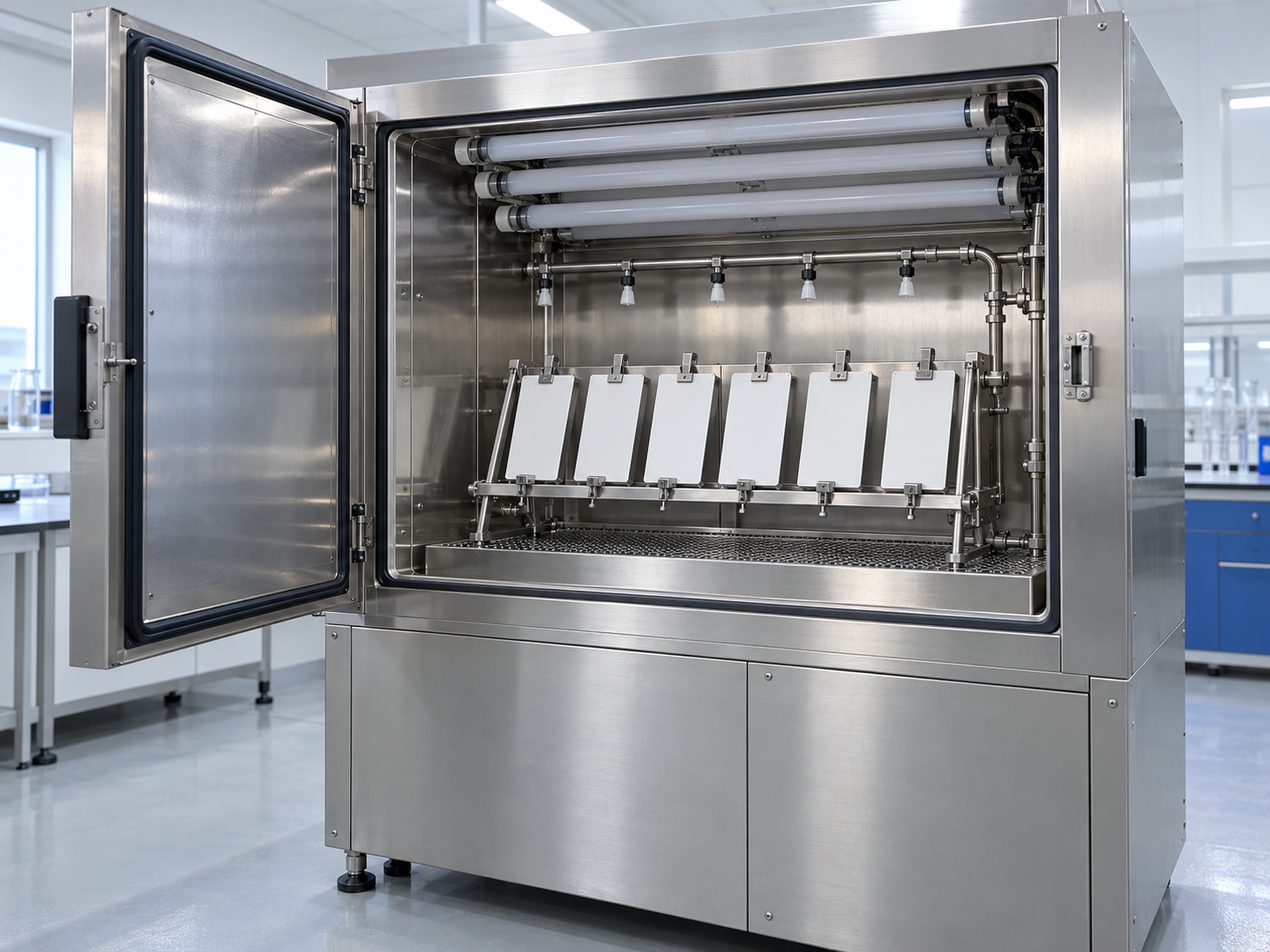
Then request accelerated weathering results: test conditions, evaluation criteria (color change, gloss loss, chalking) and the resin matrix used in the test. Results from a matrix different from your formulation are for reference only. Finally, run a trial on the extrusion line with the real formulation to check compatibility with the stabilizer system and processing conditions, then put samples through your own weathering test.
Step 3 — Choose surface-treated rutile TiO2 together with a PVC heat stabilizer system
From the filtered list, choose surface-treated rutile TiO2 intended for outdoor plastics; suppliers such as Tinox and White Arrow offer TiO2 lines for plastics. Pair it with a PVC heat stabilizer system suited to the product and the market, for example a Ca-Zn system when the customer requires lead-free. Finalize this combination after repeating the weathering test, because the TiO2 result is tied to the stabilizer system used with it.
Common mistakes when choosing TiO2 for outdoor PVC
- Using an interior paint grade for PVC. A grade designed for interior paint is not optimized in surface treatment and crystal form for UV-exposed plastics. Plastic and paint differ in binder and processing conditions, so you need a grade that explicitly states use in outdoor plastics.
- Cutting the TiO2 dosage to save cost. Cutting it weakens the UV shield, and the savings are usually smaller than the cost of warranty claims and returns when the product chalks after a few sunny seasons.
- Comparing only initial whiteness. Two grades with similar initial whiteness can still differ in photoactivity. The criterion to compare is color retention after weathering tests.
- Changing the stabilizer without retesting. Replacing the stabilizer system, for example moving from a lead-based to a lead-free system, changes the balance between components. Repeat the weathering test on the new formulation before going into mass production.
Frequently asked questions
Should titanium dioxide PVC formulations use rutile or anatase?
Use rutile for outdoor PVC. Rutile has lower photoactivity, so it generates fewer free radicals that degrade the resin under UV, and it also gives better opacity thanks to its high refractive index. Anatase has higher photoactivity, tends to cause chalking and yellowing, and is therefore not suitable for products exposed to long periods of sunlight.
Why do white PVC profiles chalk outdoors?
The usual cause is degradation of the resin around the TiO2 particles under UV. Particles with high photoactivity, or with an insufficient surface treatment, generate free radicals that break the PVC chains and expose the particles as a white powdery layer. Too little TiO2 or an unsuitable stabilizer system also speeds this up.
Can paint-grade TiO2 be used for PVC?
You cannot conclude from the name alone. Paint-grade TiO2 is usually designed for paint binders and processes, and does not necessarily have the crystal form and surface treatment suited to UV-exposed plastics. Use it only when the TDS explicitly recommends it for outdoor plastics and it has passed weathering tests on the PVC formulation.
Conclusion
TiO2 for outdoor PVC should be chosen on weather resistance, not initial whiteness. All three criteria must be met together: crystal form, surface treatment, and compatibility with the heat stabilizer system.
- Choose the rutile form; do not use anatase for products exposed to sunlight.
- Read the inorganic treatment type, the organic treatment type and the outdoor-use recommendation on the TDS.
- Check the dosage in the TDS of the TiO2 and the heat stabilizer system, then confirm by testing on your own formulation.
- Request accelerated weathering results and run a trial on the extrusion line before approving a grade.
- Repeat the weathering test whenever the TiO2 or the heat stabilizer system changes.
Vichem is a distributor of chemical additives from leading brands such as Covestro, Sinopec and Bühler in the Vietnamese market.
For more information about our products, please contact us through the following channels:
- Hotline: 08 1790 1790
- Zalo OA: Vichem JSC
- Email: contact@vichem.vn
- LinkedIn: Vichem JSC
- Website: www.vichem.vn
- Facebook: Vichem JSC