When white outdoor paint starts leaving white powder on your hand, that is paint chalking, also called white paint powdering. The cause is usually UV breakdown of the binder, and TiO₂ with high photocatalytic activity speeds that process up. To fix paint chalking, use surface-treated rutile TiO₂ together with a weather-resistant binder. Check the crystal form and surface treatment of the TiO₂, and the pigment-to-binder ratio.
Chalking and fading are two different defects
Chalking in paint is the formation of a fine powder layer on the surface of the paint film. On a white panel exposed outdoors, wipe it with a finger or a dark cloth and you will see white powder come off on your hand, along with gradual loss of gloss and a rougher surface. That powder is pigment and filler exposed when the binder above them has broken down.
Fading looks different. The colour of the film gets paler, but the surface does not powder, and nothing comes off on your finger. This defect lies in the pigment, usually a pigment with poor lightfastness whose molecular structure is broken down by UV, so it loses colour. On coloured paint, chalking also makes the colour look paler because a white powder layer covers the surface, so the two defects are often confused. The finger wipe is the quickest way to tell them apart.
These two defects need to be separated because their consequences differ. Chalking thins the film over time: each rain or wash carries away another layer of powder, so the substrate underneath gradually loses its protection and becomes prone to moisture, rust or cracking. Fading is mainly a cosmetic issue. The film stays intact and still protects the substrate; only the colour drifts from the approved sample.
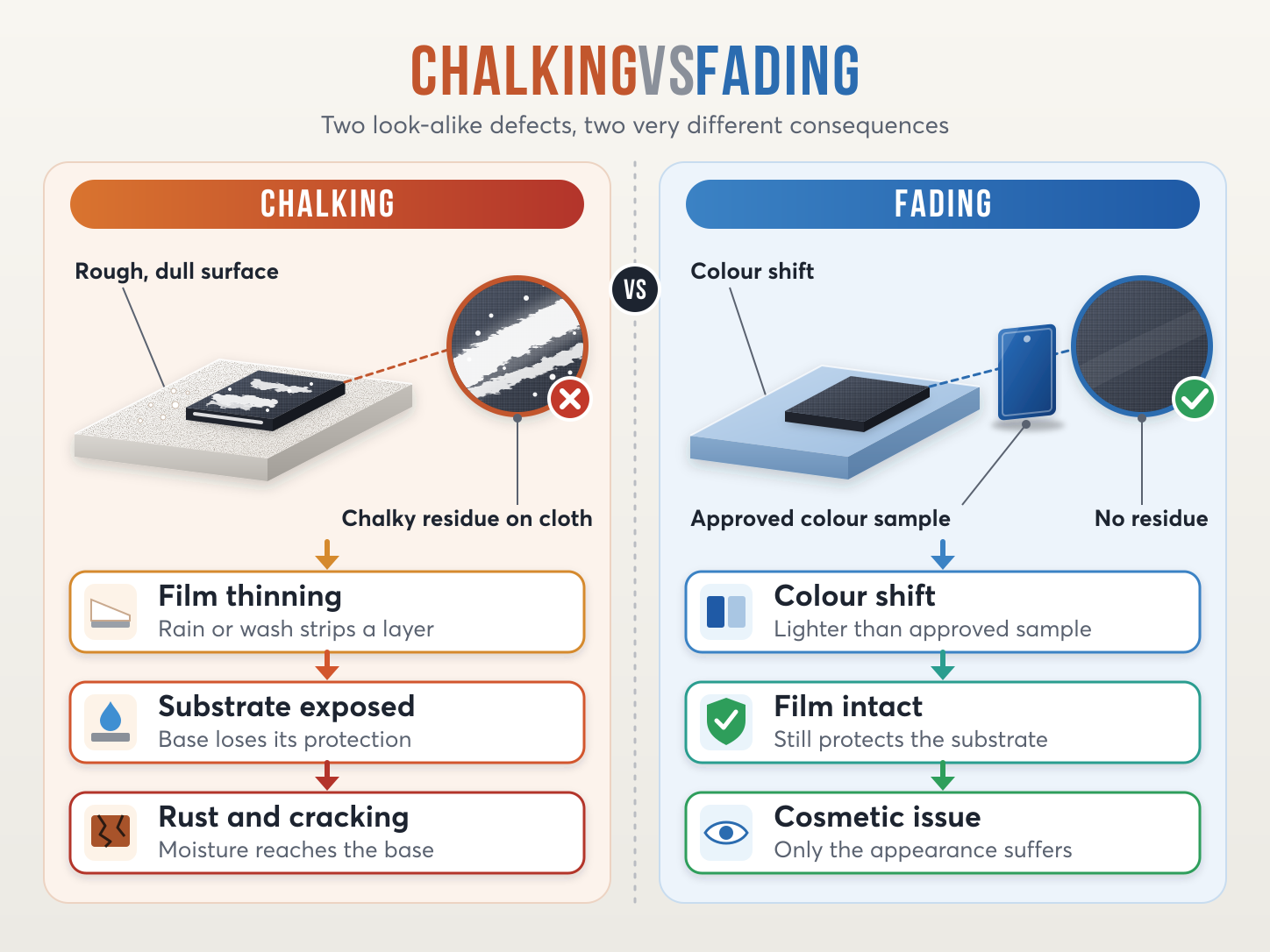
When you receive customer feedback, wipe several spots before drawing a conclusion. If the wipe shows powder, the fix lies in the binder and the TiO₂ in the formulation. If the colour is only paler, review the pigment system.
Why white paint chalks outdoors
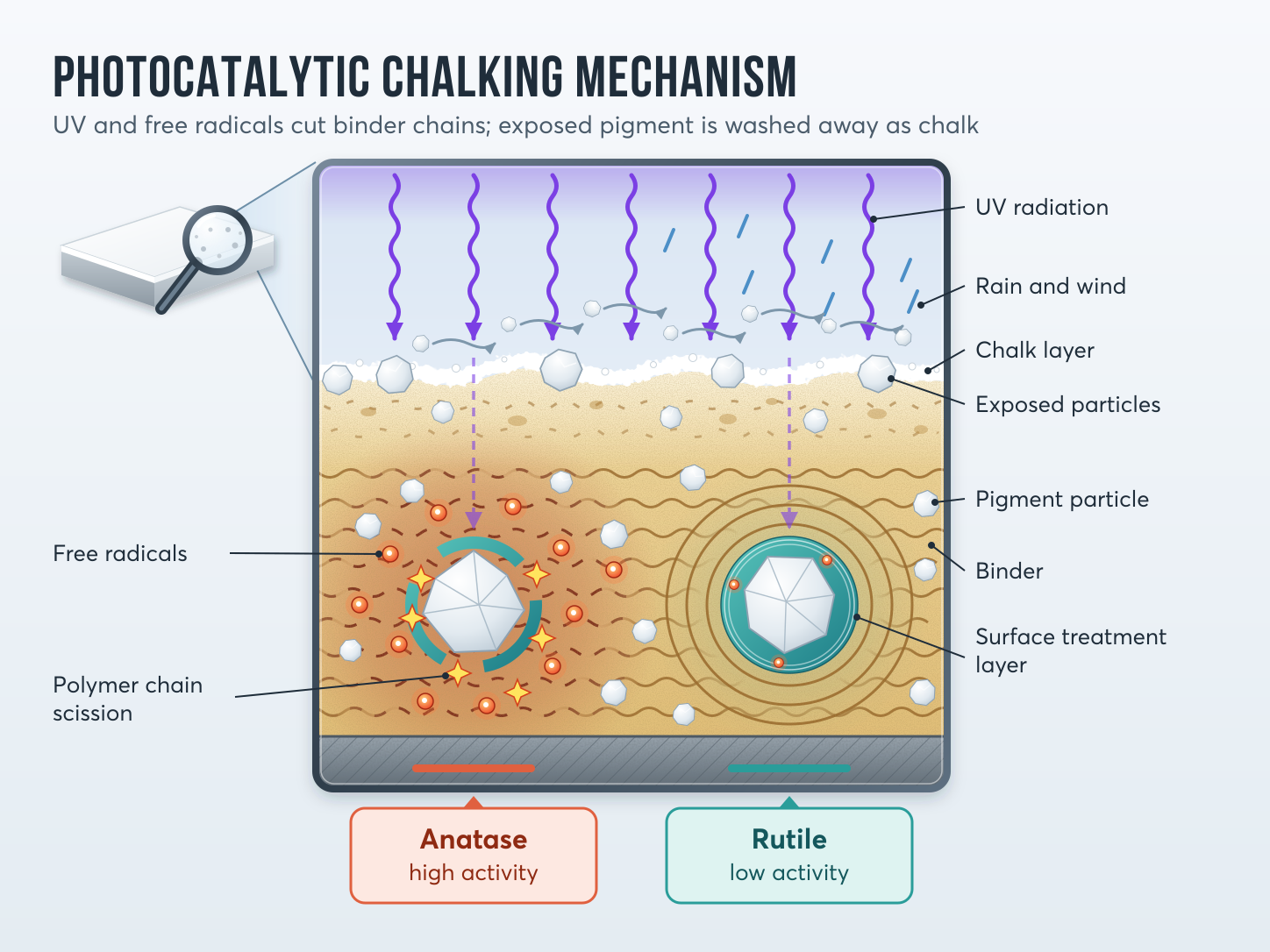
The binder is the first part to be attacked. UV and moisture cut the polymer chains of the binder in the outermost layer of the film. Once the chains are shorter, this layer can no longer hold the particles. Pigment and filler particles are exposed at the surface, then rain, wind or friction carries them off the film. What you see on your hand is particles that have left the film.
TiO₂ can accelerate this process through its photocatalytic activity. This term describes the ability of a particle to absorb UV and use that energy to start chemical reactions on the particle surface, while the particle itself is not consumed. The reaction produces free radicals, that is, molecules or atoms with an unpaired electron that are very strongly oxidizing. Every TiO₂ particle in the film is surrounded by binder, so the binder closest to the particle is oxidized first.
The degree of photocatalytic activity depends on the crystal form and on the coating around the particle. Anatase is more active than rutile, so the binder around anatase particles degrades faster under UV. A surface treatment of alumina, silica or zirconia coats the particle and blocks some of the free radicals from reaching the binder. A poorly treated particle, or one with a discontinuous coating, lets the reaction take place almost as on a bare particle. The quality of this coating is tied to the particle manufacturing technology. You can read more in the article on how the TiO2 production process affects particle quality for paint.
The formulation also helps determine how fast chalking develops:
- Pigment-to-binder ratio too high. There is not enough binder to wrap all the particles, so particles are exposed early once the outermost layer wears away.
- Binder with poor UV resistance. Structures with many UV-absorbing groups, for example aromatic rings, undergo chain scission faster in sunlight.
- Cheap fillers taking up space. Fillers add to the pigment volume, so the amount of binder per particle drops. Fillers whose surface absorbs a lot of binder make this worse.
These three factors often occur together. A formulation that cuts cost by adding filler while keeping the same cheaper TiO₂ usually performs worse in outdoor exposure than the original.
How to tell whether chalking comes from TiO₂ or from the binder
To find out whether the fault lies in the TiO₂ or in the binder, the plant needs to measure chalking on exposed panels and change one variable at a time.
Wipe and tape-pull tests on outdoor exposure panels
This test can be done right in the lab or at the exposure site. You need panels with the same substrate and the same film thickness, exposed in the same location, together with a control panel, a formulation whose outdoor behaviour is already known.
- Wipe with a dark cotton cloth, using the same force and the same number of wipes on every panel. The amount of white powder on the cloth shows the degree of chalking.
- Alternatively, press clear adhesive tape evenly onto the surface, peel it off and stick it onto a black background to see how much powder it picked up.
- Photograph the cloths or tapes side by side, arranged from least to most powder.
- Compare the samples with each other and with the control panel at the same exposure time.
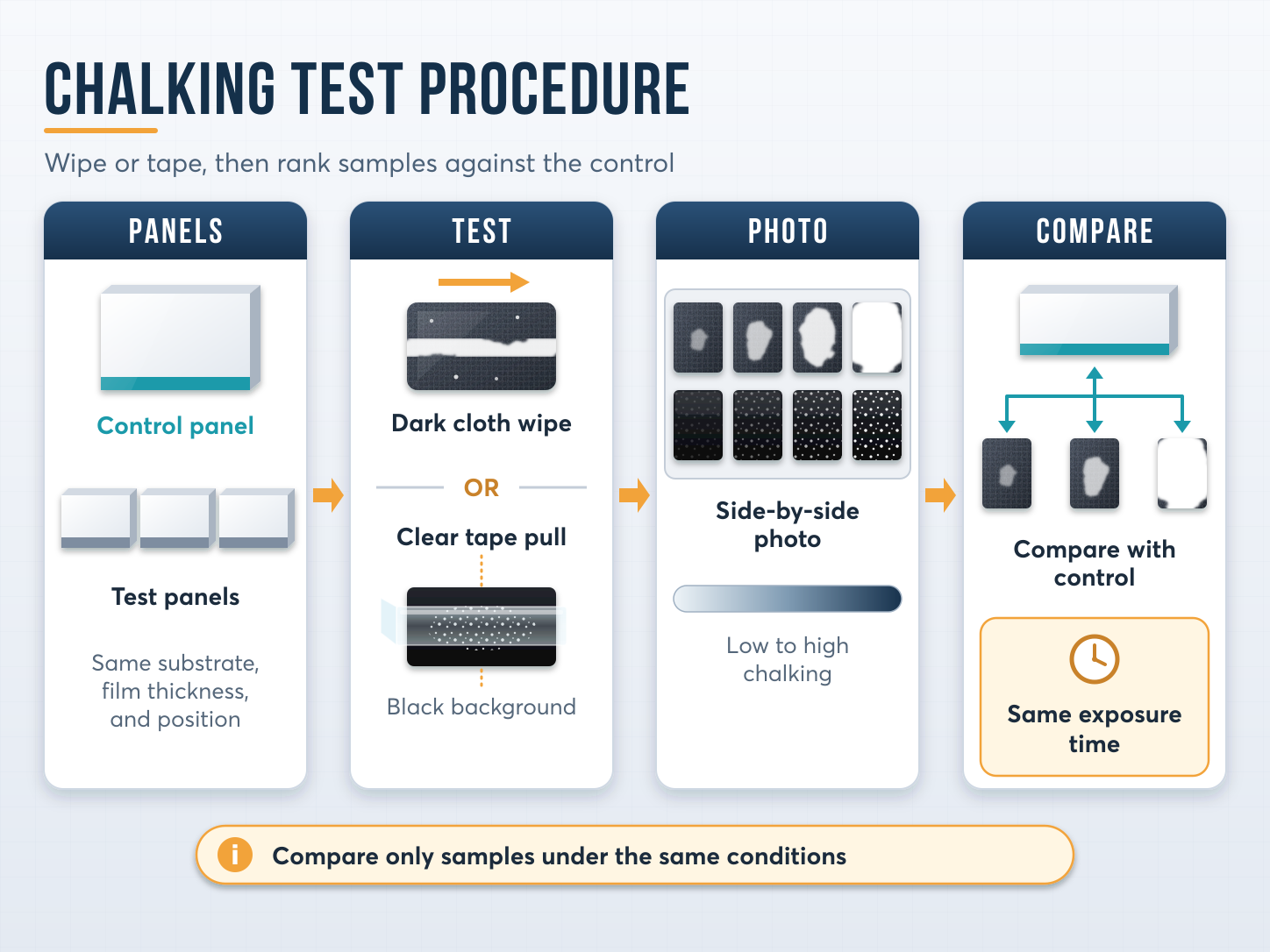
Only compare samples under the same conditions. Panels exposed at a different sun angle or with a different film thickness give results that cannot be compared.
Signs that separate TiO₂ causes from binder causes
Changing a single variable gives the clearest result: keep the binder, pigment-to-binder ratio and process unchanged, and replace only the TiO₂ with one of a different crystal form or surface treatment. If chalking clearly decreases, the cause lies in the TiO₂. If the sample still chalks almost as before, suspicion shifts to the binder and the pigment-to-binder ratio.
Accompanying observations also point the way. Chalking together with yellowing or film cracking usually points to an ageing binder, because the polymer chains degrade through the full depth of the film.
Before exposing the panels, get the COA and TDS of the TiO₂ in use and read the crystal form and surface treatment. A document that states anatase, or does not state the surface treatment, is the first suspect to rule out.
How to fix chalking in white paint
Fixes on the rutile TiO2 side
When choosing titanium dioxide for outdoor paint, switch to surface-treated rutile TiO₂ and do not use anatase. Rutile has lower photocatalytic activity, and the surface treatment blocks further reaction at the particle surface, so the binder around the particle degrades more slowly.
When choosing a specific grade, read the surface treatment type and the manufacturer's application recommendation on the TDS, then cross-check against the COA of the lot. Vichem distributes TiO₂ from Tinox and Whitearrow, with a COA and TDS for every lot so the QA team can cross-check. The same way of reading a TDS also applies when selecting raw materials for other industries, for example how to choose TiO₂ for packaging inks.
Fixes on the binder and formulation side
If changing the TiO₂ is not enough, address the rest of the formulation:
- Use a weather-resistant binder for outdoor coatings, and avoid systems with many UV-absorbing groups in the structure.
- Lower the pigment-to-binder ratio so the binder wraps the particles fully. If hiding power drops as a result, see 5 causes of poor hiding power in white paint and how to fix them before compensating by adding more pigment.
- Reduce filler, especially types that take up a lot of binder.
- Consider a UV absorber additive to reduce the amount of UV reaching the film.
Before changing the formulation at production scale, expose control panels in parallel with the old formulation and assess them with the wipe or tape-pull test described above. Move to the production line only when the new sample chalks clearly more slowly than the old one.
Frequently asked questions about paint chalking
Rutile or anatase TiO2 for outdoor paint?
Outdoor paint should use surface-treated rutile TiO₂. Anatase has stronger photocatalytic activity, so it promotes binder breakdown under UV and is better suited to indoor applications. Rutile is more durable under UV, and the surface treatment blocks further reaction at the particle surface, so chalking develops more slowly.
Can a chalked paint film be repainted?
You can repaint if you remove all of the powder layer first. A loosely bound powder layer stops the new paint from adhering to the substrate, so sand it, wash it clean, let it dry, then test adhesion on a small area. The new paint must also use a weather-resistant binder and TiO₂, otherwise chalking will return.
Does adding more titanium dioxide reduce chalking?
Adding more titanium dioxide usually does not reduce chalking and can make it worse. A higher pigment ratio means the binder wraps the particles less well, while more particles mean more photocatalytic surface. Change the TiO₂ grade or rebalance the pigment-to-binder ratio instead of adding more pigment.
How soon is chalking in white paint abnormal?
There is no general benchmark, because the chalking rate depends on the binder system, climate and level of exposure. The reliable benchmark is a control panel of the same paint system exposed under the same conditions. If your sample chalks clearly earlier than the control, or than the approved formulation record, that is abnormal.
Conclusion
Paint chalking originates from UV breakdown of the binder, and TiO₂ determines whether that process runs fast or slow. Before changing the formulation, identify the right defect and the right cause using exposed panels with a control.
- Chalking leaves powder when wiped by hand, while fading only makes the colour paler, so the two defects need different fixes.
- The root cause is UV breakdown of the binder, made worse by anatase TiO₂ or a missing surface treatment.
- Use surface-treated rutile TiO₂ and a weather-resistant binder, and rebalance the pigment-to-binder ratio.
- Every change needs a control exposure before it goes into production.
Send photos of the defect, your current formulation and the TDS of your TiO₂, and the Vichem technical team will work with you to check the cause.
Vichem is a distributor of chemical additives and equipment from leading brands such as Covestro, Sinopec, TotalEnergies Corbion, Bühler and Tinox in the Vietnamese market.
For more information about our products, please contact us through the following channels:
- Hotline: 08 1790 1790
- Zalo OA: Vichem JSC
- Email: contact@vichem.vn
- LinkedIn: Vichem JSC
- Website: www.vichem.vn
- Facebook: Vichem JSC