When two lots of rutile TiO2 for paint carry the same grade label but differ in whiteness and hiding power, the cause often lies in the TiO2 production process (sulfate or chloride). The process determines purity, whiteness and particle size uniformity, which in turn affect the whiteness, gloss and hiding power of the paint film. The process is only one factor: read the surface treatment and the TiO2 grade on the TDS before drawing a conclusion about a lot.
What a paint plant needs from TiO2
A paint plant uses TiO2 to build hiding power through light scattering. TiO2 particles have a very high refractive index, so light entering the paint film is bent and reflected back instead of passing through to the substrate. The better the film scatters light, the better it hides the substrate at the same thickness.
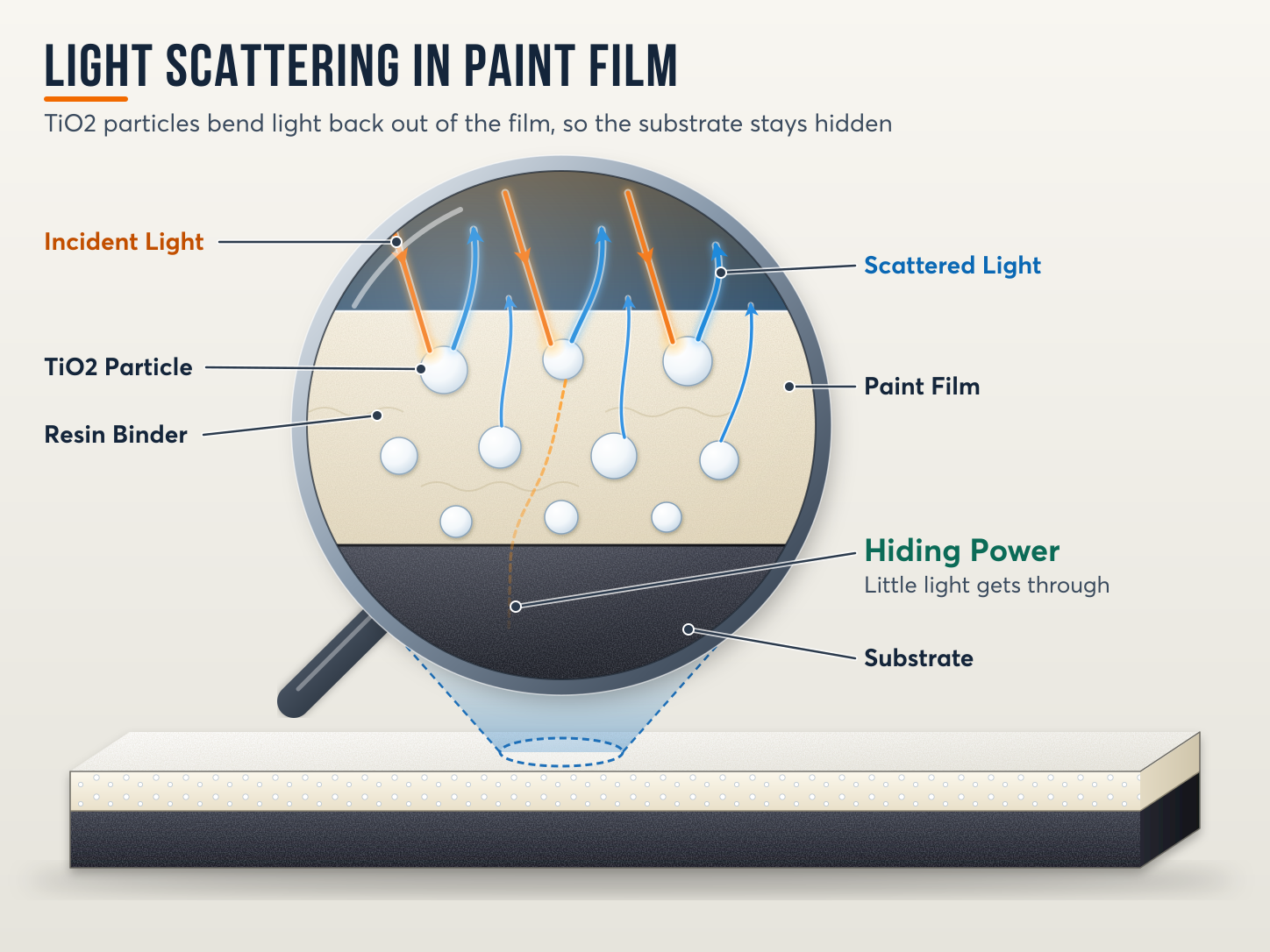
From this mechanism, formulators usually require four things from titanium dioxide for paint:
- Clean whiteness: metal impurities absorb part of the visible light, making the film look yellow, gray or cream, and causing color shift when tinting.
- Uniform particle size: particles that are too large or too small compared with the optimal scattering range both reduce hiding efficiency; coarse particles also pull gloss down.
- Good dispersion: particles that clump in the grind lose useful scattering area, so the paint uses more pigment while hiding power stays poor.
- Weather resistance: exterior films are exposed to UV and moisture, so TiO2 must limit chalking.
Many plants have tried raising the TiO2 dosage to fix hiding problems. This only adds cost when the root cause is particle quality; the article 5 causes of poor hiding in white paint and how to fix them covers other causes outside the raw material.
A common situation in the lab: two lots share the same rutile crystal form and the same paint-grade label, yet measured whiteness, gloss or hiding power differ. Crystal form cannot explain that difference. The question to answer is why, and most of the answer starts with how the TiO2 particles are made at the plant.
How the sulfate and chloride TiO2 production processes work
The two main industrial processes both start from titanium-bearing ore and both yield TiO2 as a white powder, but they differ in intermediate chemistry. That difference leaves its mark on whiteness and particle size.
The sulfate process
The ore is digested in sulfuric acid to form a titanium salt solution. The solution is filtered to remove insoluble matter, then hydrolyzed to precipitate titanium hydrate. The precipitate is washed, treated and calcined. Calcination conditions and the additives introduced before calcination determine whether the product is anatase or rutile, so this process can make both crystal forms.
The advantage is that the process accepts ore with a lower titanium content, so the feedstock base is wider. In return, iron, vanadium, chromium and other transition metals can follow into the solution. If washing and purification do not remove them fully, they remain in the particle and make the whiteness warmer and less clean. Particles formed through precipitation and calcination also tend to have a wider particle size distribution, which has to be controlled by milling after calcination.
The chloride process
Titanium-rich ore is chlorinated to titanium tetrachloride (TiCl₄). This compound can be distilled and purified, so metal impurities are removed in the gas or liquid phase before TiO2 is formed. TiCl₄ is then oxidized in the gas phase to give rutile TiO2.
Because purification happens before the particles form, and the particles form in the gas phase, this process typically gives pure rutile with a bluish-white tone and a narrow particle size distribution. In return, it requires titanium-rich ore, equipment that resists chlorine corrosion, and advanced operating technology. This is why fewer producers follow this route and the capital investment is larger.
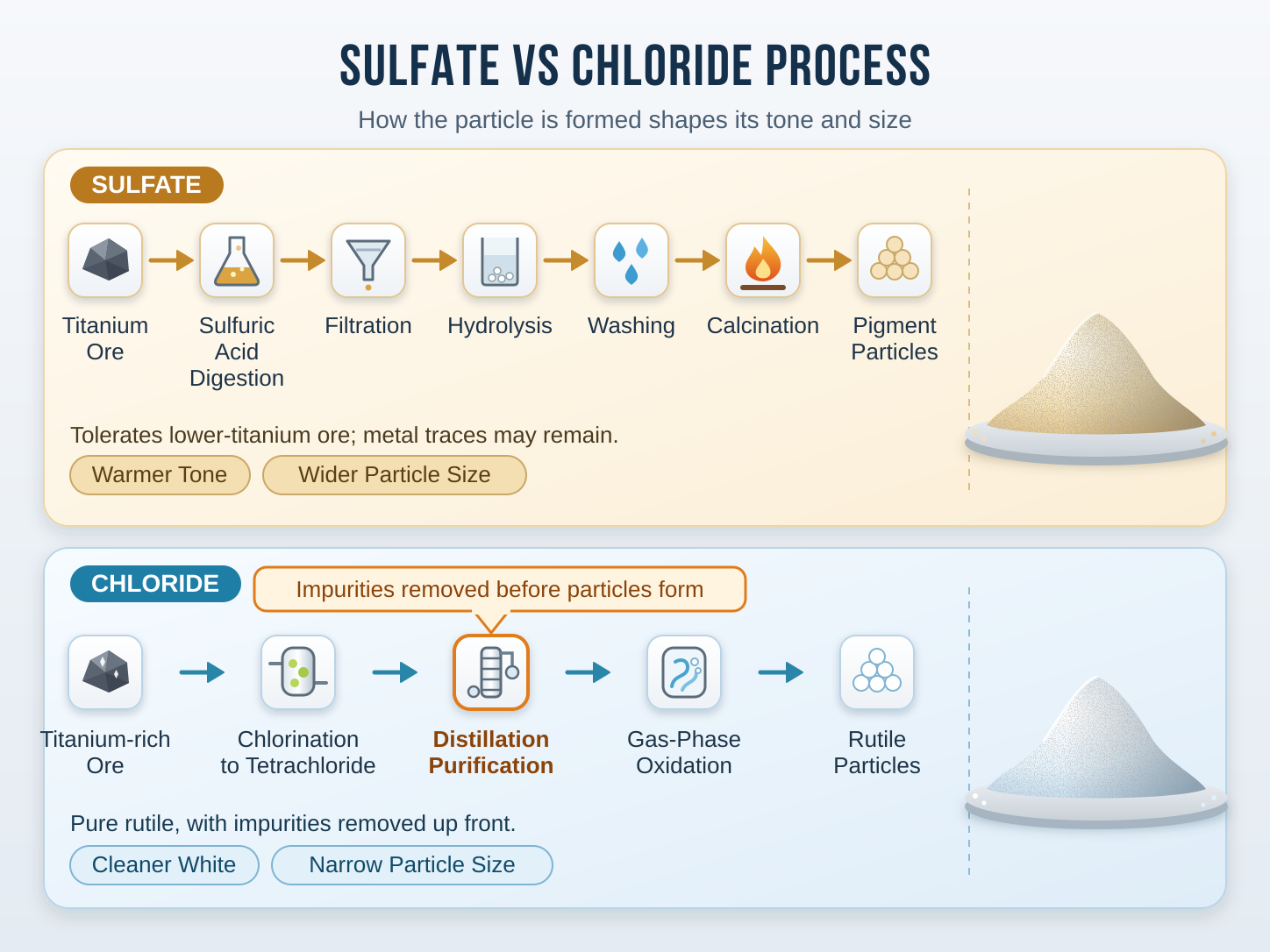
The difference between chloride and sulfate TiO2: the trade-off between the two processes
Neither process is always better for every paint. Sulfate TiO2 has a warmer tone, but a warm tone is not a defect if the paint color or coating allows it: interior paint, general industrial paint and many deep-color systems still use it well. A well surface-treated sulfate lot can perform better than a poorly treated chloride lot.
So when comparing the sulfate and chloride processes, first ask how sensitive your paint film is to whiteness and gloss, then decide whether to pay more for purity.
What determines the quality of titanium dioxide for paint beyond the process
The process determines the quality of the raw particle, while the three factors below determine how that particle performs in your paint system.
Crystal form. Rutile has a denser structure than anatase, so it is more weather resistant and less likely to catalyze resin degradation under UV; anatase tends to cause chalking outdoors. For a closer comparison, you can read the article on how to choose rutile or anatase TiO2 from Chinese suppliers.
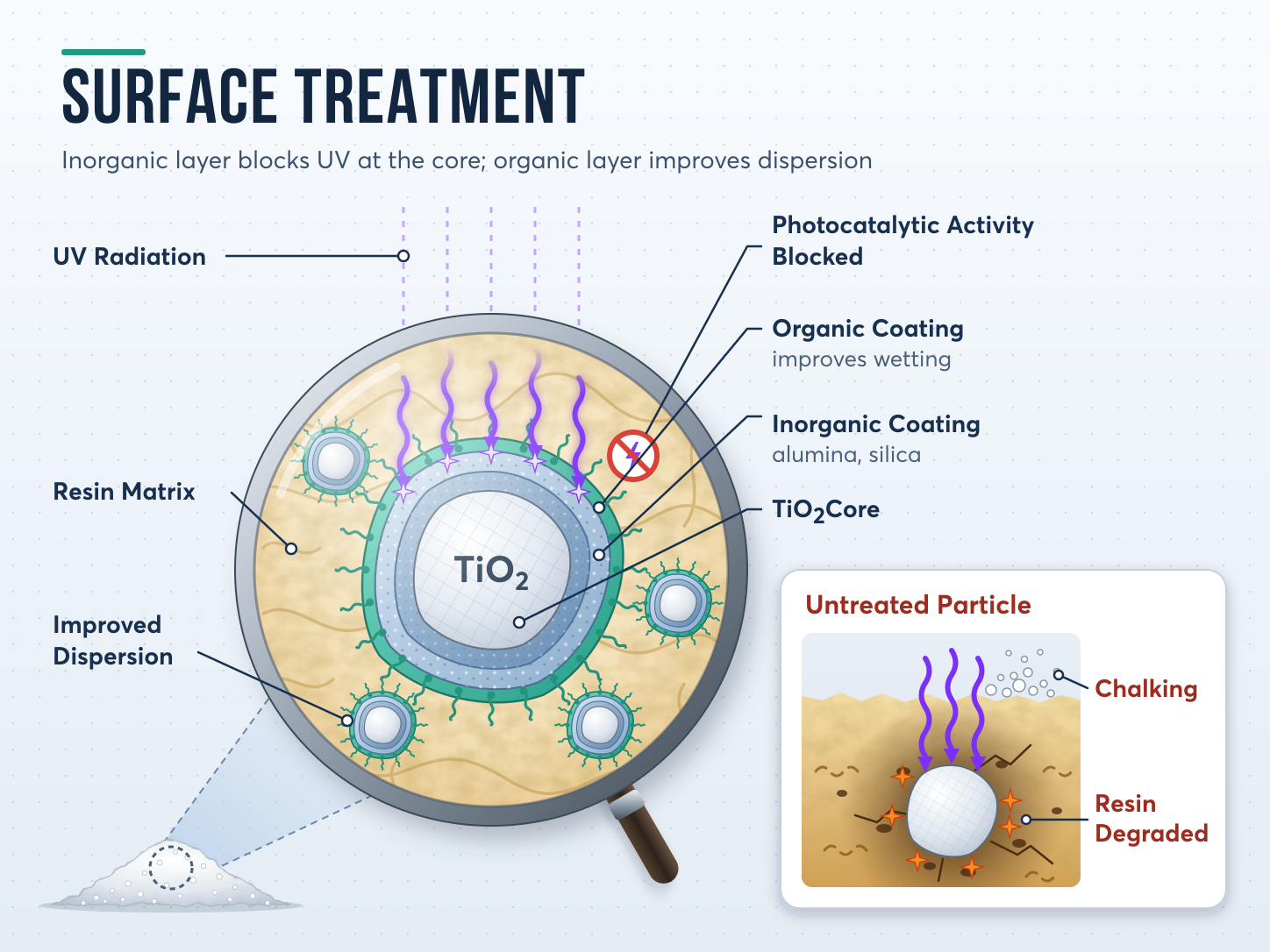
Surface treatment. TiO2 particles are usually coated with an inorganic layer (such as alumina or silica), sometimes with an added organic layer. The inorganic layer shields photocatalytic activity and reduces chalking. The organic layer improves wetting and dispersion in the resin. Two lots from the same process and the same rutile can still differ clearly in dispersion and film durability because their coatings differ. This is also why a lot that is good chemically can still give low gloss in a specific waterborne or solvent-borne paint system.
Particle size and particle size distribution. The mean particle size and the width of the distribution determine hiding power and gloss. A narrow distribution keeps more particles in the effective scattering range and has fewer coarse particles that dull the surface. This is a parameter to read on the TDS and check against the COA of each lot.
When you receive a TDS, read the crystal form, surface treatment type, application grade and particle size parameters together. A single parameter can be misleading when separated from the rest.
Choosing TiO2 for a paint plant by production process, and when not to
Choose by the requirements of the paint film, not by the name of the process.
Prioritize pure rutile, usually from the chloride process, for automotive paint, high-gloss paint and exterior paint that needs clean whiteness. In these systems, a warm tone or coarse particles show up immediately on the film, and weather resistance determines the service life of the coating.
Sulfate TiO2 can be sufficient for interior paint and general industrial paint, where absolute whiteness and high gloss are not the main criteria. If the paint system is also tinted in deep colors, differences in whiteness show even less. Packaging inks have different requirements from paint; you can refer to how to choose TiO2 for packaging inks.
Vichem supplies titanium dioxide (TiO₂) from Tinox and Whitearrow for the paint industry. The production process of each TiO2 grade is declared by the supplier in its technical documents, so you should confirm it directly before putting the grade into a formulation.
When evaluating a new TiO2 grade, follow these steps:
- Ask the supplier for the production process of the exact grade you plan to use.
- Read the crystal form, surface treatment and TiO2 content on the TDS.
- Request the COA of the sample lot to check against the TDS.
- Test side by side with the grade you currently use, in the same formulation and under the same grinding and letdown conditions.
- Measure hiding power, gloss, color and weather resistance before a production trial.
Do not switch sources just because both carry the same rutile label, and do not reject a grade just because it follows the sulfate process. Trial results in your own paint system are the real basis.
Frequently asked questions
Is chloride TiO2 better than sulfate TiO2?
No process is always better. Chloride TiO2 typically gives pure rutile with cleaner whiteness and a narrow particle size distribution, so it suits high-gloss and exterior paint. Sulfate TiO2 has a warmer tone but still suits interior paint and many industrial applications, if the surface treatment is appropriate.
What is the difference between the chloride and sulfate processes for titanium dioxide?
The difference lies in the intermediate chemistry. The sulfate process digests the ore in sulfuric acid, then hydrolyzes and calcines it; it accepts lower-grade ore but is prone to leaving metal impurities. The chloride process chlorinates the ore to TiCl₄, purifies it, then oxidizes it, and typically gives purer rutile.
How can I tell which process was used to make a TiO2?
Ask the supplier directly and request written confirmation. The TDS usually states the crystal form and surface treatment but does not always state the process. You can cross-check indirectly through whiteness, dispersion and the results of side-by-side testing in your formulation.
Can anatase TiO2 be used in exterior paint?
Usually not advised. Anatase has stronger photocatalytic activity than rutile, readily degrades the resin in the paint film under UV and causes chalking. Exterior paint should use rutile with a suitable surface treatment; anatase is mainly for interior applications or special requirements.
Conclusion
The production process sets the quality foundation of the TiO2 particle, while the result in the paint film also depends on surface treatment and the TiO2 grade in the specific paint system. Choosing correctly means matching the application requirements to the characteristics of the lot.
- The process affects the purity, whiteness and particle size of TiO2.
- When comparing two lots, check the same crystal form and surface treatment on the TDS.
- Choose by application, then test side by side before switching sources.
Send us your paint type, service conditions and current TiO2 source so the Vichem technical team can recommend a suitable grade and support sample testing.
Vichem is a distributor of chemical additives and equipment from leading brands such as Covestro, Sinopec, TotalEnergies Corbion, Bühler and Tinox in the Vietnamese market.
For more information about our products, please contact us through the following channels:
- Hotline: 08 1790 1790
- Zalo OA: Vichem JSC
- Email: contact@vichem.vn
- LinkedIn: Vichem JSC
- Website: www.vichem.vn
- Facebook: Vichem JSC