4 Zinc-Rich Paint Formulation Errors That Destroy Corrosion Protection, and How to Fix Them
Zinc-rich paint stops protecting steel when the zinc particles no longer touch each other and the steel substrate. The four most common formulation errors are insufficient zinc content in the dry film, settled zinc that cannot be redispersed, an over-thick coat, and the wrong resin system for the service environment. The film still looks intact, so the failure shows only after the steel has rusted.
How zinc-rich paint protects steel
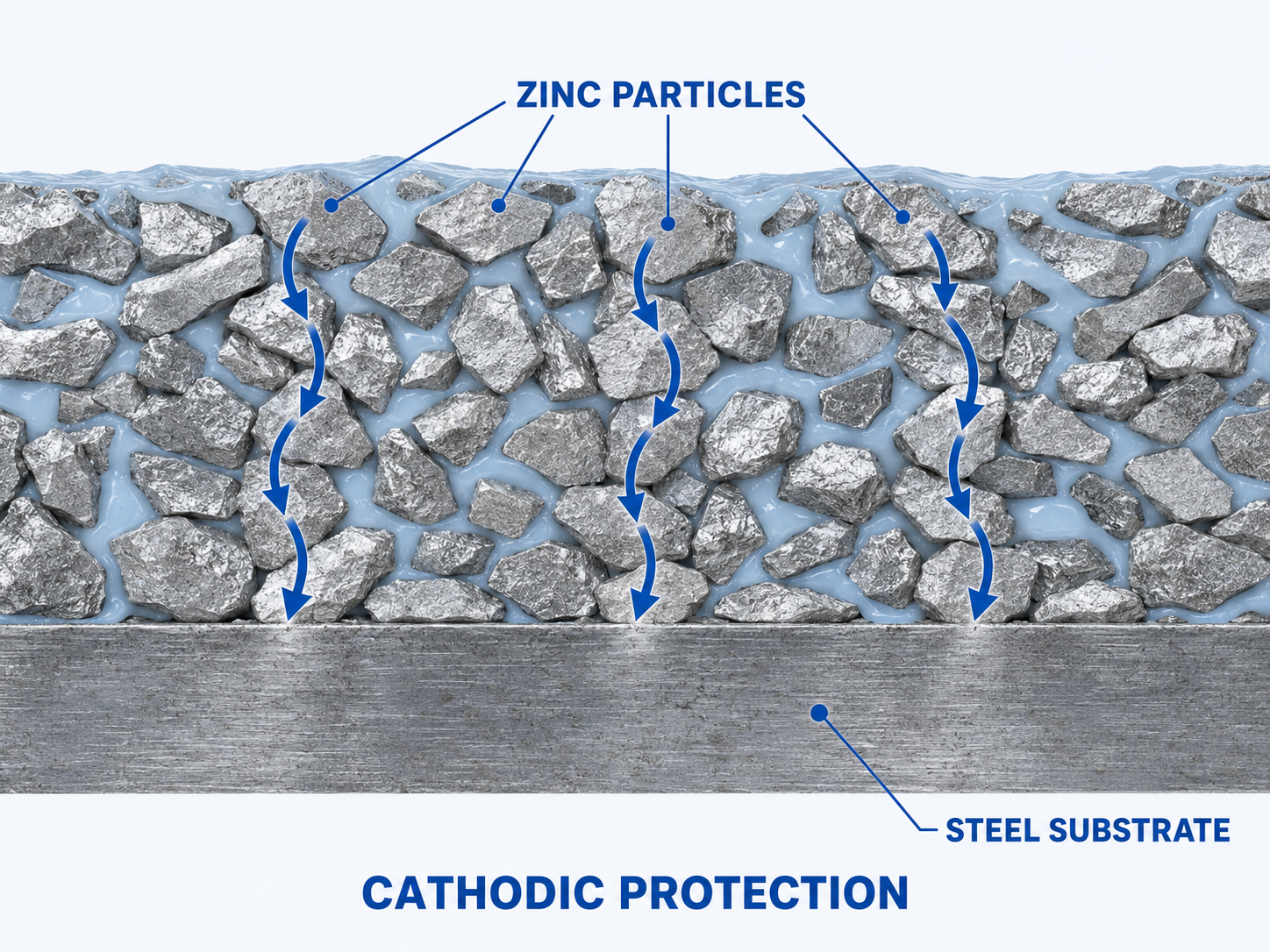
Zinc-rich paint is a primer that carries a high proportion of metallic zinc dust in the dry film, used for corrosion protection of steel structures. Its main mechanism is cathodic protection. Zinc is more electronegative than iron. When the film, moisture and steel substrate form a corrosion cell, zinc acts as the anode and dissolves gradually, while the steel acts as the cathode and is preserved.
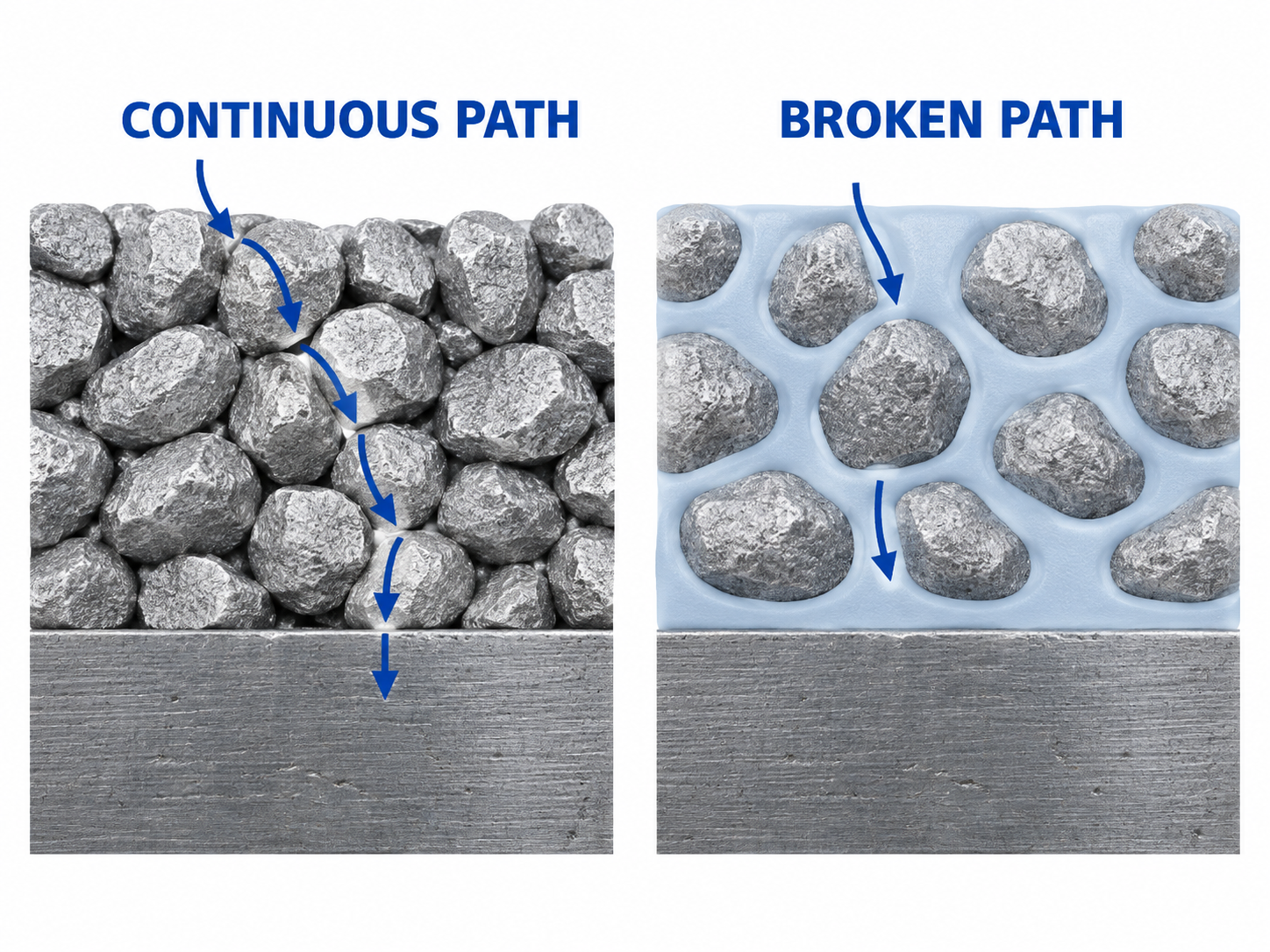
Current flows only along a continuous path. The binder is an electrical insulator, so zinc particles must touch each other in chains and touch the steel substrate at the end of each chain. Electrons travel from the zinc particles through the contact points to the steel. A particle isolated in resin takes no part in protection and only adds weight to the film. Zinc is consumed as it does this work, so the more continuous the initial contact network, the longer the film keeps its function.
Once the path is broken, the steel loses protection, but the film usually still looks intact: uniform gray, well adhered, with no blisters or cracks. The naked eye and a standard adhesion test cannot tell a conductive film from one that has lost conductivity. The steel beneath rusts gradually, and the rust shows only at edges, scratches or welds, by which time corrosion has already spread under the film.
The four errors below all lead to the same result: an interrupted electrical contact network. That is why zinc dust in primer should be assessed by measurement, not by visual inspection.
4 common formulation errors
All four errors produce the same picture in a film cross-section: zinc particles surrounded by resin and separated from one another. Each error below has its own signs, checks, fixes and risks.
Error 1 — Insufficient zinc content in the dry film
Signs: steel under the film rusts early over a wide area even though the film thickness meets the requirement. The film surface is smooth and slightly glossy, looking more like a resin film than one loaded with zinc dust.
How to check: compare the batching records with the design and convert to a dry-film basis, because formulas are usually calculated on wet paint and solvent evaporation changes the ratio. Read the metallic zinc content on the powder lot’s COA, separate from total zinc. You can also send a dry-film sample for zinc analysis.
Two materials must be distinguished. Metallic zinc dust conducts electricity, so it provides cathodic protection. Zinc oxide (ZnO) is a white powder that does not conduct electricity and gives no cathodic protection. It has a different role in paint and cannot replace metallic zinc. If the two are mixed up, total zinc calculated as the element can look sufficient while the conductive network is lacking.
How to fix: recalculate the formula on the zinc volume fraction in the dry film. Zinc is heavy, so a given mass occupies a small volume and the particles struggle to touch. Correct the batching and quarantine the suspect lot. When adjusting, do not add resin, filler or solvent outside the design.
Risk if handled wrongly: compensating with a thicker coat leads to Error 3. Adding too much zinc leaves too little resin to wet the particles, giving a porous, brittle film with poor adhesion.
Error 2 — Zinc settles in the can and cannot be redispersed
Signs: a hard layer at the bottom of the can, a stirrer that will not reach the bottom, and a thin, clear upper layer. Films from cans of the same lot differ in color and coverage.
How to check: sample from the top and bottom of the can and compare density and solids content. A clear difference between the two samples shows the zinc has stratified. Zinc is much denser than the resin and solvent, so it settles quickly when the system lacks rheological structure.
How to fix: stir mechanically from the bottom up until homogeneous, then keep stirring throughout application. If every can cakes, consult R&D to review the viscosity and structure-building capacity of the paint system, as well as the storage time.
Risk if handled wrongly: pouring off the clear top layer and using it separately gives a zinc-poor film. Using only the bottom portion gives a zinc-heavy, brittle film. Adding solvent to ease stirring thins the system, so particles settle faster and solids content drifts from the design.
Error 3 — Over-thick coat, loss of electrical contact
Signs: mud-cracking, flaking in sheets, or a surface that is dry while the layer beneath is still soft. Cracks often run all the way to the steel.
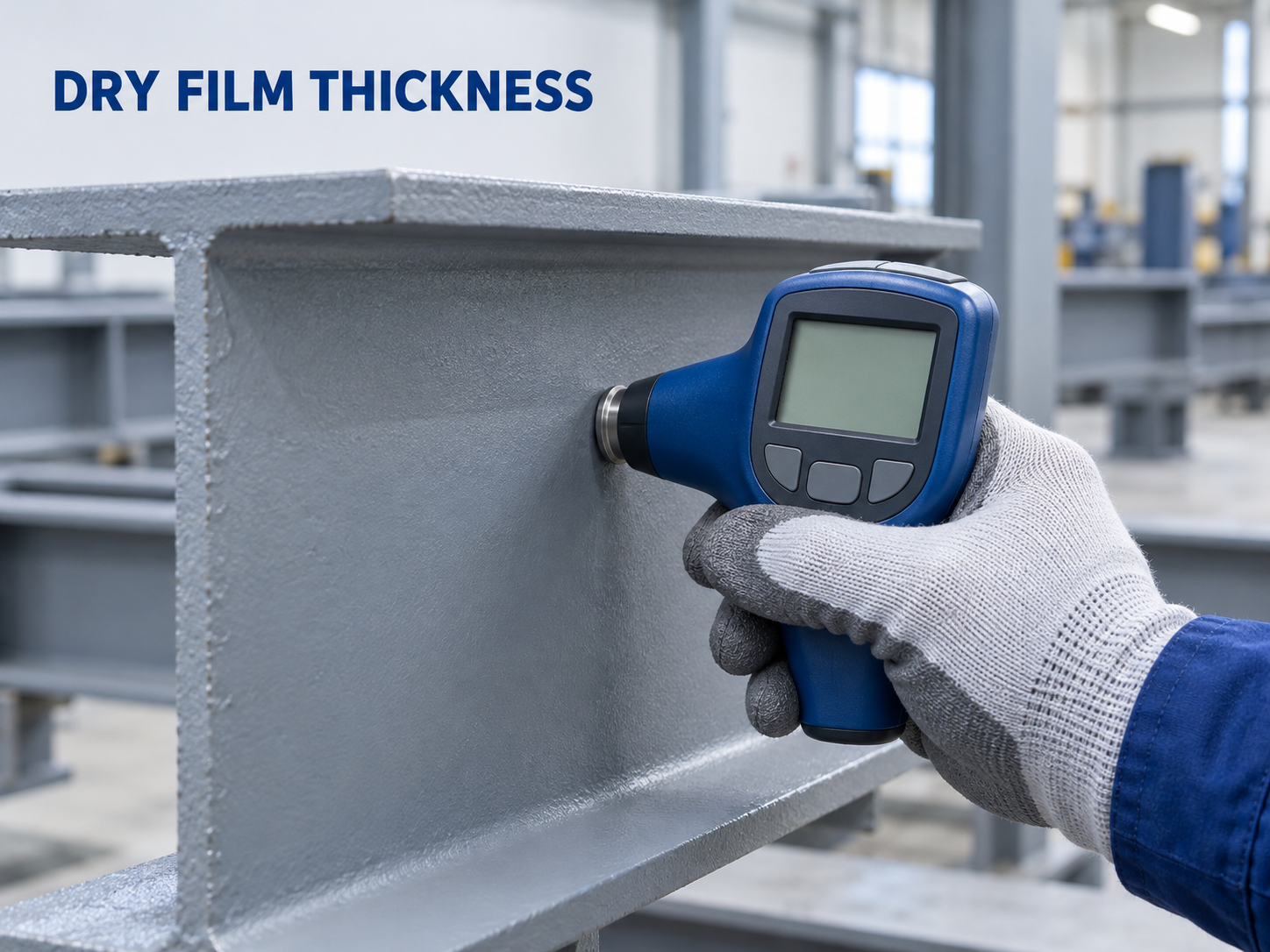
How to check: measure dry film thickness at multiple points with a dedicated gauge and compare against the dry film thickness range in the TDS of the paint in use. Also check the interval between coats and the number of coats applied.
How to fix: apply several thin coats within the TDS thickness range, allowing sufficient drying between coats. For areas that have cracked or flaked, grind back to clean steel and recoat from the start. A thick film shrinks unevenly and traps solvent, and the resulting stress pulls the film away from the substrate, so zinc particles lose contact with the steel.
Risk if handled wrongly: painting over a cracked film seals in the cracks and the solvent beneath. The steel remains unprotected, and the new coat peels off along with the old one.
Error 4 — Wrong resin system for the service environment
Signs: the film blisters or peels after exposure to water, alkali or salt spray. The paint thickens, gels or swells the can lid in storage.
How to check: list the actual service conditions: indoor or outdoor, coastal, chemical exposure or immersion. Compare them with the environmental limits of the resin stated in the TDS. Read the acid value, solids content and oil length of the alkyd resin.
The resin binds the particles and adheres to the substrate, so it must withstand the environment in which the zinc works. Alkyd resin contains ester linkages, which can hydrolyze under prolonged contact with alkali or water. Free acid groups in the resin can react with zinc to form zinc soaps, which thicken the paint in the can. In waterborne systems, metallic zinc in contact with water can generate hydrogen gas in the can, so storage stability must be checked.
How to fix: choose the resin system according to the environment, then test a sample before production. For zinc paint based on modified alkyd, check whether the degree of modification and the oil length of the resin suit the service conditions. The resin groups to consider are solventborne alkyd and waterborne alkyd, chosen on the TDS, VOC requirements and the ability to keep zinc stable in the can.
Risk if handled wrongly: switching to another resin system without testing compatibility with the topcoat and steel substrate can cause delamination between coats. Adding stabilizers or thickeners outside the design can reduce contact between particles.
Quick diagnostic procedure
When steel under a zinc paint film has rusted, rule out causes in order, starting with the cheapest and fastest tests:
- Measure dry film thickness at multiple points and compare with the TDS range. Exceeding the range together with cracking or flaking points to Error 3.
- Check the batching records of the paint lot: powder type, COA lot number, ratio converted to dry film. Records showing a shortage of metallic zinc or ZnO mixed in point to Error 1.
- Cut a film cross-section and examine it under a microscope to see the zinc particle distribution. A dense lower layer and a sparse upper layer indicate Error 2. Particles separated from each other in a thick resin matrix indicate Error 1. Cracks running to the substrate indicate Error 3.
- Compare the service environment with the resin system. If the first three steps pass and the film still fails, the cause is Error 4: the resin cannot withstand the actual conditions.
Record the results of each step to compare against other lots from the same plant. An error that repeats across many lots usually lies in the batching or stirring procedure, not in a single can.
Prevention
Raw material control. For each lot of powder, read the COA and confirm the metallic zinc content. Store metallic zinc dust and ZnO separately and label them clearly to avoid mix-ups during batching. Keep packaging sealed to limit moisture contact. For resin, compare the acid value and solids content in the TDS with the design before it goes into production.
Mixing equipment. The impeller must reach the bottom of the can, and the speed must be enough to lift the zinc without entraining air into the paint. The mixing process should include a re-check of homogeneity before filling. At the application site, use an agitator running continuously throughout painting, because zinc settles again once stirring stops.
Application procedure. Prepare the steel substrate as the TDS requires before painting, because zinc particles protect only when they touch the steel. Measure wet film thickness during application and dry film thickness after drying. Apply several thin coats and observe the interval between coats. Record the paint lot number on each item for traceability if a problem occurs.
Environmental conditions. Temperature, humidity and dew point during application must stay within the range the TDS allows. Moisture condensing on the steel weakens adhesion and makes zinc particles react early. When choosing a resin system, compare the structure’s expected environment with the resin limits in the TDS, then test a representative sample before running a large batch.
Frequently asked questions
How much zinc is enough
There is no single figure for every paint system. The minimum depends on the resin system, the zinc particle size and the zinc volume fraction in the dry film. Standard values should be taken only from the original text of the standard the project applies, and checked against the paint’s TDS.
Does zinc-rich paint need a topcoat
It depends on the environment. Zinc is consumed as it protects the steel, so a topcoat slows this process when the structure is exposed to moisture, salt or chemicals. Confirm that the topcoat is compatible with the primer through the TDS of both and through sample testing before application.
What is the difference between zinc dust and zinc oxide
Zinc dust is a metal and conducts electricity, so it gives cathodic protection when the particles touch each other and the steel. Zinc oxide (ZnO) is a white powder compound that does not conduct electricity and gives no cathodic protection. The two materials have different roles in paint and are not interchangeable.
Conclusion
Zinc-rich paint resists corrosion only when the zinc particles form a continuous conductive path to the steel substrate. The four formulation errors, namely insufficient metallic zinc, settling, an over-thick coat and the wrong resin system, all break this path while the film’s appearance stays the same. Confirm by measurement, batching records and film cross-section.
- Read the metallic zinc figure on the COA and calculate the ratio on the dry film, not only on wet paint.
- Stir until homogeneous before and during application, and never separate the clear top layer or the bottom layer for separate use.
- Measure dry film thickness and apply thin coats within the TDS range.
- Choose the resin system for the service environment and test a sample before running a large batch.
Vichem is a distributor of chemical additives from leading brands such as Covestro, Sinopec and Bühler in the Vietnamese market.
For more information about our products, please contact us through the following channels:
- Hotline: 08 1790 1790
- Zalo OA: Vichem JSC
- Email: contact@vichem.vn
- LinkedIn: Vichem JSC
- Website: www.vichem.vn
- Facebook: Vichem JSC