When a metal coating must hold its color outdoors for years, pigments for industrial coatings are used instead of dyes because pigment particles do not dissolve in the binder. They hide the substrate, resist light and heat, and do not bleed into the next coat. Dyes dissolve completely, so they are transparent and tend to fade and bleed. For any pigment for coatings, check the dispersion, the particle size, the lightfastness of pigments, and whether the pigment type suits the service conditions.
What color requirements must an industrial coating film meet
Coatings on vehicle frames, equipment housings, metal panels and plastic parts must meet four color requirements at the same time. Each requirement rules out some colorants at the pigment selection stage.
- Substrate hiding: a thin coating film must hide the color of the metal, machining marks or the plastic substrate. A transparent colorant cannot do this.
- Outdoor color retention for years: the film is exposed continuously to UV, heat, rain and humidity, so fading or color shift is the first defect customers see.
- Heat resistance during baking: baking coatings and powder coatings pass the film through an oven, and the colorant must go through this cycle without changing color.
- No bleeding into the topcoat: multi-coat systems consist of primer, color coat and clear coat; the solvent of the upper coat must not pull the color of the lower coat up to the surface.
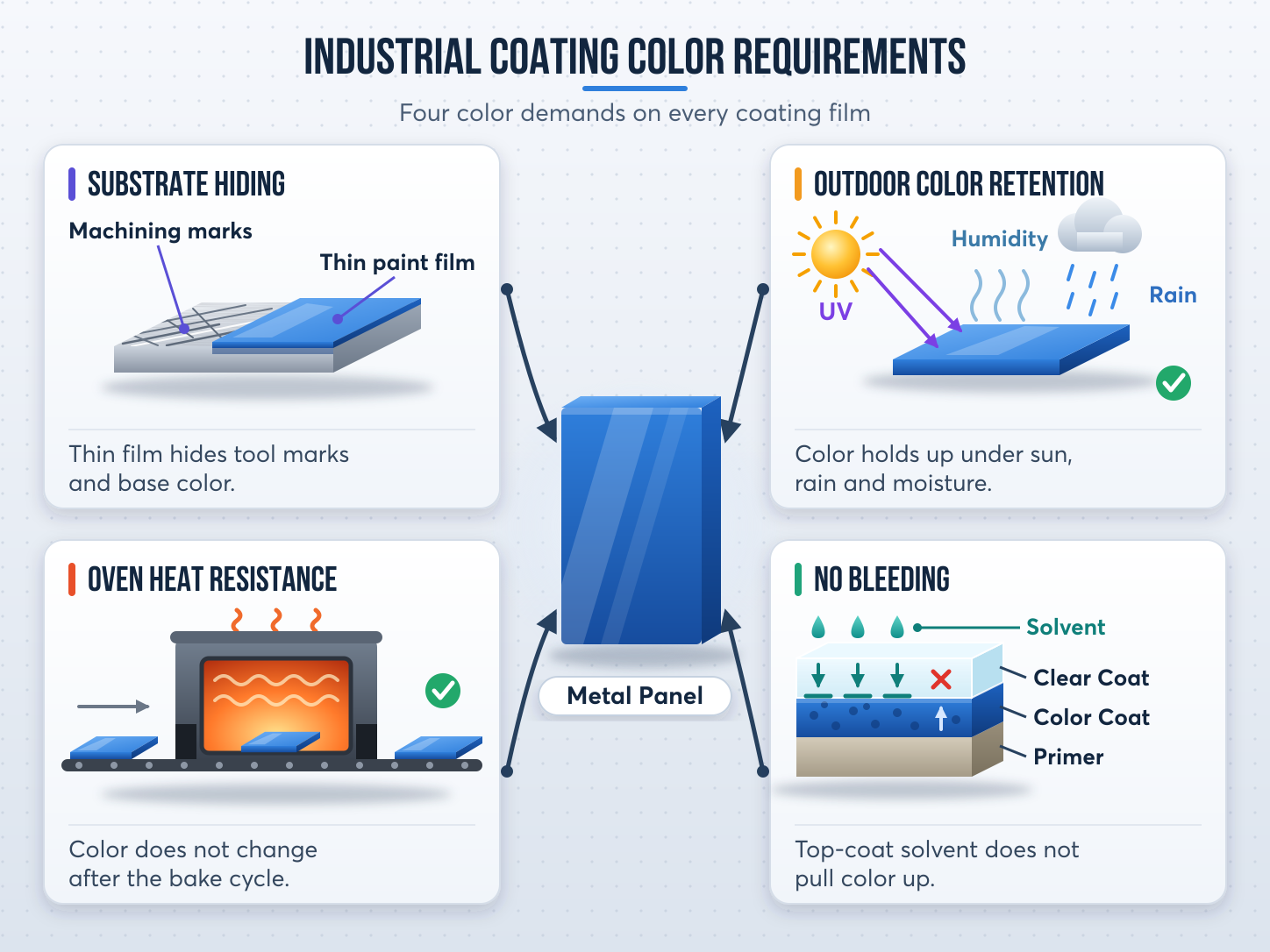
These four requirements come down to one question: does the colorant stay put in the film? A colorant that dissolves into the medium migrates, fades and exposes the substrate. A colorant that stays in particle form remains in place and hides the substrate.
Pigments are solid particles that do not dissolve in the binder or solvent and exist as separate particles in the coating film. Dyes are substances that dissolve in the medium and disperse at the molecular level. This distinction has already been compared for packaging inks; here we look only at industrial coating films, where hiding, weather resistance and bake resistance decide the choice.
How pigments work in a coating film
The difference between pigment and dye shows clearly in the coating film: a pigment particle both colors and hides the substrate through two optical effects that occur at the same time, and the same particle structure determines how durable the color is.
Color and hiding mechanism. A pigment particle selectively absorbs part of the visible light spectrum and scatters the rest at the particle surface. The absorbed part determines the color the eye sees. The scattered part bounces light back within the film so it does not reach the substrate, so the film hides the substrate. A dye dissolved at the molecular level only absorbs and hardly scatters at all. Light passes through the film, reflects from the substrate and comes back out, so a dyed film looks transparent and reveals the substrate color. On the line, a coat made with pigment can hide a steel panel, while a coat with dye alone still shows the machining marks underneath.
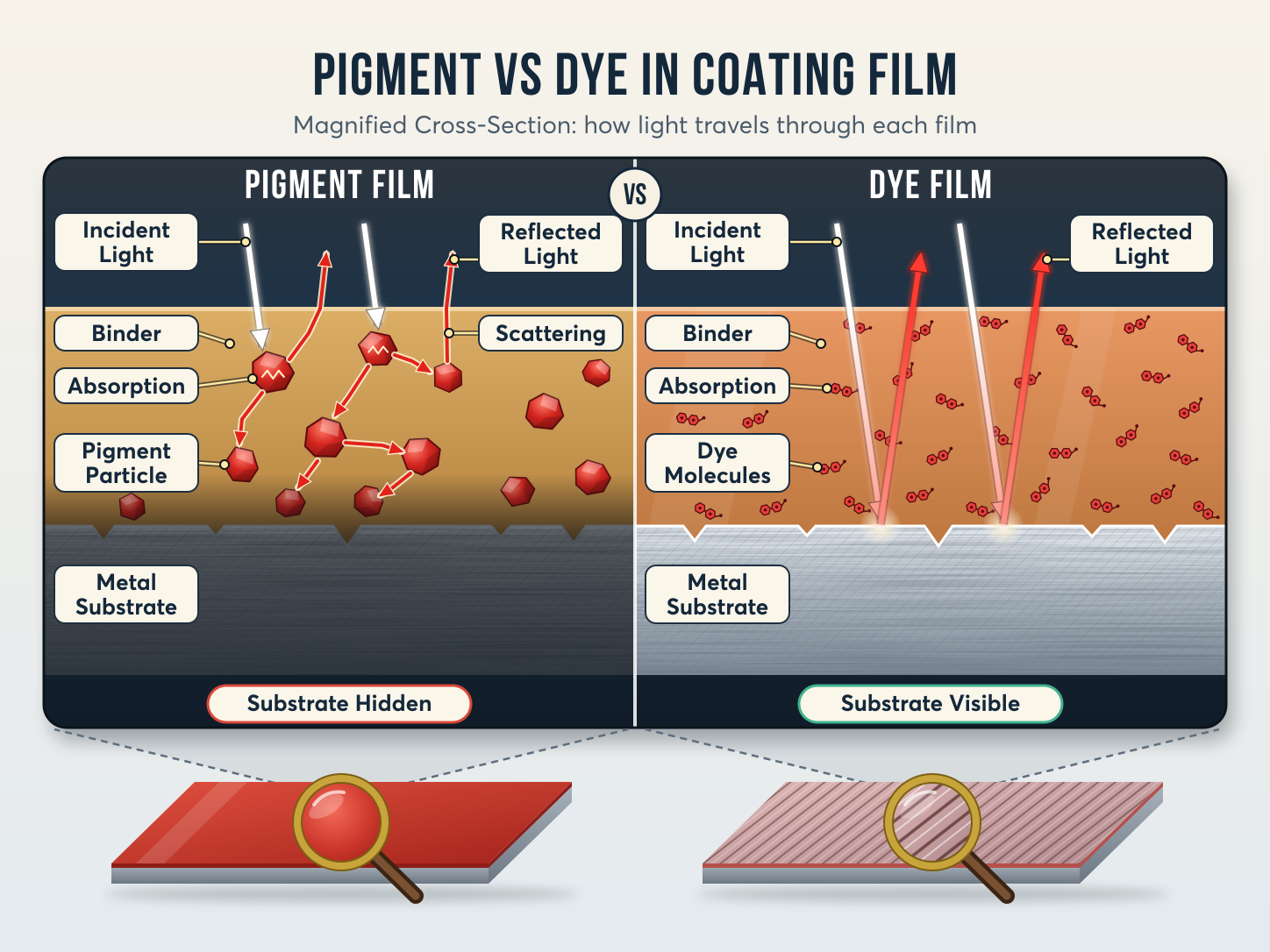
Durability mechanism. Pigment particles have a tightly packed crystal structure, so only the outer layer of the particle is directly exposed to UV, oxygen and heat, while the inside of the particle is shielded. Dye molecules sit individually in the resin and are fully exposed to these agents, so they degrade and lose color more easily. Being insoluble also helps when the film meets solvents or cleaning agents: the particles do not dissolve out, whereas dye molecules do, so the contact area bleeds or turns pale. The actual level of durability varies with each pigment type and is published separately in the TDS.
Anti-migration mechanism. Migration (also called color bleeding) is the movement of color molecules from one layer to another or to the surface. A dye dissolves in solvent and resin, so when the topcoat is sprayed, the solvent carries color into the new layer and causes bleeding. Insoluble pigment particles migrate much less. This phenomenon also occurs in plastic parts; how to deal with it is covered in the guide on fixing pigment migration in plastics.
Trade-offs of using pigments. Pigments come at a price in coating manufacturing and in color clarity:
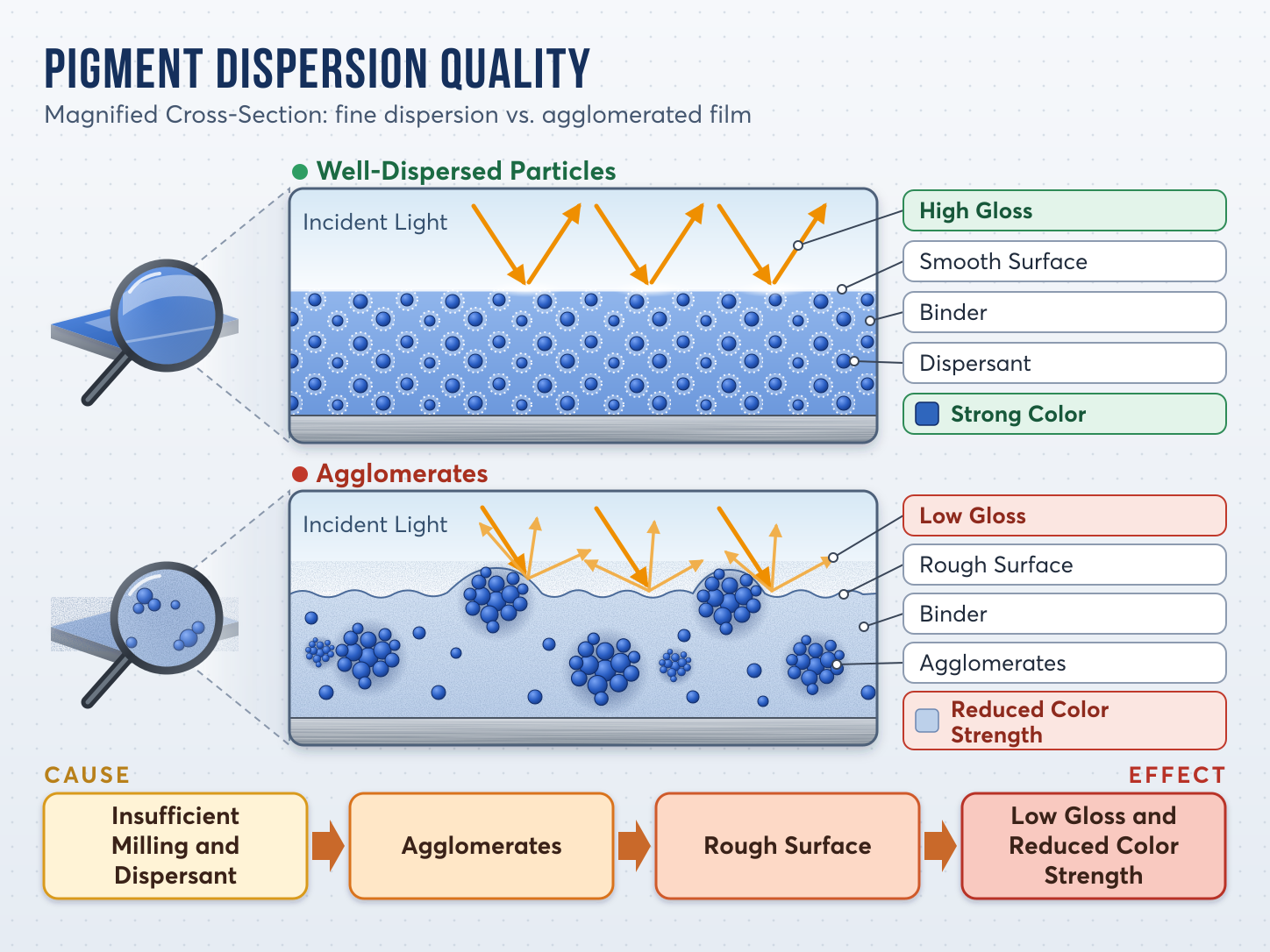
- Milling energy and dispersant: particles tend to stick together in clusters, so they must be separated by milling or high-shear mixing, and then a dispersant keeps them from clustering again. Without either one, the color is weak and the film has low gloss.
- Settling and agglomeration: solid particles are heavier than the medium, so they settle in storage, and clustered particles reduce color strength. This mechanism is analyzed for inks in the guide on fixing settling of pigment-based inks in storage.
- Less clear, less brilliant color: particles scatter light, so the color is more opaque than a dye solution of the same shade.
This is why clear coatings, wood coatings where the grain must stay visible, and metallic effect coatings sometimes still use dyes. In these systems, light must pass through the film to reach the wood grain or the aluminum flakes, which pigment particles block.
What determines how well pigments for industrial coatings perform
Particle size and dispersion. Fine, evenly dispersed particles give strong color and a high-gloss film. Particles clustered into agglomerates make the film surface rough, so gloss is lower and color strength drops, and the plant has to use more pigment to reach the same shade. When the film shows tiny particles or uneven gloss, check the milling step and the dispersant before suspecting the raw material.
Organic or inorganic nature. Inorganic pigments hide better and resist weathering better, so they are usually the starting point for outdoor coatings, as analyzed in the guide on choosing inorganic pigments for outdoor coatings. Organic pigments give brighter colors but hide less, so they often go with a white base coat or are used where a vivid shade is needed.
Resistance to light, weather, heat and chemicals. The lightfastness of pigments differs between types, even between grades in the same color family. These properties must be read on the TDS of each grade, checking the test conditions such as color depth, whether white was added, and the resin system used in the test. The baking temperature and time of the line must also be compared with the heat resistance limit of the pigment.
Compatibility with the resin system and solvent. The particle surface and the dispersant must match the resin and solvent in the coating. If they do not, viscosity and storage stability are affected: the coating thickens, the pigment settles or agglomerates, and the color changes from batch to batch. Test samples in the exact resin system and solvent in use, then store the samples long enough before running a trial on the line.
When to use pigments and when dyes still make sense
Use pigments when the coating film must hide the substrate, hold its color and withstand harsh conditions. Specifically, these systems:
- Metal coatings and automotive and motorcycle coatings: the film must hide the substrate, withstand baking and not bleed between the primer, color coat and clear coat.
- Powder coatings: the film goes through the melt-and-cure cycle, and the colorant must stay put in the molten powder layer.
- Outdoor coatings: the color must withstand UV, rain and heat over a long period.
For raw materials, plants choose between organic pigments for bright shades and inorganic pigments for hiding and weather resistance, depending on the coating system and where it is used. For plants that want to cut milling work, pre-dispersed pigment paste is worth considering: the pigment is dispersed in a liquid medium, so it only needs to be stirred into the coating. Zealan is a supplier of organic and inorganic pigments for coatings and plastics, and Vichem distributes these types to coating plants in Vietnam.
Dyes still make sense in three cases:
- Clear coatings: the color must let light pass through, such as tinted varnish over a light substrate.
- Wood staining that keeps the grain: dye molecules penetrate the wood fibers and let the grain show, which an opaque pigment layer would cover.
- Applications that do not require high outdoor durability: indoor products with little UV exposure, where a short color life is still acceptable.
For all other cases, especially multi-coat or outdoor-exposed coatings, start with pigments and then test samples on the exact coating system.
Frequently asked questions about pigments for industrial coatings
What is the difference between pigments and dyes?
The difference is solubility: a pigment is a solid particle that does not dissolve in the binder, while a dye dissolves completely at the molecular level. As a result, pigments hide the substrate and last longer, while dyes give a clear, bright color but fade easily and migrate easily into other layers.
Are organic pigments for coatings suitable outdoors, or should you use inorganic pigments?
It depends on the color requirement and outdoor service life. Inorganic pigments hide and resist weathering better, so they are usually the starting point. Organic pigments give brighter shades, but you must choose a grade with suitable weather resistance, check it on the TDS and run an exposure test on samples first.
Can dye be added to an industrial coating to make the color brighter?
It is possible within a narrow range, but the risk is high for outdoor coatings and multi-coat coatings, because dyes fade easily under UV and can bleed into the topcoat. If you need to test it, add a small amount and check color fastness and bleeding with the exact topcoat and baking cycle.
Can pigment paste replace dry pigment?
In many cases, yes, because pigment paste is pre-dispersed pigment, which cuts milling work. You need to check whether the dispersion medium of the pigment paste is compatible with the resin and solvent of the coating, since an unsuitable medium can affect viscosity and film durability.
Conclusion
Industrial coatings use pigments because the film must hide the substrate, hold its color and not bleed, which colorants that dissolve in the medium struggle to do. Dyes keep their own place in clear coatings and wood staining.
- Pigments do not dissolve, so they hide the substrate, last longer and migrate less.
- Dyes dissolve, so the color is clear and bright but fades and bleeds easily.
- Performance depends on dispersion and on whether the pigment is organic or inorganic.
- Choose by service conditions: outdoor or indoor, baking temperature, number of coats, resin system and solvent.
Send your coating sample, resin system and the baking conditions of your line, and the Vichem technical team will recommend a suitable pigment type.
Vichem is a distributor of chemical additives and equipment from leading brands such as Covestro, Sinopec, TotalEnergies Corbion, Bühler and Tinox in the Vietnamese market.
For more information about our products, please contact us through the following channels:
- Hotline: 08 1790 1790
- Zalo OA: Vichem JSC
- Email: contact@vichem.vn
- LinkedIn: Vichem JSC
- Website: www.vichem.vn
- Facebook: Vichem JSC