When selecting a PU coating for outdoor structures, use an HDI hardener in polyisocyanate form, an aliphatic hardener for PU coatings, instead of free HDI monomer, then choose between HDI trimer and HDI biuret according to whether the film must be hard or flexible. On the TDS, read the NCO content, viscosity and free monomer content, then check compatibility with the polyol (a resin containing hydroxyl groups) you use. The substrate, film thickness and application method are the conditions that govern the result.
Where outdoor PU coatings fail when the HDI hardener is chosen wrongly
A non-yellowing outdoor PU coating depends on the hardener choice. Outdoor PU films fail in three ways, and each one traces back to a wrong choice when selecting the hardener.
Using an aromatic isocyanate for an exterior coating. TDI and MDI contain aromatic rings. Aromatic rings absorb UV, so the film yellows and chalks after sun exposure, and gloss falls gradually from the surface. Vichem already has a separate article on the yellowing mechanism and how to deal with it; here we only note the consequence: an outdoor topcoat must use an aliphatic isocyanate.
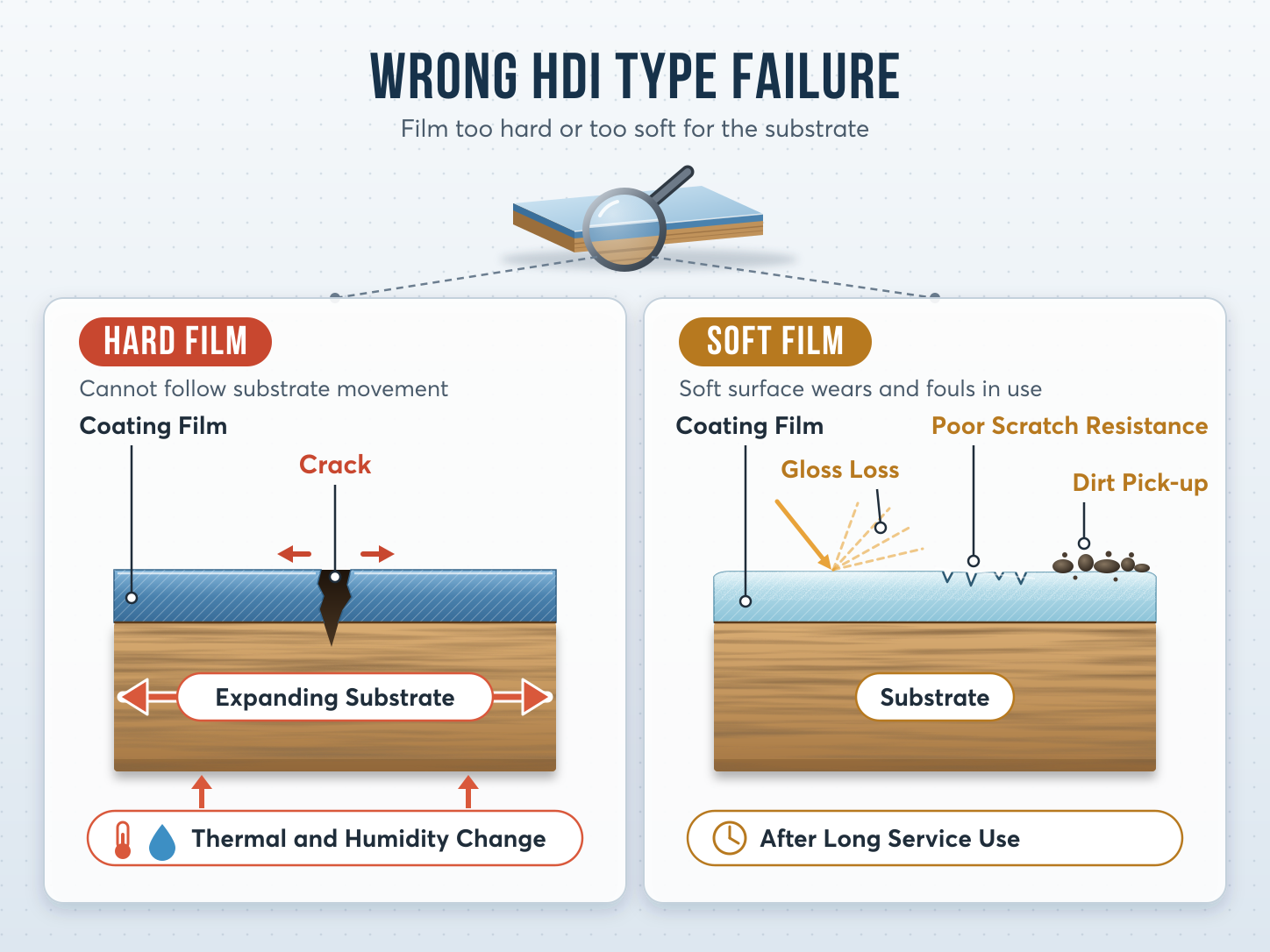
Choosing the wrong HDI type. A type that gives a film that is too hard makes the coating crack on substrates that expand, such as plastic and wood, because the film cannot follow the substrate's movement as temperature and humidity change. A type that gives a film that is too soft leaves a surface with poor scratch resistance, a tendency to pick up dirt, and weak gloss retention in service. On the line, this fault usually shows up at the hardness and bend tests, or later, after the goods have reached the customer.
Wrong NCO/OH ratio or polyol incompatibility. NCO/OH is the ratio between the isocyanate groups of the hardener and the hydroxyl groups of the polyol resin. With too little NCO, the film retains excess OH groups and dries slowly and has poor weather resistance. With too much NCO, the excess reacts with moisture, and the film becomes brittle and prone to pinholes. When the polyisocyanate does not dissolve well in the polyol, the film turns cloudy, loses gloss and loses adhesion, even if the formulation looks balanced on paper.
4 key criteria for choosing an HDI hardener
Criterion 1 — Aliphatic structure and UV resistance
HDI (hexamethylene diisocyanate) is a linear diisocyanate with no aromatic ring. The urethane linkages formed from a linear chain do not absorb UV strongly, so the film keeps its color and gloss outdoors. This is why aliphatic hardeners for PU coatings are used for outdoor topcoats.
IPDI (isophorone diisocyanate) is also aliphatic, but it has a saturated ring (not an aromatic ring). The saturated ring makes the film harder and the surface dry faster than with HDI. In return, the film leans toward hardness, so use on substrates that expand needs careful consideration. The two are often used together to balance hardness, drying speed and flexibility.
Note: HDI monomer (HDI diisocyanate) in free form has a high vapor pressure and respiratory toxicity, so industrial coatings use HDI oligomers, that is, polyisocyanates, in place of the monomer.
Criterion 2 — Oligomer type: trimer (isocyanurate), biuret, uretdione, allophanate
An oligomer is a small molecule made of a few HDI units linked together, giving several NCO groups per molecule, which lets it build a network when it reacts with polyol. Each type gives different film properties:
- Trimer (isocyanurate): three HDI molecules closed into an isocyanurate ring. The ring is heat-stable and weather-resistant and gives a hard film. HDI trimer is the familiar choice for outdoor topcoats.
- Biuret: the biuret group forms from the reaction of isocyanate with urea. The film is usually more flexible with better impact resistance, suited to substrates that must follow deformation.
- Uretdione: a ring of two HDI molecules with low viscosity, suited to high-solids coatings that need less solvent.
- Allophanate: a linkage formed between urethane and isocyanate. It also gives low viscosity and is used for high-solids coatings.
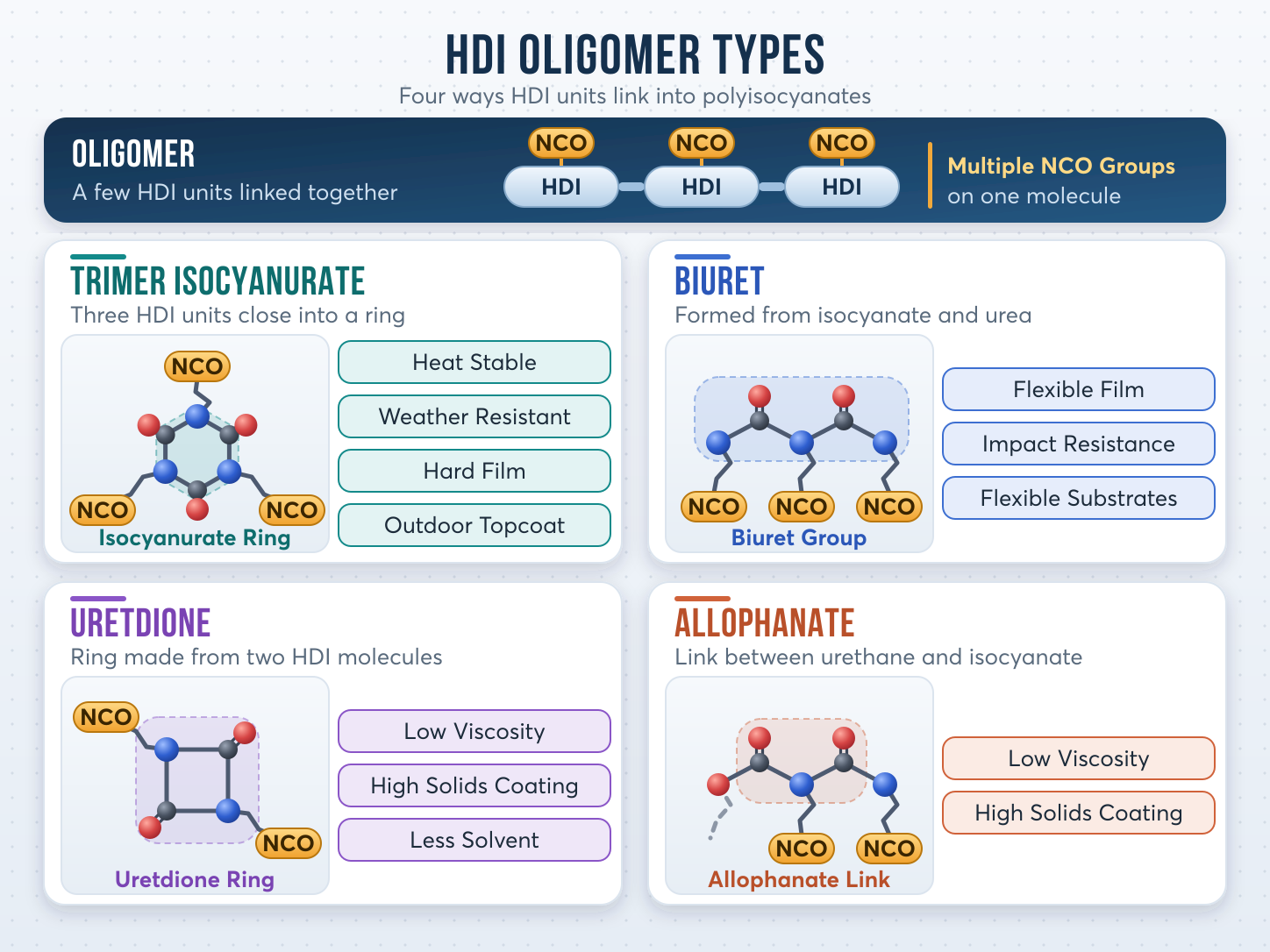
HDI biuret and HDI trimer therefore point in two different directions, and one should not replace the other without retesting.
Criterion 3 — NCO content, viscosity and free monomer
Read these three parameters on the TDS of the exact grade under review; each relates to a specific task on the line:
- NCO content: determines how much hardener is needed per amount of polyol. Two grades with different NCO content need different mix ratios, even if both are called HDI trimer.
- Viscosity: affects the amount of solvent needed for application, and through it the VOC and solids of the coating.
- Free monomer content: relates directly to worker safety in the mixing and spraying area, and should be checked against the SDS.
Compare these three parameters across grades using the same measurement method, and only then convert cost and mix ratio.
Criterion 4 — Polyol compatibility and application conditions
Acrylic or polyester polyol must dissolve well in the chosen polyisocyanate. If not, the film turns cloudy, has low gloss or shows slight layer separation after drying. Each HDI type has a different polarity, so compatibility differs with each polyol; this is why a trial mix is needed first.
Air humidity also matters: NCO reacts with water, releasing CO2 and causing pinholes in the film, especially when spraying thick films in a humid workshop. Pot life is the time during which the mixture can still be applied; it depends on the HDI type, polyol reactivity and catalyst. A faster-reacting type dries faster but shortens the working window of the mix.
How to match an HDI hardener to your outdoor coating requirement
Step 1 — Define the substrate and the weather resistance required
State clearly whether the substrate is metal, plastic or wood, and whether the coating is a topcoat or a primer. A rigid metal substrate tolerates a hard film; plastic and wood expand more, so they need a more flexible film. Then record the customer's gloss retention and color retention requirements, because these two decide the level of weather resistance to be met.
Color and gloss retention also depend on the white pigment in the formulation; to understand why TiO2 of the same type can differ in quality, see the article on how the production process affects TiO2 quality for coatings.
Step 2 — Fix the polyol system and VOC requirement
Fix the polyol in use (acrylic or polyester), the target solids and the VOC limit of the export market. The higher the solids, the lower the viscosity the hardener needs. If the plant exports to a market with a strict VOC limit, account for it from this step, not after sample testing.
When changing raw materials, the plant should also review the chemical lists it manages; the article on checking chemical lists under Decree 24 for paint plants explains how.
Step 3 — Select the HDI trimer or HDI biuret type and test samples
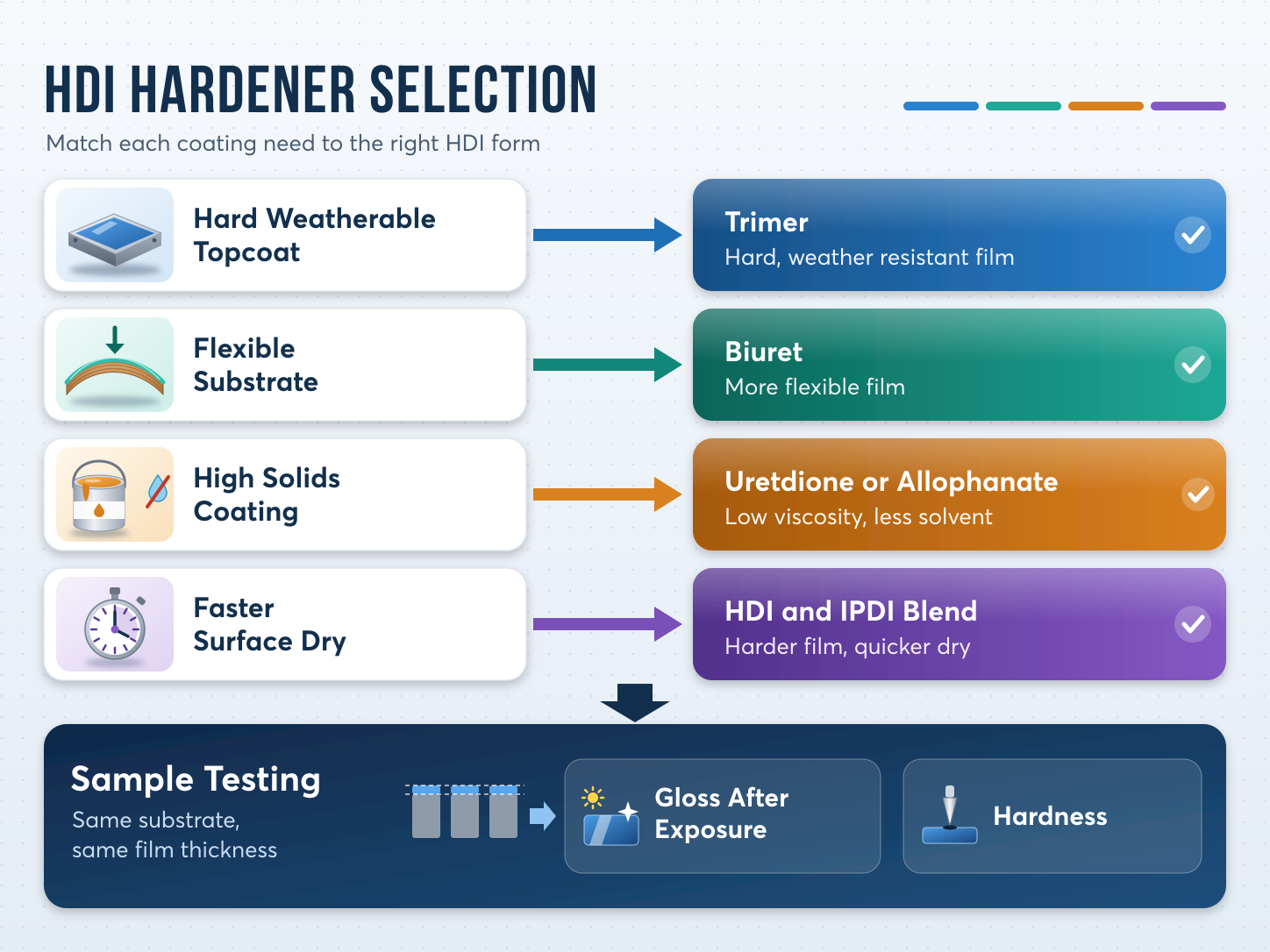
From the results of the two steps above, choose the type according to need:
- HDI trimer for coatings that need hardness and weather resistance.
- HDI biuret for substrates that need flexibility.
- Low-viscosity uretdione or allophanate types for high-solids coatings.
- Blend HDI with IPDI when faster surface drying is needed.
Covestro offers HDI-based polyisocyanate ranges in these types; you need the TDS of each grade to check the parameters in Criterion 3. For industrial floors that need thick, fast-drying films, another system such as polyaspartic resin for industrial floor coatings should also be considered.
When testing samples, coat the same substrate at the same thickness, then compare gloss after exposure testing and hardness between the types. Keep the same NCO/OH ratio for a fair comparison.
Common mistakes when choosing an HDI hardener
Comparing price per kg without converting by NCO content. A grade with lower NCO content needs more per amount of polyol, so a lower price per kg does not necessarily mean a lower cost per square meter. Convert cost by the amount of NCO needed for a batch.
Changing the HDI type but keeping the same mix ratio. NCO content differs between types and between grades. Keeping the same weight ratio will shift the NCO/OH ratio, leading to slow drying or a brittle film.
Using solvents that contain water or alcohol. Water and alcohol carry OH groups that react with NCO, consuming hardener before it reaches the polyol and causing pinholes. Thinners for PU coatings should be grades made for isocyanate systems, with the moisture content checked on the solvent TDS.
Ignoring pot life when switching to a faster-reacting type. A batch that used to last for one spray shift may thicken mid-shift. Mix smaller batches or review the catalyst before running production.
Frequently asked questions about HDI hardener
How does HDI diisocyanate differ from HDI trimer?
HDI diisocyanate is a monomer; each molecule has two NCO groups, and its free monomer content poses a respiratory risk during application. HDI trimer is an oligomer in which three HDI molecules form an isocyanurate ring; it has several NCO groups and a lower free monomer content, so it is used as a hardener for coatings.
Can HDI trimer be used for outdoor coatings?
Yes. The isocyanurate ring and aliphatic structure give a weather-resistant film that keeps its color and gloss outdoors. The film leans toward hardness, so for plastic or wood substrates, run bend and adhesion tests, or consider a biuret type.
Can a TDI hardener be replaced with HDI without changing the formulation?
Not advisable. NCO content, reactivity and polyol compatibility differ, so the mix ratio, pot life and drying time all change. Recalculate the NCO/OH ratio and run sample tests before going into production.
Should I choose HDI or IPDI for outdoor PU coatings?
Choose HDI when the substrate needs a more flexible, weather-resistant film, and IPDI when you need a hard film and a fast-drying surface. Many formulations blend both for balance, then fix the ratio by testing on the real substrate.
Conclusion
Outdoor PU coatings need an aliphatic hardener in the form of an HDI-based polyisocyanate. The specific type is chosen by substrate, polyol and VOC requirement, then confirmed by sample testing on the line's actual substrate and film thickness.
- Use aliphatic isocyanate for outdoor coatings, not TDI or MDI.
- Choose the HDI type by hardness or flexibility: trimer for hard films, biuret for flexible films.
- Convert price and mix ratio by the NCO content on the TDS of each grade.
- Check polyol compatibility and the effects of humidity and pot life.
- Compare gloss after exposure testing and hardness on samples before switching.
Send us your polyol system, substrate and line application conditions, and the Vichem technical team will recommend a suitable HDI hardener type.
Vichem is a distributor of chemical additives and equipment from leading brands such as Covestro, Sinopec, TotalEnergies Corbion, Bühler and Tinox in the Vietnamese market.
For more information about our products, please contact us through the following channels:
- Hotline: 08 1790 1790
- Zalo OA: Vichem JSC
- Email: contact@vichem.vn
- LinkedIn: Vichem JSC
- Website: www.vichem.vn
- Facebook: Vichem JSC